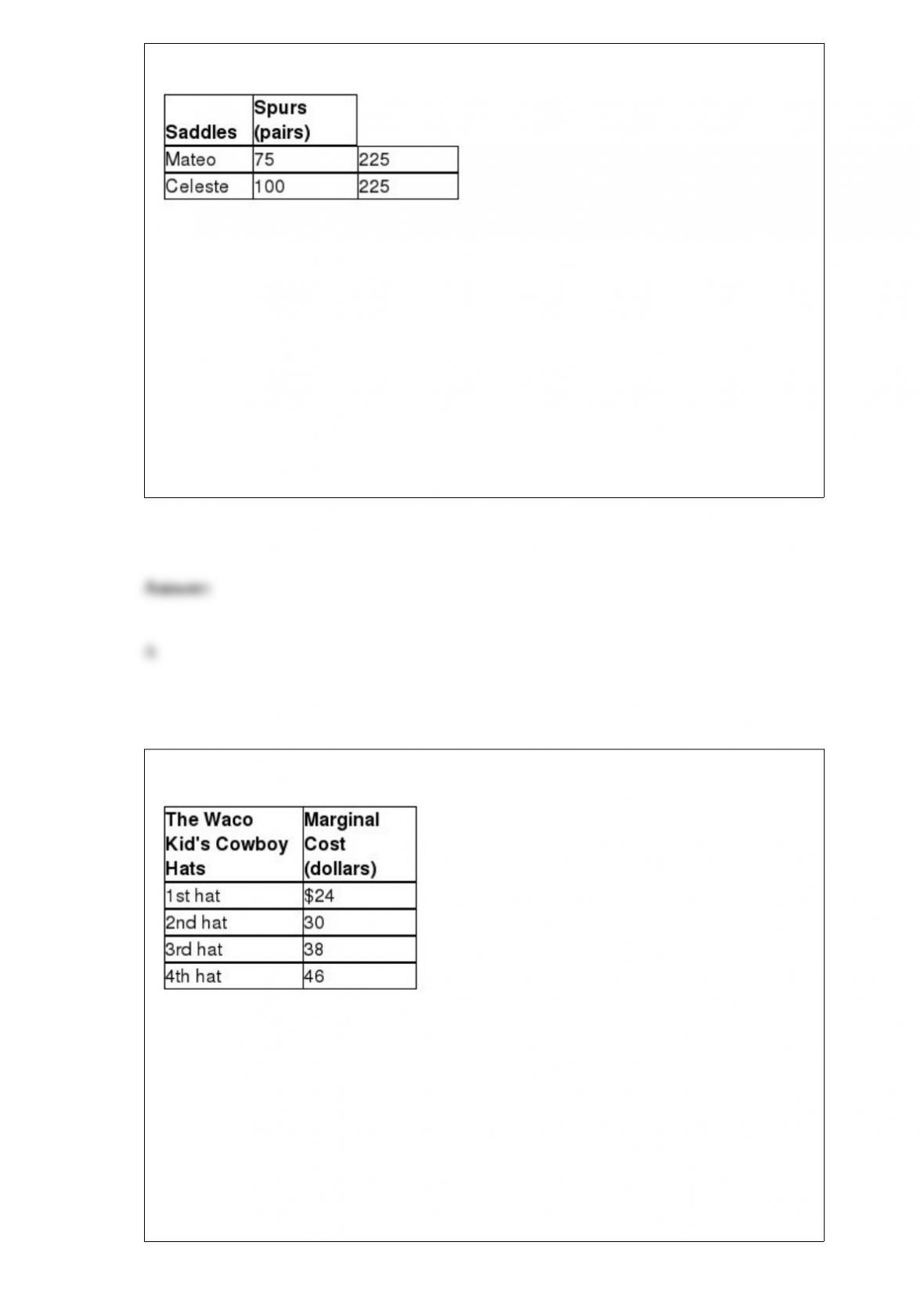
Table 9-6
Mateo and Celeste produce custom saddles and spurs. Table 9-6 lists the number of
saddles and pairs of spurs Mateo and Celeste can each produce in one month. Select the
statement that accurately interprets the data in the table.
A) Mateo has a greater opportunity cost than Celeste for making saddles.
B) Mateo’s opportunity cost for making saddles is less than Celeste’s.
C) Celeste has a greater opportunity cost than Mateo for making saddles.
D) Mateo’s opportunity cost for making saddles and making spurs are both greater than
Celeste’s.
Table 4-3
The table above lists the marginal cost of cowboy hats by The Waco Kid, a firm that
specializes in producing western wear. If the market price of The Waco Kid’s cowboy
hats is $40,
A) The Waco Kid will produce four hats.
B) producer surplus from the first hat is $40.
C) producer surplus will equal $28.

D) there will be a surplus; as a result, the price will fall to $24.
If tablet computers are considered substitutes for e-readers, the increase in the price of
tablet computers would, all else equal,
A) increase the demand for e-readers.
B) decrease the demand for e-readers.
C) increase the quantity of e-readers demanded.
D) decrease the quantity of e-readers demanded.
All of the following products are most likely to have significant network externalities
except
A) cat food.
B) cell phones.
C) popular board games.
D) fax machines.

The demand curve for corn is downward sloping. If the price of corn, an inferior good,
falls,
A) the income effect which causes you to reduce your corn purchases is smaller than
the substitution effect which causes you to increase your corn purchases, resulting in a
net increase in quantity demanded.
B) the income effect which causes you to increase your corn purchases is larger than the
substitution effect which causes you to reduce your corn purchases, resulting in a net
increase in quantity demanded.
C) both the income and substitution effects reinforce each other to increase the quantity
demanded.
D) the income and substitution effects offset each other, but the price effect of an
inferior good leads you to buy less corn.
Which of the following statements correctly describes the distinction between
technology and technological change?
A) Technology refers to the processes used by a firm to transform inputs into output of
goods and services while technological change is a change in a firm’s ability to produce
a given level of output with a given quantity of inputs.
B) Technology refers to the ability of a firm to increase its maximum output from a
given quantity of inputs and technological change is the process by which the firm
achieves this productivity gain.
C) Technology is product-centered; its refers to developing new products with limited
resources while technological change is process-centered in that it focuses on
developing new production techniques.
D) Technology involves research and development while technological change involves
the use of more efficient machinery.
A major difference between monopolistic competition and perfect competition is
A) the number of sellers in the markets.
B) the degree by which the market demand curves slope downwards.
C) that products are not standardized in monopolistic competition unlike in perfect
competition.
D) the barriers to entry in the two markets.
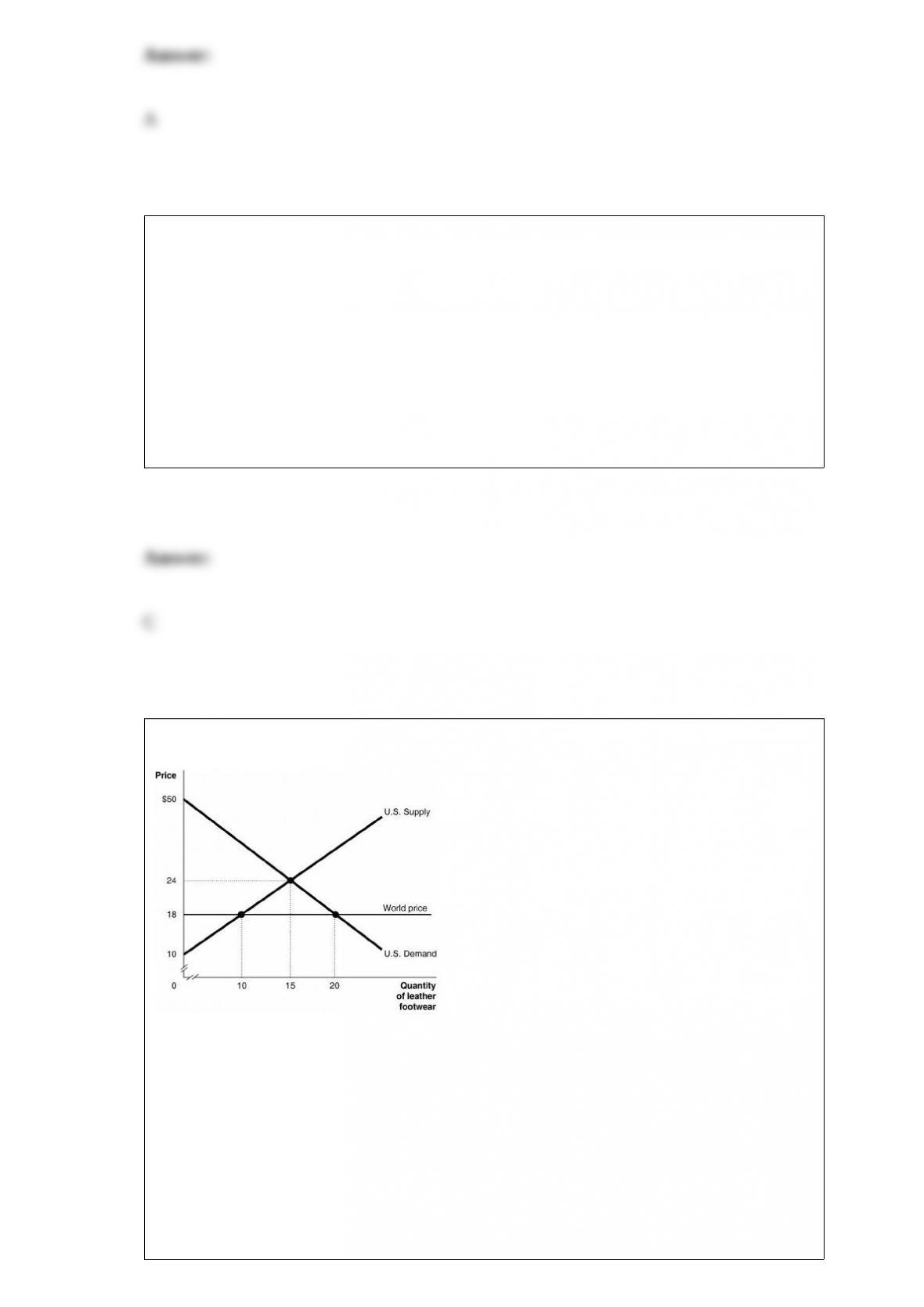
Figure 9-1
Figure 9-1 shows the U.S. demand and supply for
leather footwear. Suppose the government allows imports of leather footwear into the
United States. What will be the domestic quantity supplied?
A) 5 units
B) 10units
C) 15 units
D) 20 units

Which of the following is a function that money serves?
A) medium of exchange
B) unit of account
C) store of value
D) All of the above are correct.
Consumption spending is $16 million, planned investment spending is $4 million,
unplanned investment spending is $2 million, government purchases are $6 million, and
net export spending is $1 million. What is aggregate expenditure?
A) $22 million
B) $26 million
C) $27 million
D) $29 million

Long-run economic growth requires all of the following except
A) technological change.
B) increases in capital per hour worked.
C) government provision of secure property rights.
D) political instability.
In the 1930s, the United States charged an average tariff rate ________. Today, the rate
is ________.
A) of 100 percent; 20 percent
B) above 50 percent; less than 1.5 percent
C) of less than 10 percent; over 40 percent
D) of 17 percent; 33 percent