
Because consumers who have insurance provided by their employers usually only pay a
deductible for a visit to the doctor’s office
A) they demand a larger quantity of health care services than they would if they paid a
price that better represented the true cost of providing the service.
B) they demand a smaller quantity of health care services than they would if they paid a
price that better represented the true cost of providing the service.
C) the doctors supply a smaller quantity of health care services than they would if the
consumer paid a price that better represented the true cost of providing the service.
D) the insurance companies provide a larger quantity of health care services than they
would if the consumer paid a price that better represented the true cost of providing the
service.
A firm that is first to the market with a new product frequently discovers that there are
design flaws or problems with the product that were not anticipated. How do these
problems affect the innovating firm?
A) The firm is protected by a first-mover advantage: initial design flaws tend not to
harm a firm significantly because consumers resist changing products for fear of
incurring high switching costs.
B) They reduce profits for the new innovations and open the door to competitors who
can enter the new market with a better product.
C) Because these design flaws were not anticipated, consumers tend to be more
forgiving and are likely to remain loyal to the company and its products.
D) The firm’s cost increases as it improves the product but it will not be able to raise its
price for fear of alienating customers. Consequently, its profits will erode although its
market share remains secure.
If firms in a monopolistically competitive market are earning economic profits, which
of the following scenarios best reflects the change a representative firm experiences as
the market adjusts to its long-run equilibrium?
A) Demand decreases and becomes less elastic.
B) Demand decreases and becomes more elastic.
C) Demand increases and becomes less elastic.
D) Demand increases and becomes more elastic.
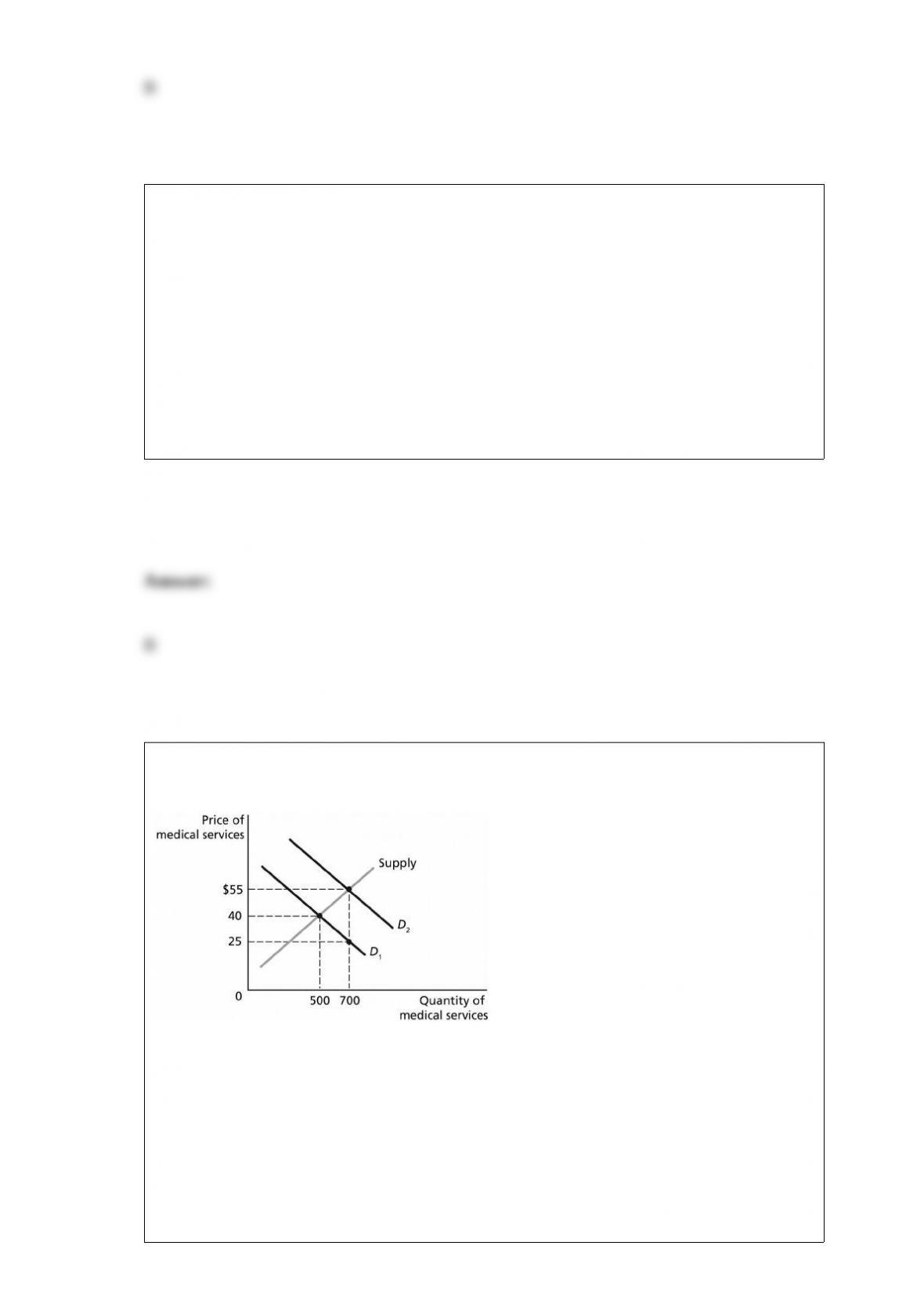
Figure 7-2
Figure 7-2 represents the market for medical services with and without insurance, and
the effect of a third-party payer system on the demand for medical services.
Refer to Figure 7-2. With insurance and a third-party payer system, the equilibrium
quantity of medical services is
A) 200.
B) 500.

C) 700.
D) >700.
Which of the following is an example of rent seeking behavior?
A) Apple earned large profits from the development and sale of the iPhone.
B) Amazon introduced the Kindle to compete with Sony’s Digital Reader. Amazon was
motivated by the desire to earn profits from the Kindle but also increased the choice of
digital music players available to consumers.
C) U.S. sugar firms convinced Congress to impose a quota on imports of sugar.
D) Recent increases in cigarette taxes faced little opposition from voters, many of
whom were rationally ignorant with respect to the tax.
Figure 3-7
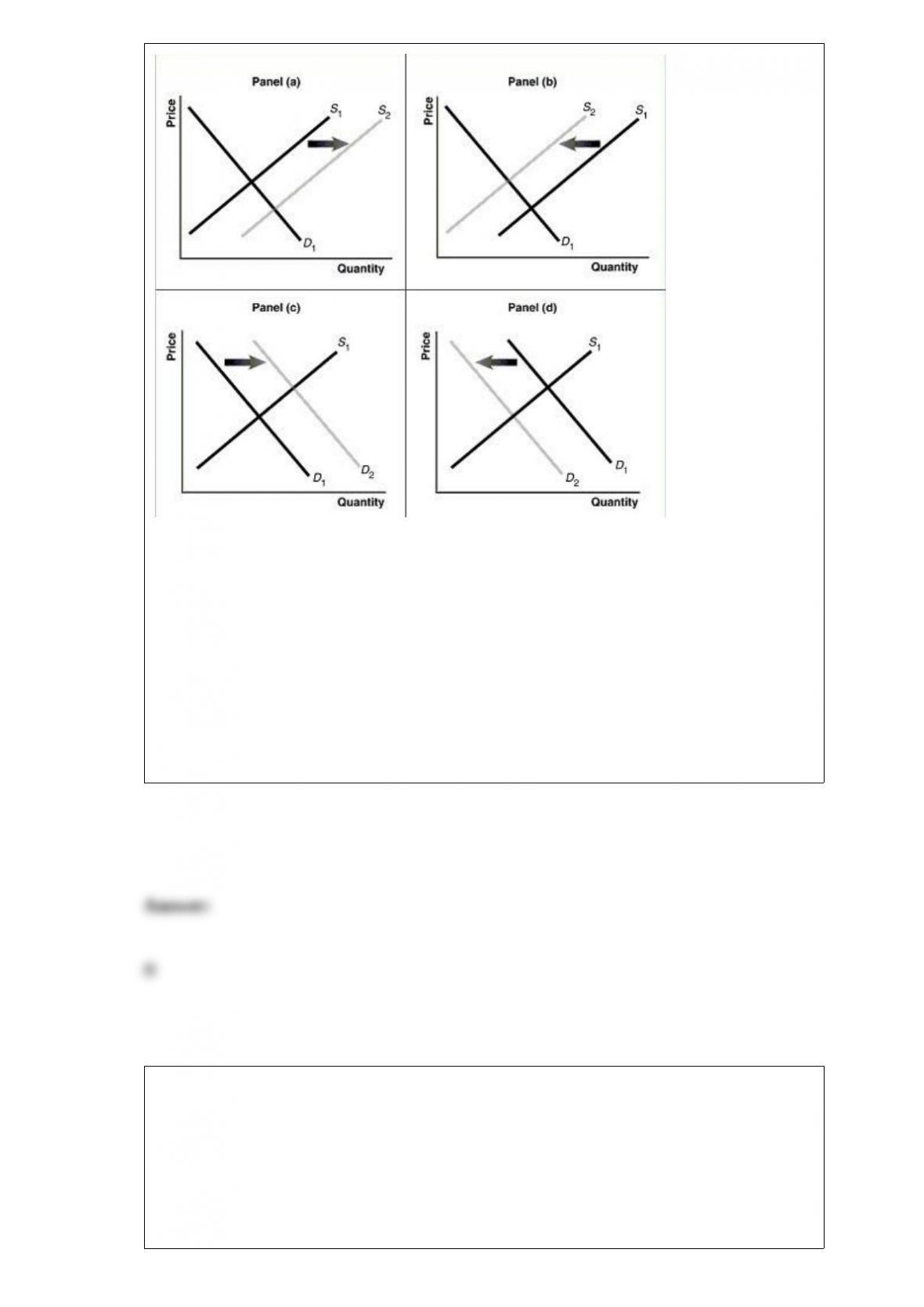
Refer to Figure 3-7. Assume that the graphs in this figure represent the demand and
supply curves for women’s clothing. Which panel best describes what happens in this
market when the wages of seamstresses rise?
A) Panel (a)
B) Panel (b)
C) Panel (c)
D) Panel (d)
Payments by a corporation to its shareholders are known as
A) stocks.
B) bonds.
C) coupons.

D) dividends.
Figure 2-14
Refer to Figure 2-14. Which two arrows in the diagram depict the following
transaction: Myrna earns $450 for working at HempHill’s Drug Store.
A) J and M
B) K and G
C) K and M
D) J and G

If demand is perfectly inelastic, the absolute value of the price elasticity coefficient is
A) infinity.
B) zero.
C) more than one.
D) equal to the absolute value of the slope of the demand curve.
In recent years the cost of producing organic produce in the U.S. has decreased largely
due technological advancement. At the same time, more and more Americans prefer
organic produce over conventional produce. Which of the following best explains the
effect of these events in the organic produce market?
A) The supply curve has shifted to the left and the demand curve has shifted to the
right. As a result there has been an increase in the equilibrium quantity and an uncertain
effect on the equilibrium price.
B) Both the supply and demand curves have shifted to the right. As a result, there has
been an increase in the equilibrium quantity and an uncertain effect on the equilibrium
price.
C) Both the supply and demand curves have shifted to the right. As a result, there has
been an increase in both the equilibrium price and the equilibrium quantity.
D) The supply curve has shifted to the left and the demand curve has shifted to the
right. As a result, there has been an increase in the equilibrium price and an uncertain
effect on the equilibrium quantity.

A Federal Reserve publication proclaimed that “Trade is a win-win situation for all
countries that participate.” This statement is
A) false since it ignores the workers who lose their jobs as result of international trade.
B) false since not all countries participate in international trade.
C) true because it refers to countries; individuals may be losers as a result of
international trade.
D) true because all consumers and workers benefit from international trade.
If a theatre company expects $250,000 in ticket revenue from five performances and
$288,000 in ticket revenue if it adds a sixth performance, the
A) marginal revenue of the sixth performance is $48,000.
B) marginal revenue of the sixth performance is $38,000.
C) cost of staging the sixth performance is probably higher than the cost of staging the
previous five.
D) company will be making a loss on the sixth performance because its ticket sales will
be less than the average received from the previous five.
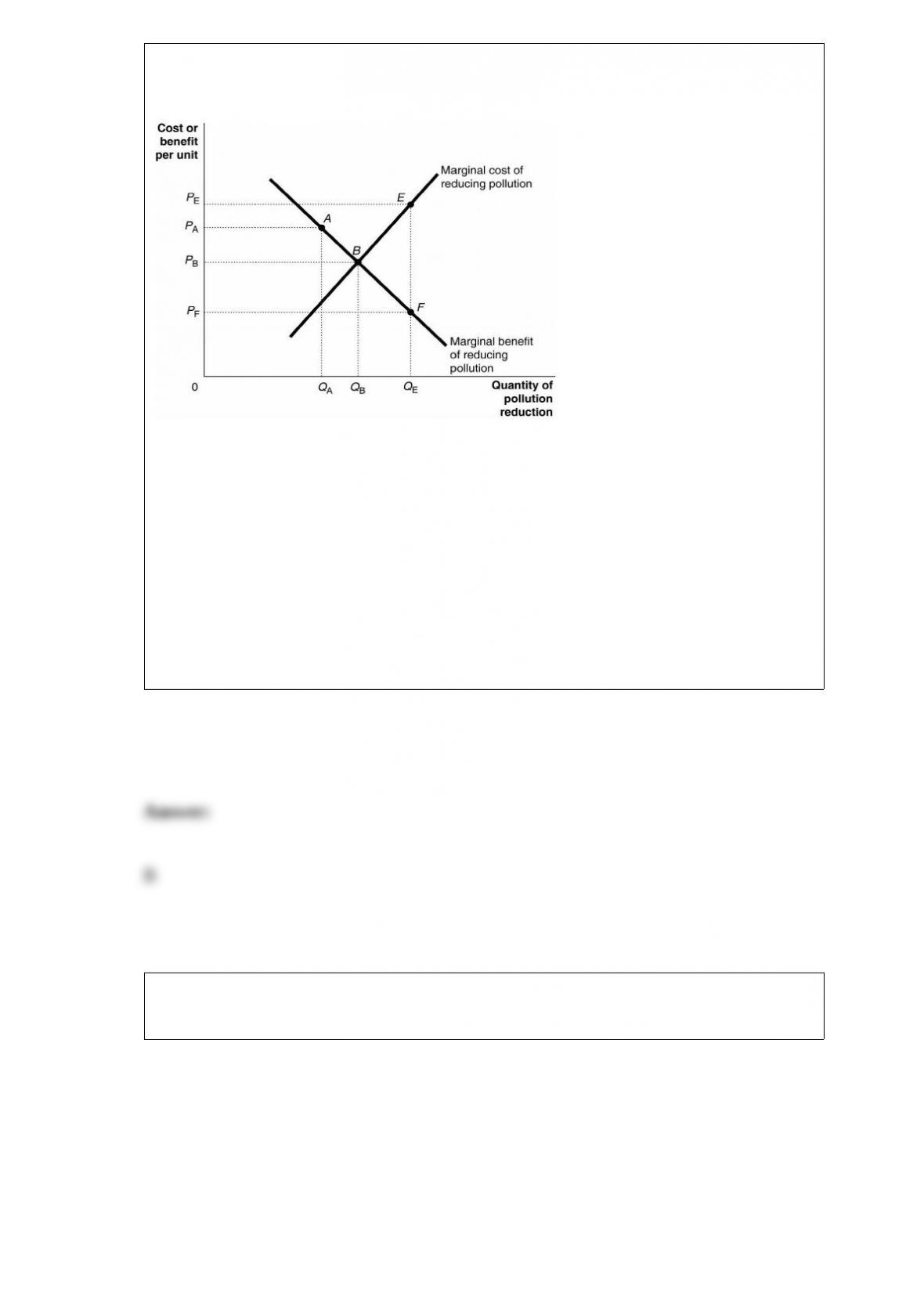
Figure 5-7
Refer to Figure 5-7. What is the incremental cost of increasing the quantity of pollution
reduction from QBto QE units?
A) PE
B) the value of the area QBBEQE
C) PEQE
D) the value of the area BEF
Figure 2-4

Figure 2-4 shows various points on three different production possibilities frontiers for
a nation.
Refer to Figure 2-4. A movement from Y to Z
A) represents an increase in the demand for plastic products.
B) could occur because of general technological advancements.
C) is the result of advancements in food production technology.
D) is the result of advancements in plastic production technology.
If a decrease in income leads to an increase in the demand for sardines, then sardines
are
A) an inferior good.
B) a neutral good.
C) a necessity.
D) a normal good.

In the United States, the largest source of funds for public schools is
A) the federal income tax.
B) the property tax.
C) the consumption tax.
D) sales taxes.
The aging of the U.S. population has tended to ________ spending on health care, and
the development of new drugs and medical equipment has tended to ________
spending on health care.
A) increase; increase
B) increase; decrease
C) decrease; increase
D) decrease; decrease

Most people buy salt infrequently and in small quantities. Even a doubling of the price
of salt is likely to result in a small decline in the quantity of salt demanded. Therefore
A) the demand for salt will be perfectly inelastic.
B) salt is a normal good.
C) the demand for salt is relatively inelastic.
D) the price elasticity of demand for salt is greater than 1 (in absolute value).
Suppose that when the price of raspberries increases, Lonnie increases his purchases of
papayas. To Lonnie,
A) raspberries and papayas are complements.
B) raspberries and papayas are inferior goods.
C) raspberries and papayas are normal goods.
D) raspberries and papayas are substitutes.
Despite evidence that companies will find it more profitable to use a commission
system of compensation rather than a salary system, many companies continue to pay
their workers salaries. Which of the following is one reason why firms choose a salary

system?
A) Most business owners and managers are not trained economists; therefore, they are
unaware of the research that shows a commission system is more profitable than a
salary system.
B) Firms often use salary systems to overcome their principal-agent problems.
C) Firms that have salary systems do not have to use compensating differentials to
attract employees to do hazardous jobs.
D) Many workers dislike risk and prefer to be paid a salary rather than to be paid by
commission.
When the marginal product of labor rises
A) the marginal cost of production will exceed the average total cost.
B) the marginal cost of production also rises.
C) the marginal cost of production falls.
D) the average total cost of production also rises.
Generally with bond ratings, the higher the rating, the ________ the interest rate an
investor will receive and the ________ the the risk that the issuer of the bond will
default.
A) higher; higher
B) higher; lower
C) lower; higher
D) lower; lower
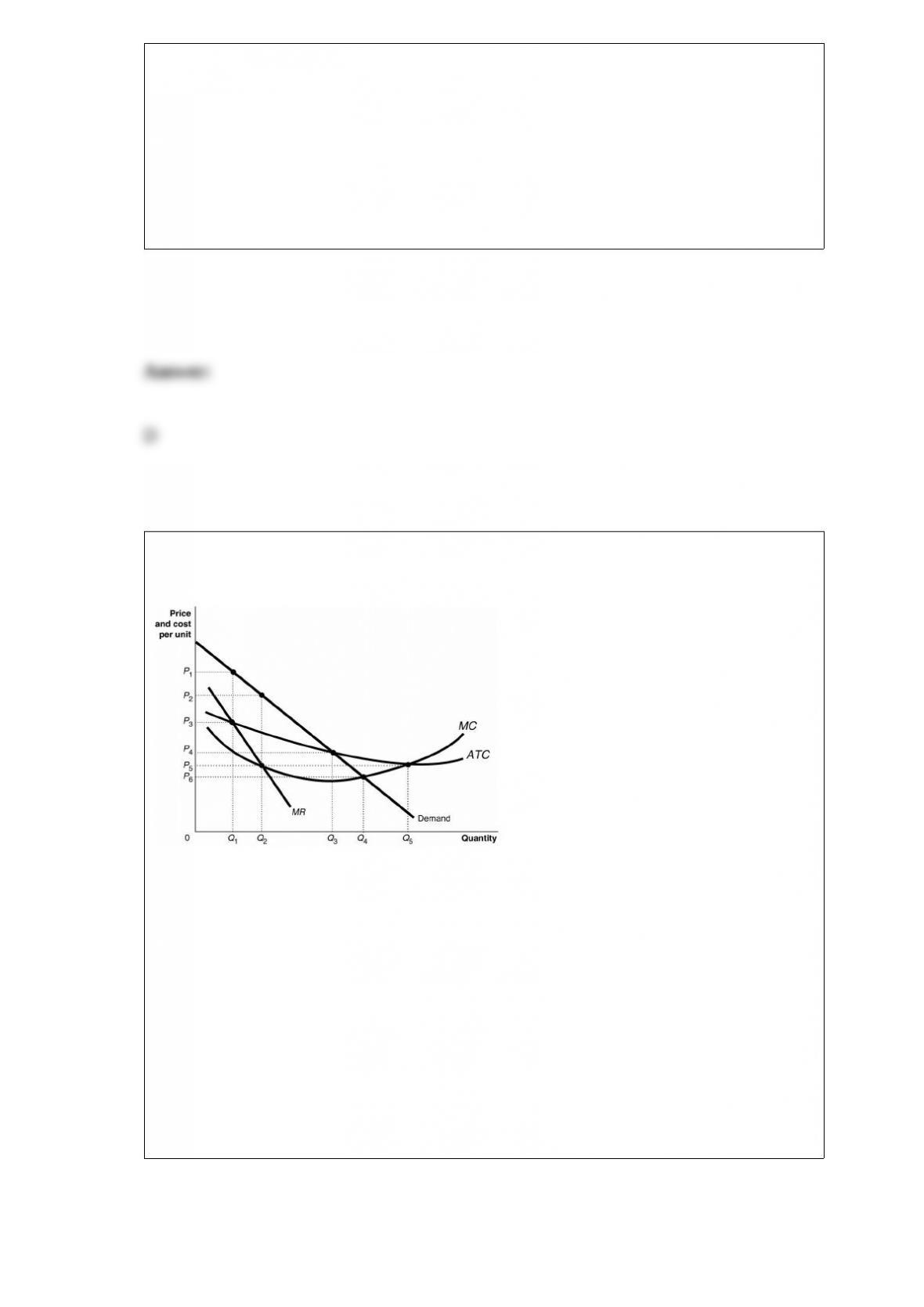
Figure 15-16
Figure 15-16 shows the market demand and cost curves facing a natural monopoly.
Refer to Figure 15-16. Which of the following would be true if government regulators
require the natural monopoly to produce at the economically efficient output level?
A) This results in a misallocation of resources.
B) The marginal cost of producing the last unit sold exceeds the marginal benefit.
C) The firm will sustain persistent losses and will not continue in business in the long
run.
D) The firm will break even.

Perfectly competitive firms produce up to the point where the price of the good equals
the marginal cost of producing the last unit. This condition is referred to as
A) productive efficiency.
B) constant returns to scale.
C) allocative efficiency.
D) perfectly competitive efficiency.
Consider the following characteristics:
a. a market structure with barriers to entry
b. demand curves that are easily identified
c. firm cannot make zero profits in the long run
d. firm can reap long run profits.
Which of the characteristics in the list above is shared by an oligopolist and a
monopolist?
A) a, b, c, and d
B) a, b, and d
C) a, c, and d
D) a and d

Which of the following statements regarding a firm’s long-run average total cost
(LRATC) curve and its short-run average total cost (SRATC) curve is true?
A) The shape of the LRATC is affected by the law of diminishing returns.
B) The SRATC, but not the LRATC, can be used by a firm’s managers for planning.
C) The LRATC shows the lowest cost at which a firm is able to produce a given level of
output when no inputs are fixed.
D) The contribution of average fixed cost to LRATC is greater than its contribution to
SRATC.
Table 14-8
Two rival oligopolists in the athletic supplements industry, the Power Fuel Company
and the Brawny Juice Company, have to decide on their pricing strategy. Each can
choose either a high price or a low price. Table 14-8 shows the payoff matrix with the
profits that each firm can expect to earn depending on the pricing strategy it adopts.
Refer to Table 14-8. If the two firms collude, is there an incentive for either to cheat on
the collusion agreement?

A) No, neither firm can gain by cheating.
B) Yes, but only Brawny Juice is in a position to gain by cheating.
C) Yes, but only Power Fuel is in a position to gain by cheating.
D) Yes, either firm can gain if it alone cheats.
Which of the following summarizes the impact of population growth on the labor
market?
A) This will increase the labor supply, reduce the equilibrium wage and increase the
quantity of labor demanded.
B) There will be an increase in the demand for labor. As a result, the wage rate will rise
and the quantity of workers supplied will decrease.
C) There will be an increase in the demand for jobs. This will result in an increase in the
equilibrium wage rate and a movement along the labor supply curve.
D) There will be an increase in both the demand for labor and the supply of labor. As a
result, the equilibrium wage will not change.
Suppose a competitive firm is paying a wage of $12 an hour and sells its product at $3
per unit. Assume that labor is the only input. If the last worker hired increases output by
three units per hour, then to maximize profits the firm should

A) not change the number of workers it currently hires.
B) lay off some of its workers.
C) hire additional workers.
D) There is not enough information to answer the question.
When there is an externality in a market
A) the externality will move the market to an economically efficient equilibrium.
B) the externality will cause the market price to be less than or greater than the
equilibrium price.
C) the government should use price controls to enable the market to reach equilibrium.
D) government intervention may increase economic efficiency.
Figure 13-9
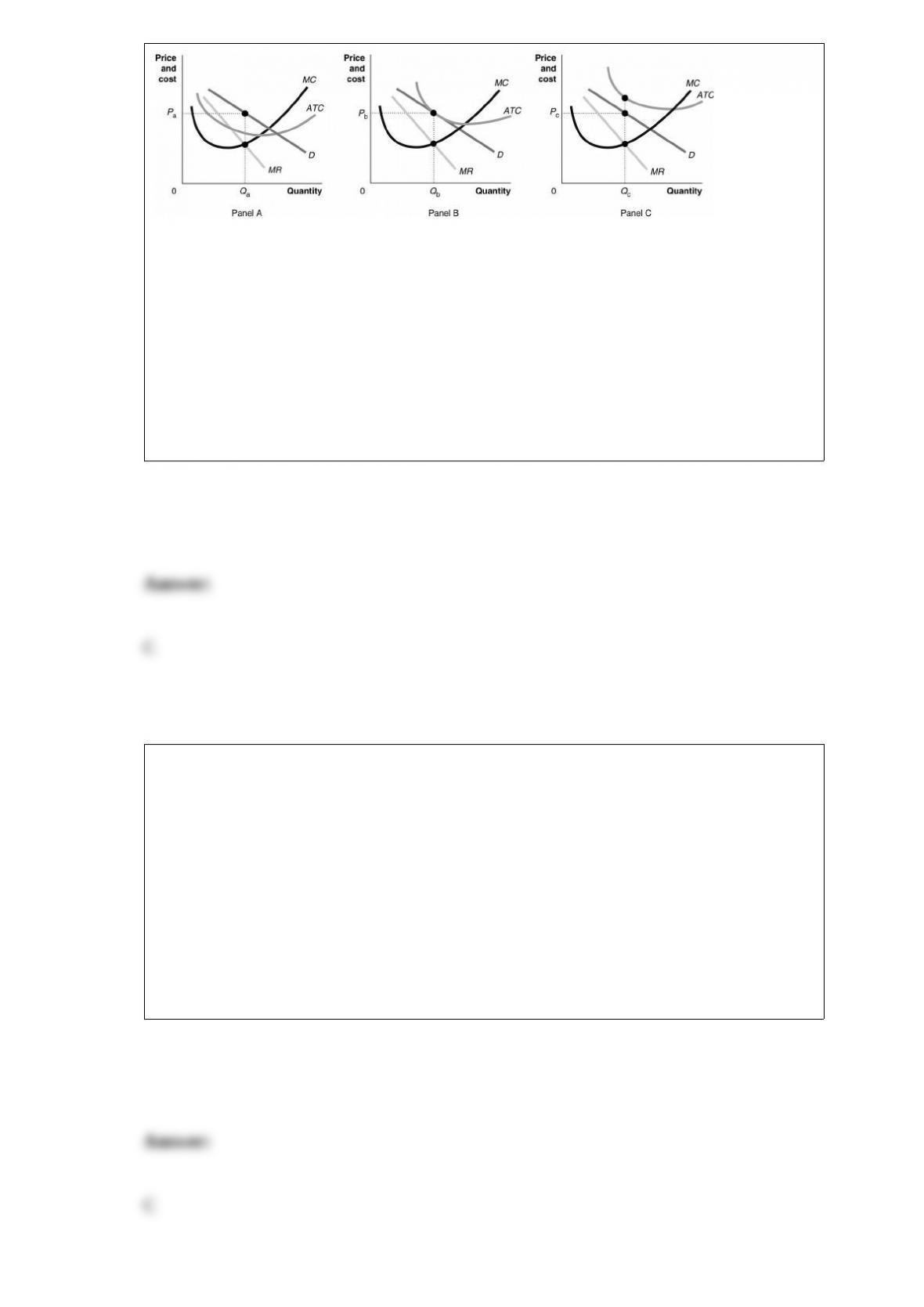
Refer to Figure 13-9. Which of the graphs in the figure depicts a monopolistically
competitive firm that is minimizing its losses?
A) Panel A
B) Panel B
C) Panel C
D) Panel A and Panel C
For a natural monopoly to exist
A) a firm must continually buy up its rivals.
B) a firm’s long-run average cost curve must exhibit diseconomies of scale beyond the
economically efficient output level.
C) a firm’s long-run average cost curve must exhibit economies of scale throughout the
relevant range of market demand.
D) a firm must have a government-imposed barrier.

If a dollar a year from now will likely have less purchasing power because of inflation,
then a dollar today ________ a dollar a year from now.
A) is more valuable than
B) is less valuable than
C) has the same value as
D) may be more valuable or less valuable than
The marginal product of labor is defined as
A) the change in total revenue that results when an additional unit of a labor is hired.
B) the additional labor required to produce one more unit of output.
C) the additional labor cost of producing one more unit of output.
D) the change in output that a firm produces as a result of hiring one more worker.
The slope of an indifference curve
A) is calculated by dividing the price of good on the vertical axis by price of the good
on the horizontal axis.

B) measures total utility.
C) measures the marginal rate of substitution between the two goods in question.
D) is calculated by dividing the quantity of the good on the vertical axis by the quantity
of the good on the horizontal axis.