
A paper mill that degrades river water while producing its product creates a divergence
between private and social costs if, and only if, the
a. mill treats the water to restore its quality before returning it to the river.
b. mill dumps the degraded water back into the river, for which privilege it pays a high
levy to towns downstream.
c. price of the paper produced there includes the cost of water treatment.
d. mill treats the water to restore its quality, for which service it is appropriately
compensated by the towns downstream.
e. water is dumped back into the river in an untreated state with no compensation paid
to downstream users.
Economists are concerned about a slowdown in productivity because of the risk of
higher inflation rates and a(n)
a. loss of our ability to diversify in manufacturing.
b. increased dependence on imported raw materials.
c. decline in service industries that depend on microelectronics technology.
d. potential decline in technological change that could affect our future rate of growth.
e. fear that it will lead to an influx of unskilled workers replacing domestic workers.
The difference between the budget deficit and the national debt is that the deficit is
a. financed by borrowing; the debt is financed by selling bonds.
b. a long-term concept; the debt is a short-term concept.
c. the difference between the size of the debt and the amount of government revenues in
a given year.
d. the estimated revenue shortfall; the debt is the actual revenue shortfall.
e. the difference between expenditures and revenues; the debt is the total amount owed
by the government.
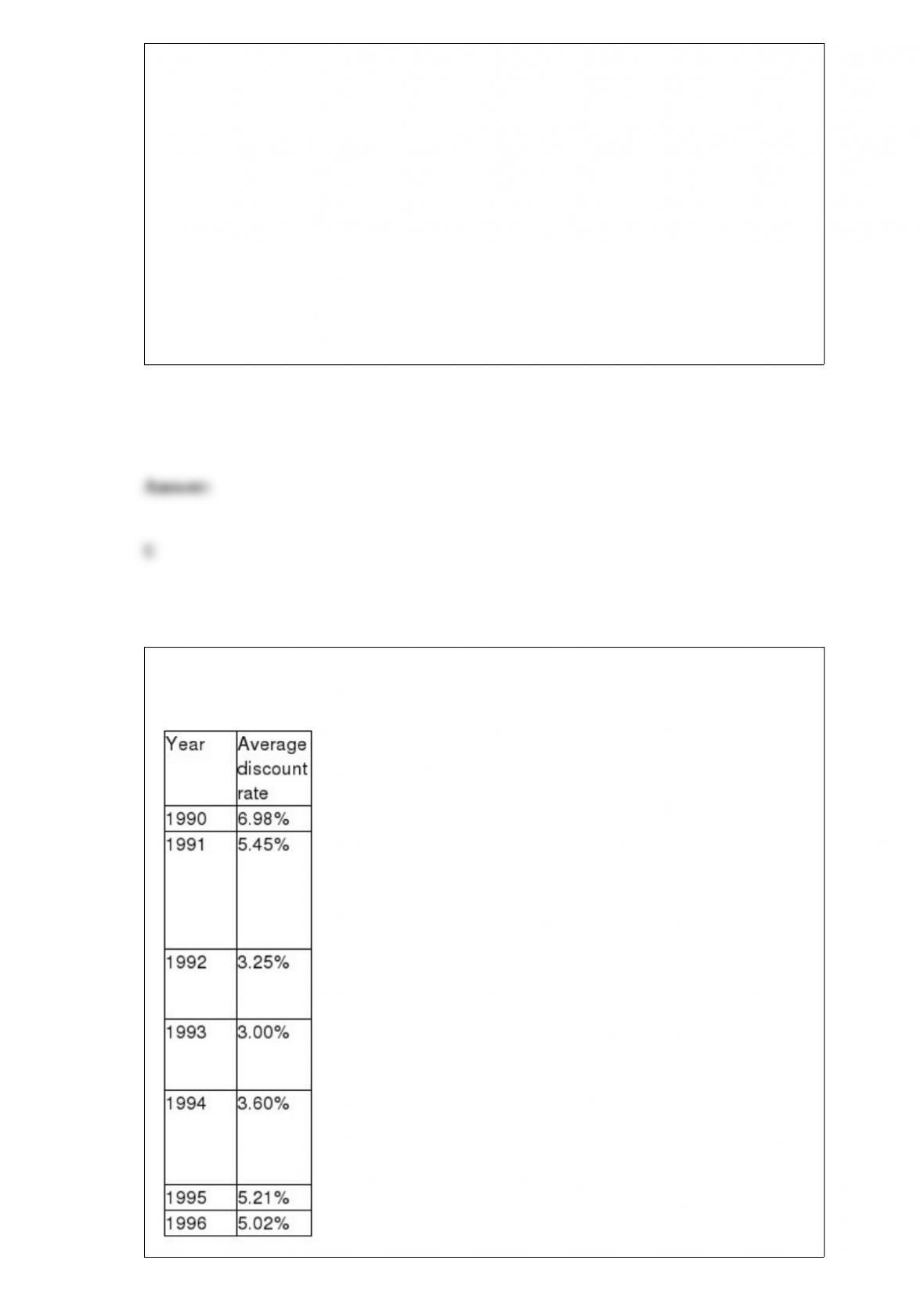
The next question is based on this table.

In December 1991, the Fed cut the discount rate by a full percentage point to 3.5
percent, the lowest discount rate in 27 years. This move clearly reflects the Fed’s
a. concern that inflation was getting out of control.
b. desire to reduce bank reserves.
c. effort to eliminate the large government budget deficit.
d. need to borrow more money from abroad.
e. attempt to send a clear signal to the banking system that it was time to expand credit.
Holding interest rates and the price level constant, a direct (upward-sloping)
relationship exists between the quantity of money demanded and the
a. level of real GDP.
b. interest rate.
c. price of money.
d. angle of the 45-degree line.
e. opportunity cost of holding money balances.
The perfectly competitive firm
a. strives to produce at the lowest total cost possible.
b. is forced to respond to price actions of rival producers.
c. cannot affect the price of its product because of government regulation.
d. is a price maker.
e. is able to sell all it can produce at the prevailing price.
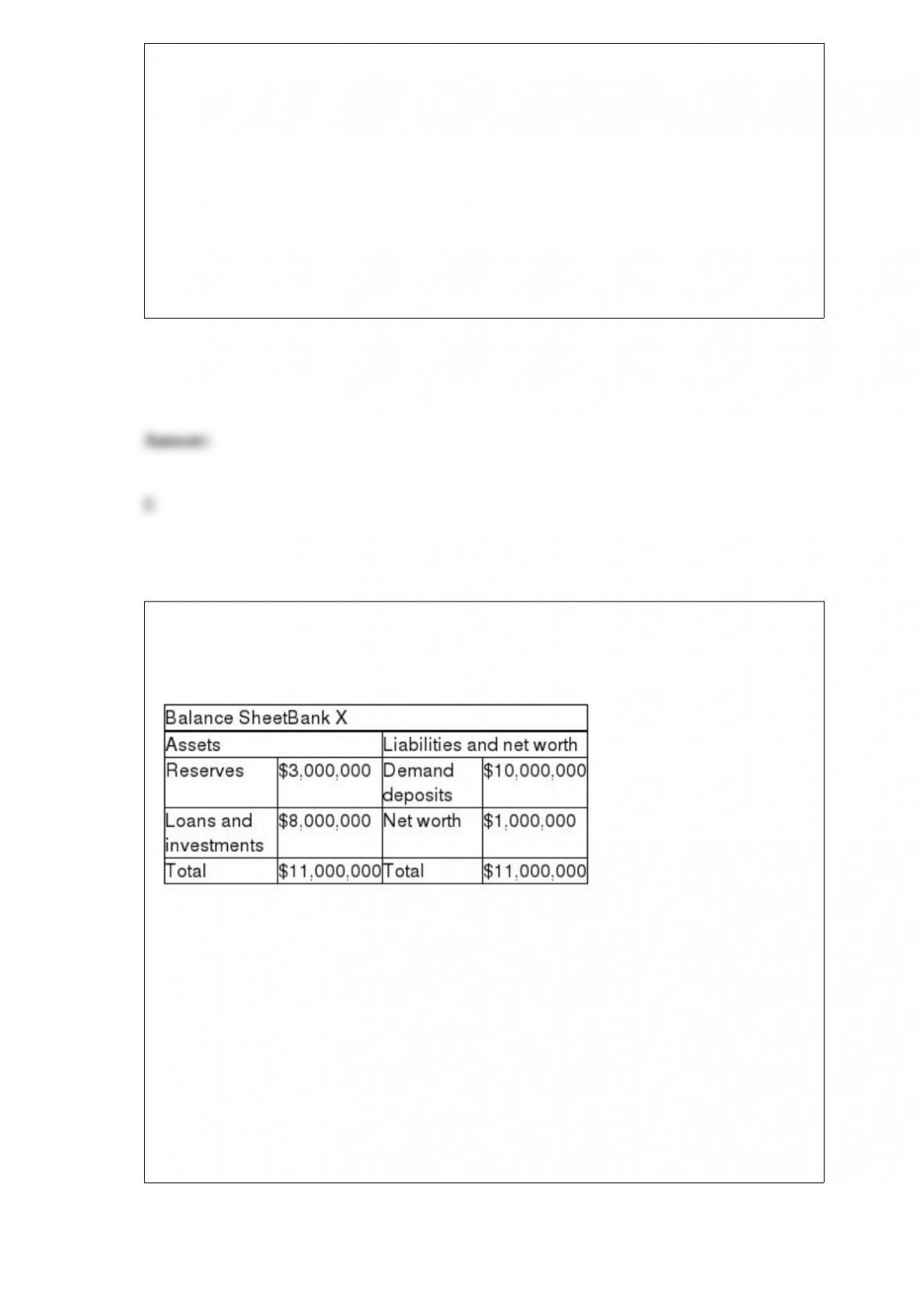
The following questions refer to the table that follows. Assume that there is a
fractional-reserve banking system, that the legal reserve requirements are 10 percent,
and that the balance sheet for Bank X is as follows:
A bank participates in the creation of money when it
a. adds to its required reserves.
b. receives a deposit of currency.
c. raises its interest rates.
d. becomes a member of the Federal Reserve System.
e. lends its excess reserves.

When a firm increases all its inputs by 20 percent and its output rises by 15 percent, it is
said to be experiencing ________ returns to scale.
a. average
b. explicit
c. increasing
d. constant
e. decreasing
In game theory, the outcomes of various strategies for two players can be summarized
in a(n)
a. payoff matrix.
b. balance sheet.
c. income statement.
d. T-accent.
e. pie chart.

As output increases, average variable cost first declines but eventually rises because
a. average variable cost is derived by dividing a constant, the total variable cost, by the
output rate.
b. of the effect of the law of diminishing returns.
c. it represents the addition to total cost resulting from the last unit of output.
d. at higher output rates, fixed costs per unit are relatively large.
e. if output is increased, total variable costs decline, then rise.
A measure of the extent of production taking place in a particular firm is called
a. value added.
b. double counting.
c. a nonmarket transaction.
d. a transfer payment.
e. opportunity cost.

Reducing or eliminating discrimination in labor markets would tend to
a. lower all workers’ wages.
b. raise the prices of final goods and services.
c. decrease the total demand for labor.
d. decrease the demand for minority labor only.
e. raise labor force productivity.
The two methods of measuring the value of GDP are the ________ approaches.
a. input and output
b. direct and residual
c. business and household
d. domestic and foreign
e. income and expenditures

A horizontal short-run aggregate supply curve reflects
a. no upward pressure on prices because of significant levels of unemployed productive
capacity.
b. full employment of the economy’s resources.
c. falling price levels.
d. stagflation.
e. Say’s law.
Critics of the new classical macroeconomics argue that
a. the necessary information for firms to formulate rational expectations is not generally
available.
b. deviations from the natural rate of unemployment are too small and transitory to have
resulted from purely unexpected events.
c. the theory neglects the slow and adaptive manner in which wages and prices adjust,
thus extending the duration of a business cycle.
d. markets clear too rapidly and continuously for individuals and firms to plan
effectively.
e. the natural rate of unemployment stated in the assumptions of the new classical
macroeconomic theory is too high to be of much use to policy makers.
Those who argue against income inequality say that

a. inequality does not help the rich very much and may well reduce society’s output.
b. a more equal distribution of income raises the productivity of society because the rich
do not want to work and the poor cannot.
c. the poor are important patrons of new and high quality products that benefit the entire
society.
d. capital formation would be greater because the poor save more since they spend only
on necessities, while the rich squander their incomes on conspicuous consumption of
useless goods.
e. income inequality leads to political inequality and reduced opportunity for advanced
education and training.
Demand deposits in a commercial bank are considered part of the bank’s
a. assets.
b. liabilities.
c. net exposure.
d. ordinary ratio.
e. fractional multiplier.

The basic distinction between perfect competition and monopolistic competition is that
a. in perfect competition there are many sellers; in monopolistic competition, there are
few.
b. entry into a market is easy for a new seller in perfect competition, while it is difficult
in monopolistic competition.
c. firms in perfect competition must advertise to sell their products, but since they have
a monopoly, monopolistically competitive firms do not.
d. perfectly competitive firms produce an identical product; monopolistically
competitive firms produce similar products.
e. a perfectly competitive firm produces with an excess capacity in the long run; a
monopolistically competitive firm does not.
The practice of featherbedding may be viewed as a(n)
a. decrease in the wage, causing an excess demand for labor.
b. decrease of the labor demand curve.
c. increase in the wage, causing an excess supply of labor.
d. increase of the labor demand curve.
e. increase of the labor supply curve.

Monetary policy is carried out primarily through actions taken by the
a. president of the United States.
b. large member banks of the Federal Reserve System.
c. Treasury Department on advice from the Board of Governors of the Federal Reserve
System.
d. Federal Reserve Board and Federal Open Market Committee.
e. chairperson of the Board of Governors of the Federal Reserve System.
A recent sale at a department store advertised 50 percent price reductions on clothing.
The store’s clothing sales increased by 200 percent. The price elasticity of demand was
a. 0.25.
b. 0.5.
c. 1.0.
d. 2.5.
e. 4.0.
Economic resources have a price above zero because

a. there are no other uses for them.
b. they cannot be easily moved from place to place.
c. otherwise they would not be able to satisfy human wants.
d. they are relatively scarce.
e. they are unlimited in supply.
The amount of money held for speculative reasons
a. increases if bond prices are expected to decline soon.
b. decreases if GDP remains the same.
c. is affected by expected bond prices but not by expected bond interest rates.
d. varies directly with the transactions demand for money.
e. decreases as the number of different assets counted as fiat money rises.
Higher expected rates of inflation
a. lead to a decline in the money supply.

b. cause unions to settle for more moderate money wage increases.
c. stem from high industrial productivity growth rates.
d. force the money wages of labor downward.
e. shift the short-run Phillips curve upward to the right.
The change in total variable cost for producing an extra unit is the same as the change
in ________ cost.
a. total fixed
b. total
c. average fixed
d. average total
e. average variable
For countries on the gold standard, bilateral exchange rates equal
a. the ratio of the size of the country’s gold stock to that of another country.
b. the reciprocal of the differences between each country’s gold supplies.

c. the ratio of the amount of gold in a unit of each country’s monetary unit.
d. a ratio that fluctuates according to the inflows and outflows of gold from one country
to another.
e. the sizes of their gold stocks divided by the reciprocal of the absolute value of their
trade deficit or surplus.
In addition to the United States, the politics of agriculture is also important in
a. Africa.
b. Europe.
c. China.
d. New Zealand.
e. South America.
Tax cuts and tax surcharges are examples of
a. public works programs.
b. discretionary fiscal policy.
c. welfare transfers.

d. monetary policy.
e. automatic stabilizers.
The decline in incremental output as equal increments of labor are added to a fixed
amount of land is called the law of
a. production.
b. diminishing marginal returns.
c. supply.
d. the land.
e. increasing numbers.
Under which of the following conditions will the principle of comparative advantage be
mostlikely to produce a situation where the price of a good is equalized among all
countries?
a. export subsidies
b. free trade and competition
c. quotas

d. tariffs
e. high transportation costs
The Senate committee that considers major tax legislation before it goes to the entire
Senate is the ________ Committee.
a. Ways and Means
b. Finance
c. Tax Analysis
d. Tax Legislation
e. Senate Budget
If price equals average total cost, economic profit will
a. become large.
b. equal marginal revenue.
c. equal total cost.
d. be zero.

e. exceed output.
A monopolistically competitive firm is likely to produce less and charge more than a
perfectly competitive firm because
a. a monopolistically competitive firm faces a downward-sloping demand curve;
therefore, price is greater than marginal revenue.
b. there is less demand for the monopolistically competitive firm’s product.
c. both firms equate marginal cost with average cost.
d. a monopolistically competitive firm faces excessive competition.
e. a monopolistically competitive firm faces different cost conditions.
Economists generally dislike the restriction of trade because it
a. encourages inefficiency.
b. does not really save jobs in the short run despite its costs.
c. is too difficult and costly to enforce.
d. reduces a nation’s industrial diversification.

e. discourages the growth of infant industries.
The phenomenon of a government deficit accompanied by a tight money policy, leading
to a rise in interest rates and causing a reduction in private spending, is an example of
a. rational expectations theory.
b. the law of diminishing returns.
c. the equation of exchange.
d. the acceleration principle.
e. the crowding-out effect.