
Which of the following factors would be most likely to encourage capital formation in a
less-developed nation?
a. high and variable rates of inflation
b. tariffs and quotas that restrict international trade
c. a legal system that provides for secure property rights and even-handed enforcement
of contracts
d. high marginal tax rates
In practice, money supply and short-term interest rates are determined by the
a. Treasury and Commerce departments.
b. Federal Open Market Committee.
c. Board of Governors.
d. House and Senate.
Figure 4-19
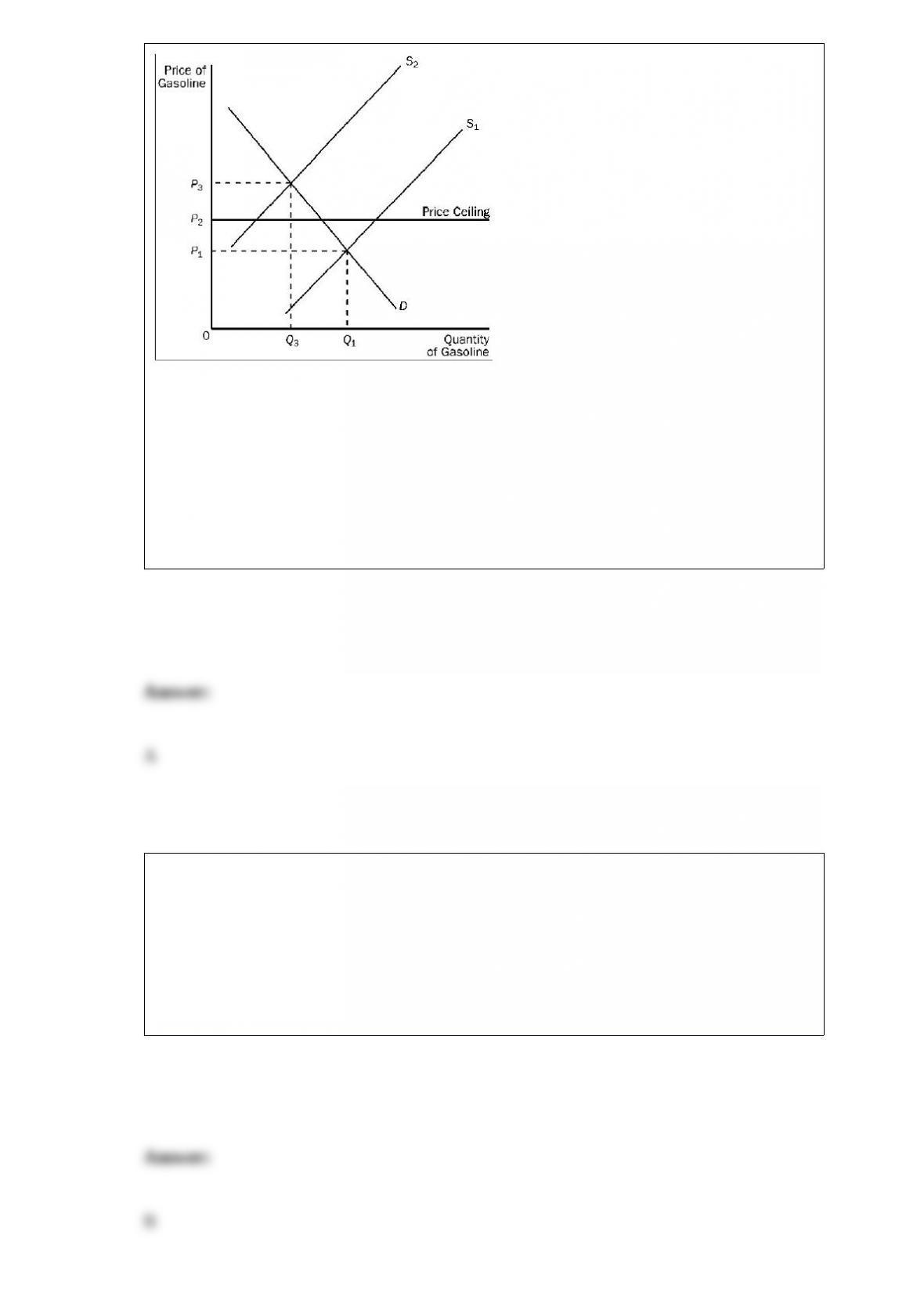
Refer to Figure 4-19. When the price ceiling applies in this market and the supply curve
for gasoline shifts from S1to S2, the resulting quantity of gasoline that is bought and
sold is
a. less than Q3.
b. Q3
c. between Q1 and Q3.
d. at least Q1.
Which of the following best explains the source of consumer surplus for a particular
product?
a. Many consumers pay prices that are greater than the equilibrium price of the product.
b. Many consumers would be willing to pay more than the market price for the product.
c. Many consumers think the market price of the product is greater than its cost.
d. Many consumers think the demand for the product is elastic.
When a firm generates external benefits, a more efficient outcome would result if
a. the firm produced a larger output level.
b. the firm reduced its output level.
c. a tax were levied on the firm equal to the dollar amount of the externalities.
d. price were fixed below the firm’s per-unit cost.
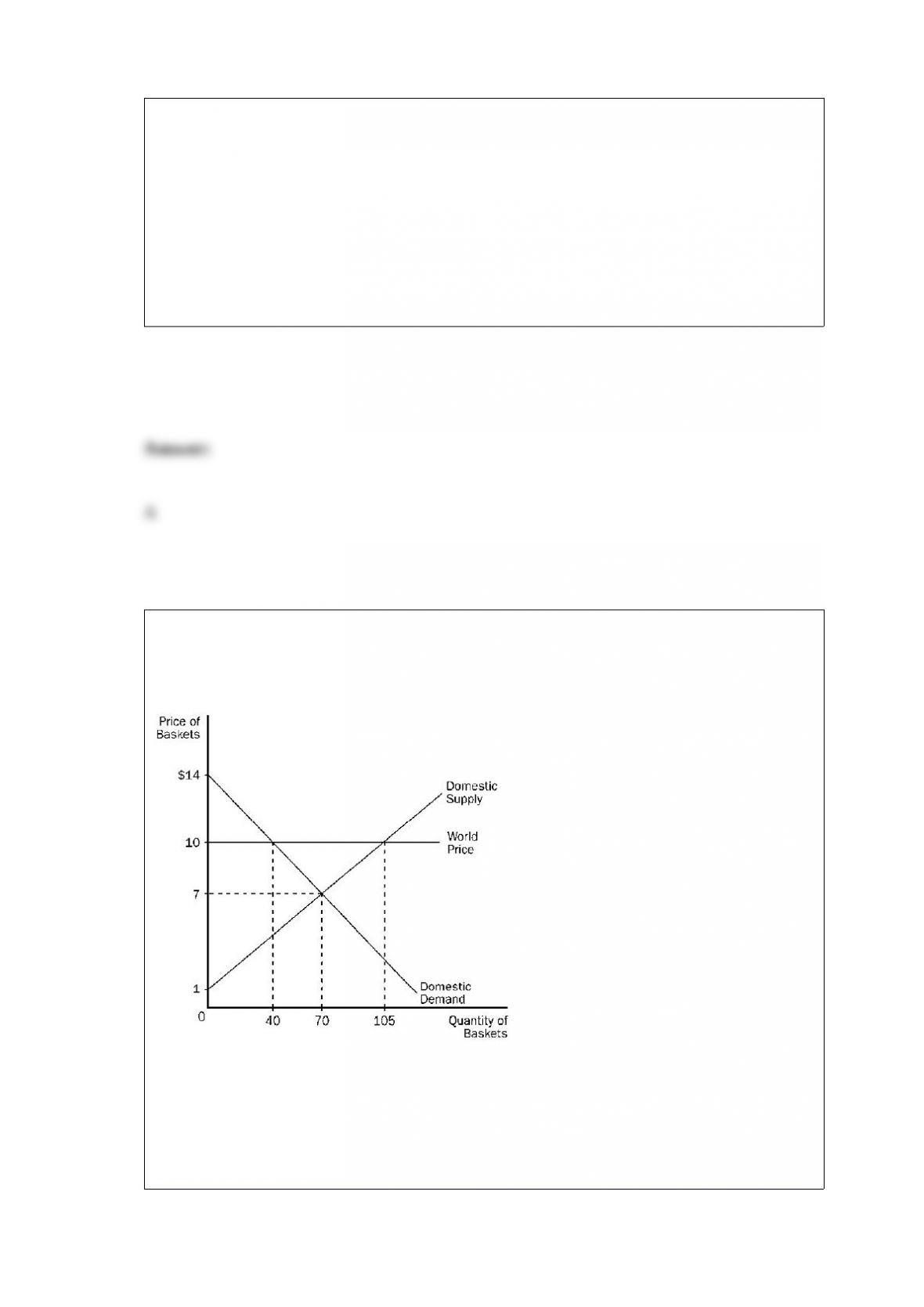
Figure 17-5
Refer to Figure 17-5. If this country chooses to trade, the price of baskets in this
country will be
a. $10 and 40 baskets will be sold domestically.
b. $10 and 105 baskets will be domestically.
c. $7 and 70 baskets will be sold domestically.
d. $7 and 40 baskets will be sold domestically.

Which countries undertook economic reforms in the 1960’s that resulted in more
economic freedom and stronger economic growth?
a. Venezuela and Zimbabwe
b. Malawi and Niger
c. Hong Kong and Singapore
d. United States and Switzerland
If drugs such as marijuana and cocaine were legalized, it would be likely that
a. their prices would decrease.
b. there would be a reduction in tainted or poor quality drugs.
c. there would be less violence occurring in drug transactions.
d. all of the above.
Which of the following best explains why the chained consumer price index generally
results in a lower rate of inflation than the regular consumer price index?
a. The chained index is based on a comprehensive bundle of goods and services, while
the regular CPI considers only changes in the prices of food and energy.
b. The chained index makes allowance each month for shifts away from goods that have
become relatively more expensive; the regular CPI does not adjust for this factor.
c. The chained consumer price index considers the impact of both rising and falling
prices, whereas the regular consumer price index considers only the impact of goods
and services with rising prices during the period.
d. The chained consumer price index considers only the prices of goods and services
purchased by households, whereas the regular CPI also includes the price changes of
investment assets such as stocks and real estate.
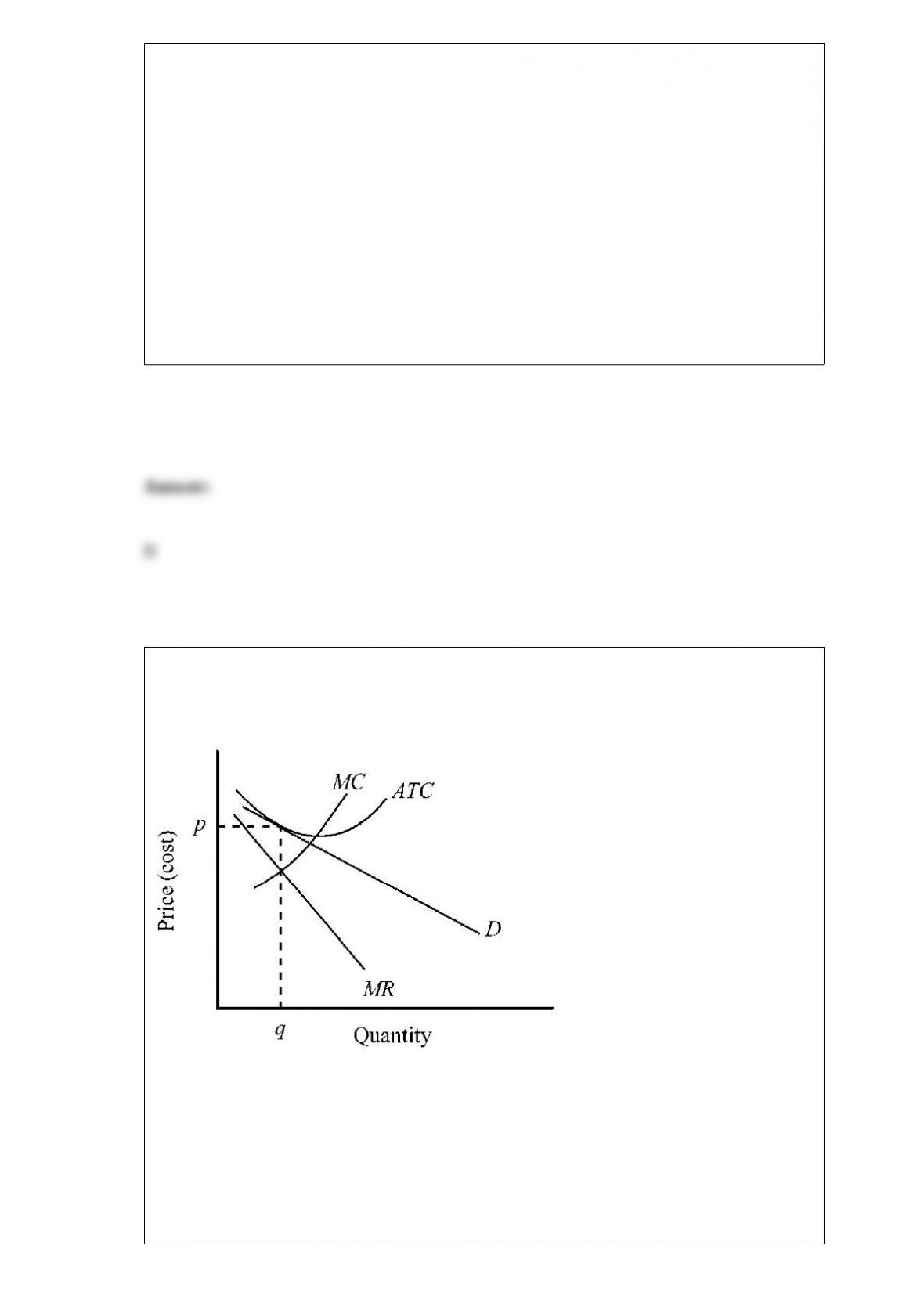
Figure 10-6
Given that the short-run cost and demand conditions shown in Figure 10-6 for the
competitive price-searcher firm are representative for all firms in the industry, what will
happen in this industry in the long run?
a. The firm will make long-run economic profits.
b. The firm will face competition from new entrants into the industry, causing this firm’s

demand to decline until zero economic profits are restored.
c. The firm will see some of its competitors exit from the industry, causing this firm’s
demand to increase until zero economic profits are restored.
d. This industry is in long-run equilibrium and will not experience any new entry or exit
of firms.
Suppose the Fed purchases $100 million of U.S. government securities from the public.
How will this affect the money supply and the national debt?
a. The money supply will increase; the national debt will decline.
b. The money supply will decline; the national debt will increase.
c. The money supply will increase; the national debt will be unaffected.
d. The money supply will decrease; the national debt will be unaffected.
Data on world reserves of minerals, gathered by Blackman and Baumol, show that
between 1950 and 2000, production of most minerals
a. greatly exceeded the reserves available in 1950.
b. declined as depletion occurred.
c. greatly reduced the reserves available in 2000.

d. was limited to a fraction of the reserves available in 1950.
Which of the following is true?
a. The United States is rich because it has democratic political institutions.
b. Economic growth is primarily the result of gains from trade, discovery of better ways
of doing things, and capital investment.
c. Without foreign aid, poor countries are unable to break the cycle of poverty, low
savings and investment, and economic stagnation.
d. Most all countries with an abundance of natural resources have been able to achieve
rapid growth and high levels of per capita income.
Suppose a country had net exports of $7.5 billion and sold $44.6 billion of goods and
services abroad. This country had
a. $44.6 billion of imports and $52.1 billion of exports.
b. $52.1 billion of exports and $44.6 billion of imports.
c. $44.6 billion of imports and $37.1 billion of exports.
d. $44.6 billion of exports and $37.1 billion of imports.

If the exchange rate between the U.S. dollar and the Japanese yen were such that one
U.S. dollar equals 100 yen, what would be the price in dollars of a Japanese automobile
that cost 2,000,000 yen?
a. $100
b. $20,000
c. $120,000
d. $2,000,000
Which of the following will increase economic freedom?
a. subsidies and regulations that favor business
b. high tariff rates
c. high marginal tax rates
d. protection of persons and their property from aggression
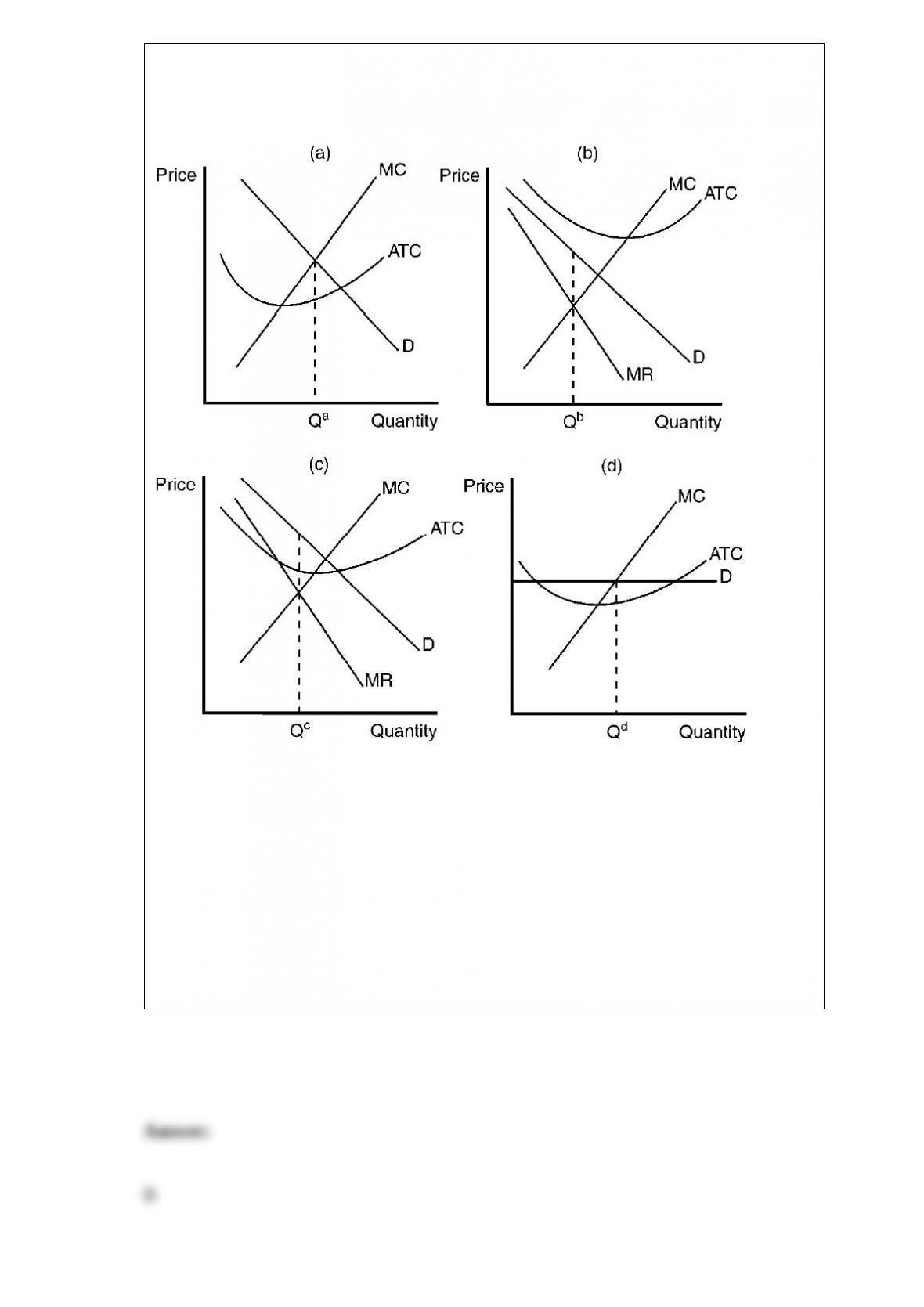
Figure 10-11
Refer to Figure 10-11. Which of the graphs shown would be consistent with a firm in a
competitive price-searcher market that is maximizing profit but profit is still negative?
a. Panel a
b. Panel b
c. Panel c
d. Panel d

Suppose that price is below the minimum average total cost (ATC) but above the
minimum average variable cost (AVC) and that the market price is expected to rise at
least to ATC in the near future. In the short run, a firm that is a price taker would
a. immediately shut down and get out of the industry.
b. continue to produce a quantity such that marginal revenue equals marginal cost.
c. shut down temporarily, in hopes of restarting in the near future.
d. cut price and expand output in hopes of achieving economies of scale
In order to be successful in a competitive market economy, an entrepreneur must
a. provide buyers at least as much satisfaction per dollar spent as the buyer could get
elsewhere.
b. supply consumers with goods and services valued less highly than the resources
necessary to produce them.
c. take resources from other producers, thus reallocating wealth but not creating new
wealth.
d. gain government grants and subsidies.
A profit-maximizing entrepreneur will produce and sell an additional unit of output as
long as
a. it lowers the firm’s unit costs.
b. it lowers the firm’s marginal cost.

c. it adds more to revenue than it adds to cost.
d. there is additional plant capacity to produce.
The demand and total cost schedules of a monopolist are presented in Table 11-3. What
price should a profit-maximizing monopolist charge?
a. $10
b. $9
c. $8
d. $7
Figure 17-8
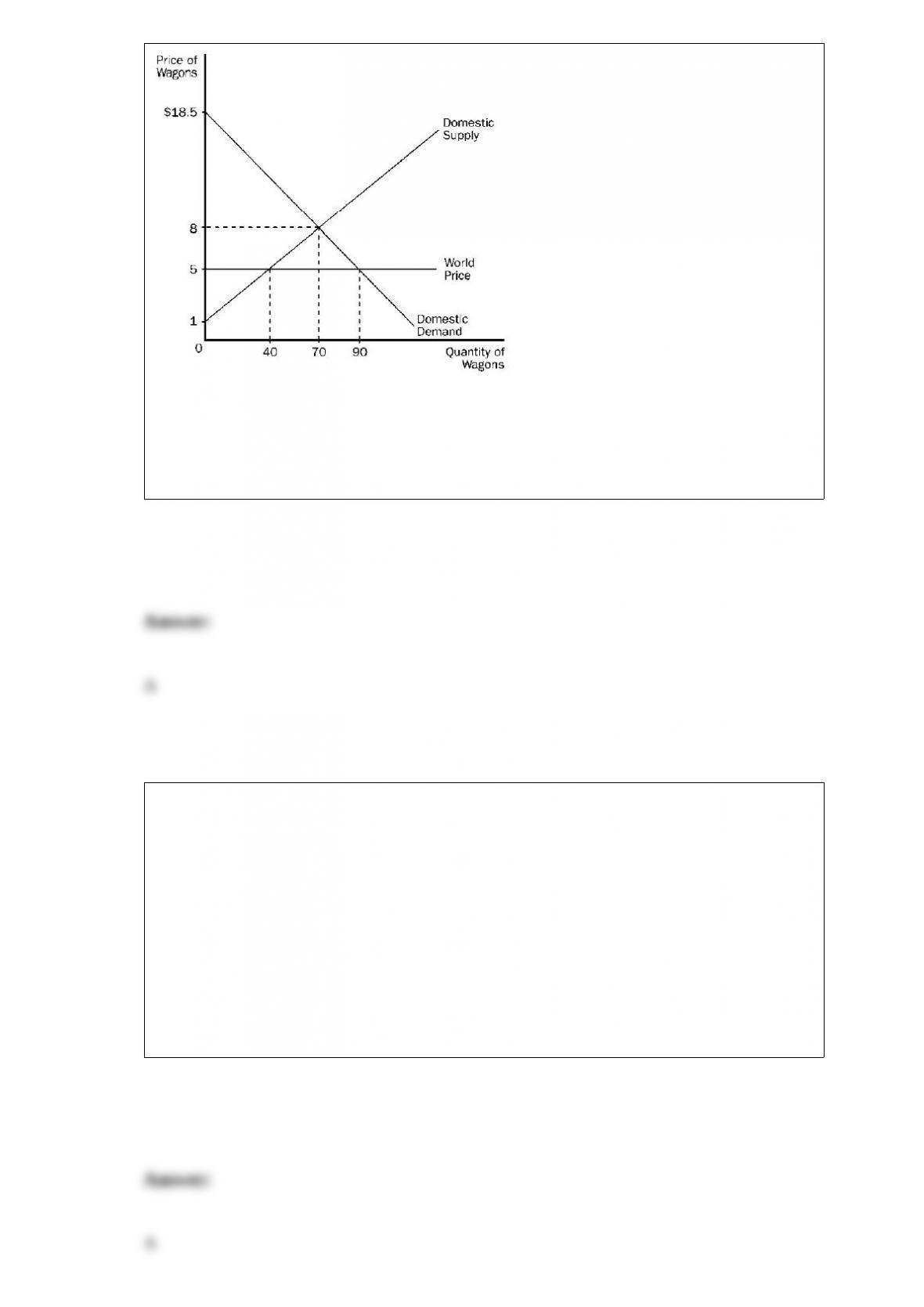
Refer to Figure 17-8. If this country allows free trade in wagons,
a. consumers will gain more than producers will lose.
b. producers will gain more than consumers will lose.
c. producers and consumers will both gain equally.
d. producers and consumers will both lose equally.
A restaurant offers an “all you can eat” meal for $9. Tyrone has eaten three servings and
is trying to decide whether or not to go back for a fourth. The economic way of thinking
suggests that Tyrone should go back for the fourth serving if and only if
a. his marginal benefit of the additional serving is greater than zero.
b. his marginal benefit of the additional serving is at least $3.
c. his marginal benefit of the additional serving is $9 or more.
d. his total value from the meal exceeds $9.

Which of the following is true?
a. Positive economics deals with how people react to changes in benefits, and normative
economics deals with how people react to changes in costs.
b. Positive economic statements are testable, but normative statements are not.
c. Positive economic statements involve value judgments while normative economics
focuses on whether a policy will achieve its intended objectives.
d. Positive economic statements focus on policy issues while normative economics
focuses on economic theory.
Which of the following is a major area of disagreement between activists and
nonactivists?
a. Activists believe discretionary macroeconomic policy can be applied in a manner that
will enhance economic stability. Nonactivists disagree.
b. Activists believe monetary policy is more potent than fiscal policy. Nonactivists
disagree.
c. Activists believe changes in monetary and fiscal policy exert their effects
instantaneously. Nonactivists think they work only with a substantial lag.
d. Nonactivists think macroeconomic policy is sometimes motivated by the pursuit of
political gain. Activists disagree.

If a fiscal policy change is going to exert a stabilizing impact on the economy, it must
a. add demand stimulus during a slowdown but restraint during an economic boom.
b. exert an expansionary impact during all phases of the business cycle.
c. restrain aggregate demand during all phases of the business cycle.
d. keep the government’s budget in balance.
When market trades in water occur, we can assume that
a. the party releasing water is the loser.
b. the party buying water is paying too much.
c. the trade in something as important as water is immoral.
d. the signals and incentives flowing from the trades help many in that water market,
not just the buyer and seller directly.
The marginal cost of a good is
a. lower for competitive firms than for monopolists.
b. the cost of an additional unit.

c. equal to fixed cost at high output levels.
d. equal to variable cost when the firm is maximizing profit.
As output is expanded, if marginal cost (MC) is less than average total cost (ATC),
a. ATC must be at its minimum.
b. ATC must be at its maximum.
c. ATC must be decreasing.
d. the firm must be earning economic profit.
If the Fed fears an economic downturn, it would be most likely to
a. buy additional bonds in order to reduce the federal funds rate.
b. buy additional bonds in order to increase the federal funds rate.
c. sell additional bonds in order to increase the federal funds rate.
d. sell additional bonds in order to reduce the federal funds rate.

In 2010, the percentage of all U.S. families officially considered to be in poverty was
approximately
a. 5 percent.
b. 11 percent.
c. 22 percent.
d. 31 percent.
Which of the following weakened the demand stimulus effects of the fed’s low interest
rate policy during the years following the 2008-2009 recession?
a. Rising stock prices in response to the low-interest rate policy.
b. The lower cost of borrowing to undertake business investment.
c. An increase in the velocity of money.
d. A reduction in earnings of senior citizens and others from money market accounts,
saving deposits, and similar forms of savings.
A decrease in the nominal interest rate would
a. encourage people to hold larger money balances.
b. encourage people to hold smaller money balances.
c. force the Fed to increase the money supply.
d. cause households to decrease consumption.
Why is it that the airline pilots union will likely be stronger and more effective than the
fruit pickers union?
Suppose all automobile manufacturers have collusively agreed to sell their cars at a
uniform price. If a firm wanted to break this agreement and not be detected, what would
be one way to do this?
Why do we use two supply curves in the aggregate goods and services market? What is
the difference between them, and why do they have different slopes?
Suppose that in the absence of trade, the U.S. price for peas was lower than the world
price for peas. Would allowing international trade mean that the United States would
import or export peas? Who in the United States would benefit and who would lose
with a free trade policy, and would the gains be greater than the losses?
Joanne states: “The best way to increase the wages of workers is to increase worker
productivity.” Is Joanne correct? Why or why not?
Cattle manure is an input often used in making fertilizer. Suppose a technique is
discovered that can transform cattle manure into quality gasoline. What would happen
in the fertilizer industry?
In 2000, a major U.S. oil company began exploration off the southeastern coast of the
United States. Suppose the company discovers huge reserves of natural gas. Using the
aggregate demand/ aggregate supply model, predict what shifts will occur and what will
happen to output and prices in both the long and short runs.
How does investment as a share of GDP in countries with more economic freedom
compare with economies that are less free? How does the productivity of investment in
the freer economies compare with its productivity in the less free economies? How will
this influence differences in growth rates and income levels? Explain.
What is the Phillips curve? What is the difference between the original Phillips curve
and the “modern” view of the Phillips curve? What problems caused the abandonment
of the ideas behind the original Phillips curve?
The Shackled Foot Corporation is a conglomerate with four major divisions. Each
division has performed poorly over the years and none has a return greater than 2
percent. Karen, who could have invested her money at 5 percent, buys the company.
What does her action imply?
Discuss how size of government can negatively affect economic growth.
Niceville, Ohio, only has two dentists, while the surrounding communities have many
more on a per capita basis. The demand for dental services is such that these two
dentists could agree to raise their prices (they play golf together every Saturday) and
earn economic profit. Instead, they choose to price competitively and earn what other
dentists earn. What might explain this?
Happyland is a country devoted to consumption. The inhabitants spend all of their
income on pleasurable things and virtually none on capital investment, human or
otherwise. Seriousland is frugal, spending very little on consumption and a great deal
on human and physical capital. Ten years from now, which country would you prefer to
inhabit?
“Trade restrictions will stop foreign imports, which will increase American employment
and protect American jobs.” Most economists realize this argument is wrong. Can you
explain why?
The Hardboard Construction Company hired Bob at $10 an hour, but its output of doll
houses only increased by three units a day. Two weeks later, the company purchased an
$8 hammer for Bob and output increased by twelve units. Since the hammer increased
the marginal product more than Bob did, and at less cost, Hardboard fired Bob. Is this
consistent with the theory of marginal productivity? Why or why not?
Jim values his car at $2,000, and Kelly values it at $5,000. Can value be created in this
situation? How? Suppose Jim refuses to sell for less than $6,000. Is value destroyed?
Why or why not?
What three types of timing problems might policy makers experience when conducting
discretionary fiscal policy?
Supply-side economics concentrates on the benefits of reducing marginal tax rates.
Describe three ways that high marginal tax rates are likely to retard output growth.