
A tax is efficient if it imposes a small excess burden relative to the tax revenue it raises.
Answer:
Merger guidelines developed by the Antitrust Division of the U.S. Department of
Justice use four-firm concentration ratios as measures of concentration.
Answer:
The equilibrium in the prisoner’s dilemma is a dominant strategy Nash equilibrium.
Answer:
An open market purchase of Treasury securities by the Federal Reserve causes the
reserves of banks to rise.
Answer:
Horizontal equity means that two people in identical economic situations should pay the
same amount of taxes.
Answer:
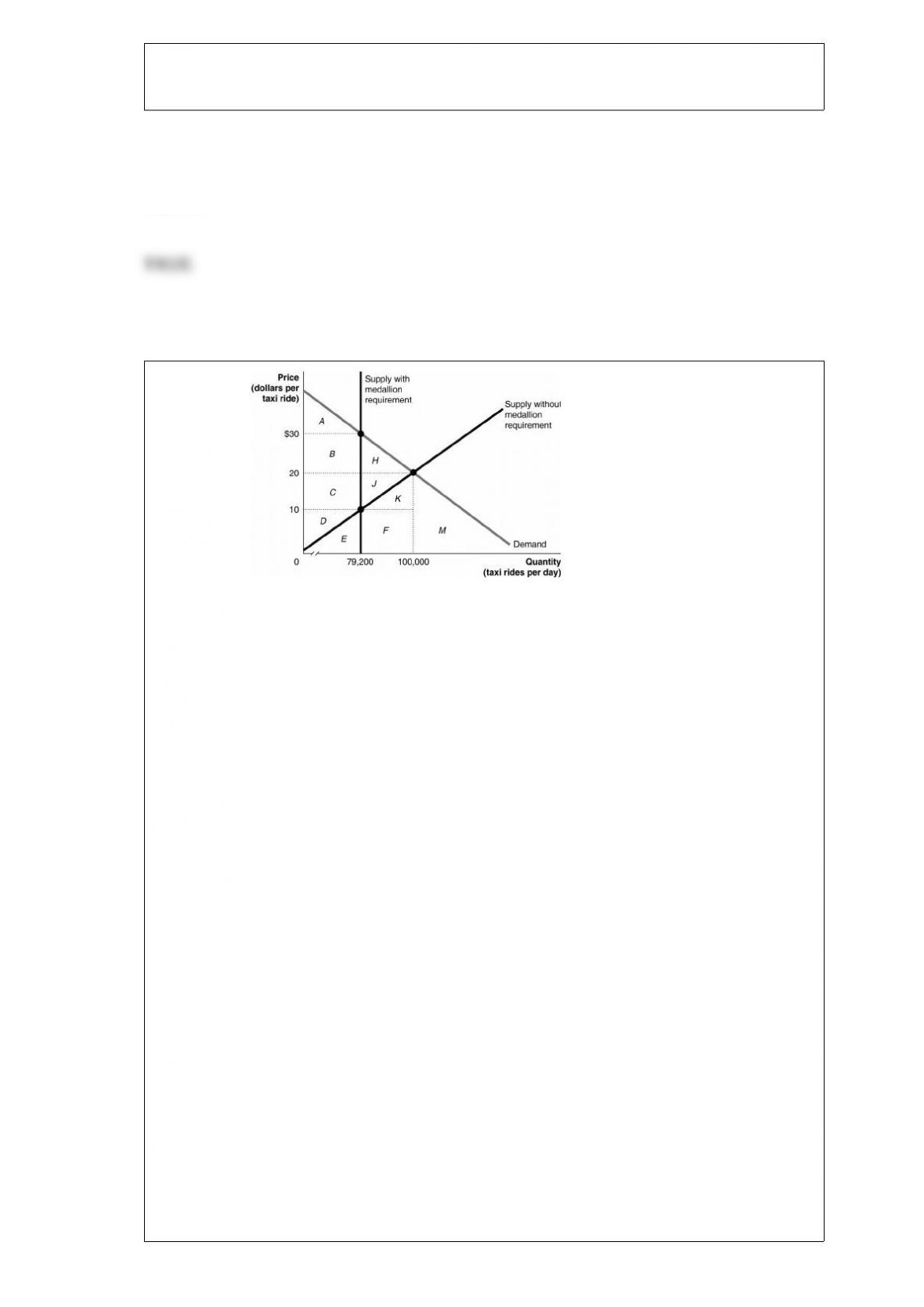
Figure 4-14 Figure 4-14 shows the market
for taxi rides. The following question(s) are based on this figure.
To legally drive a taxicab in New York City, you must have a medallion issued by the
city government. Assume that only 13,200 medallions have been issued. Let’s also
assume this puts an absolute limit on the number of taxi rides that can be supplied in
New York City on any day, because no one breaks the law by driving a taxi without a
medallion. Assume as well that each taxi provides 6 trips per day. In that case, the
quantity supplied of taxi rides is 79,200 (or 6 rides per taxi 13,200 taxis). This is shown
in the diagram with a vertical line at this quantity. Assume that there are no government
controls on the prices that drivers can charge for rides.
a. What would the equilibrium price and quantity be in this market if there were no
medallion requirement?
b. If there were no medallion requirement, indicate the area that represents consumer
surplus.
c. If there were no medallion requirement, indicate the area that represents producer
surplus.
d. If there were no medallion requirement, indicate the area that represents economic
surplus.
e. What are the price and quantity with the medallion requirement?
f. With a medallion requirement in place, what area represents consumer surplus?
g. With a medallion requirement in place, what area represents producer surplus?
h. With a medallion requirement in place, what area represents the deadweight loss?
i. Based on your answers to parts (c) and (g), are taxicab drivers better off with the
medallion requirement for taxicabs than without?
j. Are consumers better off with or without the medallion requirement for taxicabs?
Answer:
The person hired by a corporation’s board of directors to run the day-to-day operations
of the corporation is known as the
A) chairman of the board.
B) chief executive officer.

C) owner-manager.
D) corporate governor.
Answer:
If net taxes fall by $80 billion, we would expect
A) the government deficit to fall by $80 billion.
B) household saving to rise by $80 billion.
C) household saving to rise by less than $80 billion.
D) household saving to fall by more than $80 billion.
Answer:
National income is defined as
A) gross national product plus transfer payments.
B) gross national product less retained earnings plus transfer payments.
C) gross domestic product less retained earnings plus transfer payments.
D) gross domestic product less the consumption of fixed capital.
Answer:
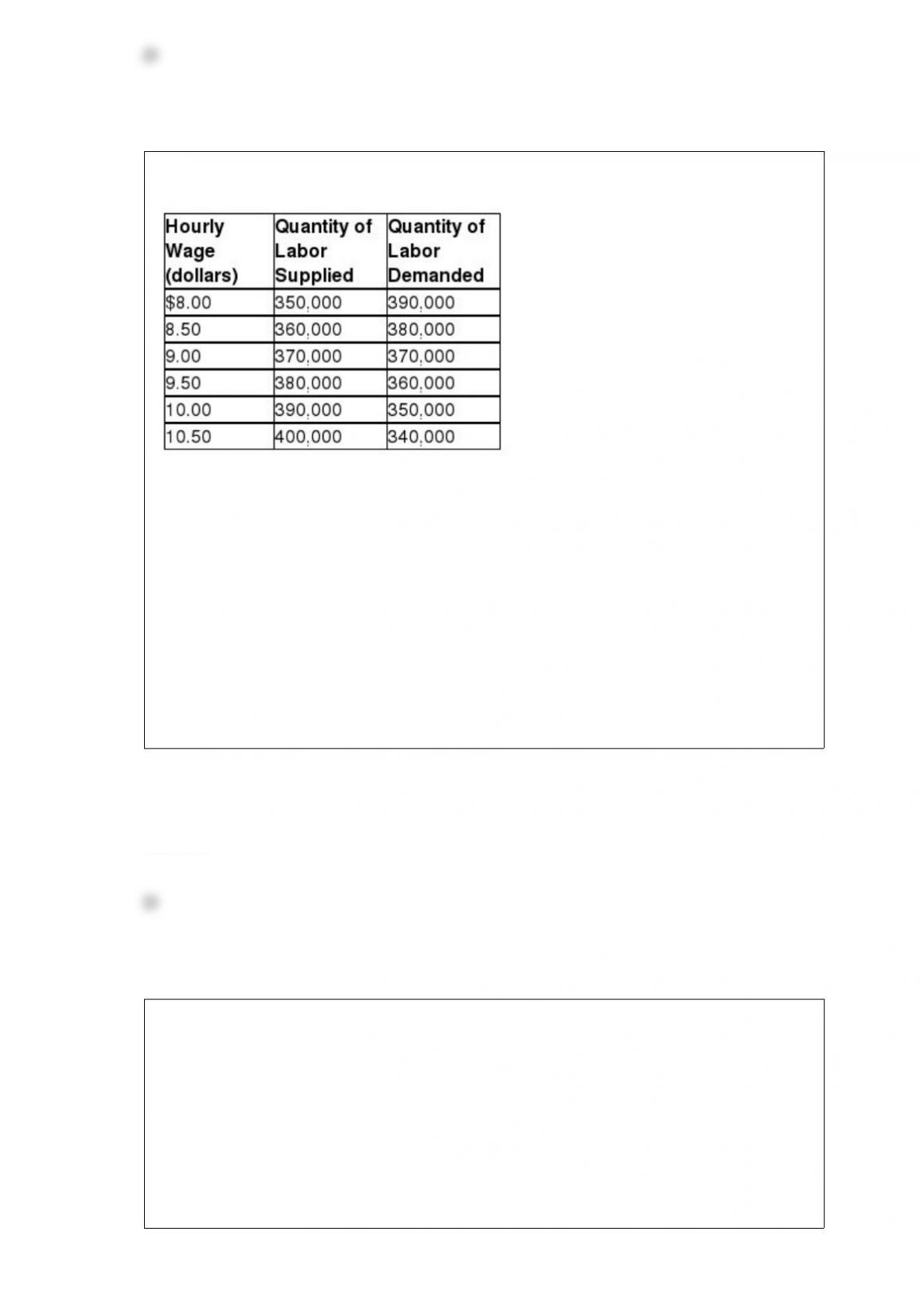
Table 4-4
Table 4-4 shows the demand and supply schedules for the low-skilled labor market in
the city of Westover.
If a minimum wage of $10.50 is mandated there will be a
A) shortage of 30,000 units of labor.
B) surplus of 30,000 units of labor.
C) shortage of 60,000 units of labor.
D) surplus of 60,000 units of labor.
Answer:
Most of the unemployment that occurred during the Great Depression was
A) frictional unemployment.
B) structural unemployment.
C) cyclical unemployment.
D) core unemployment.

Answer:
The cross-price elasticity of demand between an unlimited texting option and an
unlimited call minutes option offered from a cell phone provider would be
A) positive if subscribers consider the services substitutes for each other.
B) positive if subscribers consider the services complements to each other.
C) negative if subscribers consider the services substitutes for each other.
D) negative no matter if subscribers consider the services substitutes or complements
for each other.
Answer:
The monetary policy target the Federal Reserve focuses primarily on today is
A) the unemployment rate.
B) M1.
C) the inflation rate.
D) the interest rate.
E) M2.
Answer:

If firms sell exactly what they expected to sell, all of the following will be true except
A) aggregate expenditure will be greater than GDP.
B) there is no unplanned change in inventories.
C) inventories will not change, and GDP and employment will remain stable.
D) aggregate expenditure will be equal to GDP.
Answer:
When Americans decrease their demand for Japanese goods,
A) the demand for dollars will rise, and the demand for yen will rise.
B) the demand for dollars will fall, and the demand for yen will rise.
C) the supply of dollars will rise, and the demand for yen will rise.
D) the supply of dollars will fall, and the demand for yen will fall.
Answer:
If a bank receives a $1 million discount loan from the Federal Reserve, then the bank’s
reserves will
A) not change.
B) increase by $1 million.

C) increase by less than $1 million.
D) increase by more than $1 million.
Answer:
Indicate whether each of the following situations would shift the supply curve to the
left, to the right, or not at all. a. An increase in the price of an input
b. An increase in productivity
c. An increase in the price of a substitute in production
d. A decrease in the expected future price of a product
e. A decrease in the current price of the product
Answer:
If the United States has a net export deficit, which of the following must be true?
(Assume that the capital account is zero and net transfers are zero.)
A) The balance on the financial account must equal the balance on the current account.

B) Net foreign investment must be negative as well.
C) Domestic private saving must be less than net foreign investment.
D) Domestic public saving must be less than net foreign investment.
Answer:
Most economists believe that biases cause changes in the CPI to overstate the inflation
rate by ________ percentage points.
A) 0.1 to 0.2
B) 0.2 to 2.0
C) 0.4
D) 0.5 to 1.0
E) 1.0 to 3.0
Answer:
Why do economists refer to the pricing strategies of oligopoly firms as a prisoner’s
dilemma game?
Answer:
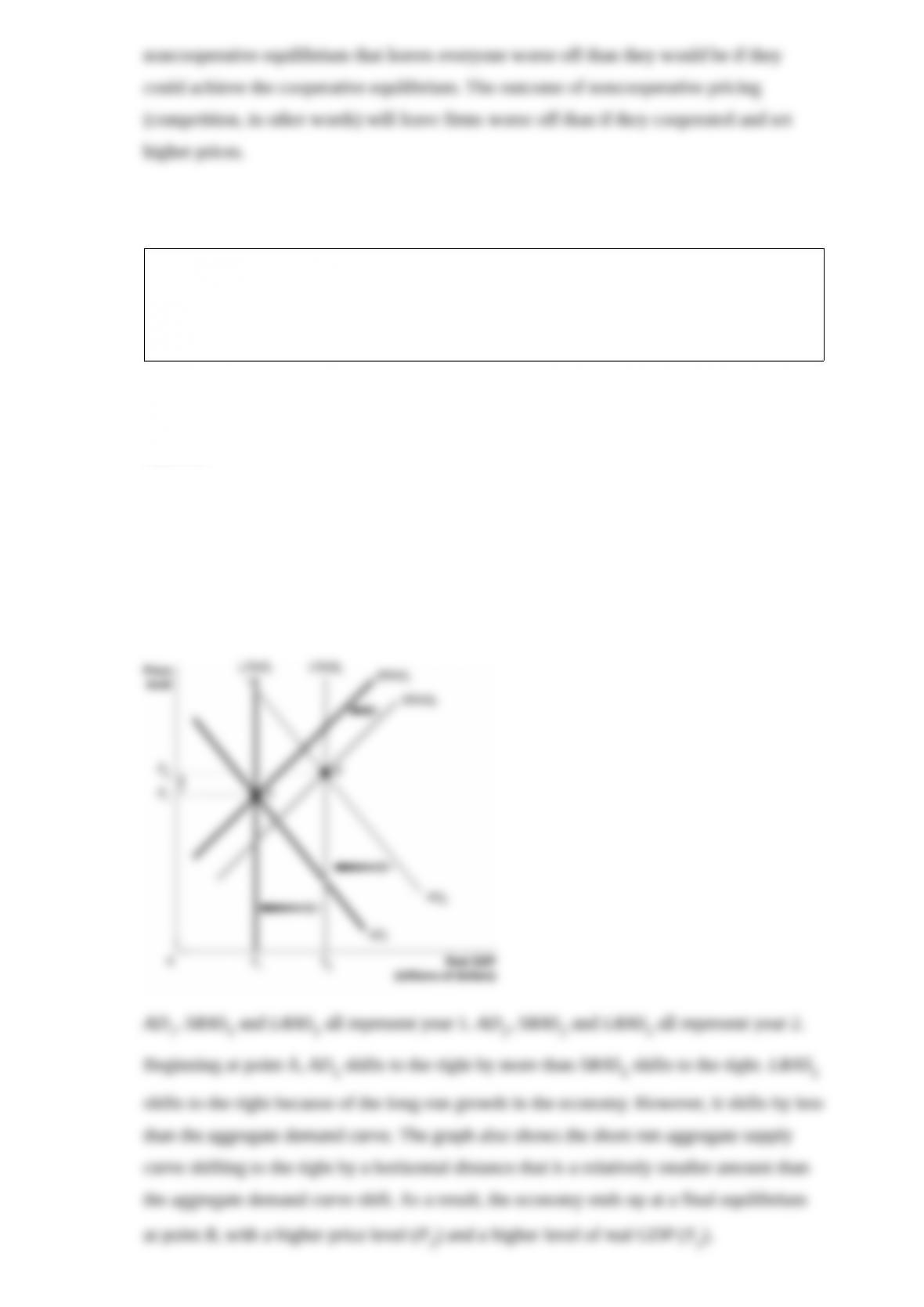
Use the dynamic model of aggregate demand and supply to illustrate a situation where
aggregate demand and short-run aggregate supply are both increasing from year 1 to
year 2, resulting in a higher price level and higher level of real GDP at macroeconomic
equilibrium in year 2.
Answer:
What does price elasticity of demand measure? When is demand elastic? Inelastic? Unit
elastic?
Answer:
Define the term “property rights.” Explain why the lack of well defined and enforceable
property rights is detrimental to the smooth functioning of a market system.
Answer:
If the GDP deflator is less than 100, which will be higher: nominal GDP or real GDP?
Why?
Answer: