
If a labor union can affect __________, it can affect its wage-employment tradeoff.
a. the availability of substitutes for the product it produces
b. availability of substitute factors
c. the fixed costs of the firm it works for
d. a and b
e. a, b, and c
Which of the following statements about a political campaign is false?
a. Candidates often label their opponents as either “too far right” or “too far left.”
b. Candidates often call themselves “middle-of-the-roaders” rather than “right-wingers”
or “left-wingers.”
c. Candidates often tend to talk about ends rather than means.
d. Candidates often tend to talk in specific terms rather than general terms about what
needs to be done.
Which of the following statements is true?
a. In a world of efficiently used scarce resources, more of one good necessarily means
less of some other good.
b. The law of increasing opportunity costs assumes that all people have the same ability

to produce goods.
c. Efficiency implies that it is impossible to get more of one good without getting less
of another.
d. Even if a country has unemployed resources, it can still be operating on its
production possibilities frontier (PPF).
e. a and c
In the prisoner’s dilemma, each prisoner would be better off if neither one confesses.
a. True
b. False
Making a decision at the margin is __________ an all-or-nothing decision.
a. consistent with
b. inconsistent with
c. the same as making
d. conditioned upon making

In most societies, dollar price acts as the main rationing device. If dollar price weren’t
the main rationing device, would there still be a need for some rationing device to take
its place?
a. No, because with dollar price there would be no scarcity, although shortages would
still exist.
b. Yes, because there is a need for a rationing device as long as scarcity exists.
c. Yes, because there is a need for a rationing device as long as the world’s population is
so large.
d. No, because dollar price creates scarcity and without money price scarcity wouldn’t
exist.
e. none of the above
In which of the following situations would a positive externality most likely be
involved?
a. Shawn is sitting at home one day when she gets a telephone call, informing her that
she has won $10,000 in a contest she entered three months ago.
b. There are eight houses in the neighborhood where Rodney lives. Rodney likes
nice-looking yards, and last week his neighbors began to beautify their yards.
c. Willy needs eight hours of sleep each night to feel good. Last night he got eight hours
of sleep.
d. Patrick received an A on a biology exam. He is feeling better about his chances of
getting admitted to medical school.

A profit-maximizing monopsonist will pay a wage rate that is less than the marginal
factor cost.
a. True
b. False
Government provides a nonexcludable public good that the public demands and can’t
seem to acquire through the market.This is government
a. acting as a transfer mechanism.
b. being non-productive.
c. engaging in rent-seeking activities.
d. being productive.
e. a and c
Special interest group X receives a 1/150th slice of the economic pie.Its net benefits
from an economic growth policy are $7,000, which are the same as its net benefits from

a transfer policy.What is the change in the size of the economic pie (Real GDP) that is
required to bring about this result?
a. $1,050,000
b. $46.67
c. $150,000
d. $2,500,000
e. none of the above
Which of the following is not a condition of a contestable market?
a. There is easy entry into the market.
b. There is costless exit from the market.
c. New firms entering the market can produce the product at lower cost than current
firms.
d. Firms exiting the market can easily dispose of their fixed assets by selling them
elsewhere.
e. None of the above; that is, all of the above are conditions of a contestable market.
Many people buy one newspaper per day, but rarely do they buy two of the same
newspapers on the same day.What is the economic justification for this behavior?
a. The marginal benefit of purchasing the second newspaper exceeds the marginal cost
of purchasing that paper.
b. The marginal cost of purchasing the second newspaper exceeds the marginal benefit
of purchasing that paper.
c. The marginal benefit of purchasing the second newspaper equals the marginal cost of
purchasing that paper.
d. none of the above is an appropriate economic justification for this behavior.
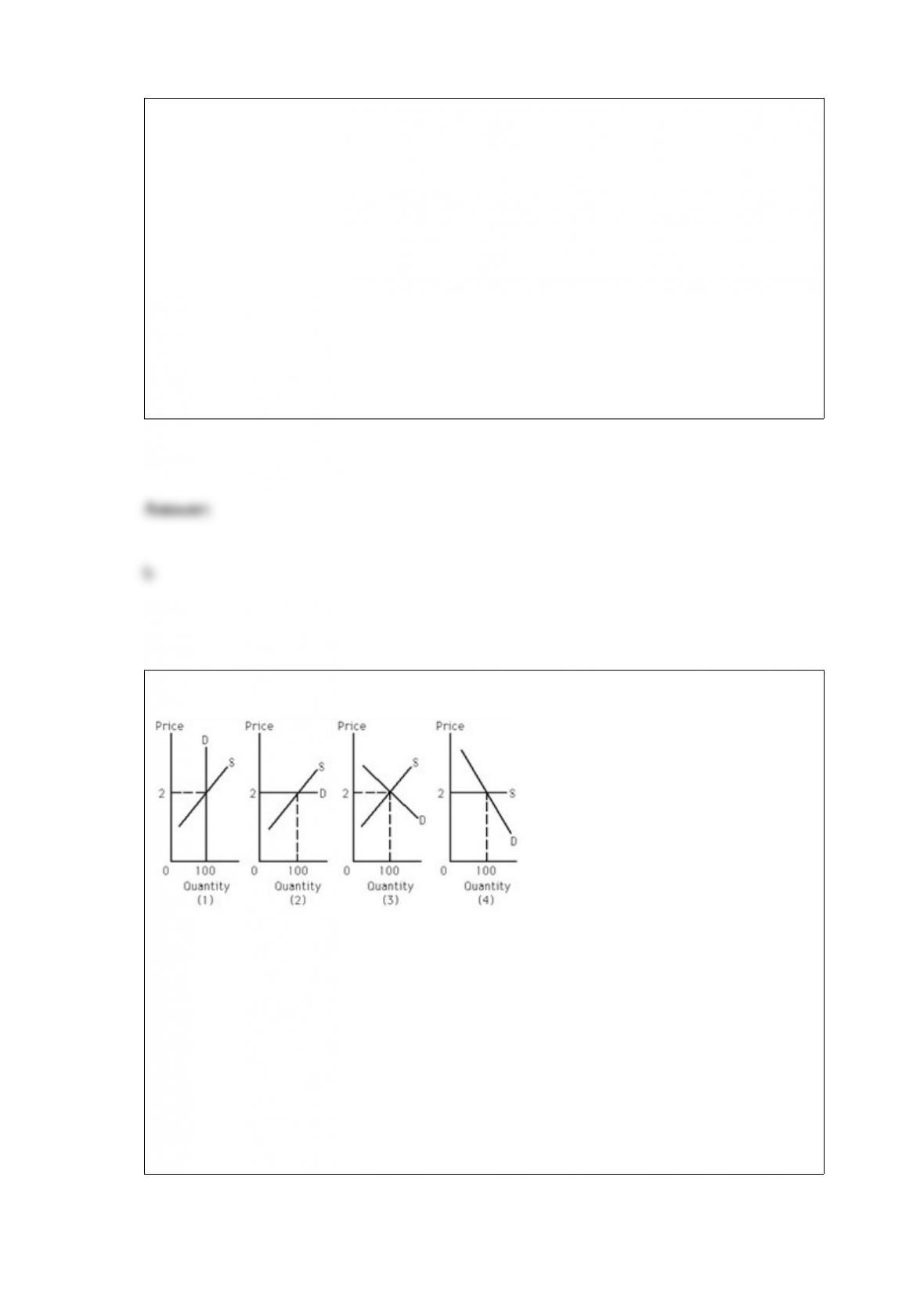
Exhibit 20-7
If the government wants to impose a per-unit tax in order to raise revenues, which of
the depicted markets should it choose in order to maximize tax revenues?
a. (1)
b. (2)
c. (3)
d. (4)