
Table 2-5
Table 2-5 shows the number of labor hours required to produce a cell phone and a board
foot of lumber in Estonia and Finland.
Refer to Table 2-5. What is Finland’s opportunity cost of producing one board foot of
lumber?
A) 0.25 cell phones
B) 4 cell phones
C) 12 cell phones
D) 16 cell phones
Suppose that in 2014, all prices in the economy double and that all wages and salaries
also double. In 2014 you
A) are worse off than you were in 2013 as you can no longer afford to buy as many
goods and services.
B) are better off than you were in 2013 as your salary is higher than it was in 2013 and
you can now buy more goods and services.
C) are no better off or worse off than you were in 2013 as the purchasing power of your
salary has remained the same.
D) cannot determine whether you are better off or worse off than you were in 2013,
because the purchasing power of your salary cannot be determined.

Which of the following contributed to the downfall of the Soviet Union in 1991?
A) public dissatisfaction with low living standards and political repression
B) producing higher-quality goods than were desired by consumers
C) the rapidly increasing standard of living
D) the lack of a strong dictator who can coordinate economic activities
In the principal-agent relationship, the principal is
A) the owner of a resource that has hired a third party to act in the best interest of that
third party.
B) the person who is placed in control over resources that are not his own, with a
contractual obligation to use these resources in the interests of some other party.
C) the person who is placed in control over resources that are not his own and agrees to
compensate the resource owner in the event of outcomes that do not satisfy the resource
owner.
D) the person who places his resources in professional hands in exchange for the
professional’s promise to act on the resource owner’s behalf.
Your roommate, Serafina, a psychology major, said, “The problem with economics is
that it assumes that consumers and firms always make the correct decision. But we
know that everyone’s human, and we all make mistakes.” Do you agree with her
comment?
A) Yes, I agree with her. One cannot make predictions about economic behavior
because in reality people make incorrect choices in many situations.
B) I disagree with her. Economics does not study correct or incorrect behaviors but
rather it assumes that economic agents behave rationally, meaning they make the best
decisions given their knowledge of the costs and benefits.
C) Yes, I agree with her. Economic theory should allow for irrational behavior so that
we can have more reliable predictions.
D) I disagree with her. If we cannot assume that decisions are correct, then we will not
be able to examine the moral implications of these decisions.
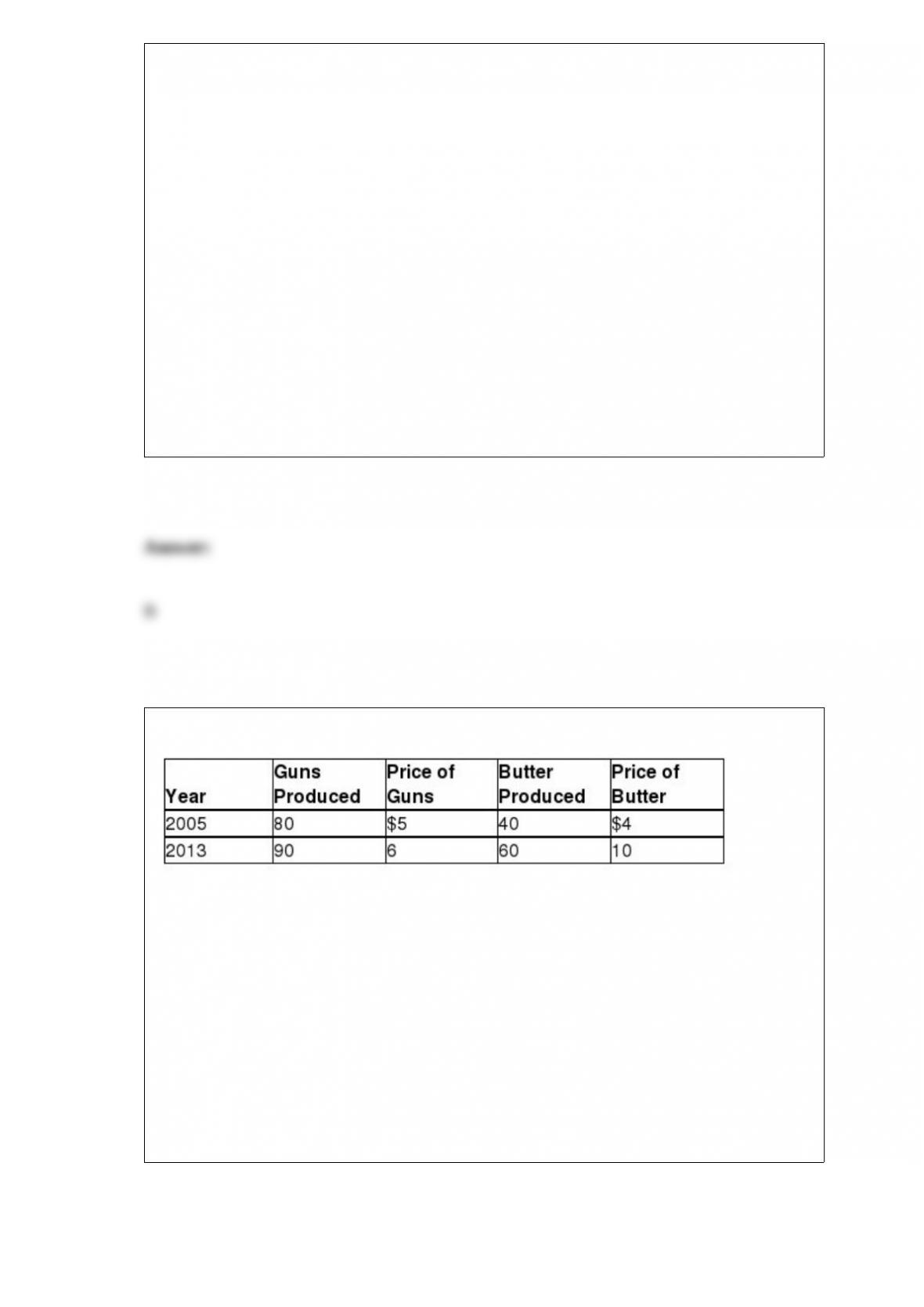
Table 8-11
Consider the following data for Tyrovia, a country that produces only two products:
guns and butter.
Refer to Table 8-11. Nominal GDP for Tyrovia in 2013 equals
A) $1,140.
B) $880.
C) $690.
D) $560.
Which of the following is a positive economic statement?
A) The inflation rate in the United States is too high.
B) Unemployment insurance payments increase when the unemployment rate rises.
C) The government should defund Obamacare.
D) States should be able to enact their own marijuana legalization laws.
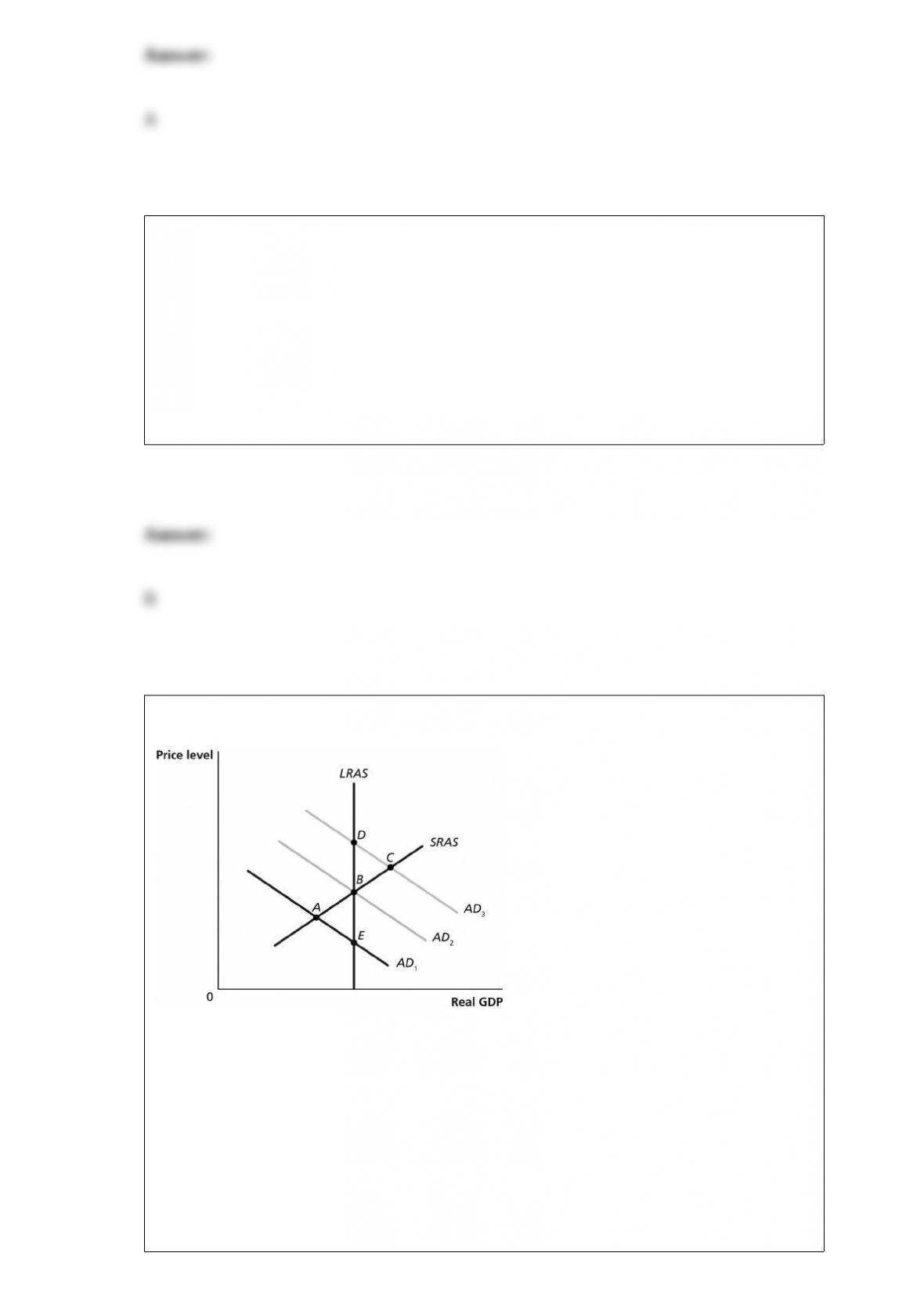
Figure 15-7
Refer to Figure 15-7. Suppose the economy is in short-run equilibrium above potential
GDP, the unemployment rate is very low, and wages and prices are rising. Using the
static AD–AS model in the figure above, the correct Fed policy for this situation would
be depicted as a movement from
A) A to B.
B) B to C.
C) C to B.

D) A to E.
E) C to D.
A decrease in the demand for eggs due to changes in consumer tastes, accompanied by
a decrease in the supply of eggs as a result of an outbreak of Avian flu, will result in
A) a decrease in the equilibrium quantity of eggs and no change in the equilibrium
price.
B) a decrease in the equilibrium price of eggs and no change in the equilibrium
quantity.
C) a decrease in the equilibrium price of eggs; the equilibrium quantity may increase or
decrease.
D) a decrease in the equilibrium quantity of eggs; the equilibrium price may increase or
decrease.
Select the phrase that correctly completes the following statement. “A decrease in the
number of manufacturers caused a decrease in the supply of sailboats. As a result,
A) the price of sailboats increased and the demand for sailboats decreased.”
B) the equilibrium quantity of sailboats increased.”
C) the price of sailboats increased and the quantity demanded of sailboats decreased.”
D) the price of sailboats increased. The higher price caused the supply of sailboats to

increase.”