
Based on the theory of purchasing power parity, in the long run, currencies of countries
with significant inflation will tend to:
A. be flexible.
B. have nominal exchange rates.
C. depreciate.
D. appreciate.
When real output increases, planned aggregate expenditures increase because:
A. autonomous expenditures increase.
B. autonomous expenditures decrease.
C. induced expenditures increase.
D. induced expenditures decrease.
In Macroland, autonomous consumption equals 100, the marginal propensity to
consume equals 0.75, net taxes are fixed at 40, planned investment is fixed at 50,
government purchases are fixed at 150, and net exports are fixed at 20. Autonomous
expenditure equals:
A. 320.

B. 320 + 0.25Y.
C. 290.
D. 290 + 0.75Y.
The time between when Congress decides to cut taxes to stimulate aggregate demand
and when the tax cuts are implemented is an example of:
A. the outside lag of macroeconomic policy.
B. the inside lag of macroeconomic policy.
C. the outside lag of fiscal policy.
D. the inside lag of monetary policy.
Refer to the table below. The average benefit of 2 units of activity is:
A. $80
B. $60

C. $40
D. $20
A reduction in the marginal tax rate can cause potential output to increase by:
A. encouraging early entry into the labor market by reducing the incentive to earn
advanced degrees.
B. increasing after-tax wage rates and thus allowing workers to work fewer hours.
C. increasing the incentive to invest more in education and earn advanced degrees.
D. increasing government revenues and thus government expenditure.
A strategy that limits defection in a repeated prisoner’s dilemma game is:
A. a Nash equilibrium.
B. a tit-for-tat strategy.
C. a cartel.
D. an ultimatum bargaining game.
Suppose a 10% increase in the price of aspirin leads to a 5% decrease in the quantity
demanded of aspirin. The demand for aspirin, therefore, is
A. elastic.
B. inelastic.
C. unit elastic.
D. perfectly inelastic.
An example of a government policy to provide a framework within which the private
sector can operate productively is:
A. the taxation of savings.
B. the suppression of political dissent.
C. establishing well-defined property rights.
D. government ownership of capital.

Suppose the value of the CPI is 1.100 in year one, 1.210 in year two, and 1.331 in year
three. Assume also that the price of computers increases by 3% between year one and
year two, and by another 3% between year two and year three. The price level is
increasing, the inflation rate is _______, and the relative price of computers is
_________.
A. increasing; increasing
B. constant; increasing
C. constant; decreasing
D. increasing; decreasing
Suppose a jar of orange marmalade that is ultimately sold to a customer at The Corner
Store is produced by the following production process:
If the oranges were grown and the jam produced in the year 2015, but the marmalade
was sold at The Corner Store in the year 2016, what is the contribution of these
transactions to GDP in the year 2016?
A. $0.00
B. $0.50
C. $2.00

D. $2.50
Leo is a welfare recipient who qualifies for two means-tested cash benefit programs. If
he does not earn any income, he receives $225 from each program. For each dollar he
earns (which his employer is required to report to the welfare agency), his benefit from
each program is reduced by 75 cents until the benefit equals zero.If Leo only values
income and not how the income was acquired, then he must earn ______ to be as well
off as when he earns nothing and receives benefits.
A. $225
B. $300
C. $450
D. $350
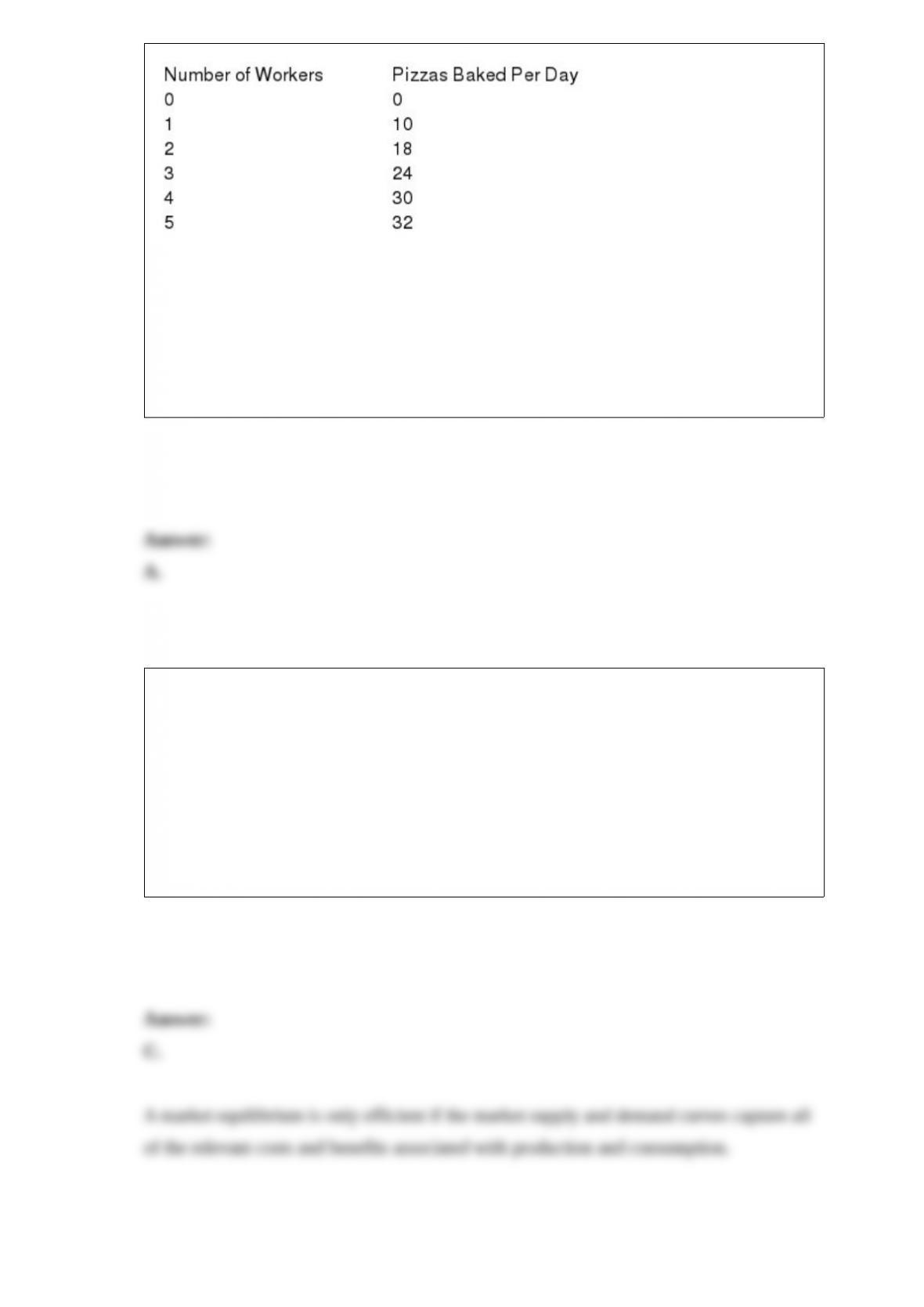
Production data for Joe’s Pizza Parlor are as follows. For simplicity assume that labor is
the only input. Each pizza sells for $5.
A. 1
B. 2
C. 3
D. 4
A market equilibrium is only efficient if:
A. the consumer surplus and the producer surplus associated with a given transaction
are equal.
B. consumer surplus and producer surplus are both zero.
C. all relevant costs and benefits are reflected in the market supply and demand curves.
D. output is distributed equitably among consumers.
One assumption of the perfectly competitive model is free entry and exit. This
assumption most directly leads to the implication that:
A. firms will have to spend money on advertising.
B. positive economic profit is only possible in the short run.
C. firms will compete on the basis of better service rather than lower prices.
D. a long-run equilibrium cannot be achieved.
Economists refer to the talents, training, and education of workers as:
A. human capital.
B. physical capital.
C. average labor productivity.
D. labor supply.

Consider the labor market below. Suppose the government passes a minimum wage
requiring employers to pay at least $8.00 per hour.
Employment will fall by ______ person-hours per day as a result of the minimum wage.
A. 2,000
B. 4,000
C. 6,000
D. 8,000
Over time, the core rate of inflation should be ______ than the general rate of inflation.
A. more stable
B. less stable
C. higher
D. less meaningful
Suppose one observes that when the price of peanut butter increases, the demand for
jelly increases. One must conclude that:
A. peanut butter and jelly are complements.
B. peanut butter and jelly are substitutes.
C. peanut butter and jelly are normal goods.
D. peanut butter and jelly are inferior goods.
The slope of a production possibilities curve is ______ because ______.
A. negative; producing more of one good requires producing less of the other
B. negative; producing less of one good requires producing less of the other
C. positive; producing more of one good requires producing more of the other
D. positive; producing more of one good requires producing less of the other
Suppose a jar of DeLux popcorn that is ultimately sold to a customer at Friendly
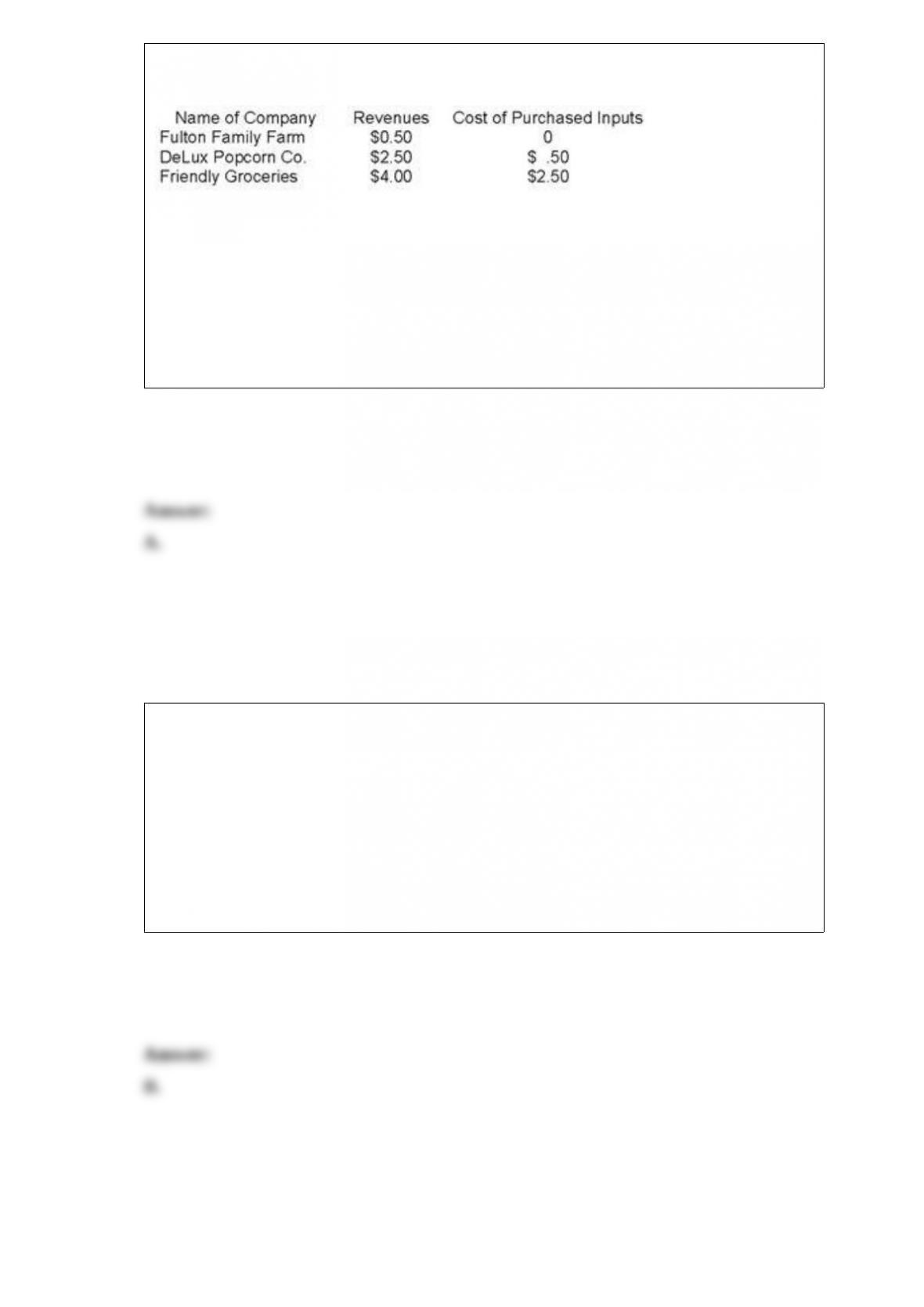
Groceries is produced by the following production process:
What is the value added of Friendly Groceries?
A. $1.50
B. $2.50
C. $3.50
D. $4.00
According to the textbook, expensive advertising campaigns are:
A. not a credible signal of quality because of adverse selection.
B. a credible signal of product quality.
C. only a credible signal of product quality if they mention a money-back guarantee.
D. a waste of resources because they provide no useful information about product
quality.

Okun’s law expresses the relationship between:
A. unemployment and inflation.
B. frictional unemployment and structural unemployment.
C. the money supply and the velocity of money.
D. cyclical unemployment and the output gap.
The basic Keynesian model is built on the key assumption that:
A. menu costs are not significant.
B. firms meet the demand for their products at preset prices.
C. firms price their products so as to see a preset quantity of output.
D. prices are prevented from changing frequently by government regulations.
Which of the following is an asset of a family?
A. Student loan
B. Mortgage
C. Unpaid credit card balance
D. Checking account balance
If a one percent increase in the price of oranges leads to a five percent increase in the
quantity supplied, the price elasticity of supply for oranges is ______.
A. 1/5
B. 1/2
C. 5
D. 2
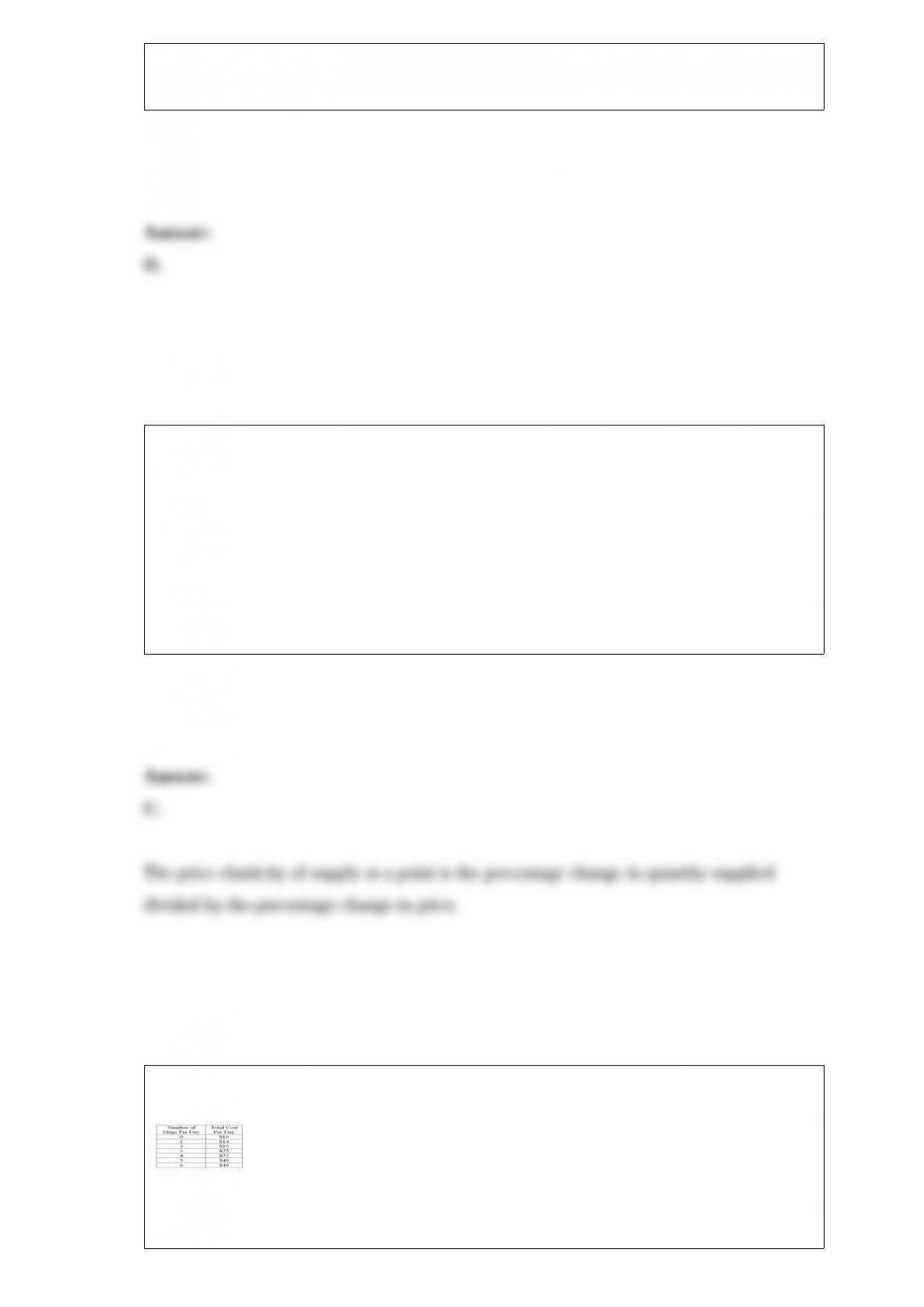
Suppose Chris is a potter who makes mugs. His total costs depend on the number of
mugs he makes each day, as shown in the table below.
If the market for mugs is perfectly competitive, and mugs sell for $7.50 each, then at his
profit-maximizing level of output, Chris will earn a ______ of ______ per day.

A. loss; $2
B. loss; $10
C. profit; $2
D. profit; $30
Net exports plus net capital inflows equal:
A. net capital outflows.
B. the international trade gap.
C. zero.
D. the trade balance.
A village has five residents, each of whom has an accumulated savings of $50. Each
villager can use the money to buy a government bond that pays 10% interest per year or
to buy a year-old goat, send it onto the commons to graze, and sell it after one year. The
price of the goat that the villager will get at the end of the year depends on the amount
of weight it gains while grazing on the commons, which in turn depends on the number
of goats sent onto the commons, as shown in table below. Assume that if a villager is
indifferent between buying a bond and buying a goat, the villager will buy a goat.

If each villager is purely self-interested, how many goats will be sent onto the
commons?
A. 2
B. 3
C. 4
D. 5
A recession occurs when ______, when _______, or when both of these occur.
A. potential output grows slowly; actual output falls below potential output
B. potential output grows slowly; actual output rises above potential output
C. potential output grows rapidly; actual output equals potential output
D. potential output grows rapidly; actual output falls below potential output
Earth Movers & Shakers operates 3 iron ore mines. The table below shows each mine’s
total daily production and the current number of miners at each mine. All miners work
for the same wage, and each miner in any given mine produces the same number of tons
per day as every other miner in that mine.

The opportunity cost of moving one miner from Mother Lode to another mine is:
A. 2 tons per day.
B. 3 tons per day.
C. 4 tons per day.
D. 1 ton per day.
If the quantity supplied of money exceeds the quantity demanded of money, people will
______ bonds which will cause bond prices to ______ and the nominal interest rate to
______ until the quantity demanded and quantity supplied of money are equal.
A. buy; rise; fall
B. sell; fall; fall
C. sell; rise; fall
D. buy; fall; rise

The current U.S. income tax system requires taxpayers to pay a higher marginal tax rate
on higher levels of taxable income. Suppose that the tax rate is 10% on the first $15,000
of taxable income, 15% on the next $45,000 of taxable income, 30% on the next
$60,000 of taxable income, and 35% on taxable income above $120,000.
Suppose the tax code also includes provisions that allow taxpayers to reduce the income
on which they are taxed, and that those provisions most often apply to the richest
taxpayers. These provisions tend to make the tax code:
A. more progressive.
B. more efficient.
C. less progressive.
D. less regressive.
The current U.S. income tax system requires taxpayers to pay a higher marginal tax rate
on higher levels of taxable income. Suppose that the tax rate is 10% on the first $15,000
of taxable income, 15% on the next $45,000 of taxable income, 30% on the next
$60,000 of taxable income, and 35% on taxable income above $120,000.
This income tax system is:
A. progressive.
B. regressive.
C. proportional.
D. progressive when income is low, then regressive.

Suppose Scott’s demand for a public good is P = 7 – .3Q and Mike’s demand is P = 10 –
1.5Q. The equation for the total demand for the public good is:
A. P = 20 – 3.0Q.
B. P = 17 – 1.8Q.
C. P = 3 – 1.2Q.
D. P = 14 – .6Q.