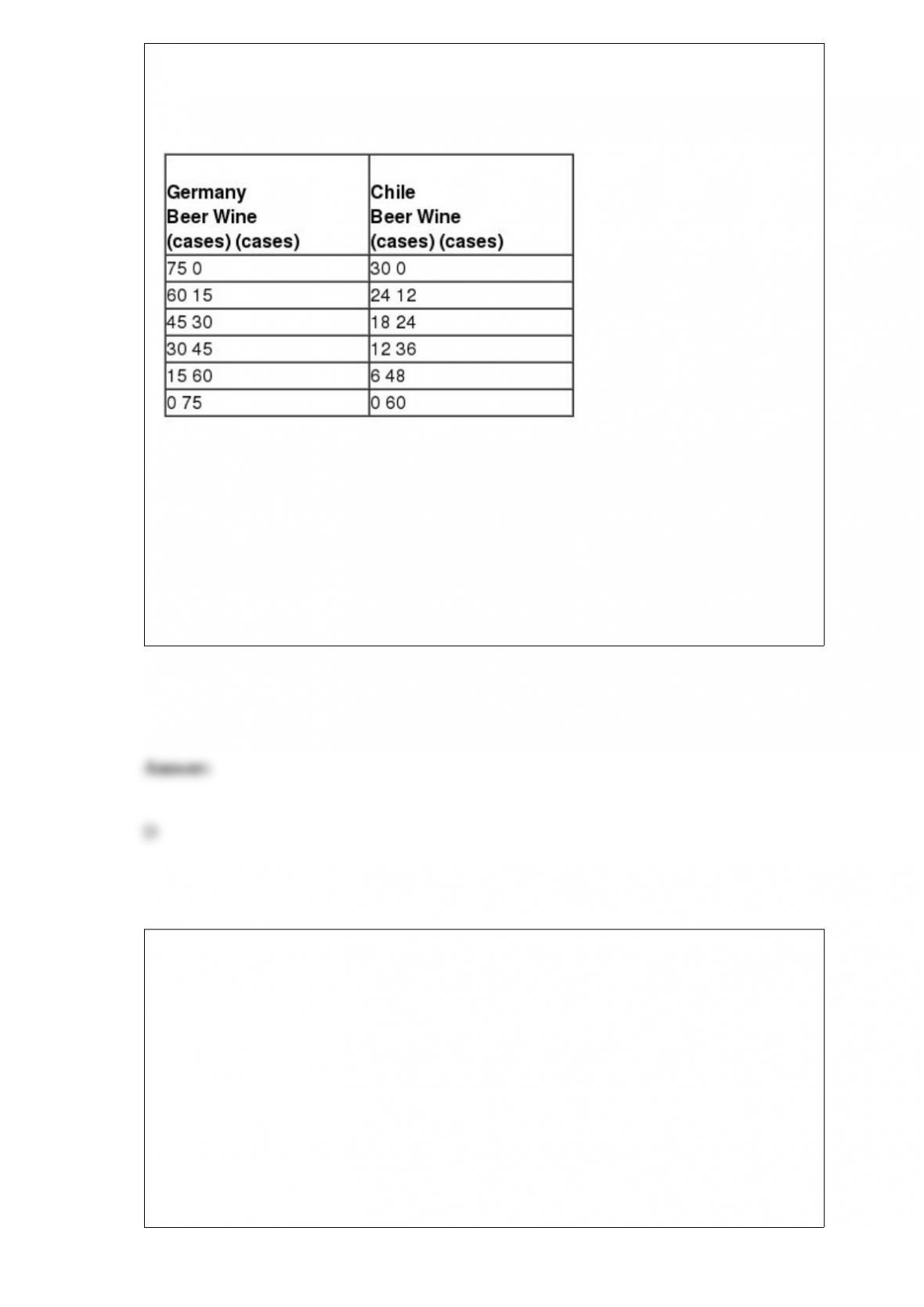
Table 20.1
Refer to Table 20.1. Germany has
A) a comparative advantage in beer production.
B) an absolute advantage in wine production.
C) an absolute advantage in beer production.
D) all of the above
An economy that is producing on the production possibility frontier at some point other
than the output of efficient allocation is
A) efficient, as it is on the production possibility frontier.
B) inefficient, as the combination of goods and services produced is not what people
want.
C) efficient, as the economy is producing goods at the lowest possible cost.
D) inefficient, as that combination of goods could be produced at a lower cost if more
efficient technology were employed.

There are 1,000 families in a neighborhood that is affected by noise pollution from a
local factory. The noise level is within legal limits, but could be reduced further if the
company spent $5,000 on technological improvements. The company agrees to make
these improvements if the affected families contribute the $5,000. A committee starts to
collect donations to pay for the improvements. Which of the following is most likely to
occur?
A) Because there are relatively few families involved and the individual contribution is
so small, all families will voluntarily contribute.
B) Because each individual contribution is so small and individuals will benefit from
the reduction in noise whether they contribute or not, most people will not contribute
and the firm will not make the improvements.
C) Even if the families raise the $5,000, the firm will not reduce its noise pollution
because it is within legal limits.
D) The courts will force the firm to spend the $5,000 regardless of whether or not the
families contribute the money.
Monopolistically competitive firms in longrun equilibrium produce at ________ the
optimal scale.
A) more than
B) exactly
C) less than

D) sometimes more and sometimes less than
If diminishing marginal returns have already set in for The Picture Perfect Framing
Store and the marginal product of the fifth picture framer is 25, then the marginal
product of the sixth picture framer must be
A) negative.
B) zero.
C) less than 25.
D) greater than 25.
A lender faces a(n) ________ problem when the lender lends funds to a borrower for a
specific purpose and the borrower then opportunistically uses the funds for another
purpose.
A) adverse selection
B) moral hazard
C) external cost
D) freerider
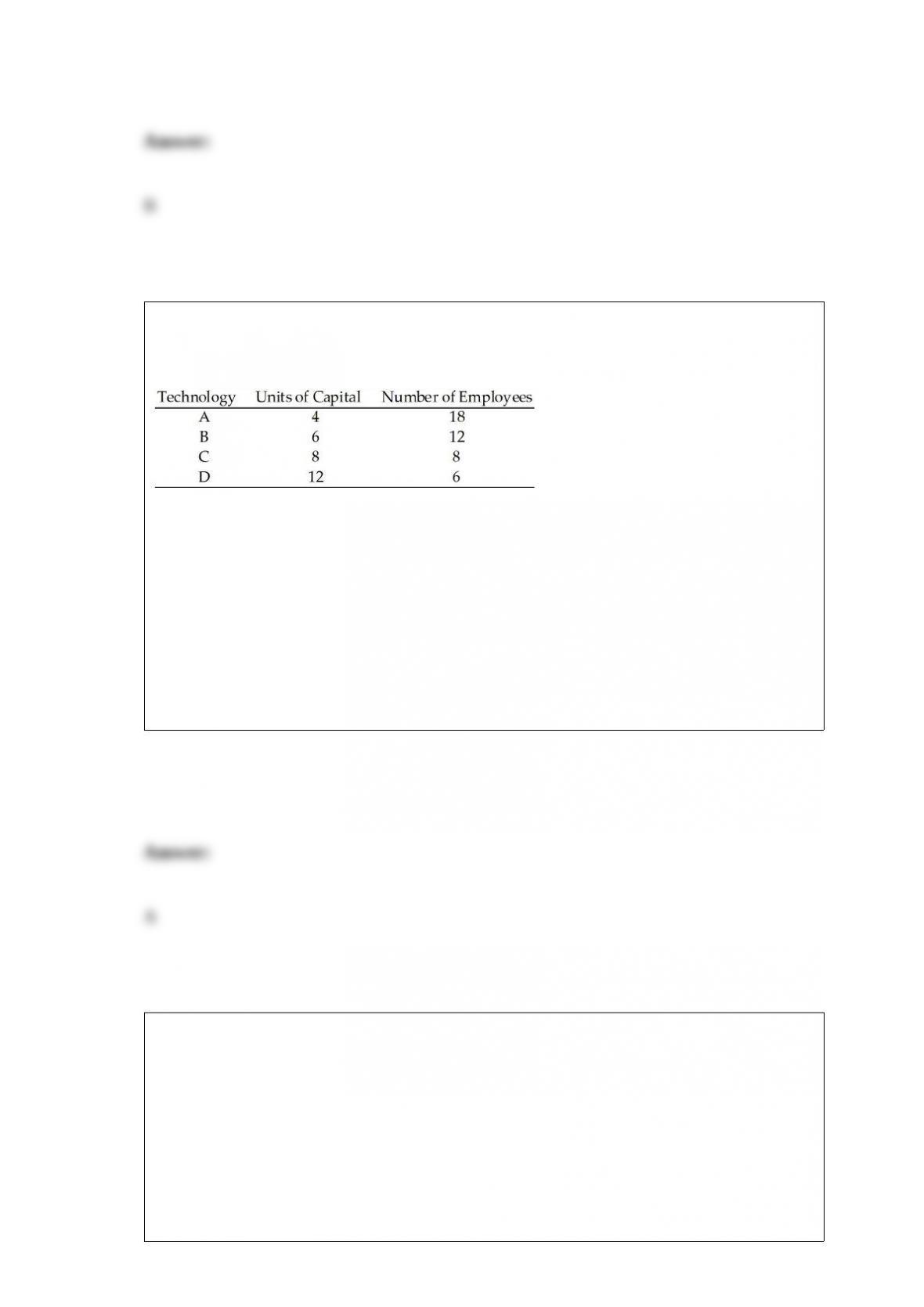
Table 7.1
Inputs Required to Produce a Product Using Alternative Technologies
Refer to Table 7.1 above. Which technology is the most labor intensive?
A) A
B) B
C) C
D) D
Easy entry of new firms is NOT a characteristic for ________ industries.
A) perfectly competitive and monopolistically competitive
B) monopolistically competitive and oligopolistic
C) oligopolistic and monopolistic
D) monopolistic and perfectly competitive

Related to the Economics in Practice on page 338: Crying babies on airplane impose a
negative externality on those sitting around them. Which of the following policies
would NOT help to reduce the externality?
A) Provide discount tickets for babies and young children.
B) Segregate families with young children in the back of the plane and provide
discounted tickets to those passengers willing to sit in the rows just in front of them.
C) Impose a minimum flying age of 5 years old.
D) Charge a higher ticket fee for babies and young children (under 5 years of age) than
for all other passengers.
According to the output effect of a factor price change, if supply of labor decreases,
then once the firm fully adjusts to the labor supply change, it
A) increases output and thus demand for all inputs increases.
B) decreases output and thus demand for all inputs decreases.
C) decreases demand for labor alone and there is no change in its output level.
D) decreases output and decreases demand for labor.

If the supply of oranges is unit elastic, the price elasticity of supply of oranges is
A) 0.
B) 0.
C) -1.0.
D) -100.0.
Daisy is consuming X and Y so that she is spending her entire income and MUx/Px =
12 and MUy/Py = 10. To maximize utility, she should
A) continue to consume the same amount of X and Y since she is already maximizing
utility.
B) consume less of both X and Y.
C) consume more X and less Y.
D) consume less X and more Y.
________ is financed through a payroll tax.
A) The Food Stamp program
B) The Supplemental Security Income program
C) The Earned Income tax Credit program
D) The Social Security system
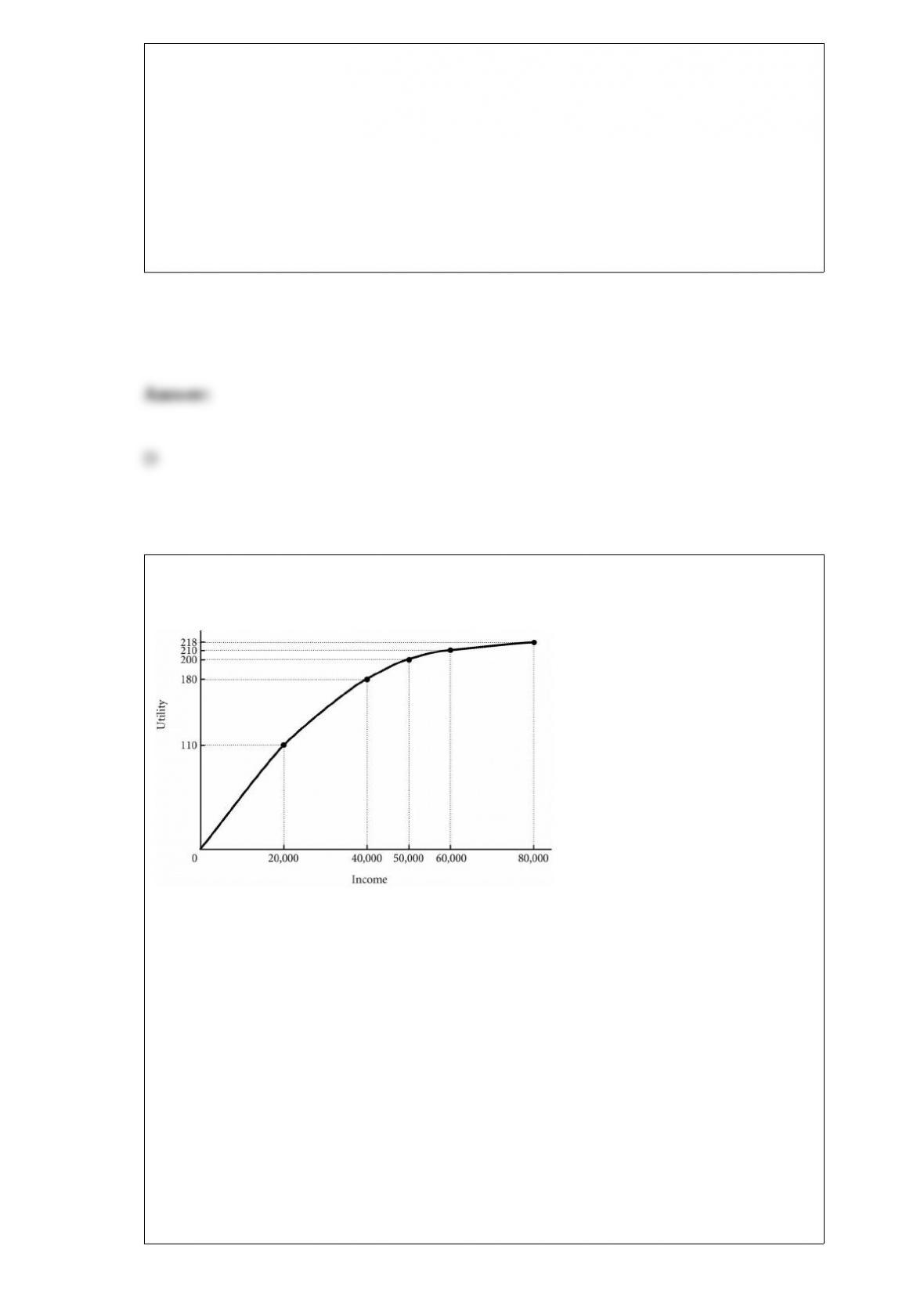
Figure 17.1
Refer to Figure 17.1. Dmitri has two job offers when he graduates from college. Dmitri
views the offers as identical, except for the salary terms. The first offer is at a fixed
annual salary of $40,000. The second offer is at a fixed salary of $20,000 plus a
possible bonus of $40,000. Dmitri believes that he has a 50-50 chance of earning the
bonus. If Dmitri takes the offer that maximizes his expected utility and is he is risk
averse, then
A) he will take the first offer.
B) he will take the second offer.
C) he is indifferent between the offersboth yield the same expected utility.
D) Indeterminate from the given informationwe cannot say what he will do.
The figure below shows the market for cotton fabric:
(a.) If the price in the market is $8.00, would the market be at equilibrium? If not, is
there a shortage or a surplus? How large is the shortage or surplus?
(b.) If the price in the market is $5.00, would the market be at equilibrium? If not, is
there a shortage or a surplus? How large is the shortage or surplus?
(c.) If the price in the market is $2.00, would the market be at equilibrium? If not, is
there a shortage or a surplus? How large is the shortage or surplus?
If the government used the revenue from the excise tax on cigarettes to fund research on
lung cancer treatment programs, this would be an example of
A) an ability-to-pay tax.

B) a benefits-received tax.
C) a vertical equity tax.
D) a user fee.
Which of the following contains most of the characteristics of a public good?
A) vaccinations
B) metal recycling
C) a public park
D) a civil defense system
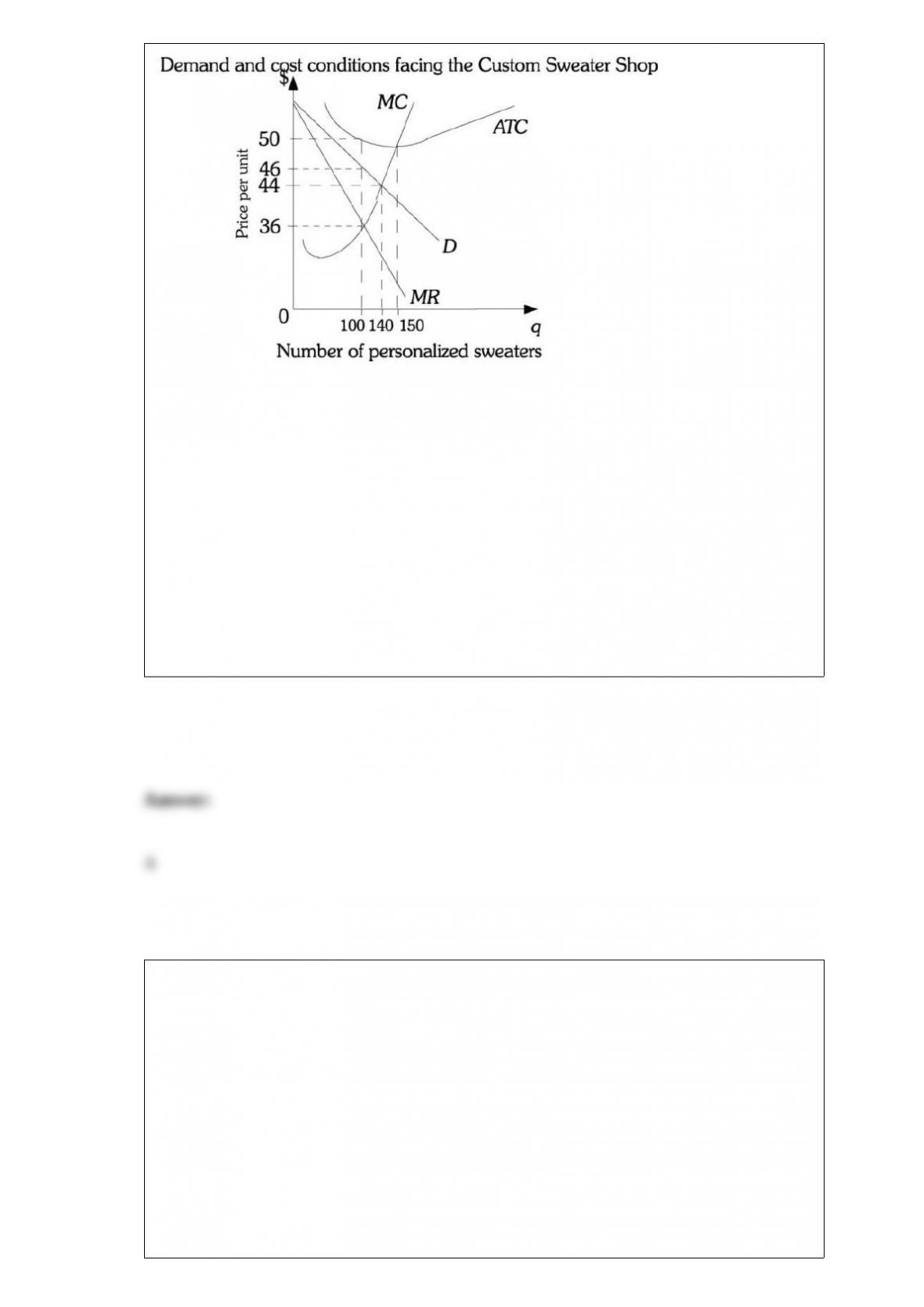
Figure 15.5
Refer to Figure 15.5. If the Custom Sweater Shop is monopolistically competitive, what
is the maximum level of average variable cost that would lead to the firm continuing to
operate at the profit-maximizing level in the short run?
A) $400
B) $4600
C) $5000
D) The firm would continue to operate regardless of the level of variable costs.
Adam Smiths’s four principles of taxation taken from the Wealth of Nations
“The rich should contribute to the public expense not only in proportion to their
revenue,” Smith believed, “but something more than in that proportion.”
“the tax which each individual is bound to pay ought to be certain and not arbitrary” and
“clear and plain”–that is, transparent to everyone.
“ought to be levied at the time, or in the manner, in which it is most convenient for the
contributor to pay it.”
“both to take out and keep out of the pockets of the people as little as possible over and
above what it brings into the public treasury of a state.”
Using Adam Smith’s four principles of taxation above evaluate the federal income tax
system based on each criteria.
Investors put up $520,000 to construct a building and purchase all equipment for a new
restaurant. The investors expect to earn a minimum return of 10 per cent on their
investment. The restaurant is open 52 weeks per year and serves 900 meals per week.
The fixed costs are spread over the 52 weeks (i.e. prorated weekly). Included in the
fixed costs is the 10% return to the investors and $1,000 per week in other fixed costs.
Variable costs include $1,000 in weekly wages and $600 per week for materials,
electricity, etc. The restaurant charges $5 on average per meal.
Total variable costs per week are
A) $600.
B) $1,000.
C) $1,600.
D) $2,000.

For a monopolist to sell one more unit, it must
A) raise the price of only the last unit produced.
B) lower the price of only the last unit produced.
C) raise the price of the last as well as all previous units produced.
D) lower the price of the last as well as all previous units produced.
Capital goods yield benefits
A) as soon as the investment decision is made.
B) before they are put to use.
C) over their life span.
D) in the present only.
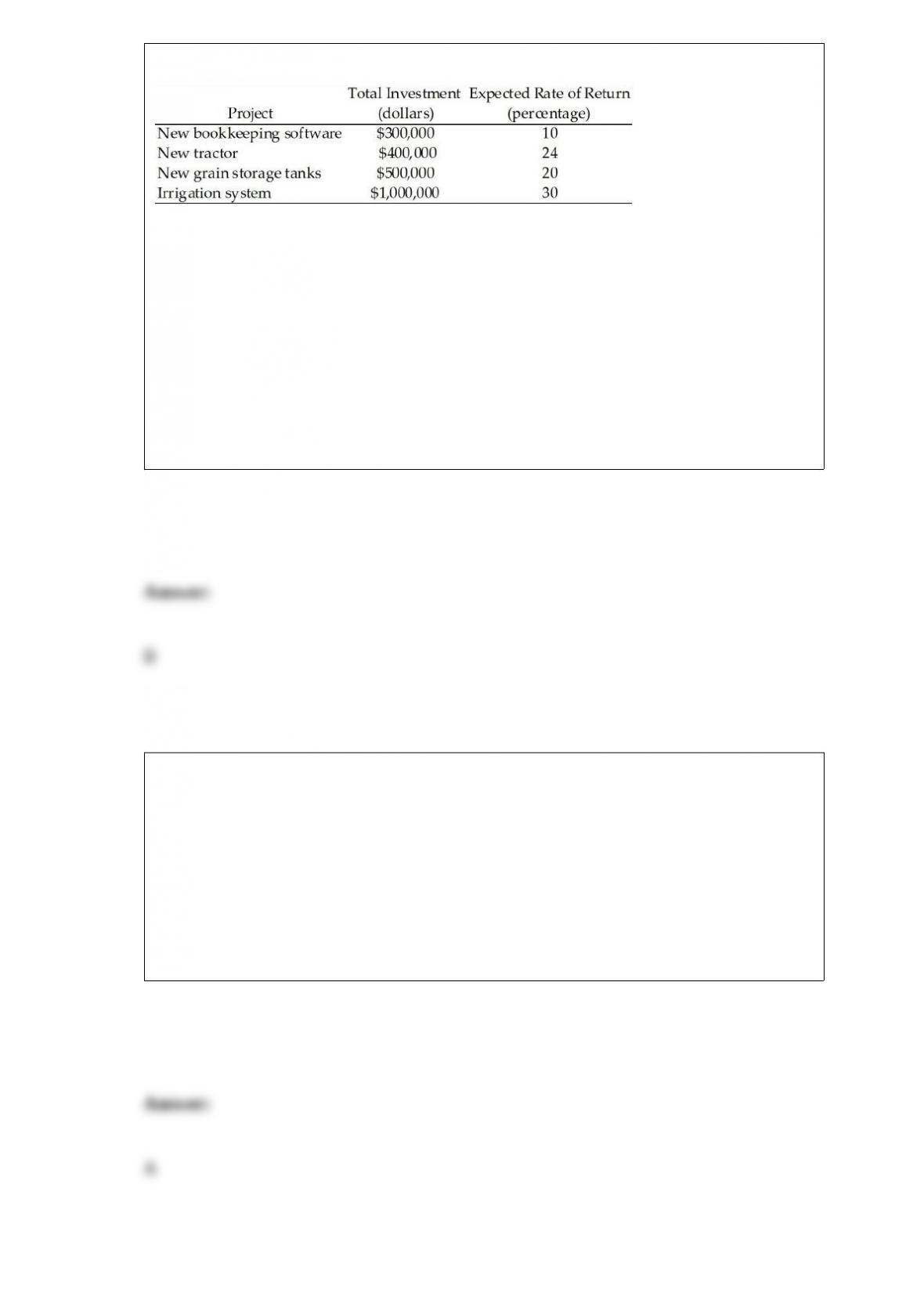
Table 11.2
Refer to Table 11.2. When the interest rate ________, the farmer will investment in all
four projects.
A) is greater than 30%
B) is less than 10%
C) is less than 30%
D) is greater than 10%
LoJacks convey ________ to third parties.
A) positive externalities
B) negative externalities
C) economies of scale
D) public goods
At a NASCAR race, you stand up to see better. Everyone else stands up, as well. This is
an example of
A) the fallacy of composition.
B) the post hoc, ergo propter hoc fallacy.
C) ceteris paribus.
D) Ockham’s razor.
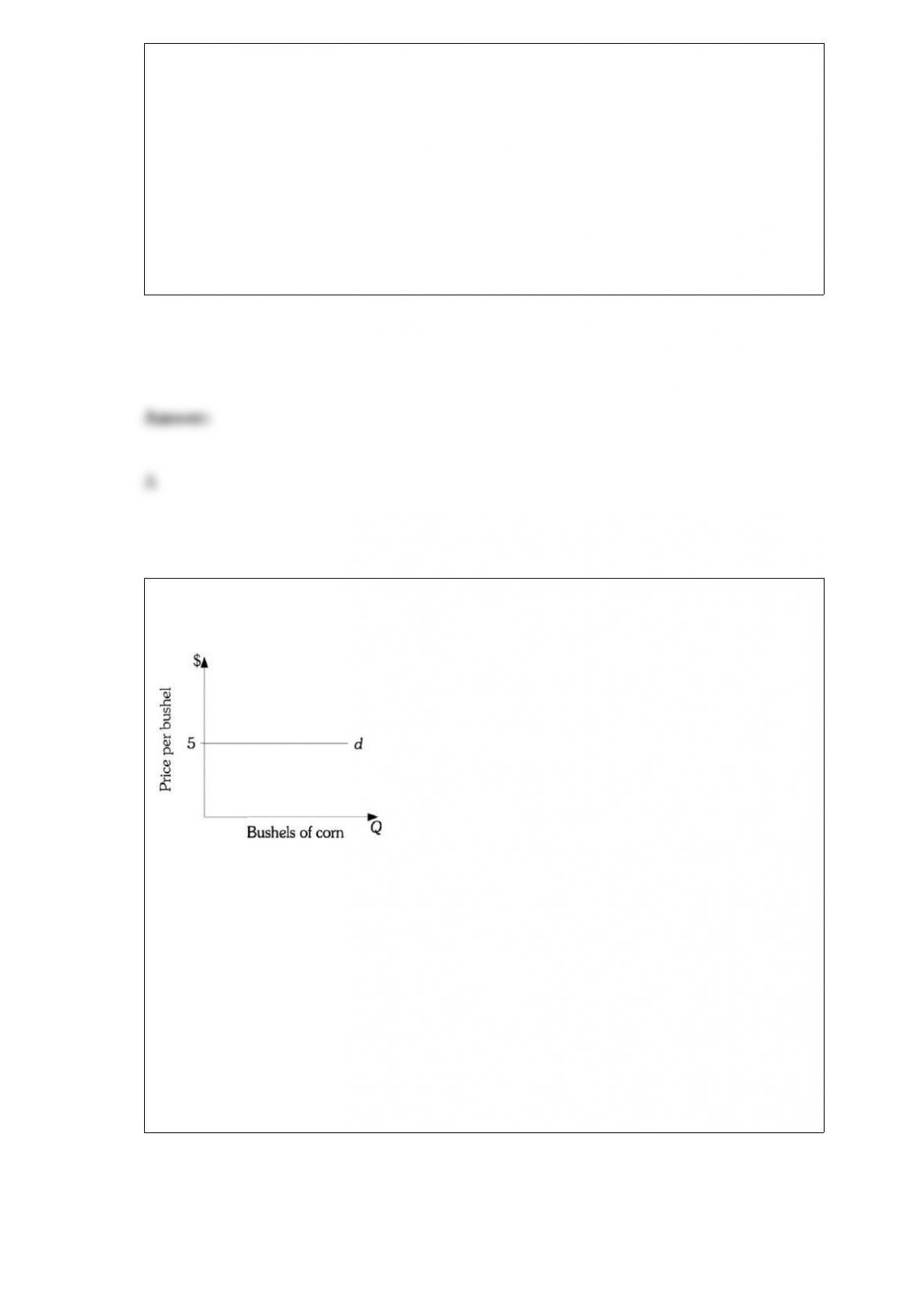
Figure 7.1
Refer to Figure 7.1. This corn producer earns a total revenue of $900. Each bushel of
corn is sold for $5. This corn producer must be selling ________ bushels of corn.
A) 180
B) 450
C) 900
D) 4,500
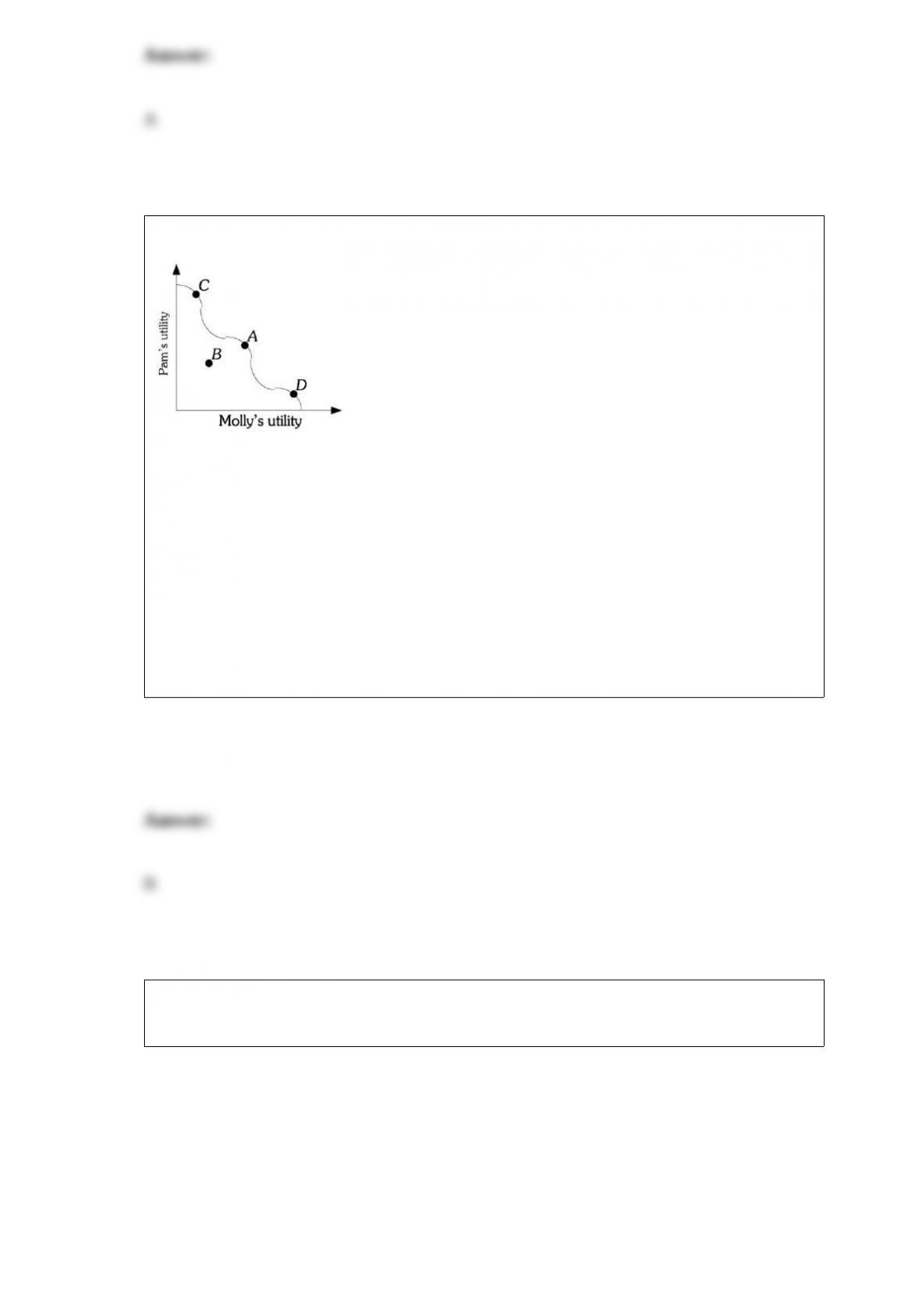
Figure 18.2
Refer to Figure 18.2. Which point represents an INEFFICIENT outcome?
A) A
B) B
C) C
D) D
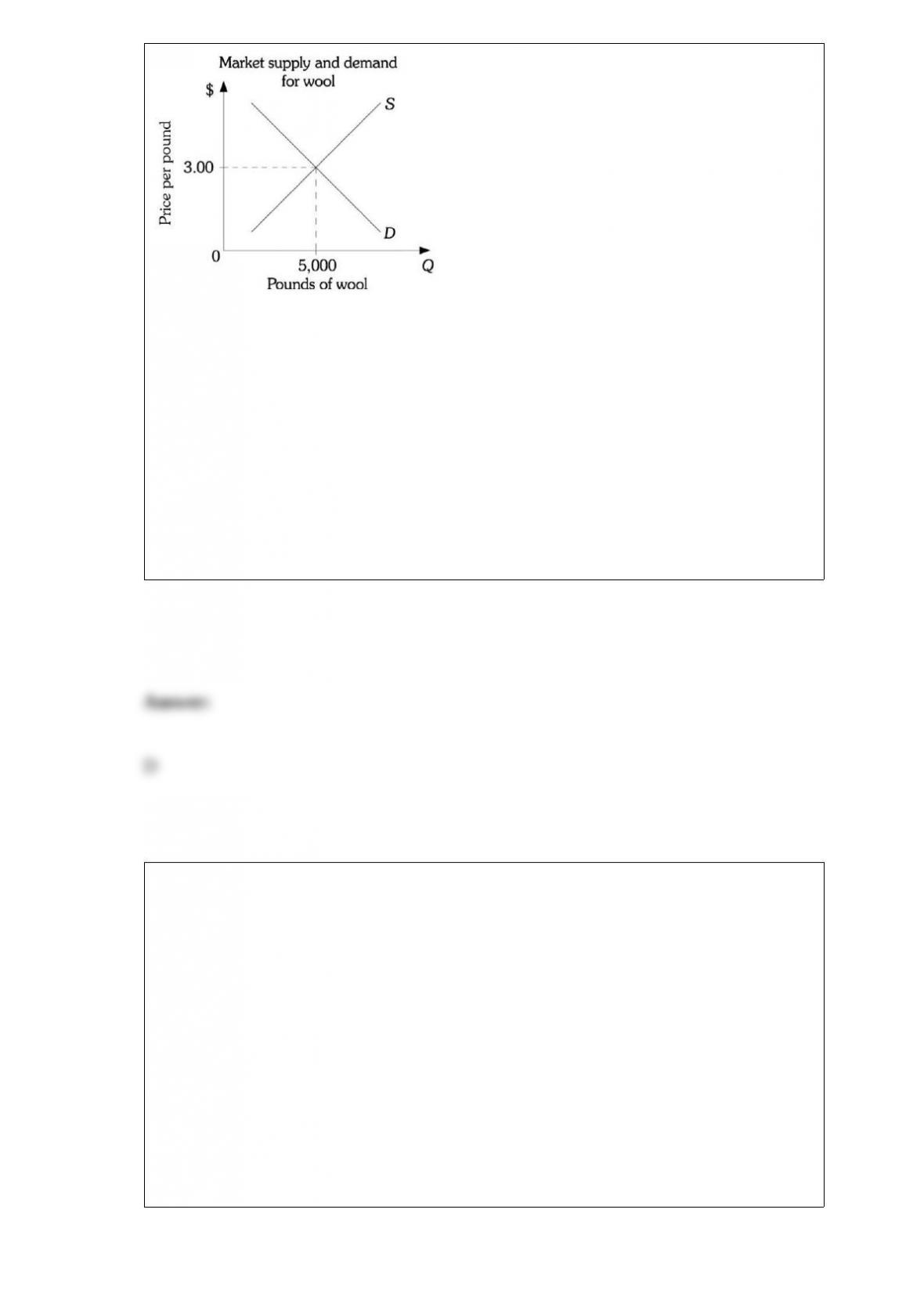
Figure 8.11
Refer to the Figure 8.11. Assuming wool is a perfectly competitive industry, the demand
curve faced by each wool producer is ________ starting at $3.00 per pound.
A) downward sloping
B) upward sloping
C) vertical
D) horizontal
Tom borrowed $80,000 from his parents to open a donut stand. He agrees to pay his
parents a 5% yearly return on the money they lent him. His other yearly fixed costs
equal $16,000. His variable costs equal $60,000. He sold 50,000 dozen donuts during
the year at a price of $3.00 per dozen.
Tom’s total costs equal
A) $20,000.
B) $40,000.
C) $60,000.
D) $80,000.
The $4,500 you earned last year in dividend payments is an example of ________
income.
A) property
B) transfer
C) inheritance
D) human capital
Explain why imperfect information can lead to market failure. Explain how the market
can solve the problem of imperfect information. Under what circumstances may it be
more efficient for the government to produce information instead of relying on the
market?
People often complain bitterly when they learn that CEOs of non-profit companies like
the United Way or the Red Cross earn salaries commensurate to what could be earned in
by CEOs employed by for-profit companies? Is this complaint valid? Explain.
What is the Herfindahl-Hirschman index?
Explain why demand for a monopolistically competitive firm’s product is more elastic
than the demand curve that a monopolist faces.
How is the market demand curve for new capital derived?
A successful local entrepreneur opens up the only Chevrolet dealership in a medium
sized Texas town. Why does this not necessarily constitute a monopoly position?
Define price elasticity of demand. What does it measure?
When the price of a gallon of orange juice rises from $1.50 to $2.00, the number of
gallons of apple juice demanded rises from 20,000 to 30,000 per year. Use the midpoint
formula to calculate the cross-price elasticity between orange juice and apple juice.
What does the sign imply about the relationship between these two goods?
Under what conditions does an oligopoly market result in the same outcome as
monopoly? What does this imply for the oligopoly’s long-run profits?
Why do U.S. government loans generally pay a low interest rate?
Use a graph and comment on the following statement: “If an economy is producing
inside its production possibilities frontier, it could possibly produce more of one good
without giving up any of the other.”
SCENARIO 3: Assume the following information on the price of small-screen
televisions and quantity demanded.
Compare and discuss the two elasticity estimates computed above. Without doing any
more calculations what would you expect to happen to the value of the elasticity
estimates as price continues to fall? Assume a linear demand curve.
If the price of apples decreases, what is the likely effect on the market for peaches?
What assumptions lead to the conclusion that final products are distributed efficiently
among households?
The prisoners’ dilemma shows that the players’ dominant strategies often lead them to
less than optimal outcomes. Is there any way in which this will not be the case?
Assume a customer of natural gas is negotiating with his supplier over the telephone. At
the time prices of all the supplier’s competitors are precisely the same. The customer
tells the supplier that if he raises his price even one penny he will walk away. What
does the perceived demand curve for natural gas look like for this customer? Why?
Explain Thomas Hobbes’ view that favors consumption as the best tax.
What is a perfectly contestable market?
Explain why cable television is not a pure private good.