1) Which of the following is directly illegal under the Sherman Act?
A.price discrimination
B.tying contracts
C.price fixing
D.interlocking directorates
2) Critics of industrial regulation say that such regulation:
A.benefits small firms at the expense of large firms.
B.perpetuates monopoly long after new technology has eroded natural monopoly.
C.creates insurmountable principal-agent problems.
D.has resulted mainly from the paradox of voting.
3) Describe the effect of the following events would on the aggregate demand (AD)
curve.
(a)A boost in research and development by computer companies produces more
powerful and efficient computers and equipment.
(b)Income falls in several countries that trade heavily with the U.S.
(c)Prices fall across several industries.
(d)After a budget surplus, Congress moves to cut personal income taxes.
4) which of the following is correct?
a.there is no relationship between mp and mc.
b.when ap is rising mc is falling, and when ap is falling mc is rising.
c.when mp is rising mc is rising, and when mp is falling mc is falling.
d.when mp is rising mc is falling, and when mp is falling mc is rising.
5) Unless people can benefit from conservation, there is a temptation to:
A.delay resource extraction as long as possible.
B.extract and use resources at a constant rate.
C.extract and use resources as quickly as possible.
D.ban the extraction of non-renewable resources.
6) Changes in the equilibrium interest rate will:
A.affect both the size of the domestic output and the allocation of capital goods among
industries.
B.affect the size of the domestic output, but not the allocation of capital goods among
industries.
C.affect the allocation of capital goods among industries, but not the size of the
domestic output.
D.have no perceptible effect on either the size of the domestic output or the allocation
of capital goods among industries.
7) The following table for a commercial bank or thrift:
Refer to the above table. When the legal reserve ratio is 20 percent, the money creating
potential of the entire banking system is:
A.$4,000.
B.$6,000.
C.$8,000.
D.$10,000.
8) economic growth rates in follower countries:
a.tend to be lower than in leader countries because labor forces in follower countries are
too small.
b.tend to exceed those in leader countries because followers can cheaply adopt the new
technologies that leaders developed at relatively high costs.
c.will never bring real gdp per capita up to the same levels as in leader countries, even
if follower growth rates are greater than those in leader countries.
d.typically average about 2 percent per year.
9)
Refer to the above information. The multiplier in this economy is:
A.4.
B.5.
C.2.5.
D.3.5.
10) Some economists have criticized standard government figures on income inequality,
arguing that these data:
A.exclude households whose earnings arise in the public sector.
B.conceal the strong trend toward greater equality in household sizes.
C.conceal the growth of poverty due to a growing number of discouraged workers.
D.overstate the degree of income inequality by failing to include noncash transfers as
income.
11) The basis of the following table shows market shares of firms in hypothetical
industries. Assume these are distinct industries with no buyer-seller relationships or
competition among them.
Refer to the above table. The government would likely challenge a merger between:
A.Firm 1 in Alpha and Firm 6 in Delta.
B.Firms 3 and 4 in Beta.
C.Firms 1 and 2 in Cappa.
D.Firm 4 in Alpha and Firm 3 in Cappa.
12) Largely because of large current account deficits, the United States:
A.is the leading exporting nation in the world.
B.has the world’s largest external debt.
C.has the world’s highest saving rate.
D.is experiencing an increase in its net inflow of investment income.
13) The real burden of an increase in the public debt:
A.may be very small or conceivably zero when the economy is in a severe depression.
B.will be smaller when full employment exists than when the economy has large
quantities of idle resources.
C.can be shifted to future generations if the debt is internally financed.
D. can best be measured by the dollar increase in the size of the debt.
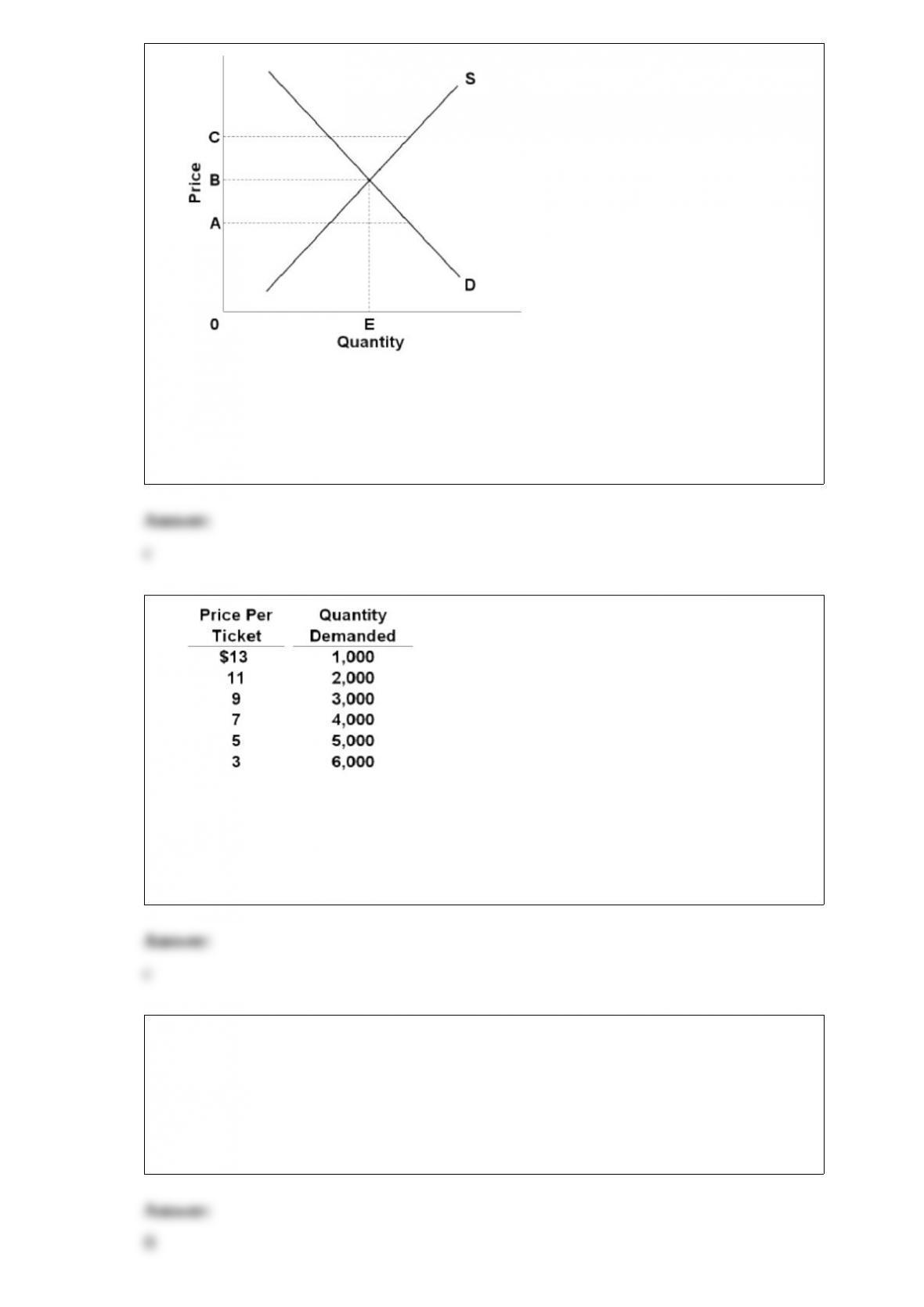
14)
refer to the above diagram. a government-set price floor is best illustrated by:
a.price a
b.quantity e
c.price c
d.price b
15)
refer to the above information. over the $13-$11 price range, demand is:
a.perfectly elastic.
b.perfectly inelastic.
c.elastic.
d.inelastic.
16) If net exports decline from zero to some negative amount, the aggregate
expenditures schedule would:
A.shift upward.
B.shift downward.
C.not move (net exports do not affect aggregate expenditures).
D.become steeper.