
The increase in the federal deficit due to the 2009 stimulus package may have had a
smaller impact on the economy due to forward-looking households and firms
A) reducing consumption and investment expenditures in anticipation of future tax
increases.
B) purchasing more treasury securities to finance the stimulus package and purchasing
fewer goods and services.
C) taking advantage of the strong U.S. dollar to purchase more imported goods.
D) waiting for the real interest rate to fall before borrowing to make long-term
investments.
Most recessions in the United States since World War II have begun with a
A) rise in oil prices.
B) stock market crash.
C) a major devaluation of the dollar.
D) decline in residential construction.
If the nominal exchange rate between the U.S. dollar and the Thai baht (baht per dollar)
is lower than the relative purchasing power between the two countries, which of the
following would be true?
A) Purchasing power parity predicts that the value of the dollar will fall as traders take
advantage of profit opportunities.
B) Purchasing power parity predicts that the baht is undervalued as traders take
advantage of profit opportunities.
C) There are opportunities for profit by purchasing goods in the United States and
selling them in Thailand.
D) There are no opportunities for profit by purchasing goods in one country and selling
them in the other.
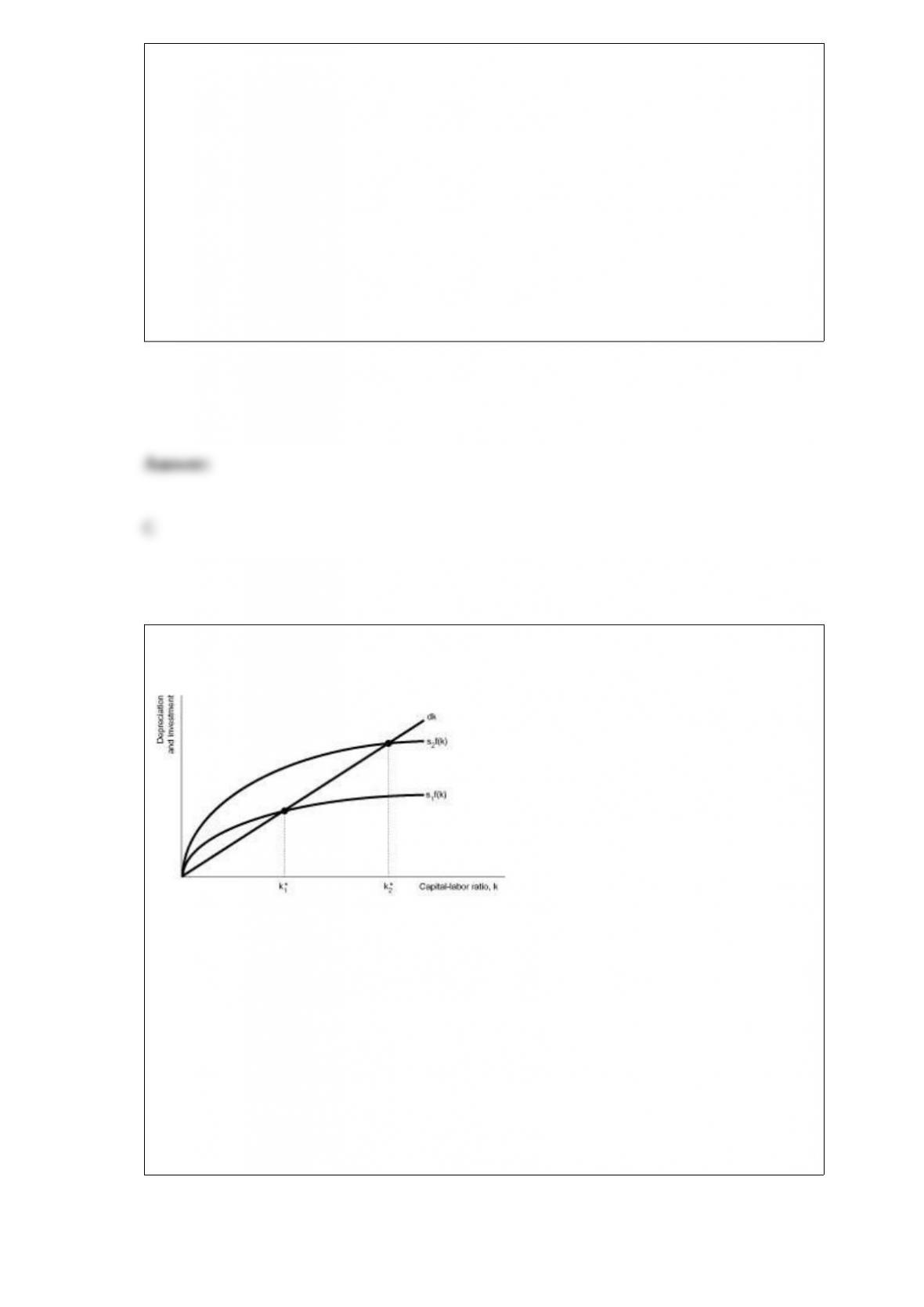
Figure 6.1
Refer to Figure 6.1. Suppose the economy is originally in steady state at k*1. If the
saving rate increases from s1 to s2, the capital-labor ratio will begin to ________, and
real GDP per worker will ________.
A) rise; rise
B) rise, fall
C) fall, fall
D) fall; rise

Holding other factors constant, the increase in the prison population over the past 30
years in the United States has likely
A) decreased structural plus frictional unemployment.
B) increased cyclical unemployment declined.
C) decreased cyclical unemployment increased.
D) increased the natural rate of unemployment.
As the economy nears the end of a recession, which of the following would we most
likely see?
A) further decreases in consumer spending
B) falling wages relative to output prices
C) increased spending on capital goods by firms
D) increasing interest rates
Daniel was just laid off from his teaching job at the local high school due to state
budget cuts resulting from the reduction in tax revenue during the recent economic
downturn. Daniel would best be categorized as
A) frictionally unemployed.
B) structurally unemployed.
C) cyclically unemployed.
D) seasonally unemployed.
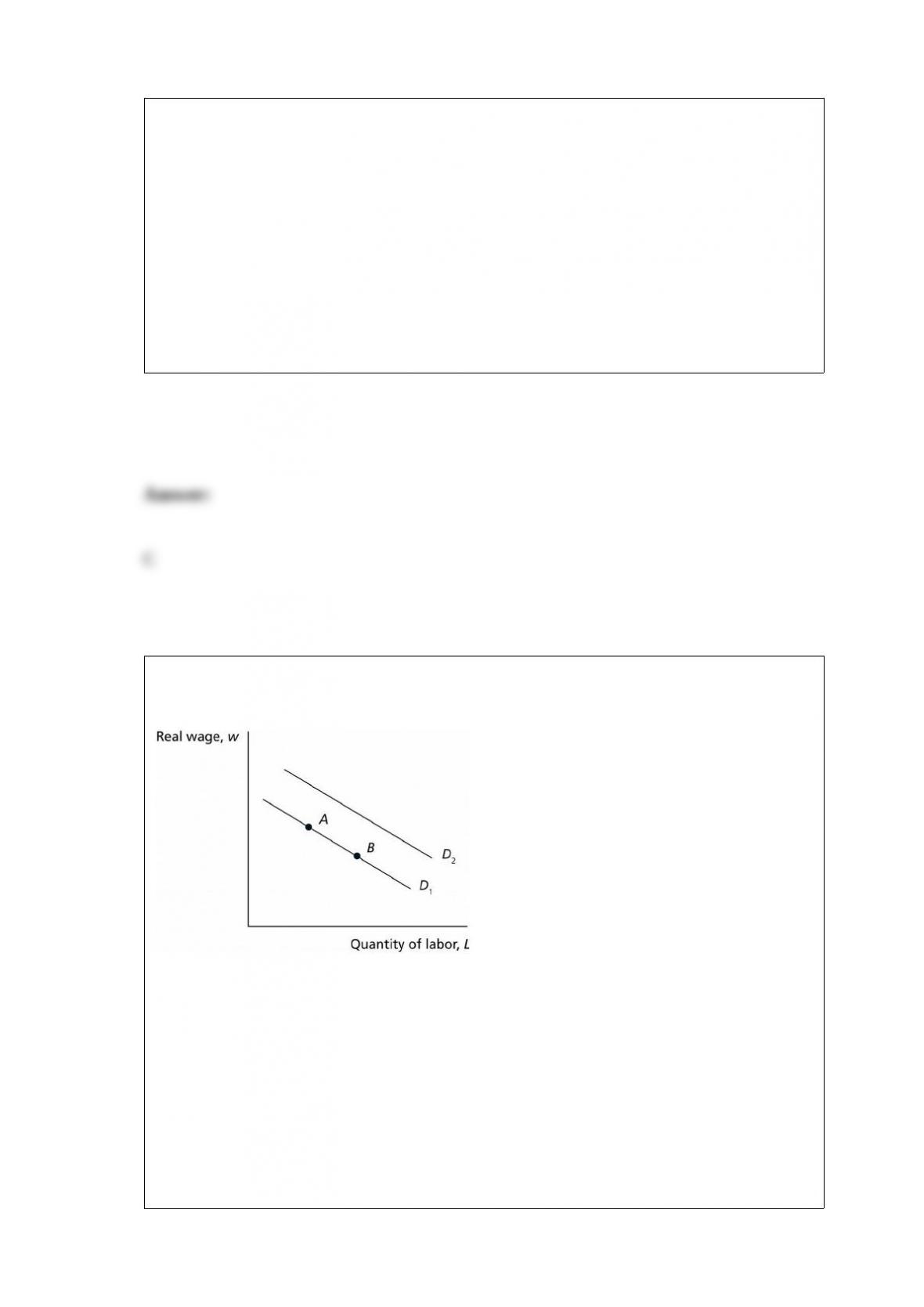
Figure 8.1
Refer to Figure 8.1. Holding other variables constant, an improvement in technology
will result in a
A) shift from curve D1 to curve D2.
B) shift from curve D2 to curve D1.
C) movement from point A to point B.
D) movement from point B to point A.
Identify which of the following people would be considered either employed,
unemployed, or not in the labor force:
a. Alejandro just lost his job at an automobile assembly plant and is looking for work in
another industry.
b. Bonnie quit her job 6 months ago to take care of her newborn triplets.
c. Cheyenne just received her bachelor’s degree in accounting and is going to backpack
through Europe for 6 months before seeking employment as an auditor.
d. Danitra owns a talent agency which provides clowns for children’s birthday parties.
e. Edgar is a full-time student and is working 10 hours each week as a lab assistant at
Faber College.
f. Flavio was awarded a $10 million settlement from his former employer and has
chosen to retire.

All of the following are possible private-sector adjustments to an increase in the
government’s budget deficit except
A) increasing private savings.
B) decreasing investment.
C) decreasing expenditures on transfer programs.
D) increasing the trade deficit by increasing imports and/or decreasing exports.
________ is a company that provides advice to firms issuing new securities,
underwrites the issuing of securities, and develops new securities.
A) A mutual fund
B) A pension fund
C) A hedge fund
D) An investment bank
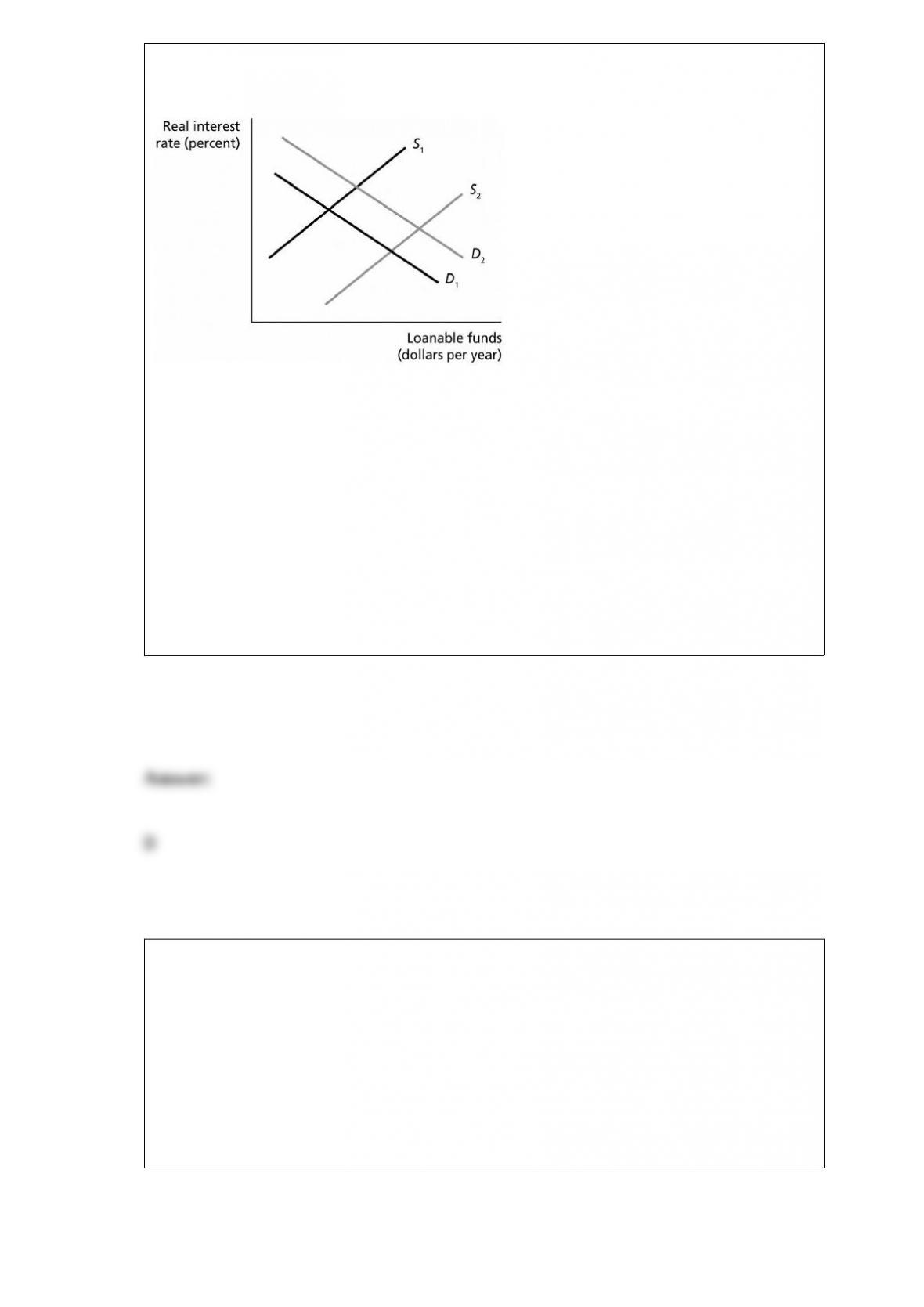
Figure 4.3
Refer to Figure 4.3. All else equal, an increase in the government’s budget deficit
accompanied by a decrease in corporate taxes would cause which of the following
shifts?
A) S1 to S2 and D1 to D2
B) S2 to S1 and D1 to D2
C) S1 to S2 and D2 to D1
D) S2 to S1 and D2 to D1
The purchase of Treasury securities by the Federal Reserve will, in general,
A) not change the money supply.
B) not change the quantity of reserves held by banks.
C) decrease the quantity of reserves held by banks.
D) increase the quantity of reserves held by banks.

The return that a domestic investor receives on a foreign investment is equal to
A) the interest rate on the foreign investment minus the interest rate on a comparable
domestic investment.
B) the appreciation rate of the foreign currency minus the appreciation rate of the
domestic currency.
C) the interest rate on the foreign investment times the appreciation rate of the foreign
currency.
D) the interest rate on the foreign investment minus the rate of appreciation of the
domestic currency.
If the real interest rate in the United States decreases, foreign investors will ________
their demand for U.S. dollars because they desire to ________ fewer U.S. financial
assets.
A) increase; buy
B) increase; sell
C) decrease; buy
D) decrease; sell
In a market economy, uncertain levels of inflation
A) make prices less useful as signals for resource allocation.
B) prompt firms to enter into fewer short-term contracts, and more long-term contracts,
with suppliers.
C) balance out income redistribution in the long run.
D) are more beneficial to lenders than to borrowers, as lenders have a tendency to
overestimate the expected inflation rate.
Figure 4.3
Refer to Figure 4.3. All else equal, an increase in net exports accompanied by a
decrease in expected future profits would cause which of the following shifts?
A) S1 to S2 and D1 to D2
B) S2 to S1 and D1 to D2

C) S1 to S2 and D2 to D1
D) S2 to S1 and D2 to D1
C = $5 million + 0.9(1 – 0.1)Y
I = $7 million
G = $6 million
NX = $1 million
Based on the above data, the equilibrium level of GDP is
A) $20.9 million.
B) $23.5 million.
C) $100 million.
D) $111.8 million.
If the actual capital-labor ratio is below the steady-state capital labor ratio, growth from
convergence will be ________, and the economy will grow ________ than it will along
a balanced growth path.
A) negative; slower

B) negative; faster
C) positive; slower
D) positive; faster
Suppose the economy is in equilibrium with an output gap equal to zero and the actual
inflation rate equals the expected inflation rate. If the economy experiences a negative
demand shock, real GDP will become ________ potential GDP and the economy will
move to the ________ along an existing Phillips curve.
A) greater than; right
B) greater than; left
C) less than; right
D) less than; left
If the saving rate increases, break-even investment will be ________ than investment,
and GDP per worker will ________.
A) greater; increases
B) greater; decreases
C) less; increases
D) less; decreases
Suppose y = k1/2, total factor productivity is constant and equal to 1, s = 0.40, and d =
0.10. When the economy reaches the steady state, consumption per worker is ________.
A) $1.20
B) $2.40
C) $4.80
D) $13.60
Figure 9.1
Refer to Figure 9.1. Assume the economy is initially at point A. Following the initial

change in short-run equilibrium resulting from a recession caused by an increase in oil
prices, the end of the recession is best represented by which long-run equilibrium
combination of price level and real GDP?
A) P1; Y1
B) P3; Y3
C) P1; Y3
D) P3; Y1
Suppose the annual growth rate of real GDP for the nation of Svengali is 5% and the
growth rate of velocity is 0%. If the money supply growth rate decreases from 6% to
2%, what was the initial rate of inflation in Svengali?
A) -1%.
B) 1%.
C) 1.25%.
D) 9%.
Assume that seigniorage and the government’s primary deficit are both zero. If the real
interest rate is less than the growth rate of real GDP, fiscal policy ________, and if the

real interest rate is greater than the growth rate of real GDP, fiscal policy ________.
A) is sustainable; may be sustainable
B) is unsustainable; is sustainable
C) is sustainable; is unsustainable
D) is unsustainable; may be sustainable
The German hyperinflation of the early 1920s was caused by
A) an overly aggressive monetary policy implemented to combat a severe recession.
B) large surpluses resulting from the high levels of wartime production and low level of
taxes.
C) rising oil prices following World War I and the resulting severe stagflation.
D) the German government raising funds to finance its expenditures by printing money.
Figure 6.2
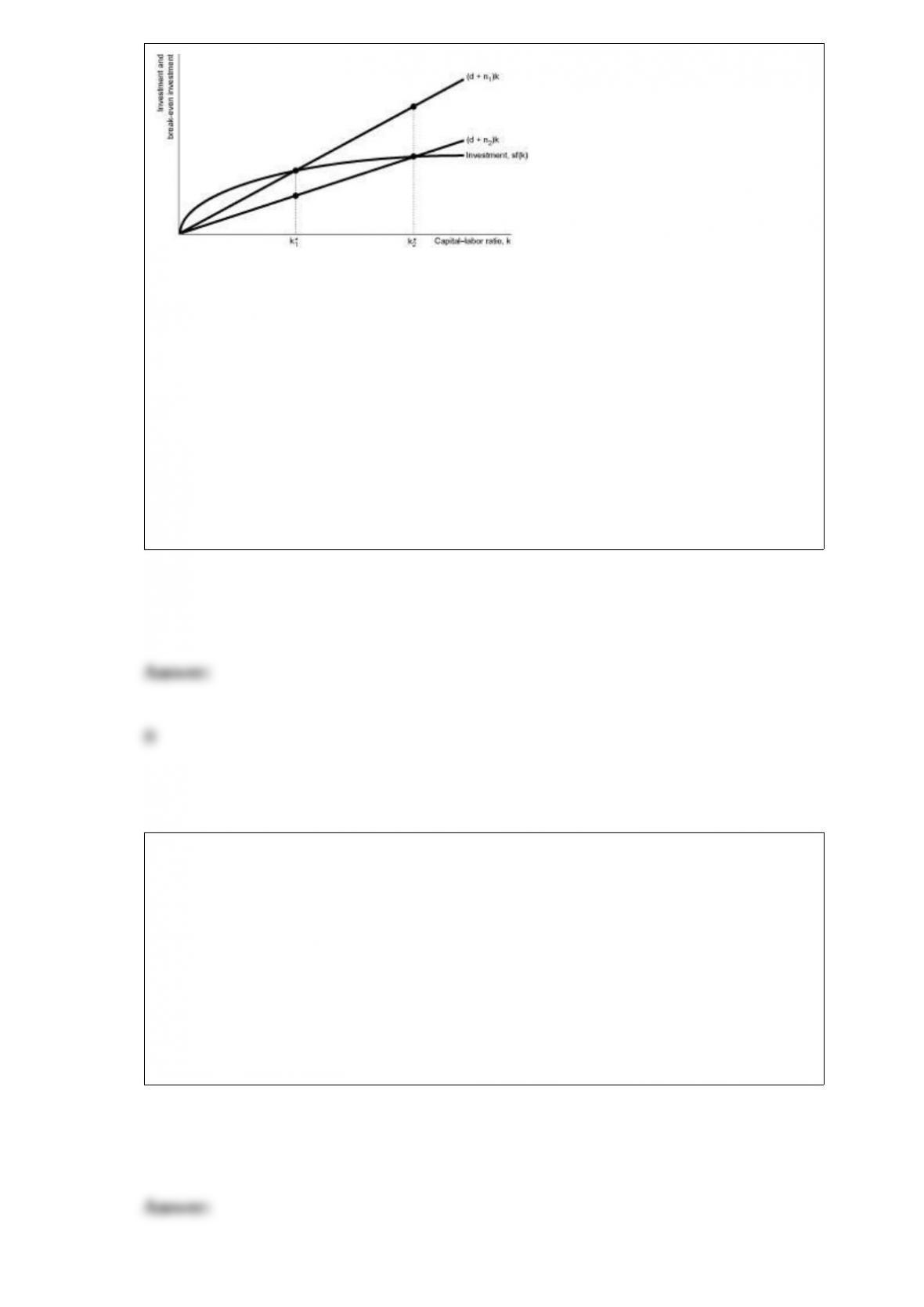
Refer to Figure 6.2. Suppose the economy is originally in steady state at k*2. All else
equal, if the labor force growth rate increases , the change in the capital-labor ratio is
represented by the vertical distance between
A) sf(k) and (d + n2)k.
B) sf(k) and (d + n1)k.
C) (d + n1)k and (d + n2)k.
D) k*2 and(d + n2)k.
A situation in which the price of an asset rises significantly above the asset’s
fundamental value is referred to as
A) asset liquidity.
B) dissipation.
C) a bubble.
D) magnification.
Suppose you are paid a wage of $50 per hour. if your marginal income tax rate is 20%,
then for every additional hour you work, your tax wedge is
A) $10.
B) $20.
C) $25.
D) $40.
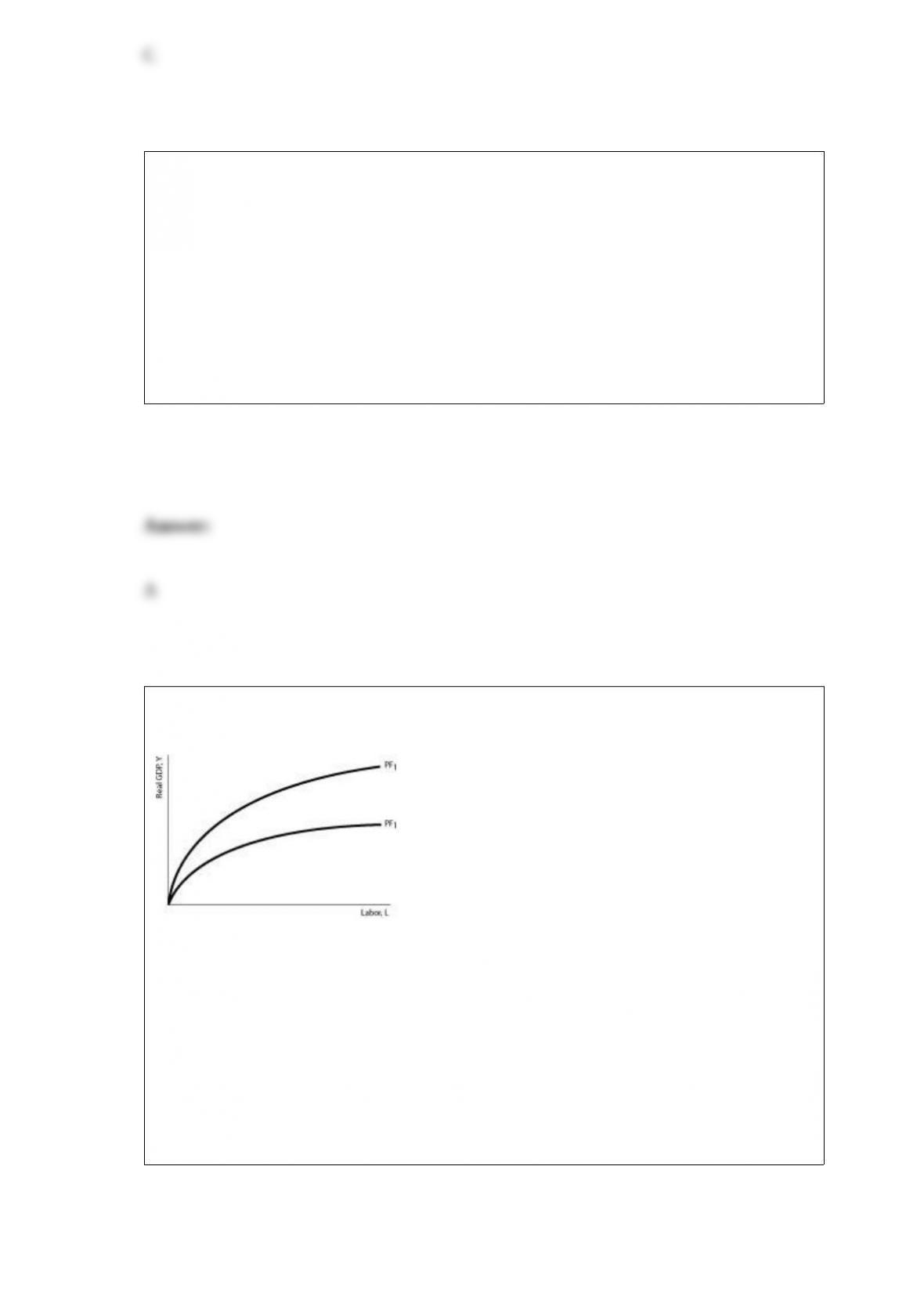
Figure 5.1
Refer to Figure 5.1. All else equal, an increase in total factor productivity will cause a
A) shift from PF1 to PF2.
B) shift from PF2 to PF1.
C) movement up and to the right along PF1.
D) movement down and to the left along PF2.

Assume that the growth rate of real GDP in Astoria is 7.5%. Assume the growth rate of
velocity is 0%. If Astoria’s current annual inflation rate of 5.99%, the growth rate of the
money supply will be
A) -1.51%.
B) 1.51%.
C) 5.99%.
D) 13.49%.
Suppose the Fed has a target inflation rate of 3%, the Fed always hits its target, and the
inflation rate has been 3% for several years. Furthermore, assume Amazon sets the price
of its Kindle Fire at $140 in 2012 and wants to keep the real price of the Kindle
constant in order to maximize profits. Now suppose that the Fed announces on January
1, 2013 that it will decrease its target rate for inflation to 1%. If Amazon has adaptive
expectations, it will set its price for the Kindle in 2013 at
A) $137.20.
B) $140.00.
C) $141.40.
D) $144.20.