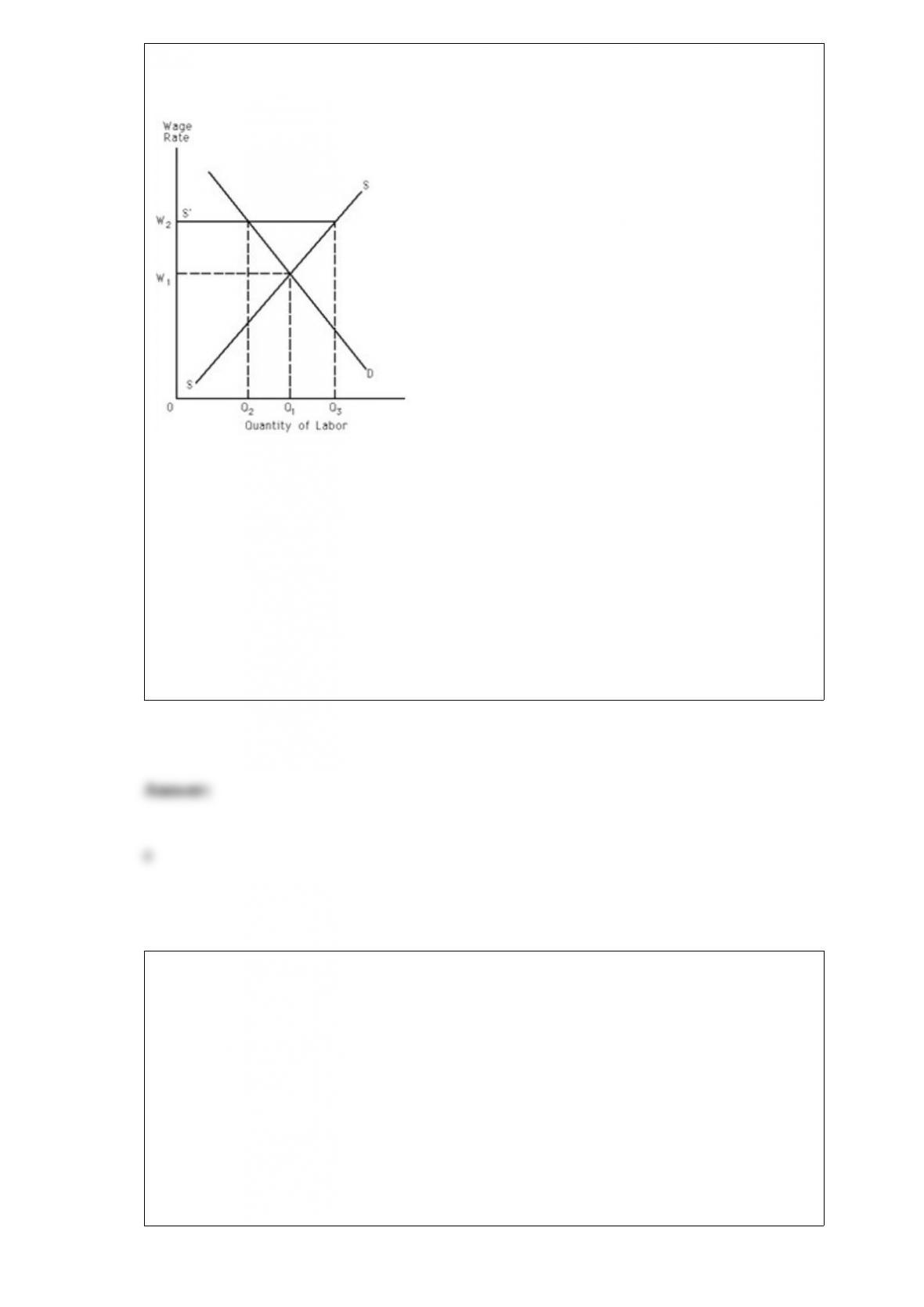
Exhibit 28-2
One of the things that the labor union probably can do to convince management that the
supply curve is S’S instead of SS is
a. make a credible threat of a strike.
b. ask workers to take a cut in fringe benefits.
c. try to maximize the wage bill to the union.
d. try to maximize membership in the union.
The Herfindahl index measures the
a. average market share of the firms in an industry.
b. total market share of the four largest domestic firms in an industry.
c. total market share of the four largest firms worldwide in an industry.
d. degree of concentration in an industry.
e. degree of competition among the four largest firms in an industry.

Rent seeking is more likely to occur in a family when the parents make their inheritance
plans clear by telling the children ahead of time that their estate will be divided equally
among the children (and that under no circumstances will the parents change their
minds) than when there is more uncertainty with regards to the parents€ inheritance
plans.
a. True
b. False
A local government prevents any firm from competing with a natural monopoly firm.
Those people who believe this is a wise policy action would likely say
a. this is a desirable state of affairs since if competition is allowed, the natural
monopoly firm will out compete all newcomers and in the end the newcomers will go
out of business.
b. the public doesn’t want more than one company to produce certain goods that it buys.
c. the first company that provides a certain good to the public should have the right to
produce that good without competition from others.
d. if competition is allowed, no firm in the industry will be able to earn profits.
e. none of the above
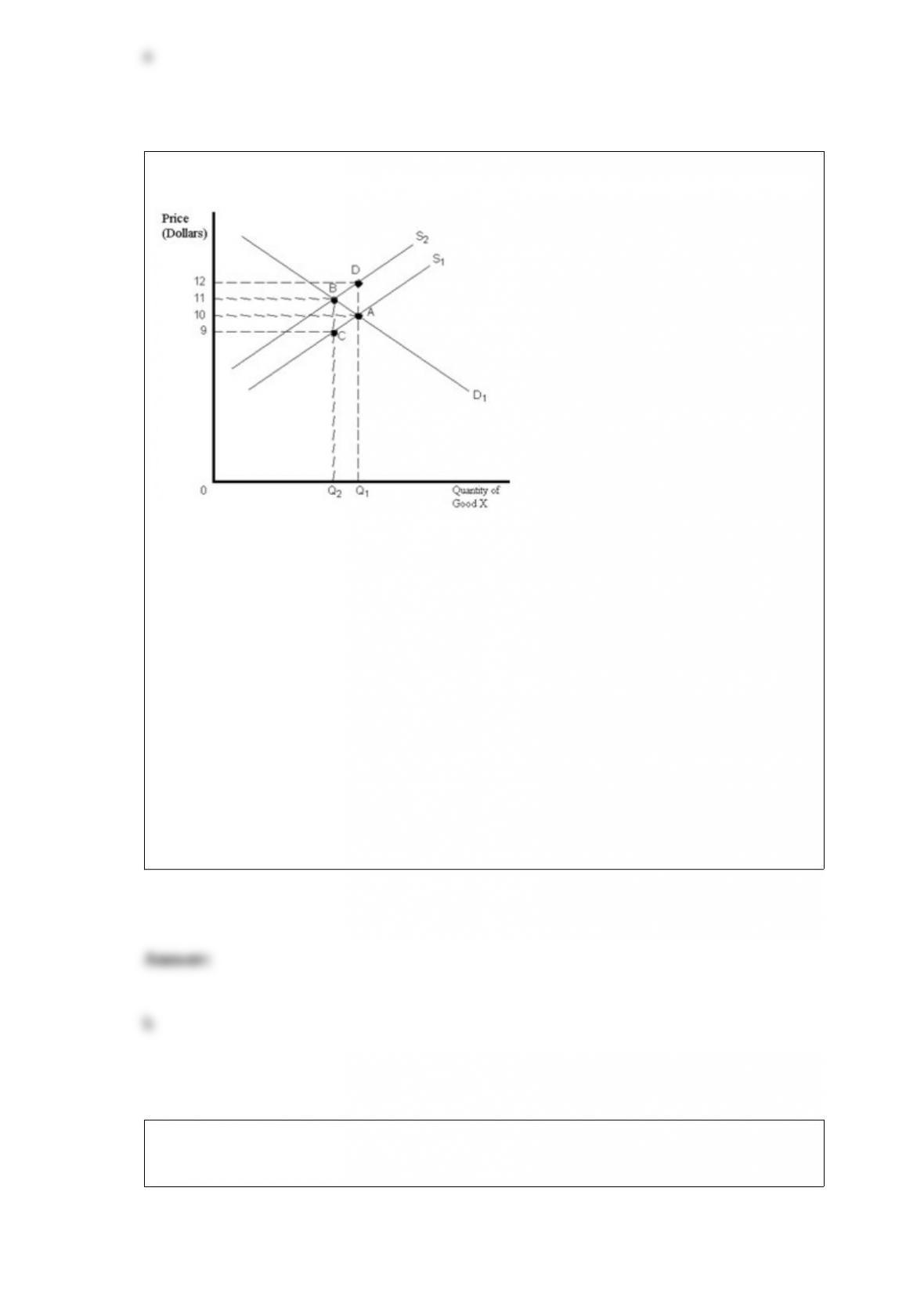
Exhibit 20-8
The market for good X is initially at point A. A tax is then placed on the production of
good X. As a result, the equilibrium price changes to __________, and sellers now
receive __________ per unit they sell and they get to keep __________ for each unit
they sell.
a. $11; $10; $9
b. $11; $11; $9
c. $12; $11; $10
d. $12; $11; $9
e. $11; $12; $10
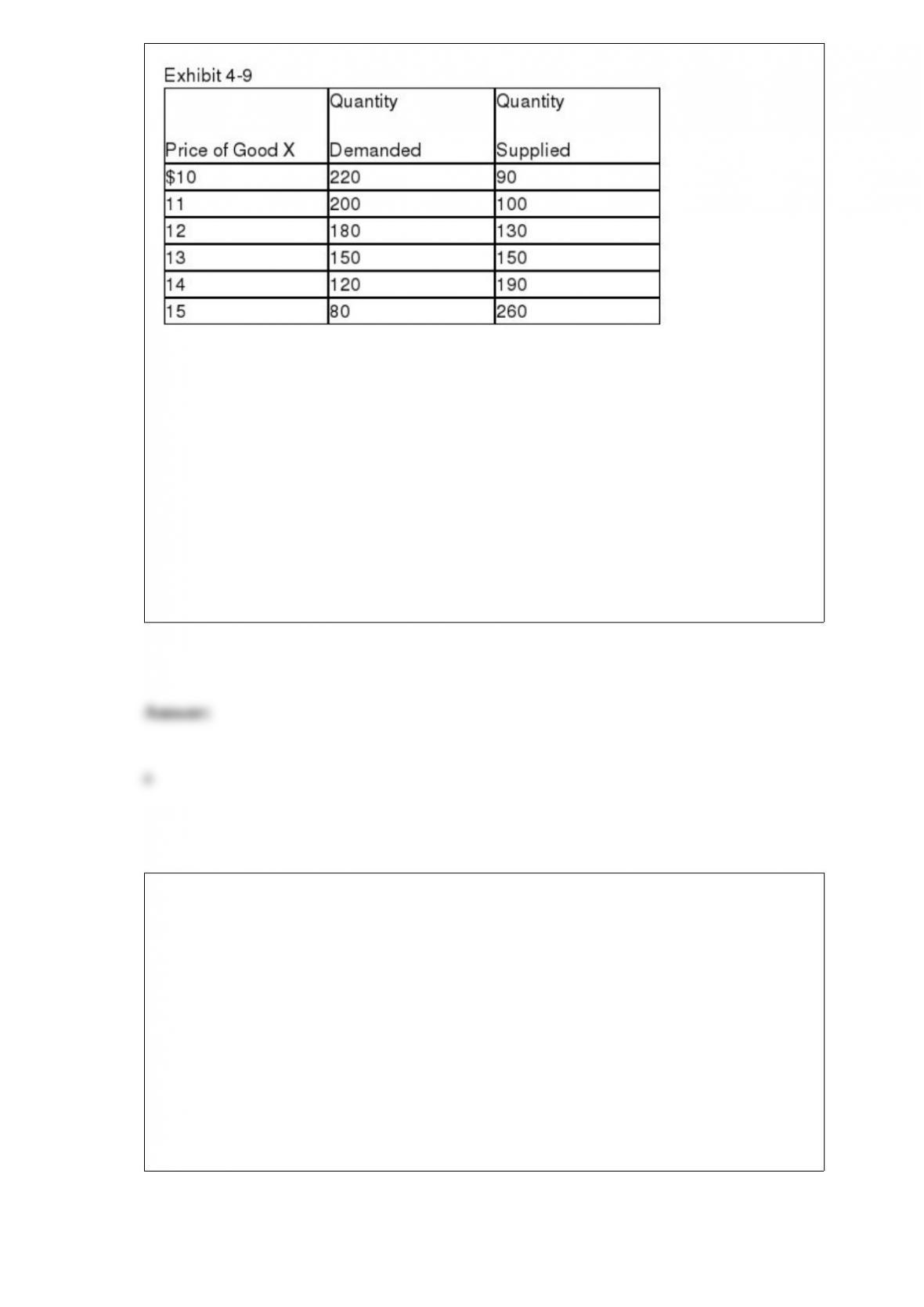
Suppose that the government imposes a price ceiling at a price of $11.How many fewer
units would be exchanged at the price ceiling than would be exchanged at the
equilibrium price?
a. 50
b. 30
c. 40
d. 70
A country has a (an) __________ in the production of a good it produces at lower
opportunity cost than another country.
a. absolute advantage
b. specialization disadvantage
c. tariff-efficient advantage
d. infant-industry advantage
e. none of the above

The terms interest and interest rate are synonyms.
a. True
b. False
Cy recently went into the business of producing and selling cardboard boxes. For this
business, which of the following is most likely to be a fixed cost?
a. fire insurance
b. labor costs
c. paper costs
d. adhesive costs
e. b, c, and d are equally likely to be fixed costs
If the MU/P ratio for two goods is the same, then
a. the slope of the budget constraint between the two goods is equal to the marginal rate

of substitution (MRS) between the two goods.
b. the indifference curve between the two goods is concave to the origin.
c. the prices of the two goods are the same.
d. it follows that consumers prefer fewer goods to more goods.
e. a and c
Total costs are
a. fixed costs plus average total costs.
b. average fixed costs plus variable costs.
c. fixed costs plus variable costs.
d. fixed costs minus variable costs.
e. fixed costs divided by total variable costs.
Price elasticity of supply measures the responsiveness of __________ to changes in
__________.
a. quantity supplied; income

b. quantity supplied; price
c. quantity supplied; quantity demanded
d. income; quantity demanded
e. none of the above
Smith argues that American producers cannot compete with foreign producers because
wages are lower in foreign countries than in the United States. Smith is
a. advancing the foreign export subsidies argument for protectionism.
b. making the mistake of believing that high wages mean high costs.
c. advancing the antidumping argument for protectionism.
d. making the mistake of believing that productivity is higher in foreign countries than
in the United States.
e. none of the above