
In which market structure is the interdependence of firms a key characteristic?
a. perfect competition
b. monopolistic competition
c. oligopoly
d. monopoly
Situation 4-1
During the winter of 1973-74, a general system of wage and price controls (including a
price ceiling on gasoline) was in force in the United States. At the beginning of 1974,
some oil-producing countries imposed an oil embargo (a legal prohibition on
commerce) on the West. In the spring of 1974, price controls were] abolished.
Before the oil embargo, the price ceiling on gasoline had no noticeable effect on the
market. What is the most likely explanation for this?
a. The equilibrium price of gasoline was probably below the price ceiling.
b. The demand curve for gasoline in the 1970s was vertical.
c. The supply curve for gasoline in the 1970s was vertical.
d. The equilibrium price of gasoline was probably above the price ceiling.
You turn to the Treasury bond market page of a newspaper and look under the column
headed €Ask€ and see that it says, €128:16€ this indicates that

a. the price that the buyer is willing to pay for this bond is $128.16.
b. the price that the buyer is willing to pay for this bond is $1,280.16.
c. the price that the seller is willing to sell this bond for is $1,285.
d. the price that the seller is willing to sell this bond for is $128.16.
Something that provides disutility is called a
a. good.
b. want.
c. need.
d. bad.
e. none of the above
Which of the following is a positive microeconomics statement?
a. The central bank should increase the nation’s money supply.
b. The increase in the nation’s money supply helped push the nation’s unemployment
rate down in the short run.
c. Ford Motor Company’s new advertising campaign ended up hurting General Motors’s
sales.
d. The local government ought to spend more on recreational activities.
Another term for stocks is equity.
a. True
b. False
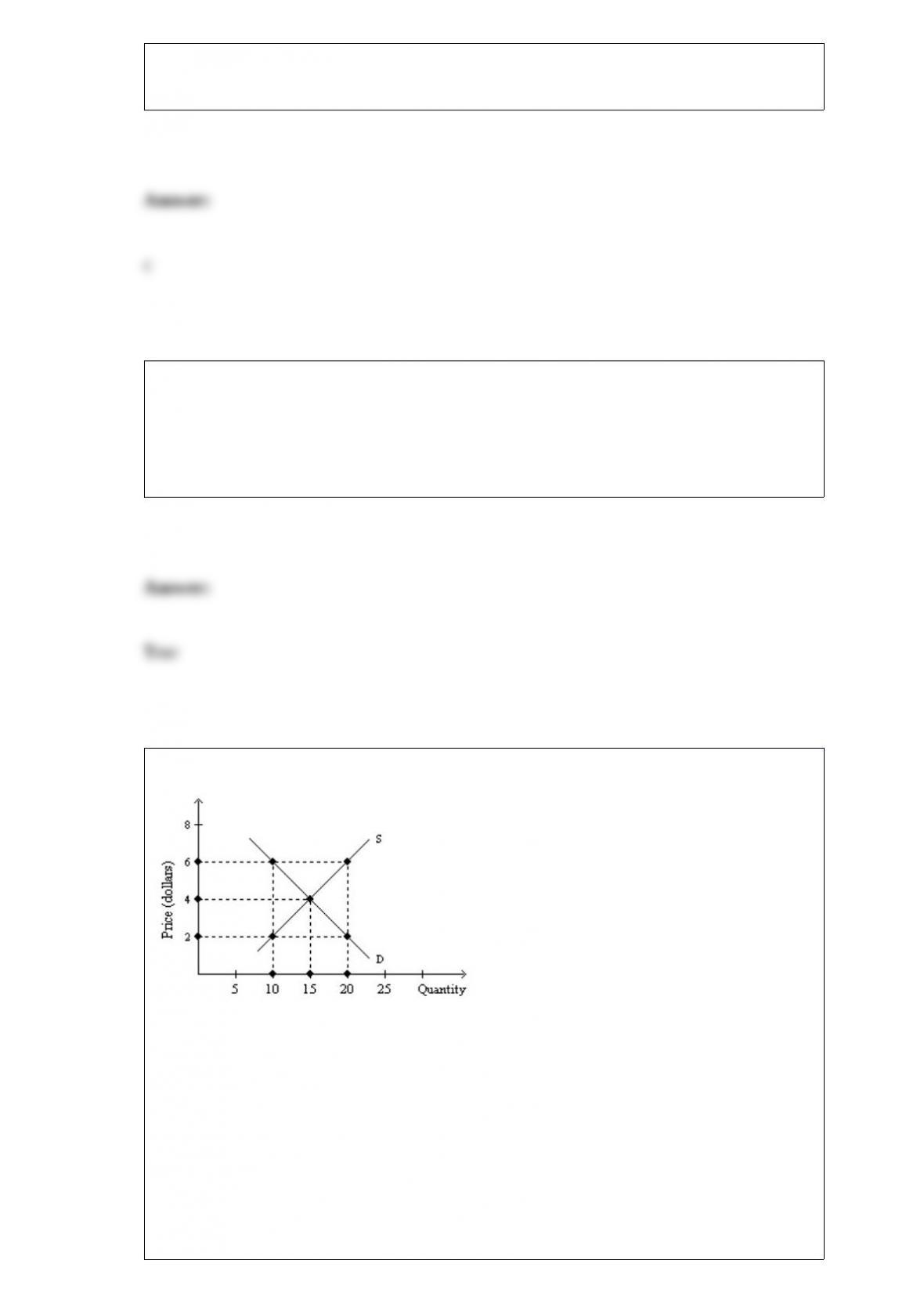
Exhibit 3-4
A price of $2 in the market will result in a
a. shortage of 10 units.
b. surplus of 10 units.
c. surplus of 5 units.
d. shortage of 5 units.

If the coupon payment on a bond is $350 and the coupon rate is 7%, then what is the
face value of the bond?
a. $5,000
b. $374.50
c. $24.50
d. $528.57
e. There is not enough information provided to answer this question.
If the percentage change in quantity demanded is greater than the percentage change in
price for good X, then the demand for good X is
a. inelastic.
b. unit elastic.
c. elastic.
d. perfectly inelastic.
Which of the following predictions is consistent with public choice theory?
a. Voters will sometimes cast votes based on whether they like a candidate’s personality,
not on hard facts.
b. Many voters will be uninformed on political and government issues.
c. Much legislation will be special interest legislation.
d. b and c
e. a, b, and c
Which of the following statements is true?
a. When a firm lowers the price of its product, total revenue always falls.
b. When a firm raises the price of its product, total revenue always rises.
c. When a firm raises the price of its product, total revenue always falls.
d. When a firm lowers the price of its product, total revenue always rises.
e. none of the above
If the demand for agricultural products is price inelastic and the supply is dependent
upon weather conditions, then

a. price changes are likely to be small, and farm revenues are likely to be highly
volatile.
b. price changes are likely to be large, and farm revenues are likely to be highly
volatile.
c. prices are likely to be constant, and farm revenues are likely to be constant.
d. prices are likely to be constant, and farm revenues are likely to be highly volatile.
e. price changes are likely to be small, and farm revenues are likely to be constant.
If a market is in disequilibrium, economists would predict that the product€s price
would __________ to reach equilibrium when the quantity demanded is __________
than the quantity supplied.
a. rise; greater
b. fall; less
c. fall; greater
d. rise; less
e. a and b
Regulatory lag refers to
a. the fact that most regulated firms are slow to change their structures of production.

b. the fact that most regulated firms are slow to respond to their customers’ preferences.
c. the time period between when a natural monopoly’s costs change and when the
regulatory agency adjusts prices for the natural monopoly.
d. the time period between when natural monopoly begins to produce its output and
when it sells its product.
e. none of the above
The Coase theorem is significant because it
a. implies that no transaction costs are associated with solving externalities.
b. shows that property rights can be assigned.
c. shows that under certain conditions externalities can be corrected in the market
without resorting to nonmarket means.
d. a and b