
The branch of economics which studies how households and firms make choices,
interact in markets and how government attempts to influence their choices is called
A) macroeconomics.
B) microeconomics.
C) positive economics.
D) normative economics.
During what period of time did the United States most consistently adhere to the gold
standard?
A) from the nineteenth century until the 1930s
B) from the eighteenth century until the nineteenth century
C) from 1914 until 1929
D) from 1944 until 1980
When President Obama took office in January 2009, he pledged to pursue an
expansionary fiscal policy to try to pull the economy out of the recession. The next
month, Congress passed the American Recovery and Reinvestment Act of 2009, a $840
billion package of ________ that was the largest fiscal policy action in U.S. history.
A) spending increases and tax cuts
B) interest rate reductions and increases in the money supply
C) treasury bond purchases and mortgage-backed securities purchases
D) commercial and investment bank bailouts
Monetary policy refers to the actions the
A) President and Congress take to manage the money supply and interest rates to
pursue their economic objectives.
B) Federal Reserve takes to manage the money supply and interest rates to pursue its
macroeconomic policy objectives.
C) President and Congress take to manage government spending and taxes to pursue
their economic objectives.
D) Federal Reserve takes to manage government spending and taxes to pursue its
economic objectives.
If you pay a constant percentage of your taxable income in taxes, the tax is
A) regressive.
B) proportional.
C) progressive.
D) random.
It is difficult to determine if foreign companies are selling their products for prices
below their costs of production because
A) the true costs of production are difficult to calculate.
B) the firms have no legal obligation to reveal this information.
C) costs are calculated in the firms’ local currencies.
D) domestic taxes increase the firms’ costs but it is difficult to determine the incidence
of these taxes.
The balance of payments includes all of the following accounts except
A) the current account.
B) the financial account.
C) the capital account.
D) the national debt account.

What is the “reverse causality” problem in determining cause and effect?
A) It is a problem that occurs when one concludes that a change in variable X caused a
change in variable Y when in actual fact, it is a change in variable Z that caused a
change in variable Y.
B) It is a problem that occurs when one observes that a change in variable X caused a
change in variable Y which caused a change in variable Z and concludes that a change
in variable X caused a change in variable Z.
C) It is a problem that occurs when one concludes that a change in variable X caused a
change in variable Y when in actual fact, it is a change in variable Y that caused a
change in variable X.
D) It is a problem that arises when two variables are inter-connected so that a change in
variable X causes a change in variable Y, and a change in variable Y causes a change in
variable X.
Which of the following describes the infant industry argument for protectionism?
A) An industry must be protected in its early stages of development so that firms can
compete with government-subsidized foreign competition.
B) Some strategic industries must be protected to ensure adequate supplies of resources
needed for national defense in emergencies.
C) Domestic producers in high-wage countries must be protected from foreign
producers in low-wage countries to produce a level playing field.
D) Domestic producers require time to gain experience and lower their unit costs; this
will allow these producers to compete successfully in international markets.
An item has utility for a consumer if it
A) is scarce.
B) has a high price.
C) is something everyone else wants.
D) generates enjoyment or satisfaction.
Under J.C. Penney’s everyday low pricing policy, the everyday low prices
A) ended up being the highest prices ever charged by the company.
B) were always lower than the sale prices under the previous policy.
C) were not actually charged every day, but only once a month during half-off sales.
D) ended up being higher than the sale prices under the previous pricing policy.
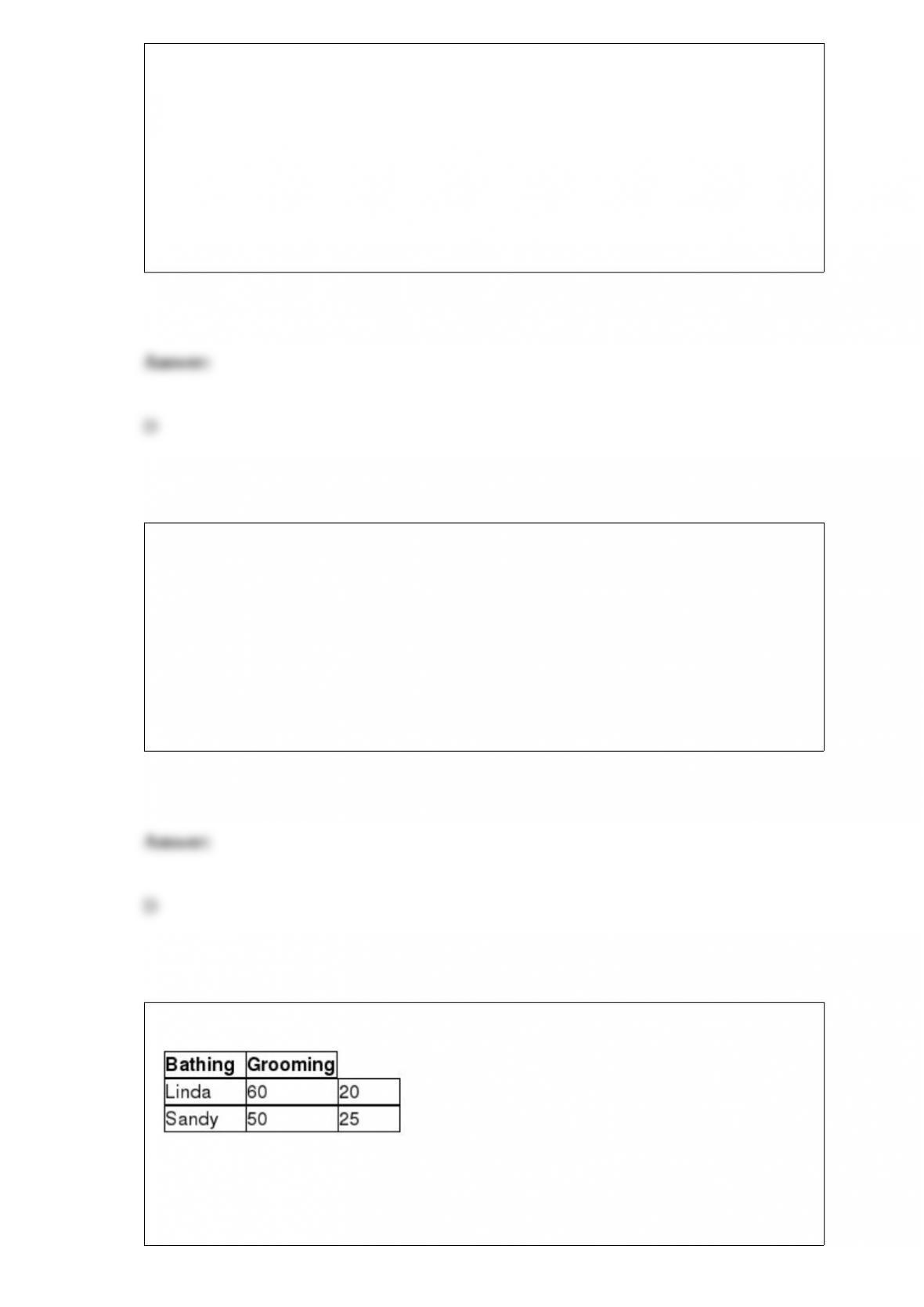
Table 9-1
Linda and Sandy own The Preppy Puppy, a dog grooming business. Table 9-1 lists the
number of dogs Linda and Sandy can each bathe and groom in one week. Select the
statement that accurately interprets the data in the table.

A) Linda has a comparative advantage in dog bathing.
B) Sandy has an absolute advantage in dog bathing.
C) Sandy has a comparative advantage in dog bathing.
D) Linda has a comparative advantage in dog grooming and dog bathing.
Assume that the demand curve for MP3 players shifts to the right and the supply curve
for MP3 players shift to the left, but the supply curve shifts less than the demand curve.
As a result
A) both the equilibrium price and quantity of MP3 players will decrease.
B) both the equilibrium price and quantity of MP3 players will increase.
C) the equilibrium price of MP3 players may increase or decrease; the equilibrium
quantity will decrease.
D) the equilibrium price of MP3 players will increase; the equilibrium quantity will
decrease.
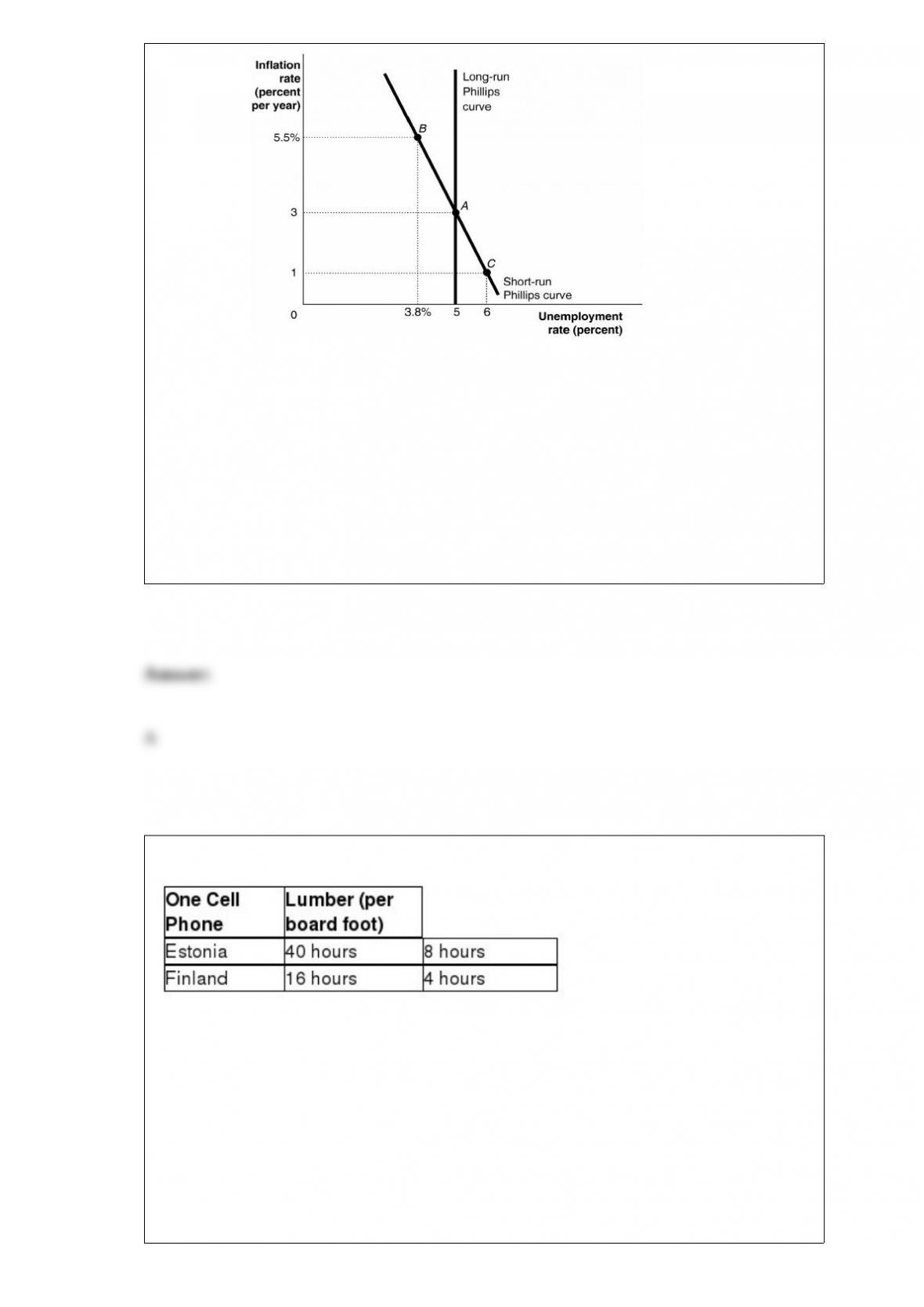
Figure 17-2
At which point are inflation expectations equal to the actual inflation rate?
A) A
B) B
C) C
D) all of the above
Table 2-5
Table 2-5 shows the number of labor hours required to produce a cell phone and a board
foot of lumber in Estonia and Finland. If the two countries specialize and trade, who
should export lumber?
A) There is no basis for trade between the two countries.
B) Estonia
C) Finland
D) They should both be exporting lumber.
The complexity of the U.S. federal income tax system results in significant annual
deadweight losses. The opportunity cost of the hours taxpayers spend on record keeping
and completing their tax returns amounts to billions of dollars.
a. If the tax system was simplified, how would this benefit the economy?
b. Why hasn’t the tax system been simplified?
If the minimum wage is set above the market wage,
A) the quantity of labor supplied will be below the quantity of labor demanded.
B) unemployment will rise.
C) highly-skilled workers will have a harder time finding jobs.
D) All of the above are correct.
When the Fed decided to buy long-term Treasury securities while selling an equal
amount of shorter-term treasury securities to keep long-term interest rates low, it was
following a strategy known as
A) securitization.
B) operation twist.
C) quantitative easing.
D) indirect finance.