
If, in the market for oranges, the supply has increased then
A) the supply curve for oranges has shifted to the right.
B) the supply curve for oranges has shifted to the left.
C) there has been a movement upwards along the supply curve for oranges.
D) there has been a movement downwards along the supply curve for oranges.
Marginal revenue product falls as more labor is hired because
A) the price of the product must fall for a perfectly competitive firm to sell more.
B) the wage rate rises as more workers work more hours.
C) the marginal product of labor is negative as additional units of labor are hired.
D) the marginal product of labor falls as a result of the law of diminishing returns.
Assume the average annual CPI values for 2012 and 2013 were 207.3 and 215.3,
respectively. What was the percent increase in the CPI between these two years?
A) 0.96
B) 1.04

C) 3.86
D) 8.0
The financial statements of firms generally are audited by
A) employees of the firm being audited.
B) employees of private accounting firms.
C) employees of the federal government.
D) the board of directors of the corporation being audited.
Which of the following statements about commission systems of compensation is false?
A) They increase the risk to workers because sometimes output declines for reasons not
connected to the worker’s effort.
B) During sluggish periods, an employer’s payroll expenses will decline along with
sales.
C) If workers are paid on the basis of the number of units produced, they may become
less concerned about quality.
D) The lack of income stability will induce the more productive workers to leave in
search of more secure employment.

A monopolist faces
A) a perfectly elastic demand curve.
B) a perfectly inelastic demand curve.
C) a horizontal demand curve.
D) a downward-sloping demand curve.
If the price elasticity of demand for insulin is equal to zero, then the demand curve for
insulin is
A) horizontal.
B) downward sloping.
C) curvilinear.
D) vertical.
Who selects the board of directors of a corporation?

A) the state where the corporation is chartered
B) employees
C) stockholders
D) managers
Price discrimination is the practice of
A) charging different prices for the same good when the price differences are not due to
differences in cost.
B) charging different prices for the same good when the price differences arise because
of differences in cost.
C) charging different prices for different qualities of a product.
D) charging higher prices for brand named goods and lower prices for generic versions
of the goods.
If an increase in income leads to a decrease in the demand for salami, then salami is
A) an inferior good.
B) a neutral good.
C) a necessity.

D) a normal good.
In the long run, if the demand curve of a monopolistically competitive firm is tangent to
its average total cost curve then
A) the firm would break even.
B) the firm would shut down temporarily.
C) the firm would earn enough revenue to cover its variable costs, but not its fixed
costs.
D) the firm would earn an economic profit.
If, as economist Alwyn Young has suggested, high growth rates in Singapore are not a
result of technological progress, how are growth rates in Singapore expected to change
over time?
A) Without technological progress, the high growth rates cannot be sustained.
B) As long as the labor force participation rate is rising, growth can still continue,
despite a lack of technological progress.
C) As long as the amount of capital per hour worked continues to expand, the growth
rate in Singapore will continue to rise at an increasing rate.
D) Agricultural workers will continue to expand their productivity, thereby allowing
Singapore to achieve growth rates above those of higher-income countries.

If the labor supply is unchanged, an increase in the demand for labor will
A) increase the equilibrium wage and decrease the number of workers employed.
B) increase the equilibrium wage and increase the quantity of jobs demanded.
C) decrease the equilibrium wage and increase the number of workers employed.
D) increase the equilibrium wage and increase the number of workers employed.
If weak aggregate demand is pushing the economy into recession, which of the
following must be true?
A) The economy is at an equilibrium that is on the long-run aggregate supply curve.
B) The economy is at an equilibrium that is on the long-run Phillips curve.
C) The economy is at an equilibrium that is not on the long-run Phillips curve.
D) Contractionary monetary policies will push the economy back to the long-run
Phillips curve.
Online companies gather personal information about the customers who shop on their
Websites and some of those companies will use the data to estimate price elasticities of
the customers. Doing this is a way that these companies might be able to charge a
higher price for a product to those customers who have a ________ price elasticity of
demand.
A) high
B) low
C) negative
D) unitary
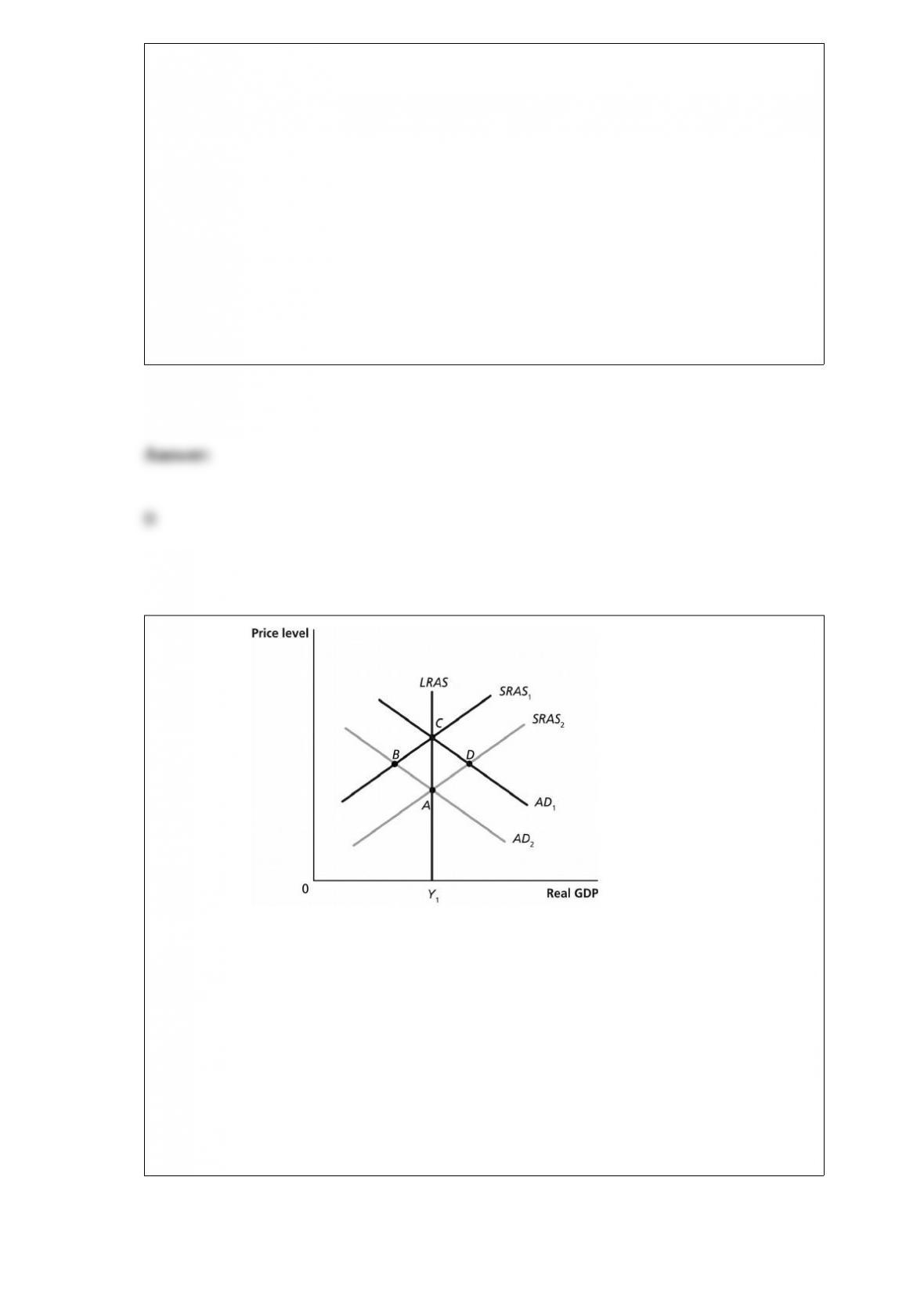
Figure 13-3
Suppose the economy is at point C. If investment spending decreases in the economy,
where will the eventual long-run equilibrium be?
A) A
B) B
C) C
D) D
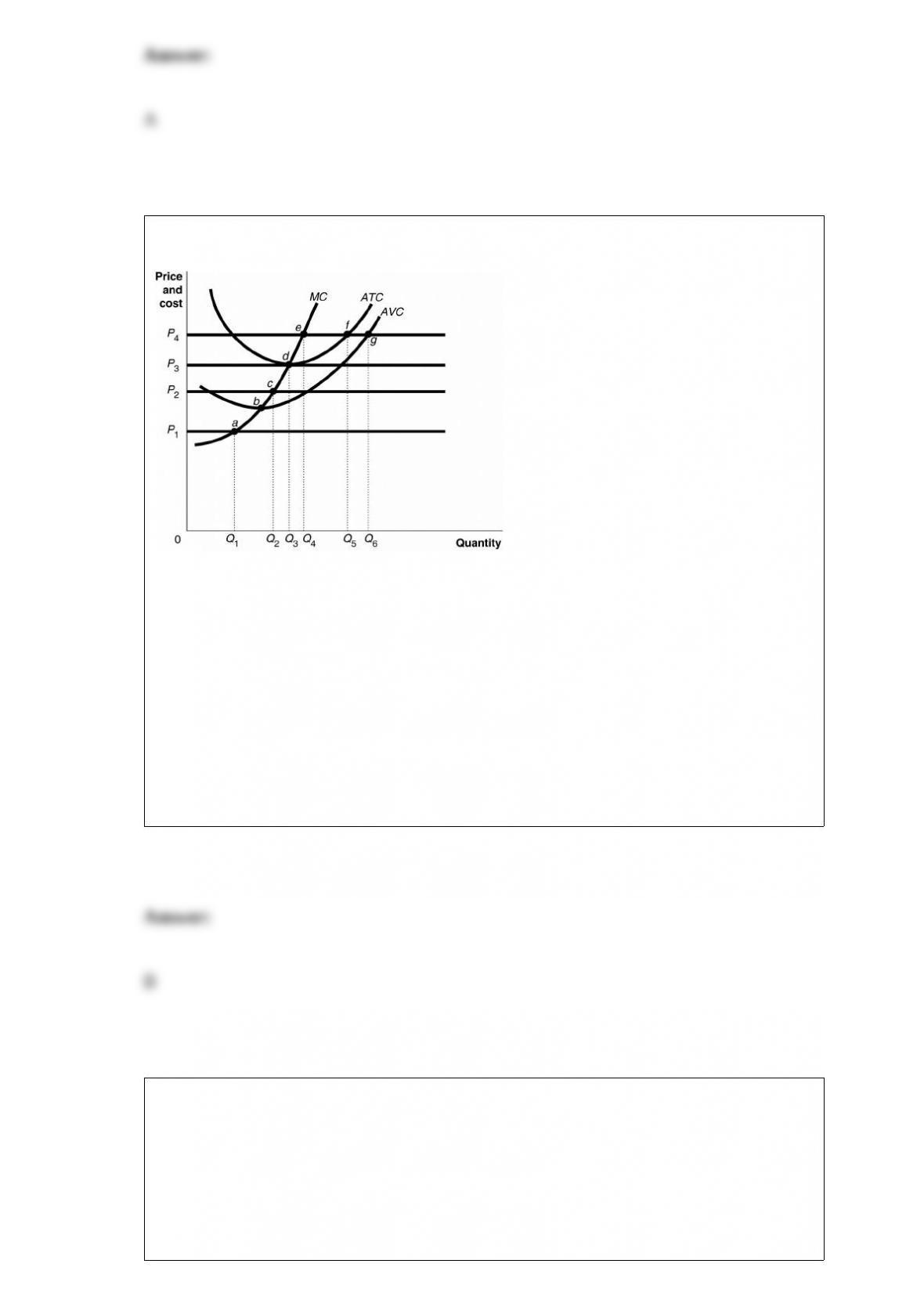
Figure 12-9
Figure 12-9 shows cost and demand
curves facing a profit-maximizing, perfectly competitive firm.
At price P1, the firm would
A) lose an amount equal to its fixed cost.
B) lose an amount more than fixed cost.
C) lose an amount less than fixed cost.
D) break even.
An explicit cost is
A) a nonmonetary opportunity cost.
B) a cost specifically related to government rules and regulations.
C) a cost that involves spending money.

D) a cost unique to corporations.
A market demand curve reflects the
A) private benefits of consuming a product.
B) external benefits of consuming a product.
C) social benefits of consuming a product.
D) the sum of private and social benefits of consuming a product.