
If an increase in income results in a decrease in the quantity demanded of a good, then
for that good, the
a. crossprice elasticity of demand is negative.
b. price elasticity of demand is elastic.
c. income elasticity of demand is negative.
d. income elasticity of demand is positive.
Suppose a tax is imposed on bananas. In which of the following cases will the tax cause
the equilibrium quantity of bananas to shrink by the largest amount?
a. The response of buyers to a change in the price of bananas is strong, and the response
of sellers to a change in the price of bananas is weak.
b. The response of sellers to a change in the price of bananas is strong, and the response
of buyers to a change in the price of bananas is weak.
c. The response of buyers and sellers to a change in the price of bananas is strong.
d. The response of buyers and sellers to a change in the price of bananas is weak.
Table 327
Assume that Huang and Min can switch between producing parasols and producing
porcelain plates at a constant rate.
Labor Hours Needed to Make 1Quantity Produced in 36 Hours
ParasolPlateParasolPlate
Huang26186
Min24189
Refer to Table 327. The opportunity cost of 1 parasol for Huang is
a. 1/3 plate.
b. 1/2 plate.
c. 3 plates.
d. 6 plates.

Table 74
The numbers in Table 71 reveal the maximum willingness to pay for a ticket to a
Chicago Cubs vs. St. Louis Cardinal’s baseball game at Wrigley Field.
BuyerWillingness to Pay
Jennifer$10
Bryce$15
Dan$20
David$25
Ken$50
Lisa$60
Refer to Table 74. If you have two (essentially) identical tickets that you sell to the
group in an auction, what will be the selling price for each ticket?
a. $21
b. $26
c. $51
d. $61
If the government levies a $1,000 tax per boat on sellers of boats, then the price paid by
buyers of boats would
a. increase by more than $1,000.
b. increase by exactly $1,000.
c. increase by less than $1,000.
d. decrease by an indeterminate amount.
Almost all variation in living standards is attributable to differences in countries’
a. population growth rates.
b. productivity.
c. systems of public education.
d. taxes.
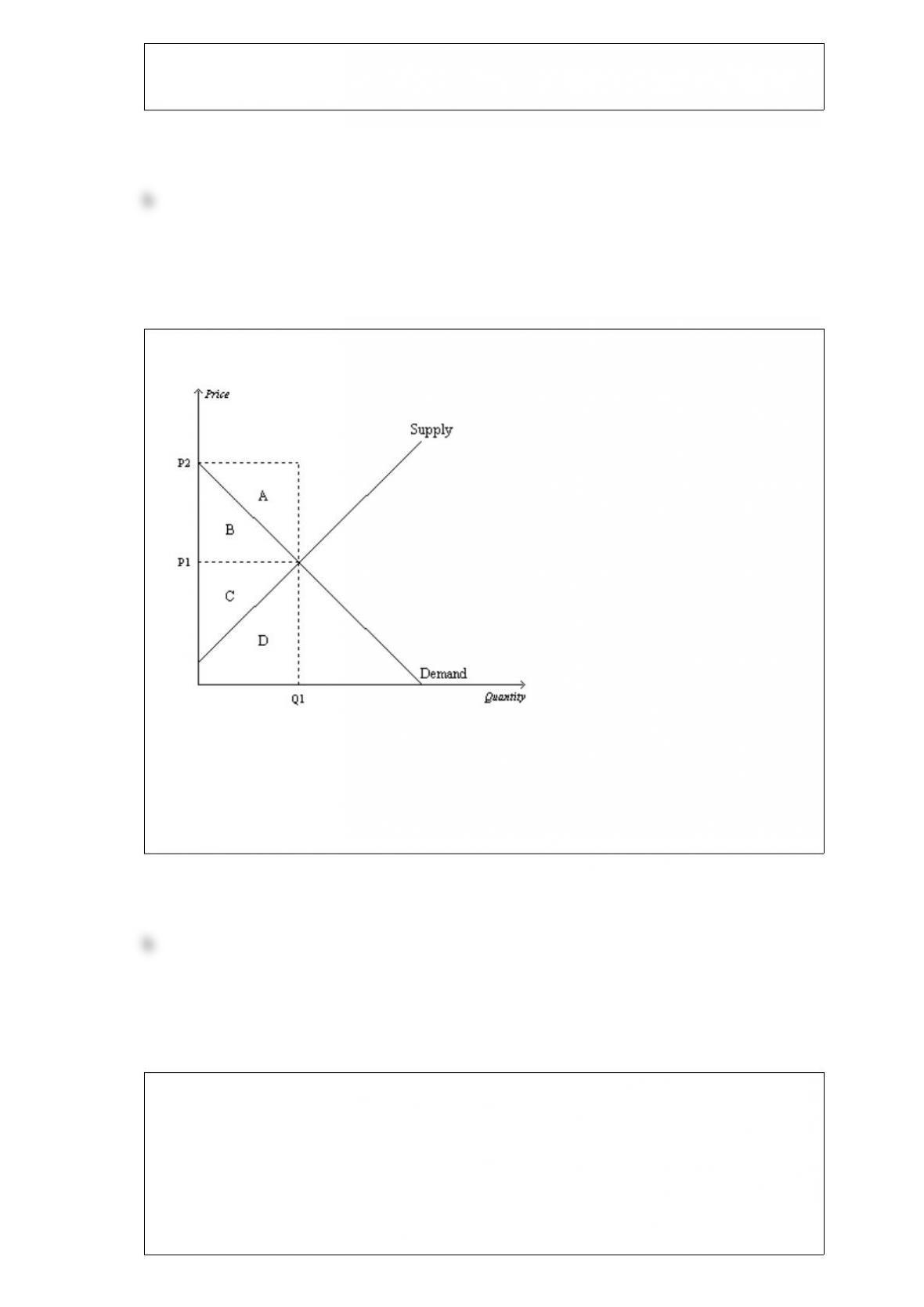
Figure 721
Refer to Figure 721. Which area represents consumer surplus when the price is P1?
a. A
b. B
c. C
d. D
Suppose that gasoline prices increase dramatically this month. Lola commutes 100
miles to work each weekday. Over the next few months, Lola drives less on the
weekends to try to save money. Within the year, she sells her home and purchases one
only 10 miles from her place of employment. These examples illustrate the importance
of
a. the availability of substitutes in determining the price elasticity of demand.
b. a necessity versus a luxury in determining the price elasticity of demand.

c. the definition of a market in determining the price elasticity of demand.
d. the time horizon in determining the price elasticity of demand.
Table 79
The only four consumers in a market have the following willingness to pay for a good:
BuyerWillingness to Pay
Ashleigh$12
Barb$15
Carolyn$19
Danita$27
Refer to Table 79. If there is only one unit of the good available for purchase, and if the
buyers bid against each other for the right to purchase it, then the consumer surplus will
be
a. $0 or slightly more.
b. $3 or slightly less.
c. $4 or slightly more.
d. $8 or slightly less.
Scenario 54
Milk has an inelastic demand, and beef has an elastic demand. Suppose that a
mysterious increase in bovine infertility decreases both the population of dairy cows
and the population of beef cattle by 50 percent.
Refer to Scenario 54. The change in equilibrium quantity will be
a. greater in the milk market than in the beef market.
b. greater in the beef market than in the milk market.
c. the same in the milk and beef markets.
d. Any of the above could be correct.
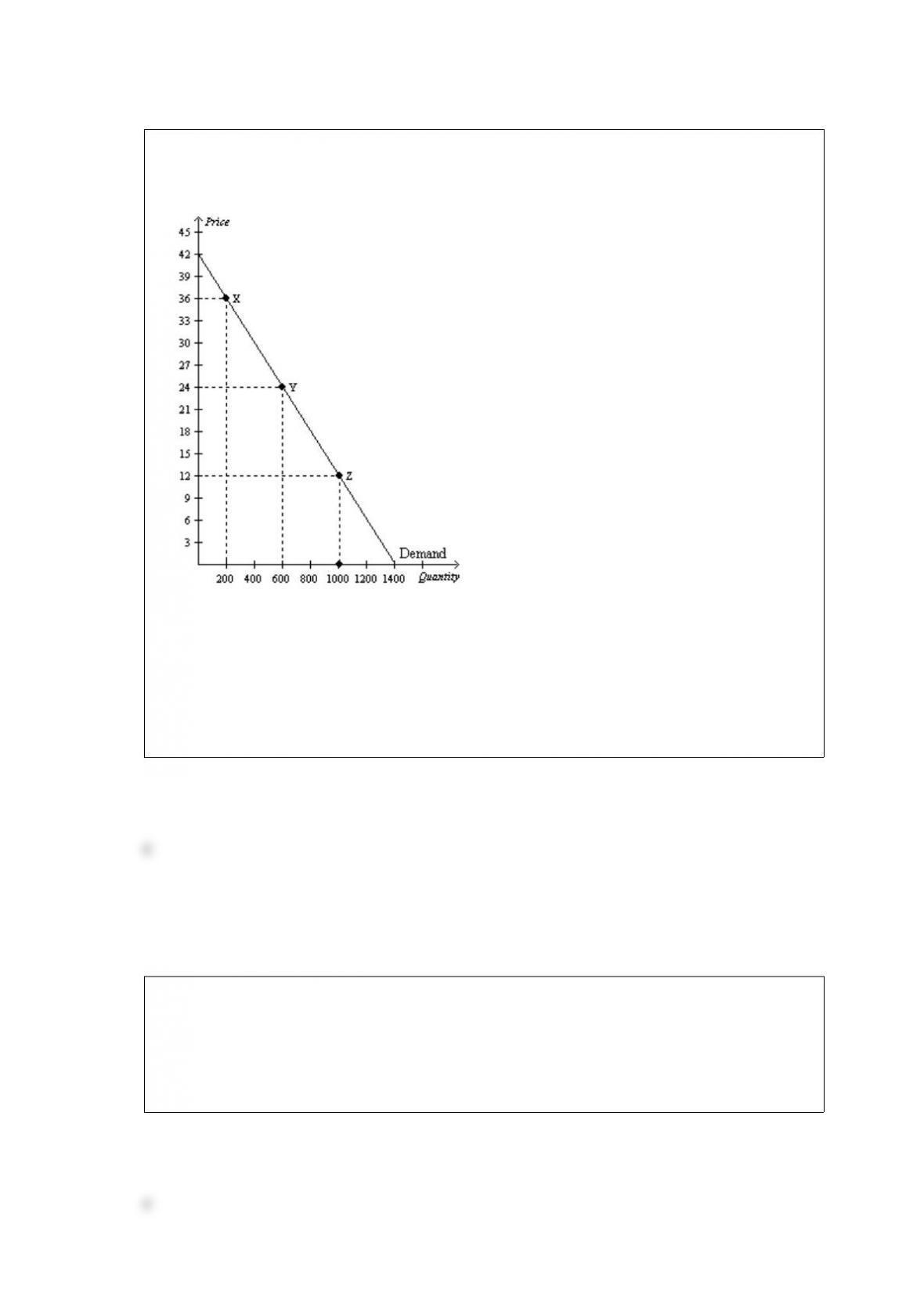
Figure 512
Refer to Figure 512. Which of the following price changes would result in no change
in sellers’ total revenue?
a. The price increases from $15 to $21.
b. The price increases from $18 to $21.
c. The price decreases from $24 to $18.
d. The price decreases from $27 to $24.
Minimumwage laws dictate
a. the exact wage that firms must pay workers.
b. a maximum wage that firms may pay workers.
c. a minimum wage that firms may pay workers.
d. both a minimum wage and a maximum wage that firms may pay workers.

When economists are trying to explain the world, they are
a. scientists.
b. policy advisers.
c. in the realm of microeconomics rather than macroeconomics.
d. in the realm of normative economics rather than positive economics.
A certain state legislature is considering an increase in the state gasoline tax.
Representative Campbell argues that an increase in the gasoline tax would harm
lowincome drivers disproportionately. Representative Richards responds by saying that
lowincome drivers own smaller cars that use less gasoline, and that lowincome drivers
therefore would not be harmed disproportionately.
a. Representative Campbell’s argument is based primarily on efficiency, while
Representative Richards’ argument is based primarily on equality.
b. Representative Campbell’s argument is based primarily on equality, while
Representative Richards’ argument is based primarily on efficiency.
c. Both representatives’ arguments are based primarily on efficiency.
d. Both representatives’ arguments are based primarily on equality.
When two countries trade with one another, it is most likely because
a. the wealthy people in each of the two countries are able to benefit, through trade, by
taking advantage of other people who are poor.
b. some people involved in the trade do not understand that one of the two countries
will become worseoff because of the trade.
c. the opportunity costs of producing various goods are identical for the two countries.
d. the two countries wish to take advantage of the principle of comparative advantage.

In the short run, rent control causes the quantity supplied
a. and quantity demanded to fall.
b. to fall and quantity demanded to rise.
c. to rise and quantity demanded to fall.
d. and quantity demanded to rise.
If the price elasticity of demand for a good is 1.4, then a 14 percent increase in the
quantity demanded must be the result of
a. a 0.1 percent decrease in the price.
b. a 1 percent decrease in the price.
c. a 10 percent decrease in the price.
d. a 19.6 percent decrease in the price.
Table 59
Supply Curve ASupply Curve BSupply Curve C
Price $1.00 $2.00 $1.00 $3.00$2.00 $5.00
Quantity Supplied 500 600 600 900 400 700
Refer to Table 59. Which of the three supply curves represents the least elastic supply?
a. supply curve A
b. supply curve B
c. supply curve C
d. There is no difference in the elasticity of the three supply curves.
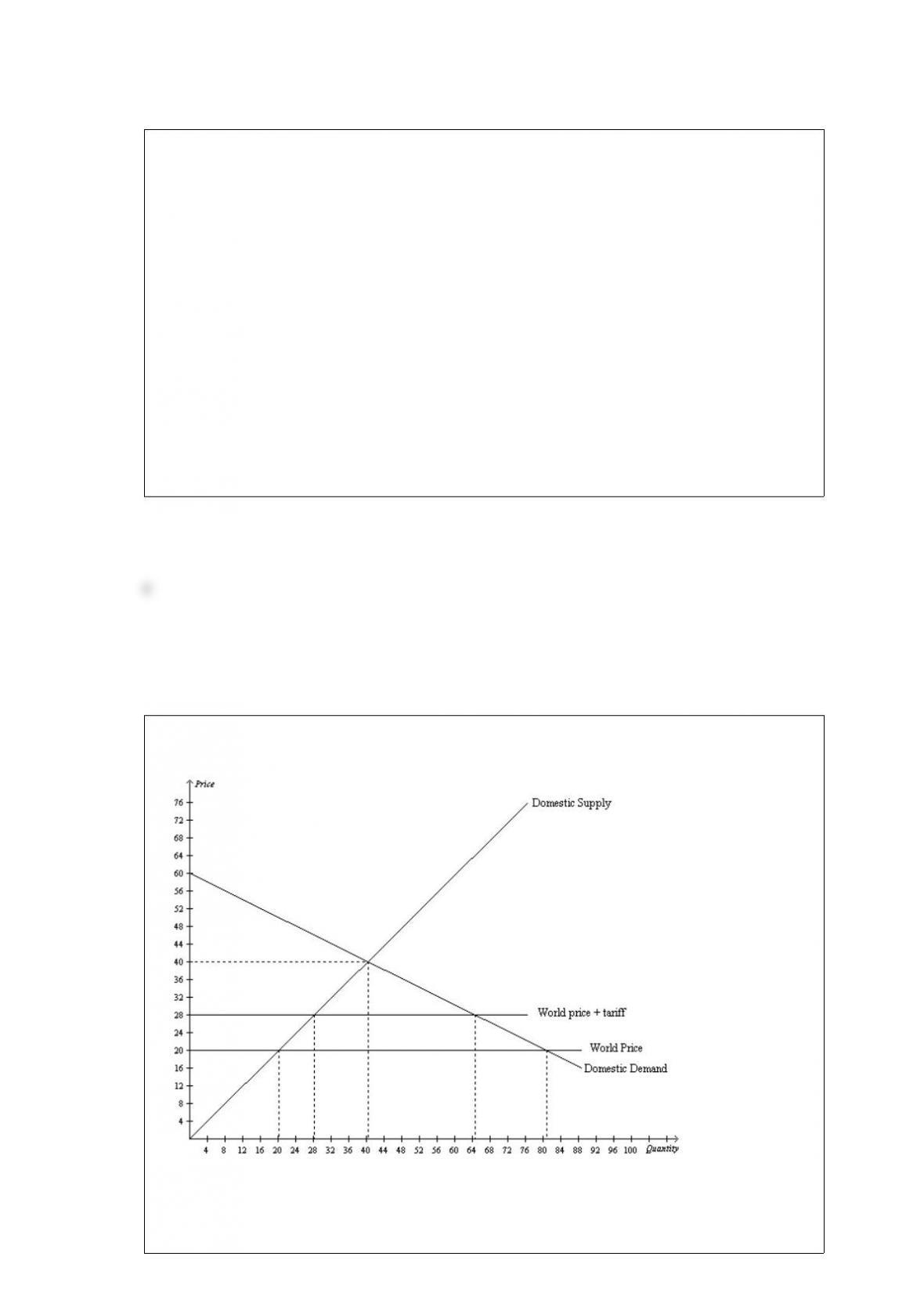
Table 334
Assume that Indonesia and India can switch between producing rice and bananas at a
constant rate.
Labor Hours Needed to Make 1 Unit ofNumber of Units Produced in 40 Hours
RiceBananasRiceBananas
Indonesia25208
India421020
Refer to Table 334. India’s opportunity cost of producing rice is
a. 1/2 units of bananas. This is higher than Indonesia’s opportunity cost of producing
rice.
b. 1/2 units of bananas. This is lower than Indonesia’s opportunity cost of producing
rice.
c. 2 units of bananas. This is higher than Indonesia’s opportunity cost of producing rice.
d. 2 units of bananas. This is lower than Indonesia’s opportunity cost of producing rice.
Figure 917
Refer to Figure 917. When the country moves from no trade to free trade, consumer
surplus
a. increases by $1,200 and producer surplus increases by $600.

b. increases by $1,200 and producer surplus decreases by $600.
c. decreases by $1,350 and producer surplus increases by $450.
d. decreases by $1,350 and producer surplus decreases by $450.
What will happen to the equilibrium price and quantity of traditional camera film if
traditional cameras become more expensive, digital cameras become cheaper, the cost
of the resources needed to manufacture traditional film falls, and more firms decide to
manufacture traditional film?
a. Price will fall, and the effect on quantity is ambiguous.
b. Price will rise, and the effect on quantity is ambiguous.
c. Quantity will fall, and the effect on price is ambiguous.
d. Quantity will rise, and the effect on price is ambiguous.
A barber currently cuts hair for 50 clients per week and earns a profit. He is considering
expanding his operation in order to serve more clients. Should he expand?
a. Yes, because cutting hair is profitable.
b. No, because he may not be able to sell more services.
c. It depends on the marginal cost of serving more clients and the marginal revenue he
will earn from serving more clients.
d. It depends on the average cost of serving more clients and the average revenue he
will earn from serving more clients.
Figure 58
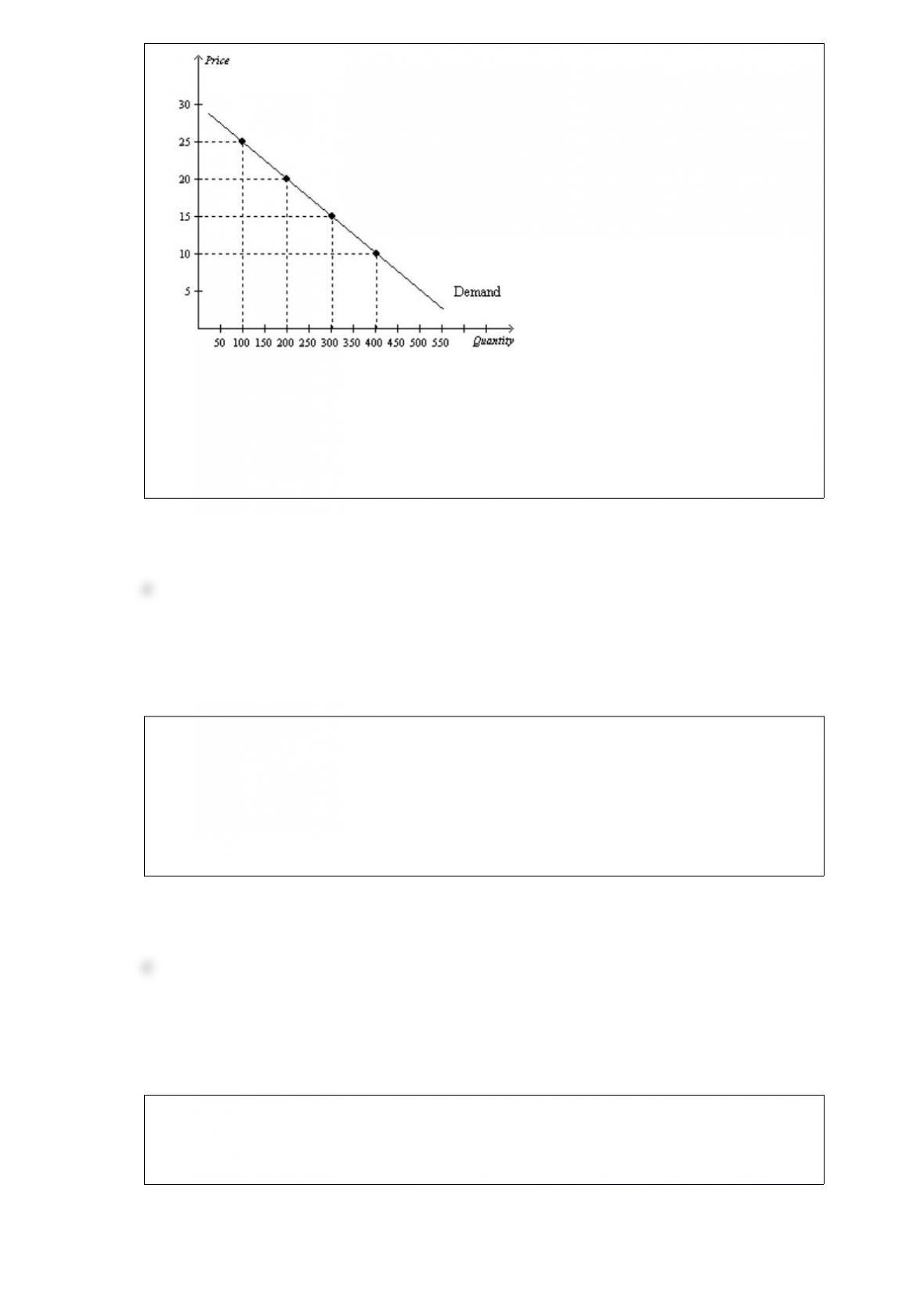
Refer to Figure 58. When price falls from $25 to $20, demand is
a. inelastic, since total revenue decreases from $4,000 to $2,500.
b. inelastic, since total revenue increases from $2,500 to $4,000.
c. elastic, since total revenue increases from $2,500 to $4,000.
d. unit elastic, since total revenue does not change.
Consumer surplus
a. is closely related to the supply curve for a product.
b. is represented by a rectangle on a supplydemand graph when the demand curve is a
straight, downwardsloping line.
c. is measured using the demand curve for a product.
d. does not reflect economic wellbeing in most markets.
Figure 922
The following diagram shows the domestic demand and domestic supply in a market. In
addition, assume that the world price in this market is $40 per unit.
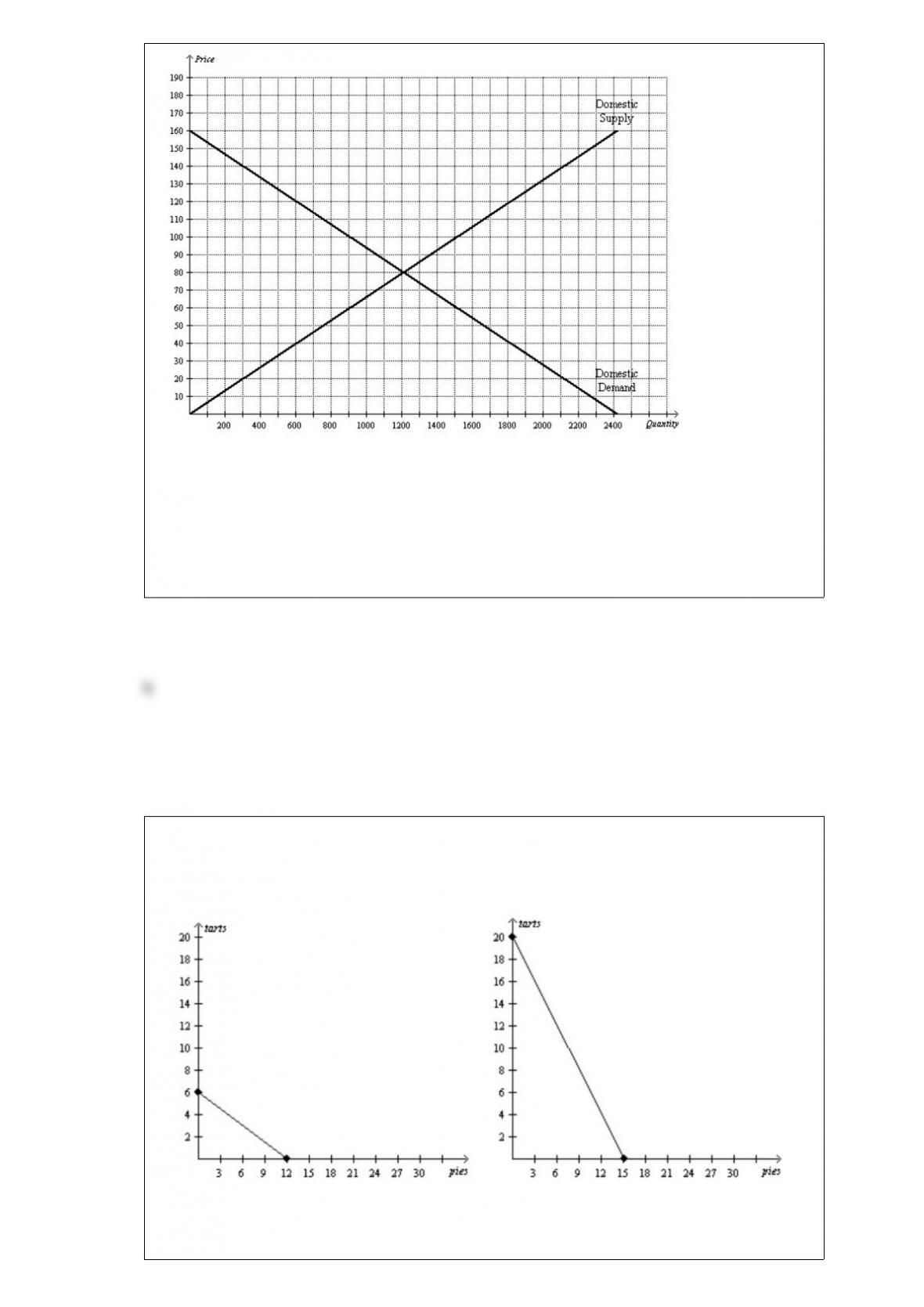
Refer to Figure 922. Suppose the government imposes a tariff of $20 per unit. With
trade and a tariff, total surplus is
a. $96,000.
b. $114,000.
c. $120,000.
d. $126,000.
Figure 317
Maxine’s Production Possibilities FrontierDaisy’s Production Possibilities Frontier
Refer to Figure 317. If Maxine and Daisy switch from each person dividing her time
equally between the production of pies and tarts to each person spending all of her time

producing the good in which she has a comparative advantage, then total production of
tarts will increase by
a. 7.
b. 10.
c. 17.
d. 20.
Food and clothing tend to have
a. small income elasticities because consumers, regardless of their incomes, choose to
buy relatively constant quantities of these goods.
b. small income elasticities because consumers buy proportionately more of both goods
at higher income levels than they buy at low income levels.
c. large income elasticities because they are necessities.
d. large income elasticities because they are relatively inexpensive.
Table 39
Assume that Maya and Miguel can switch between producing mixers and producing
toasters at a constant rate.
Hours Needed to Make 1Amount Produced in 60 Hours
MixerToasterMixerToaster
Maya 631020
Miguel105612
Refer to Table 39. Assume that Maya and Miguel each has 60 hours available. If each
person divides his/her time equally between the production of mixers and toasters, then
total production is
a. 8 mixers and 16 toasters.
b. 3.5 mixers and 6 toasters.
c. 15 mixers and 9 toasters.
d. 20 mixers and 12 toasters.

The following table contains a supply schedule for a good.
PriceQuantity Supplied
$10100
$20Q1
If the law of supply applies to this good, then Q1 could be
a. 0.
b. 50.
c. 100.
d. 150.
Table 63
The following table contains the demand schedule and supply schedule for a market for
a particular good. Suppose sellers of the good successfully lobby Congress to impose a
price floor $2 above the equilibrium price in this market.
PriceQuantity
DemandedQuantity
Supplied
$0150
$1133
$2116
$399
$4712
$5515
$6318
Refer to Table 63. Following the imposition of a price floor $2 above the equilibrium
price, irate buyers convince Congress to repeal the price floor and to impose a price
ceiling $1 below the former price floor. The resulting shortage is
a. 0 units.
b. 2 units.
c. 5 units.
d. 7 units.

Scenario 53
The supply of aged cheddar cheese is inelastic, and the supply of bread is elastic. Both
goods are considered to be normal goods by a majority of consumers. Suppose that a
large income tax increase decreases the demand for both goods by 10%.
Refer to Scenario 53. The equilibrium quantity will
a. increase in both the aged cheddar cheese and bread markets.
b. increase in the aged cheddar cheese market and decrease in the bread market.
c. decrease in the aged cheddar cheese market and increase in the bread market.
d. decrease in both the aged cheddar cheese and bread markets.
A person can benefit from specialization and trade by obtaining a good at a price that is
a. lower than his or her opportunity cost of that good.
b. the same as his or her opportunity cost of that good.
c. higher than his or her opportunity cost of that good.
d. different than his or her opportunity cost of that good.
The Council of Economic Advisers
a. was created in 1946.
b. advises the president of the United States on economic policy matters.
c. writes the annual Economic Report of the President.
d. All of the above are correct.