
If a decision maker chooses an option that leaves him or her worse off than choosing
another available option, he or she is:
A) using bounded rationality.
B) basing the decision on risk aversion.
C) making an irrational decision.
D) making a rational decision.
People who live in large cities decide to spend less in their day-to-day activities. This
will most likely lead to:
A) less income for other people.
B) more income for other people.
C) no impact on other people.
D) inflation.
Figure: Monopoly Profits in Duopoly
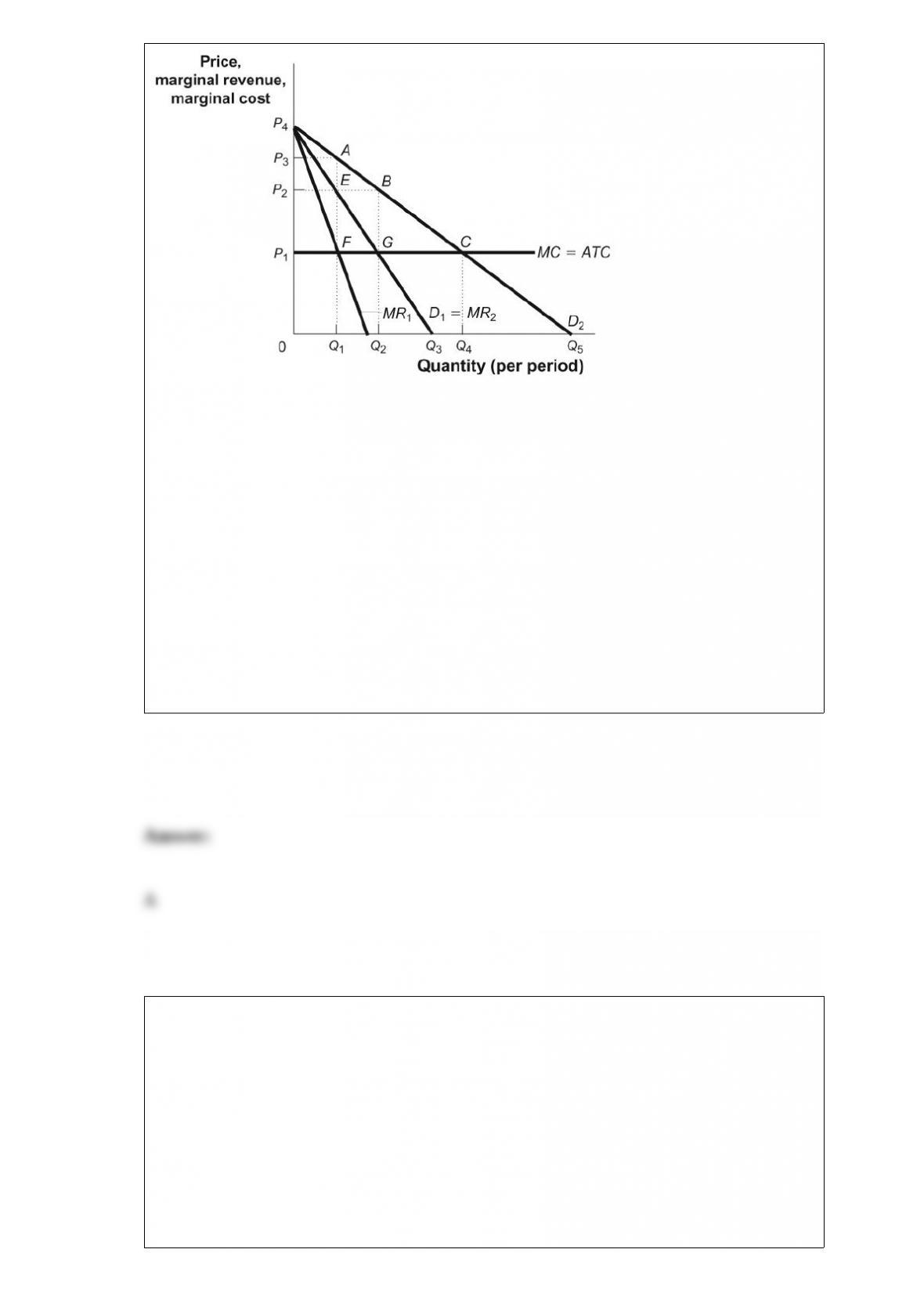
(Figure: Monopoly Profits in Duopoly) The figure Monopoly Profits in Duopoly shows
how an industry consisting of two firms that face identical demand curves (D1) can
collude to increase profits. If the firms collude to share the market demand equally, then
each firm will act as if its marginal revenue curve is given by:
A) MR1.
B) 2 × MR1.
C) MR2.
D) MC.
Scenario: Accounting and Economic Profit
Rather than put the $100,000 that his grandmother left him in a mutual fund that earns
5% each year, Tommy Wang quit his job, which paid $60,000 per year, and started
Wang’s Wicker Furniture Store. He rented a showroom for $20,000 for the year,
purchased $60,000 in wicker furniture, and incurred costs of $40,000 for sales help and
advertising. Instead of using the capital for his own business, he could rent it to a rival
firm and earn $5,000 a year. In his first year, his revenue was $150,000.

(Scenario: Accounting and Economic Profit) Look at the scenario Accounting and
Economic Profit. What is the opportunity cost of Wang’s $100,000 inheritance being
used to start his business?
A) $0
B) $5,000
C) $10,000
D) $100,000
Think about running a restaurant. Probably:
A) cooks and hosts are variable resources.
B) a building is a variable resource in the short run.
C) cheese and other wholesale food items are fixed resources in the short run.
D) valet parking staff is a fixed resource in the long run.
Assume that flood insurance premiums are determined in the competitive market.
Suppose that devastating floods along the Mississippi River have increased the degree
of risk aversion among the insurance investors in this market. The _____ insurance
shifts _____, leading to a(n) _____ in equilibrium premiums and a(n) _____ in the

quantity of insurance bought and sold.
A) supply of; rightward; decrease; increase
B) demand for; leftward; decrease; decrease
C) supply of; leftward; increase; decrease
D) demand for; rightward; increase; increase
A copper mining operation discharges waste products into a river and causes higher
costs and discomfort to downstream users of the water for which they are not
compensated. In this case:
A) too little of society’s resources is being used to produce copper.
B) too much of society’s resources is being used to produce copper.
C) the optimal amount of society’s resources is being used to produce copper.
D) there is an external benefit to society from copper production.
The concept of comparative advantage is based upon:
A) absolute labor productivity.
B) relative labor costs.
C) dollar prices of labor.
D) relative opportunity costs.
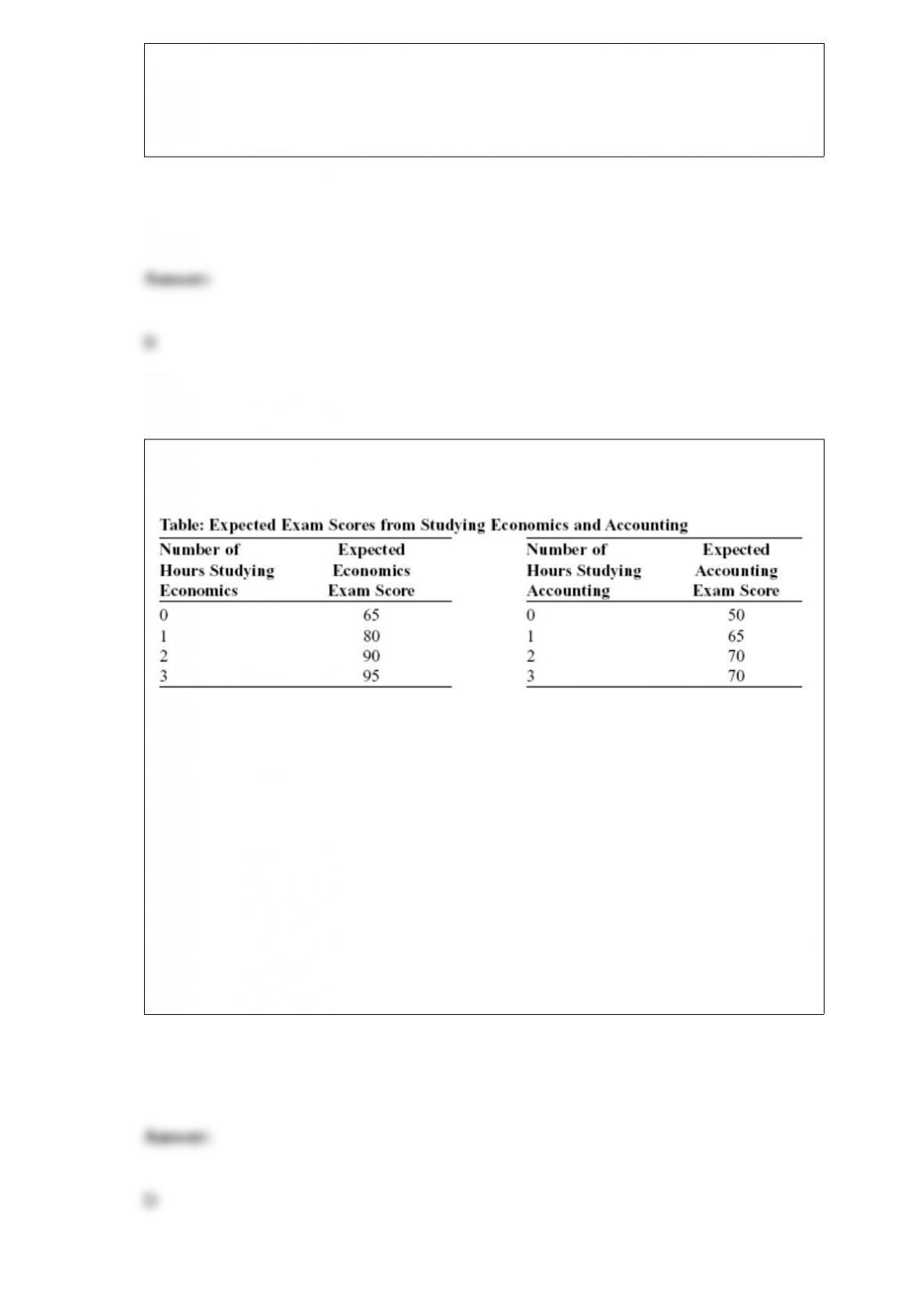
(Table: Expected Exam Scores from Studying Economics and Accounting) Look at the
table Expected Exam Scores from Studying Economics and Accounting. The
opportunity (or marginal) cost in terms of your accounting score of spending the first
hour studying economics is _____ points.
A) 0
B) 5
C) 10
D) 15
Max consumes only yogurt and almonds, and he is on his highest possible indifference
curve. Bundle A (4 yogurts and 2 almonds) and bundle B (3 yogurts and 3 almonds) are
on this indifference curve. Between points A and B, what is Max’s marginal rate of
substitution of yogurt for almonds?
A) 1
B) 2
C) 3
D) 1.33
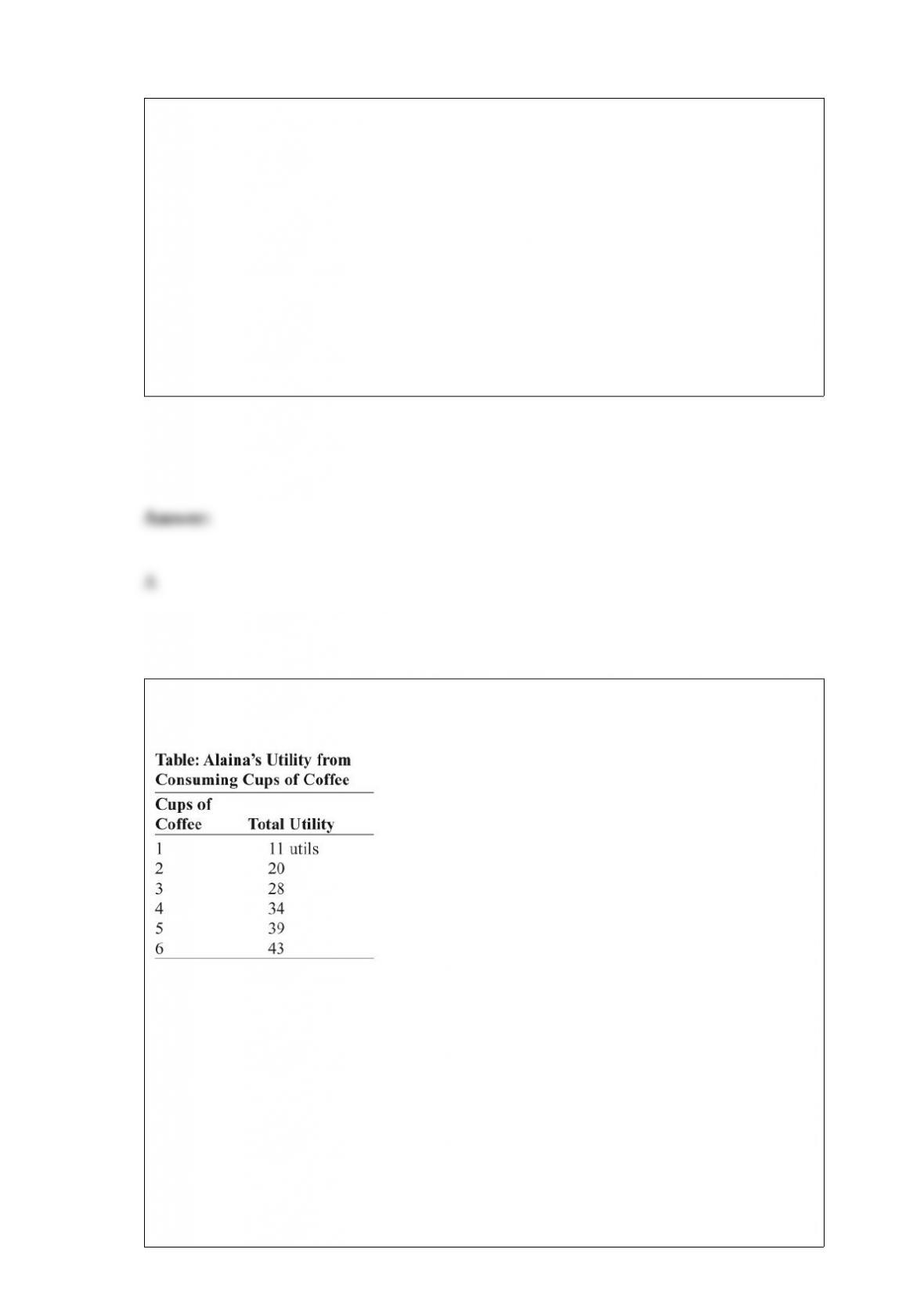
(Table: Alaina’s Utility from Consuming Cups of Coffee) Look at the table Alaina’s
Utility from Consuming Cups of Coffee. Given the information in the table, Alaina’s
total utility from drinking coffee:
A) decreases as she consumes additional coffee.
B) increases at a decreasing rate as she consumes more coffee.
C) stays constant as she consumes more coffee.
D) equals zero.
For a monopolist, the market demand curve:
A) is also the demand for the monopolist’s product.
B) is equal to the monopolist’s MR curve.
C) must be horizontal.
D) is not important, since the monopolist is the only producer.
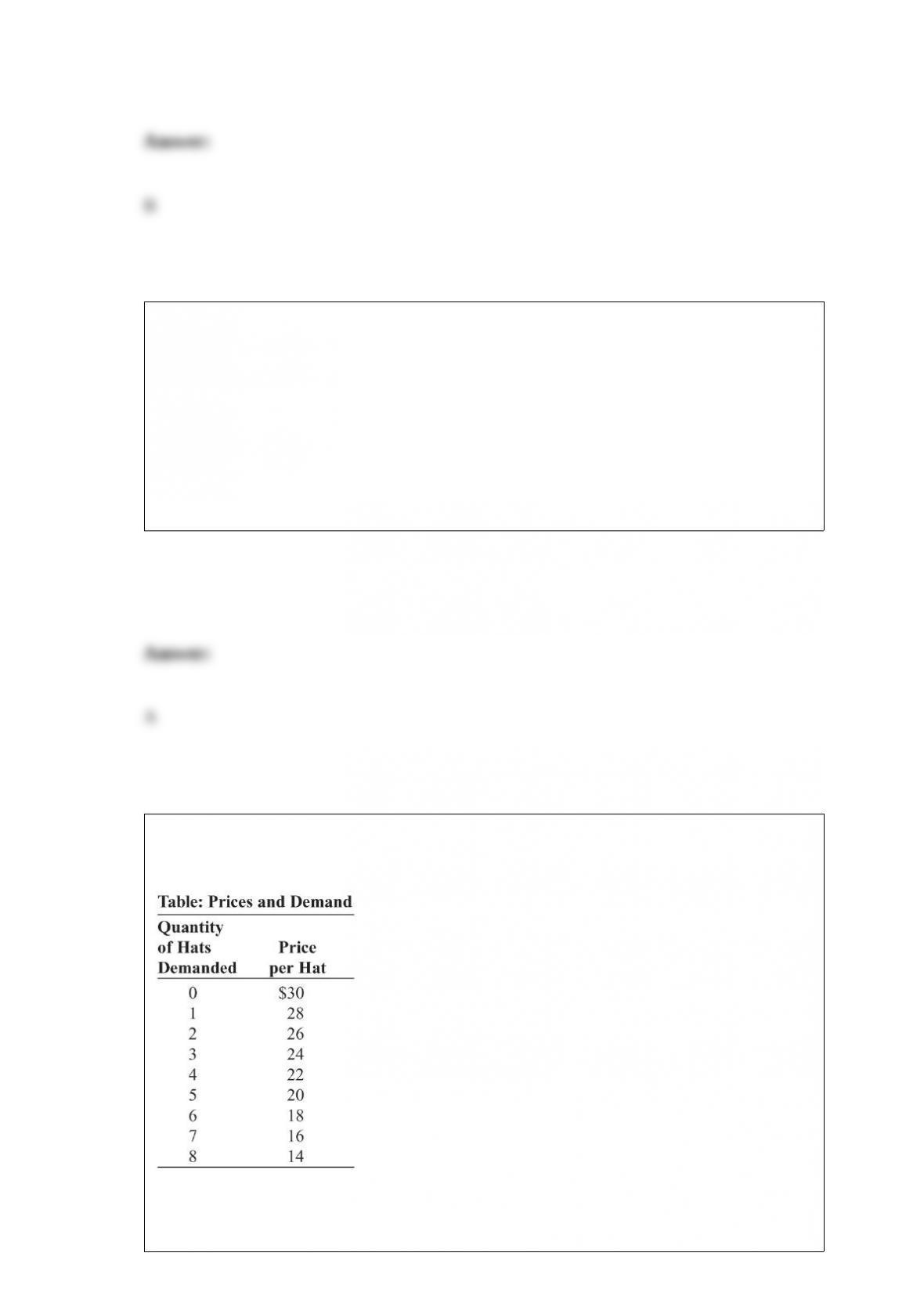
(Table: Prices and Demand) The New Orleans Saints have a monopoly on Saints logo
hats. The marginal cost of producing a hat is $18. If the Saints increase the number of
hats they sell from four to five, the price effect is a(n) _____ in total revenue of _____.
A) decrease; $20
B) increase; $20
C) decrease; $8
D) increase; $8
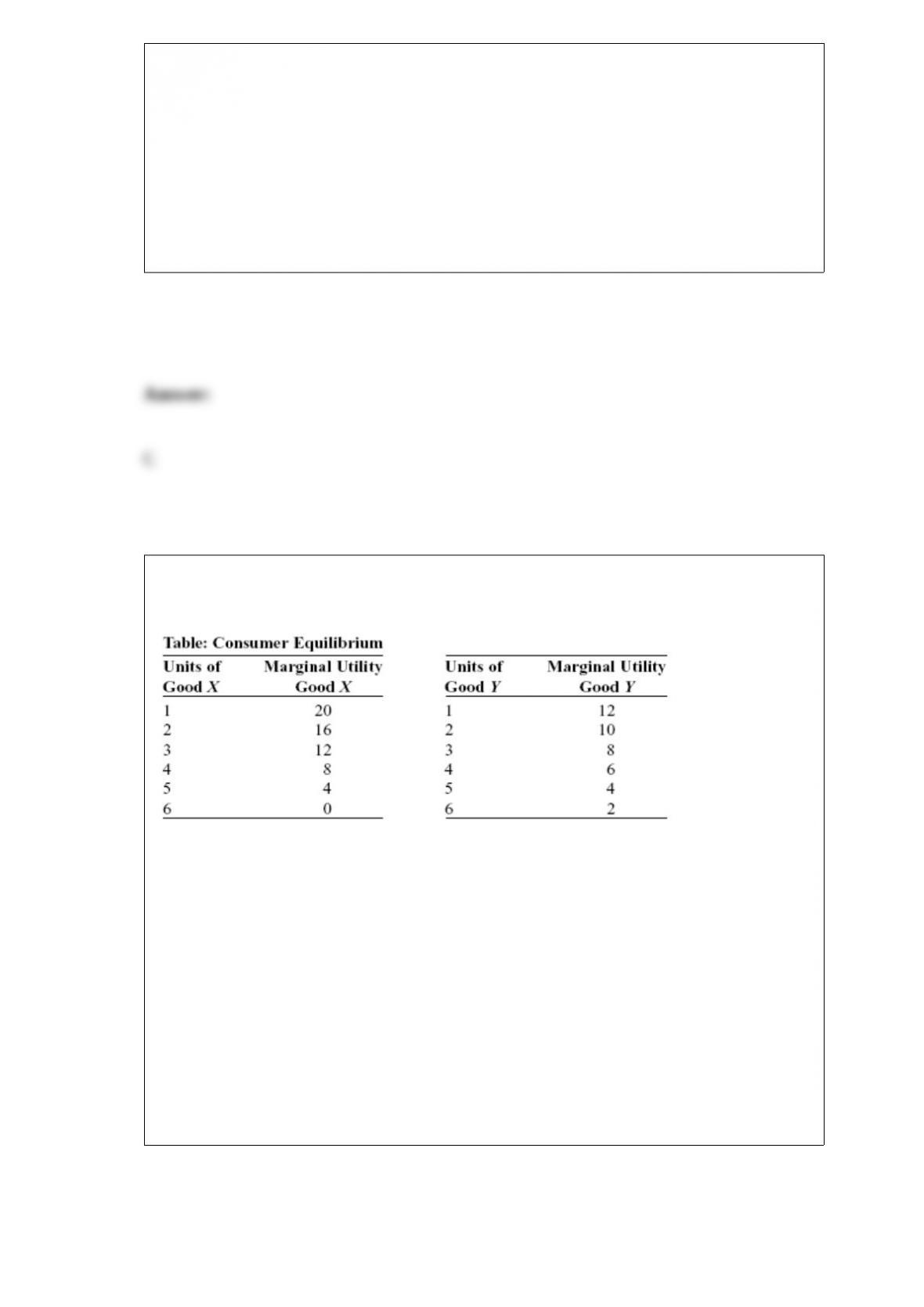
(Table: Consumer Equilibrium) Look at the table Consumer Equilibrium. Assume that
the price of both goods is $1 per unit, that you consume four units of good X and two
units of good Y, and that you are spending all of your income. To maximize utility,
assuming that the goods are divisible, you would consume _____ of X and _____ of Y.
A) less; more
B) more; more
C) less; less
D) more; less
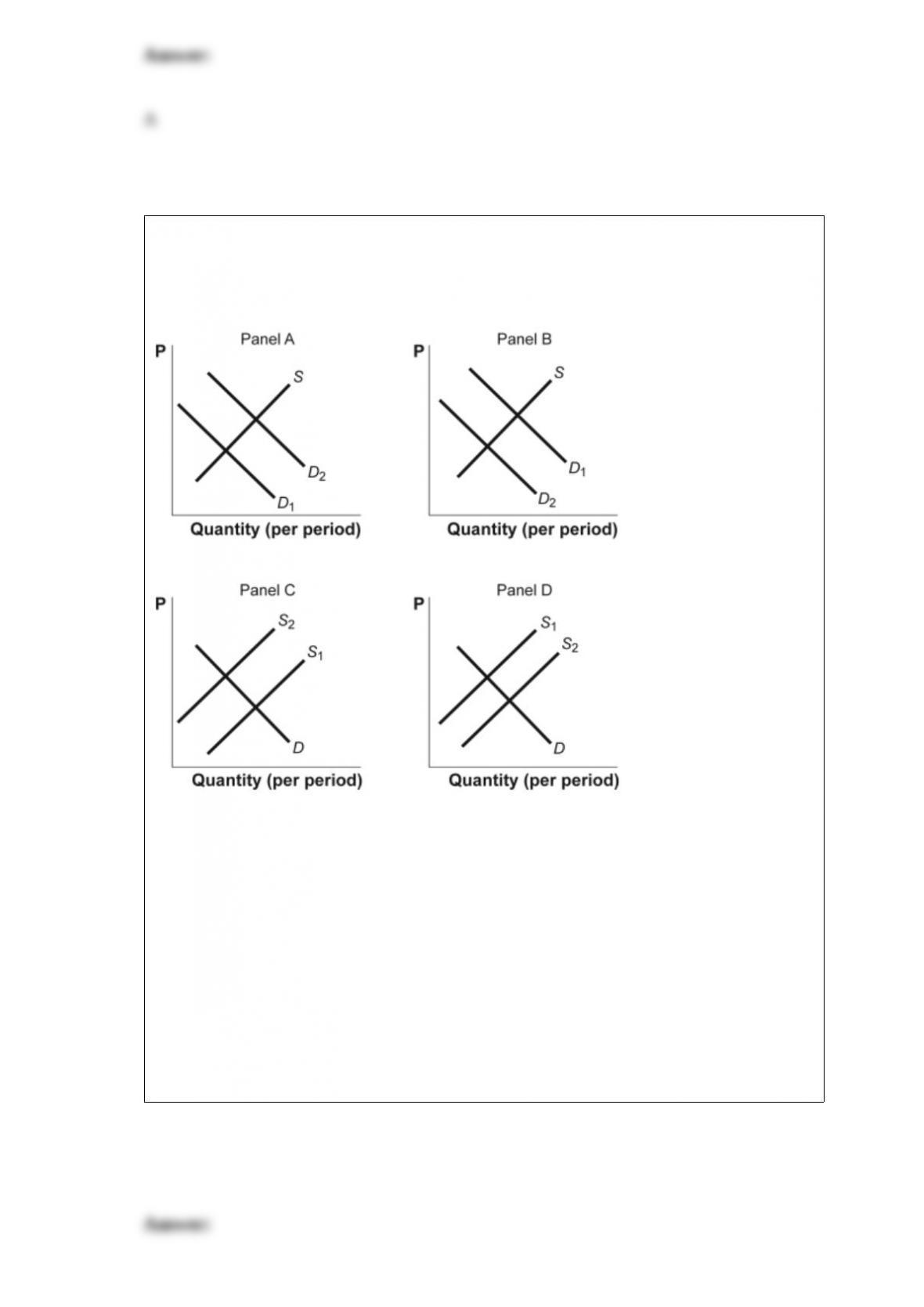
Figure: Shifts in Demand and Supply II
(Figure: Shifts in Demand and Supply II) Look at the figure Shifts in Demand and
Supply II. The graph shows how supply and demand might shift in response to specific
events. Suppose consumer incomes decrease. Which panel BEST describes how this
will affect the market for used clothing, an inferior good?
A) panel A
B) panel B
C) panel C
D) panel D

Consider the supply curve for cotton shirts. An increase in the price of cotton will:
A) increase the supply of cotton shirts.
B) decrease the supply of cotton shirts.
C) increase the quantity supplied of cotton shirts.
D) decrease the demand for cotton shirts.
The benefits principle of taxation means individuals pay according to:
A) whether and how much they use a good or service.
B) benefits gained by society as a whole.
C) benefits to government from having taxpayers.
D) ability to pay.
If the price elasticity of demand for tobacco is 0.5 and the income elasticity of demand

for tobacco is 0.4:
A) an increase in the price of tobacco will decrease total revenue from sales of tobacco.
B) a 20% increase in the price of tobacco will decrease the quantity demanded of
tobacco by 8%.
C) tobacco is an inferior good.
D) a 50% increase in income will increase the quantity demanded of tobacco by 20%.
In the United States in the first two decades following World War II:
A) income distribution in the United States became less equal.
B) income equality measures stayed the same.
C) income distribution became more nearly equal.
D) there was no way to determine income distribution.
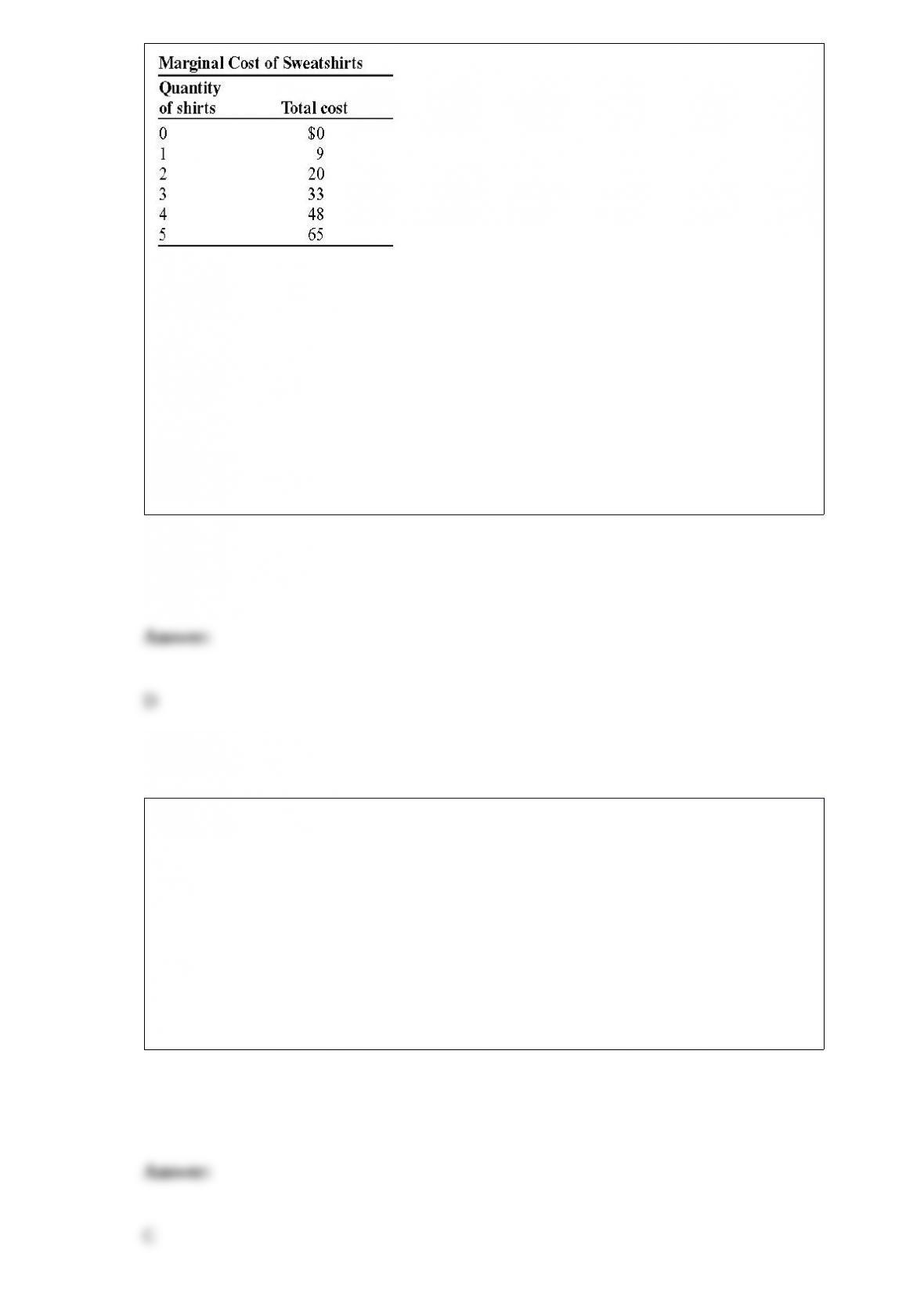
(Table: Marginal Cost of Sweatshirts) Look at the table Marginal Cost of Sweatshirts.
The marginal cost of the fourth sweatshirt is:
A) $9.
B) $20.
C) $24.
D) $15.
An industry characterized by many competitors, each producing identical products,
with free entry and exit, is described as:
A) monopolistically competitive.
B) oligopolistic.
C) perfectly competitive.
D) monopolistic.

A college student is faced with a difficult decision of how to spend one hour tonight.
She could babysit her professor’s child at an hourly wage of $7; she could work at the
college library at a wage of $6; or she could finish her economics homework
assignment. If she chooses to complete her homework assignment, she has incurred an
opportunity cost equal to:
A) $7.
B) $6.
C) $13.
D) $0.
A factor of production whose quantity can be changed during the SHORT run is a(n)
_____ factor of production.
A) marginal
B) fixed
C) incremental
D) variable
Kawamura, a careful utility maximizer, consumes peanut butter and ice cream. Assume
that both peanut butter and ice cream are normal goods and that diminishing marginal
utility applies to both goods. He had just achieved the utility-maximizing solution in his
consumption of the two goods when the price of peanut butter fells. As he adjusted to
this event, the marginal utility of peanut butter _____ and the marginal utility of ice
cream _____.
A) rose; rose
B) fell; fell
C) fell; rose
D) rose; fell
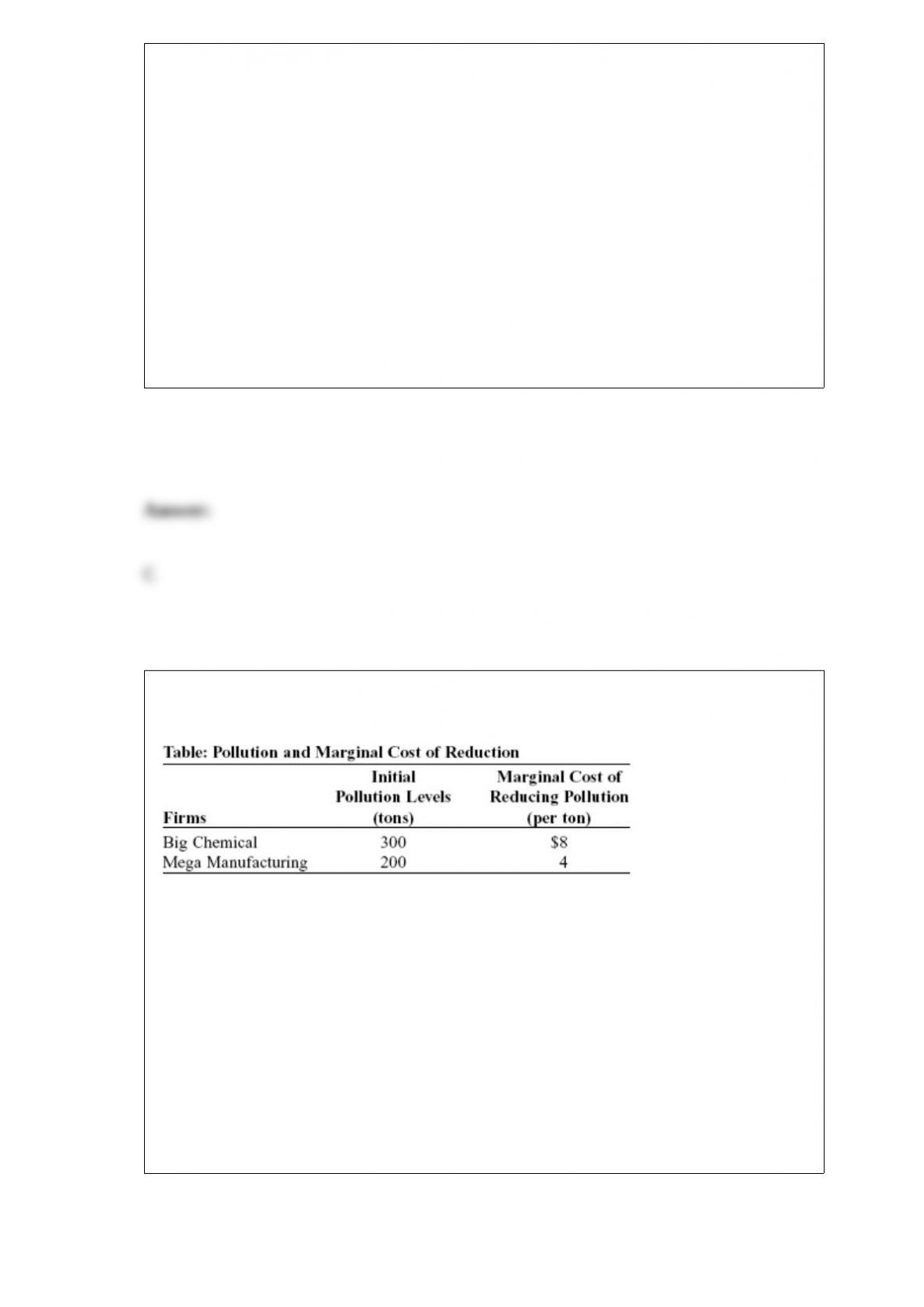
(Table: Pollution and Marginal Cost of Reduction) Look at the table Pollution and
Marginal Cost of Reduction. There are two large firms in your community, Big
Chemical and Mega Manufacturing, and each is a significant source of pollution.
Combined, they are producing 500 tons of pollution, and the EPA has determined that
emission levels should be reduced by half. The marginal cost of reducing pollution is
constant. A) If the EPA dictated that each firm must emit only 125 tons of pollution,
how much total cost would the firms incur to meet this environmental standard? B) If
the EPA distributes 125 pollution permits to each firm, each permit giving the firm the
right to emit 1 ton of pollution, which firm will sell pollution permits, and which firm
will buy them? C) Under this system, what is the total cost to the firms of reducing
pollution to a total of 250 tons?
For most families, total utility does NOT:
A) rise as income rises.
B) rise less quickly as income rises.
C) show increasing marginal utility.
D) show diminishing marginal utility.
Figure: Consumer Equilibrium II
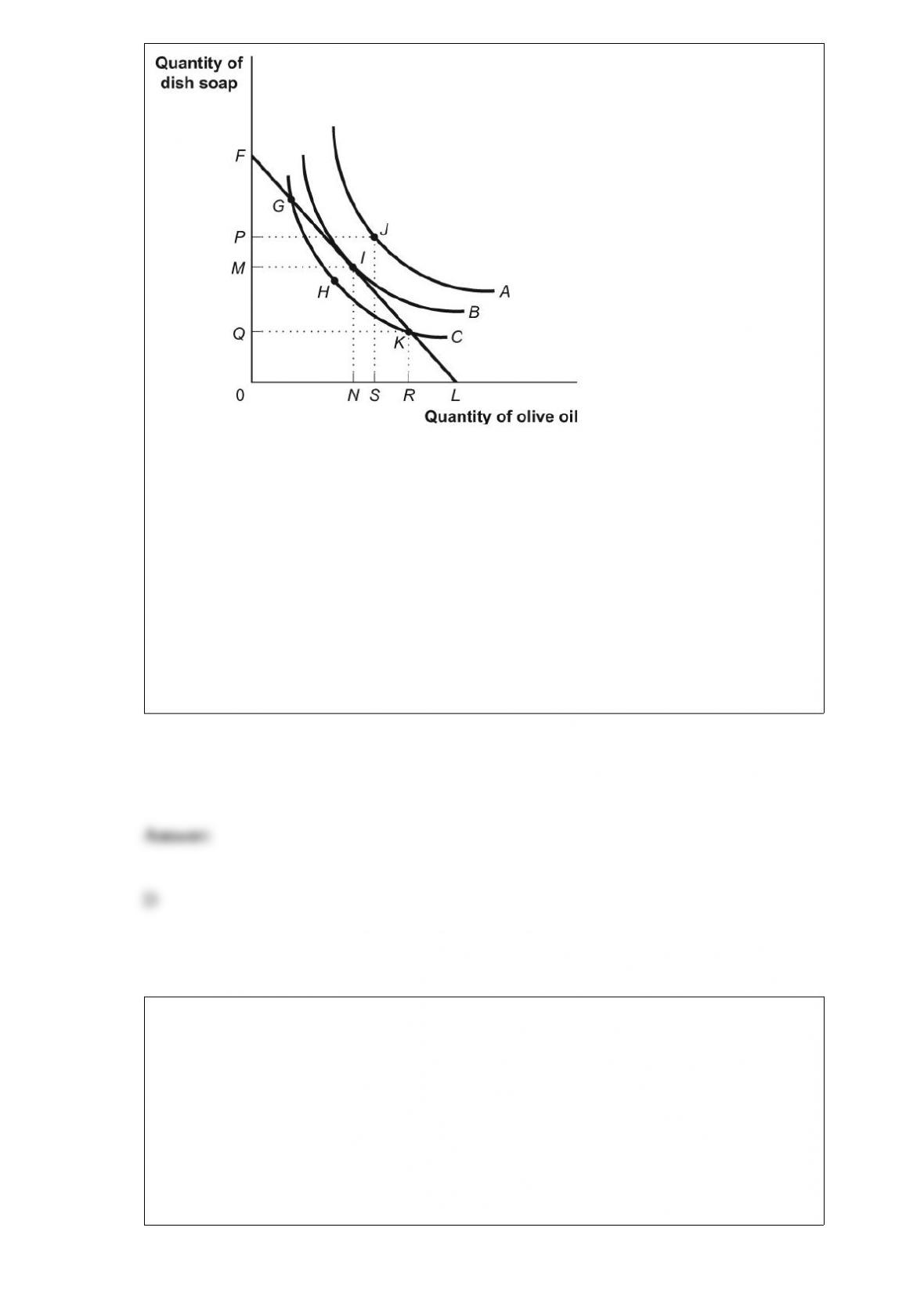
(Figure: Consumer Equilibrium II) Look at the figure Consumer Equilibrium II. The
HIGHEST level of total utility is associated with point _____ on indifference curve
_____.
A) H; C
B) I; B
C) G; B
D) J; A
Price takers are individuals in a market who:
A) select a price from a wide range of alternatives.
B) select the lowest price available in a competitive market.
C) select the average of prices available in a competitive market.
D) have no ability to affect the price of a good in a market.
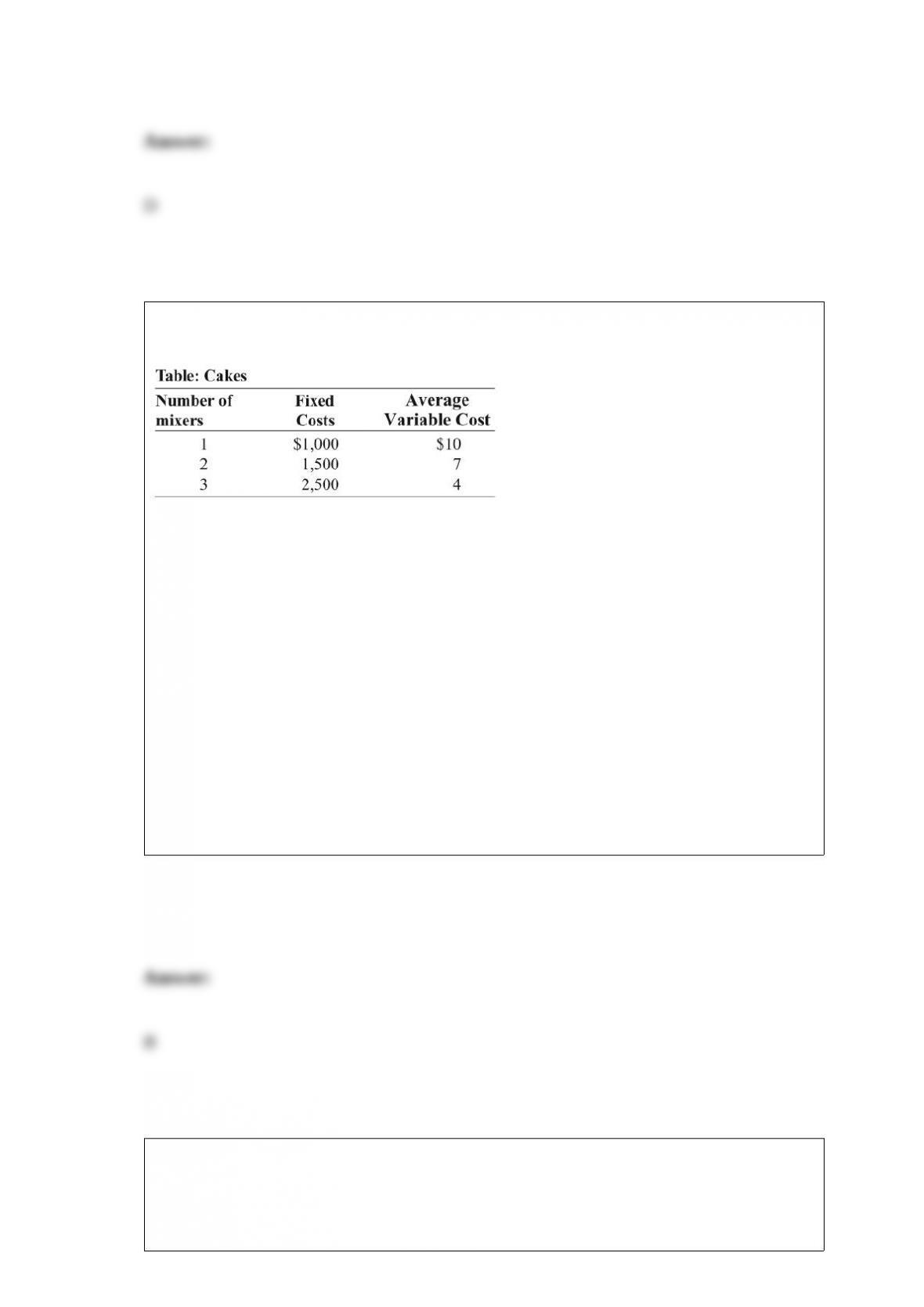
(Table: Cakes) Look at the table Cakes. Pat is opening a bakery to make and sell special
birthday cakes. She is trying to decide how many mixers to purchase. Her estimated
fixed and average variable costs if she purchases one, two, or three mixers are shown in
the table. Assume that average variable costs do not vary with the quantity of output. If
Pat purchases three mixers, her average total cost _____ in the range of output between
100 and 400 cakes.
A) increases
B) decreases
C) remains the same
D) can’t be calculated
If the value of homes in University City increases and as a result the people of
University City spend more, incomes in University City will:
A) decrease.

B) increase.
C) remain the same.
D) be unaffected.
A profit-maximizing firm will hire workers up to the quantity of labor where:
A) VMPL > W.
B) VMPL = W.
C) VMPL < W.
D) MP × MR = VMPL.

Faruq spends all of his income on tacos and milkshakes. His income is $100, the price
of tacos is $10, and the price of milkshakes is $2. If Faruq spends all of his income, the
opportunity cost of one milkshake is equal to _____ tacos.
A) 2
B) 10
C) 5
D) 1/5
The total amount of the good that can be transacted under a quantity control is called
the:
A) ceiling price.
B) demand price.
C) quota limit.
D) supply price.