
A graphical representation of the demand function is called a:
a. demand schedule.
b. demand curve.
c. demand function.
d. marginal revenue schedule.
e. marginal revenue curve.
Insurance companies are able to offset the adverse selection in markets for life
insurance by:
a. requiring premiums that are above the expected value of receipts.
b. only insuring people who appear to be sick.
c. insuring a wide variety of people so that gains on some policies offset losses on
others.
d. requiring medical exams from people whom they insure.
e. requiring higher premiums from healthy people than from sick people.
When average profit is increasing with increases in output, marginal profit must be:

a. increasing.
b. less than average profit.
c. greater than average profit.
d. decreasing.
e. constant.
Marginal profit is maximized when:
a. average profit is equal to marginal profit.
b. total profit is maximized.
c. average profit is increasing.
d. average profit is maximized.
e. average profit is decreasing.
Consider this decision tree, which represents the outcomes of two alternative projects
that Ink, Inc., a producer of printers, might pursue. Ink, Inc., needs to borrow $1,000 to
pursue either project and is going to sell bonds to finance the venture.
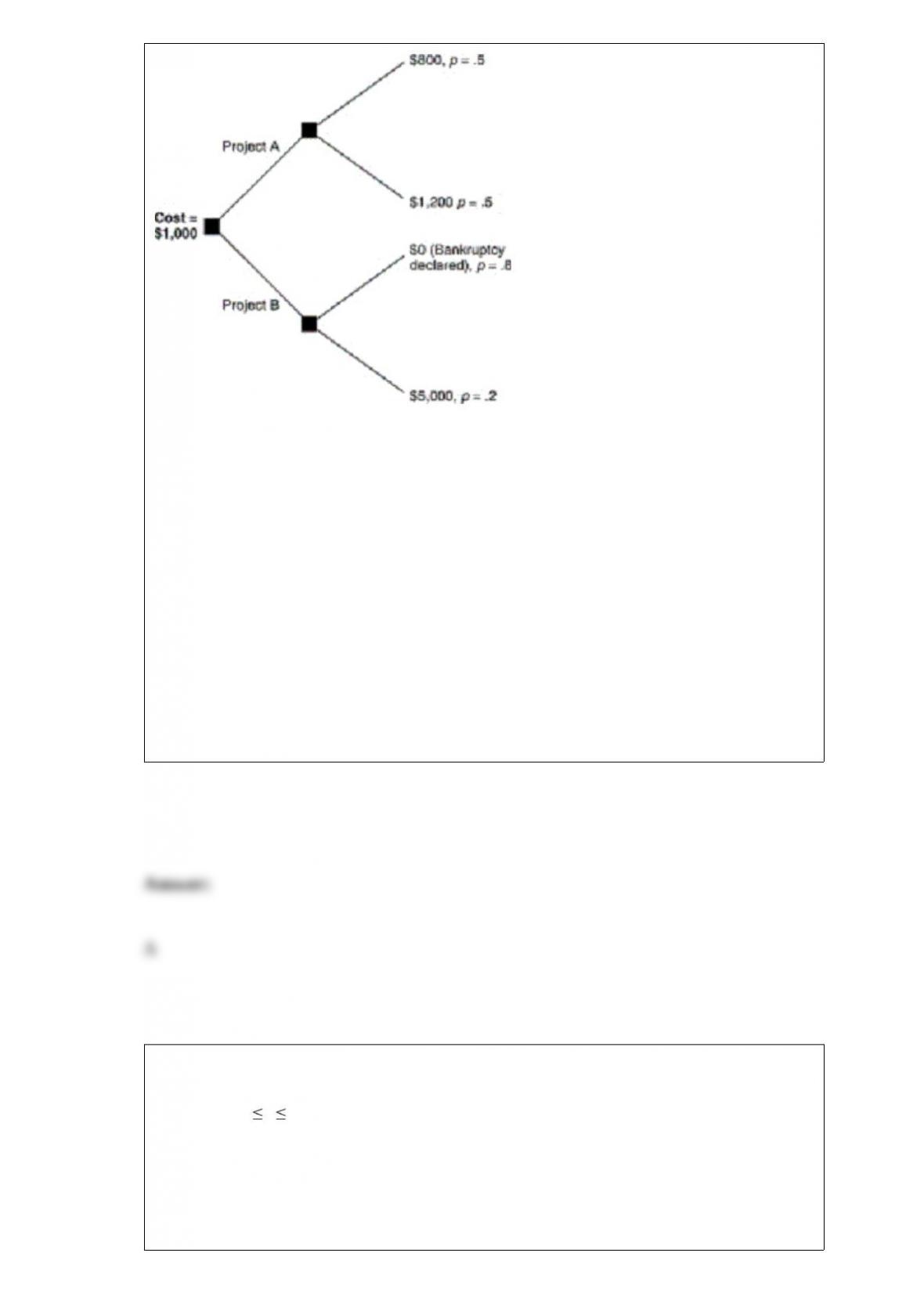
Under these circumstances, bondholders and shareholders may have incompatible
incentives because:
a. shareholders know that they have limited liability because of their ability to declare
bankruptcy.
b. bondholders are not profit maximizers.
c. shareholders are not profit maximizers.
d. bondholders have limited liability because insurance against risk is provided by the
federal government.
e. shareholders insure bondholders against risk.
I. M. Hogg, who is risk-neutral over votes, is running for office with 500,000 sure
voters. To add voters, he wants to choose n, the number of negative campaign ads to
run, where 0 n The ads will backfire with probability n/5 and give him no extra
votes. Otherwise, the ads will work and give him 100,000 + 40,000n extra votes. So n =
0 implies a total of 600,000 votes. He should choose n = :
a. 0
b. 1
c. 2
d. 3
e. 4
A project could yield a profit of $1, $2, $3, or $6, with equal probability. Then the
variance, s2, is:
a. 1
b. 3/2.
c. 7/2.
d. 9/2.
e. 14
Susan is investing in the stock market. She is choosing among a variety of stocks; each
stock has an expected return and a level of risk attached. Susan likes higher returns, but
she dislikes risk. If we were to draw indifference curves for Susan over risk and
expected return, they would be:
a. L-shaped.
b. linear.
c. upward-sloping.
d. downward-sloping.
e. vertical lines.
The long run is a time period during which:
a. all inputs are semivariable.
b. all inputs except capital and entrepreneurship are variable.
c. average variable costs are strictly less than average total cost.
d. all inputs are quasivariable.
e. all inputs are variable.
The addition to total cost resulting from the addition of the last unit of output is known
as:
a. marginal product.
b. average product.

c. average variable cost.
d. average total cost.
e. marginal cost.
Break-even analysis usually assumes:
a. marginal revenue is declining with output.
b. all costs are variable.
c. managers wish to minimize fixed costs.
d. marginal costs are increasing with output.
e. average variable costs are constant.
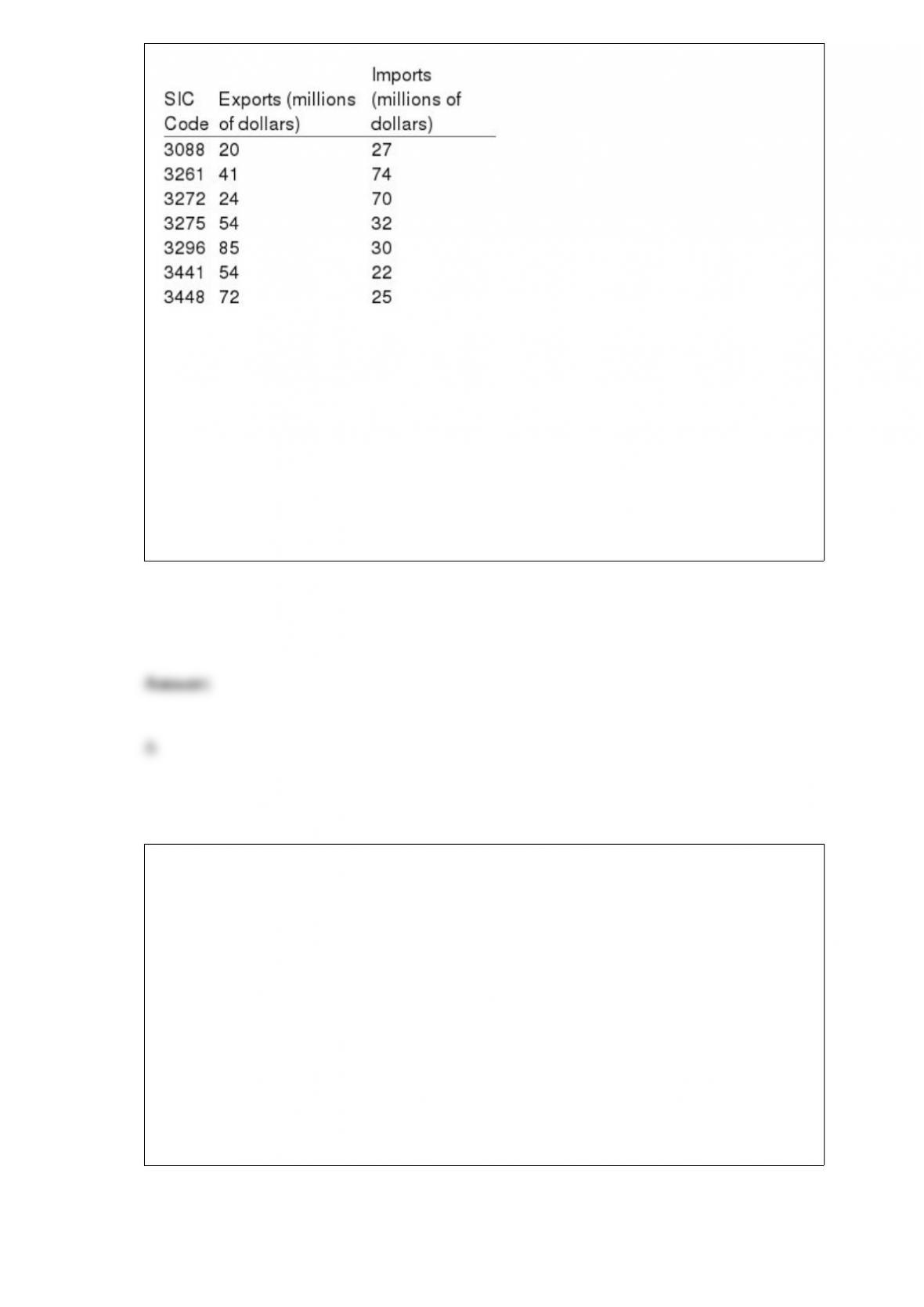
The 1991 exports and imports by industry code are given in the following table. What is
the approximate slope coefficient estimate b of the regression of exports as a function of
imports?
a. “0.5.
b. “5.0.
c. “0.3.
d. “3.0.
e. 0.4.
If a firm in a monopolistically competitive industry is profit maximizing, it should
choose its level of advertising such that the marginal revenue of an additional dollar of
advertising:
a. is equal to the elasticity of its demand curve minus 1.
b. is exactly $1.
c. increases revenues by $1.
d. is equal to 1 plus the elasticity of its demand curve.
e. is equal to the elasticity of its demand curve.

Suppose Al is currently consuming four movies and four concerts per month. If his
utility function is given by U = 15M0.5C, where M represents the number of movies
consumed and C represents the number of concerts attended, what is the marginal utility
of the next concert Al will attend?
a. 15
b. 30
c. 60
d. 120
e. 960
If Y = 12 ” 6X + 8X“1/2, then dY/dX is:
a. “6 ” 4X “3/2.
b. “4X “3/2.
c. 6 ” 4X “3/2.
d. “6 ” 4X “1/2.
e. “6 ” X “3/2.
Breckner Gas Company faces a demand for their gas given by P = 30 ” 0.25Q. It has
total costs (exclusive of the required rate of return on its invested capital) of TC = “60 +
8Q + 0.75Q2. If the commission that regulates Breckner determines that $100 is
sufficient to compensate equity holders for their invested capital, what are the regulated
price and output?
a. P = 23.75, Q = 25.
b. P = 25, Q = 20.
c. P = 27.5, Q = 10.
d. P = 22.5, Q = 30.
e. P = 20, Q = 40.
Lines that represent bundles of inputs that cost the same total amount are called:
a. total cost curves.
b. isocost curves.
c. cost curves.
d. isoquants.
e. isoprofit curves.

Suppose the Ajax Insurance Company provides insurance for skydivers whose wealth
before diving is $400. An accident will leave divers with a wealth of $100. The
company divides the divers into two classes: safe (probability of an accident = 0.2) and
unsafe (probability of an accident = 0.5). The utility of wealth for all divers is given by
the function: U(w) = w0.5. If only the unsafe divers buy insurance and the premium is
$100, the insurance company will:
a. earn a profit of $100 per unsafe diver.
b. break even.
c. incur a loss of $200 per unsafe diver.
d. incur a loss of $300 per unsafe diver.
e. experience none of the above.
Managerial economics uses to help managers solve problems.
a. formal models
b. prescribed behavior
c. quantitative methods
d. microeconomic theory
e. all of the above

So long as price exceeds average variable cost, in the model of monopoly, the firm
maximizes profits by producing where:
a. the difference between marginal revenue and marginal cost is maximized.
b. marginal revenue equals price.
c. the difference between price and marginal cost is maximized.
d. price equals marginal cost.
e. marginal cost equals marginal revenue.
At the profit-maximizing level of output for the monopolist:
a. total revenue is equal to total cost.
b. total costs are minimized.
c. total revenue is maximized.
d. marginal revenue is equal to marginal cost.
e. average revenue is equal to average cost.

A firm with production located in a poor Georgia town sells toys locally for $10 each
and ships the same toys to sell in a wealthy North Carolina town for $15 each. They are
not price discriminating if:
a. laws in Georgia allow it.
b. laws in North Carolina allow it.
c. total advertising costs are $5 per unit.
d. total transportation costs are $5 per unit.
e. consumers in North Carolina would pay more than $15 for the toys.
The long-run supply curve for a product is horizontal with ATC = 200. Market demand
is defined as P = 1,000 ” 5Q. The market is competitive and is in long-run equilibrium
with 40 firms in the industry. If a $50 tax is imposed on sellers, how many firms will be
in the industry at the new long-run equilibrium?
a. 44
b. 37
c. 32
d. 29
e. 28
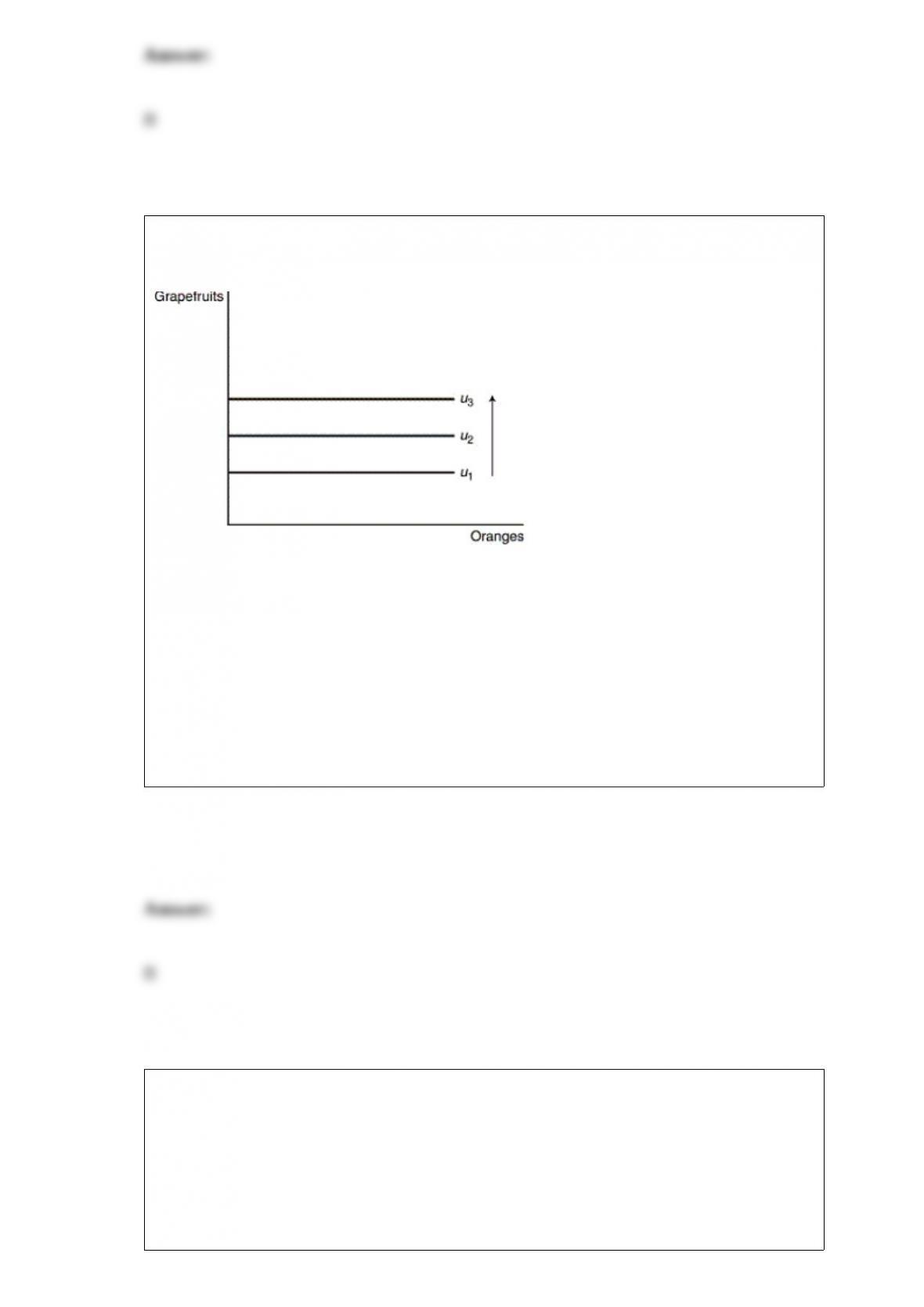
Consider the indifference map below. This map represents Larry’s preferences over two
goods, oranges and grapefruits. Larry:
a. does not like oranges and will not eat them.
b. gets greater utility from additional grapefruits, but not from additional oranges.
c. prefers oranges to grapefruits.
d. will always choose to consume equal amounts of oranges and grapefruits.
e. will always choose to consume a combination of oranges and grapefruits.
The formula for the arc elasticity of demand can be written as:
a. hXY = [DQX /(Q1
X + Q2
X)]/[DPX/(P1
X + P2
X)].
b. hXY = [DQX /(Q1
Y + Q2
Y)]/[DPY/(P1
X + P2
X)].

c. hXY = [DQX /(Q1
X + Q2
X)]/[DPY/(P1
Y + P2
Y)].
d. hXY = [DPX /(P1
X + P2
X)]/[DQY/(Q1
Y + Q2
Y)].
e. none of the above.
Two local ready-mix cement manufacturers, Here and There, have combined demand
given by Q = 105 ” P. Their total costs are given by TCHere = 5QHere + 0.5Q2
Here and
TCThere = 5QThere + 0.5Q2
There. If they successfully collude, their maximum joint
profits will be:
a. $500.
b. $1,000.
c. $1,600.
d. $2,000.
e. $2,500.
Marginal cost is equal to the:
a. change in total variable cost divided by the change in output.
b. total variable cost divided by the level of output.
c. price of the input divided by the average product of the variable input.
d. price of the input divided by the total product of the variable input.
e. total variable cost divided by the change in output levels.
If Y = aX / (b + Xc), then dY/dX is:
a. [a(b + Xc) ” acXc] / (b + Xc)2.
b. a(b + Xc) + acXc” 1.
c. [a(b + Xc) ” acXc” 1] / (b + Xc).
d. [a(b + Xc) + acXc” 1] / (b + Xc)2.
e. a(b + Xc) / (b + Xc)2.
Creditors and shareholders may have an incentive incompatibility because:
a. shareholders can declare bankruptcy and hence have limited liability.
b. creditors must bear less risk than shareholders.

c. creditors can call debt if better opportunities arise.
d. shareholders choose projects with less risk than creditors would like.
e. none of the above; creditors and shareholders are both interested in maximizing the
profits of the enterprise.
If price is $25 when the price elasticity of demand is “0.5, then marginal revenue must
be:
a. $50.
b. “$25.
c. $12.50.
d. $37.50.
e. $25.
If a firm has a dominant strategy:
a. its optimal strategy depends on the play of rivals.
b. its optimal strategy is always the same, even if payoffs change.
c. it is determined by the behavior of only one key rival.

d. it receives the same profits regardless of the strategy of rivals.
e. its optimal strategy is independent of the play of rivals.