
If there is a sudden increase in government spending, which of the following should the
Fed do if it wants to keep the price level steady?
a. Do nothing, since the self-correcting mechanism will adjust the economy
b. Sell bonds in the open market
c. Wait, since the price level usually does not change when government spending
increases
d. Decrease the required reserve ratio
e. Buy bonds in the open market
We measure GDP in different ways because
a. we can then check for errors and gain different insights into how the economy
performs
b. certain economists do not like the expenditure approach for GDP
c. the expenditure equation ignores certain aspects of the economy
d. it is too difficult to determine accurate values of consumption and investment
e. the particular situations of different countries require different approaches
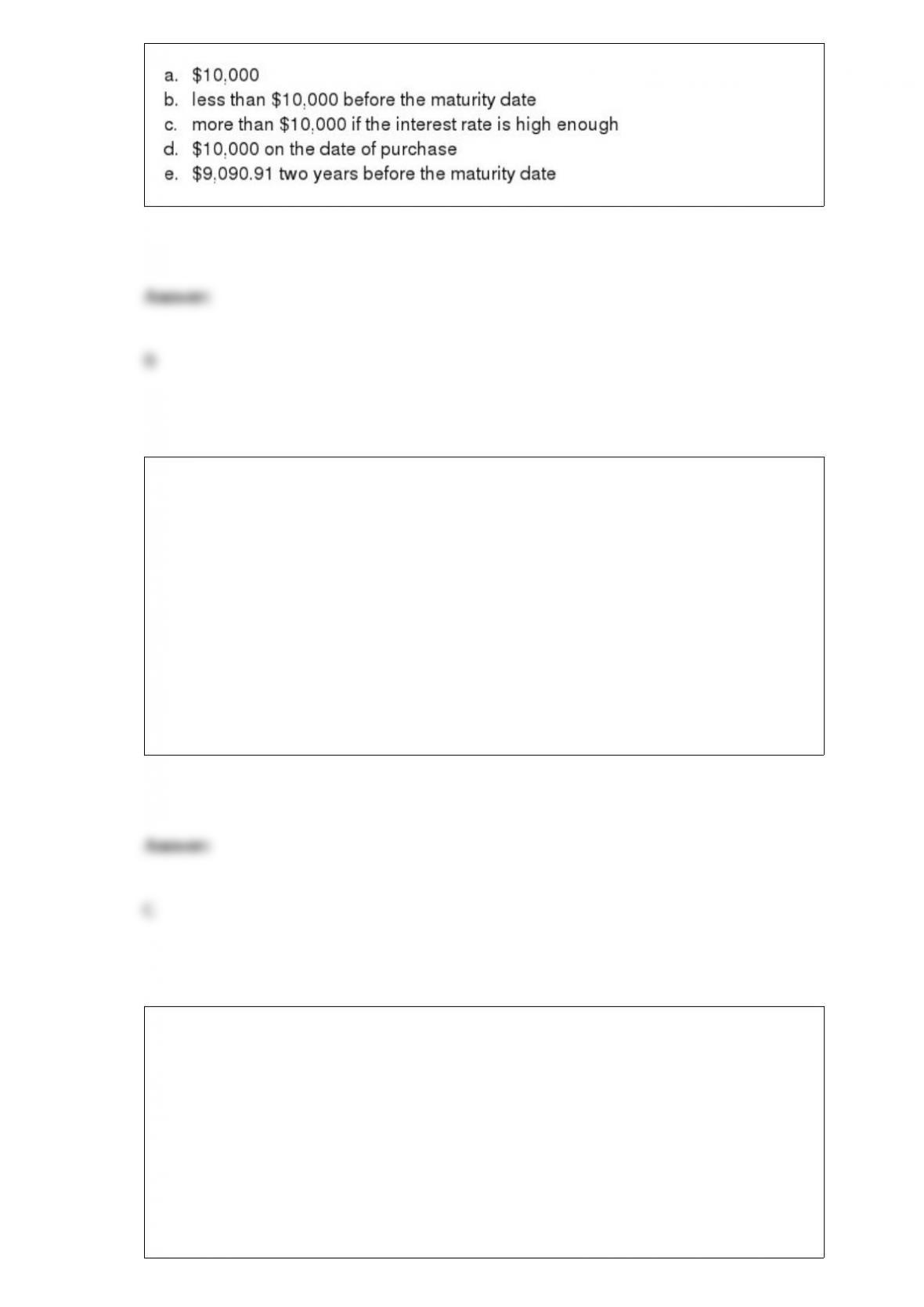
A bond with a face value of $10,000 (and no coupon payments) is always worth
If money demand changes for some reason other than a spending shock, the Fed can
stabilize
a. GDP without changing the interest rate
b. GDP, but at the expense of interest rate stability
c. GDP by keeping the interest rate stable
d. the price level by keeping the interest rate stable
e. the price level and GDP by stabilizing the interest rate
Which of the following shocks is most likely to cause an expansion?
a. Defense spending falls
b. Defense spending rises
c. Defense spending rises and then falls
d. Oil prices surge upward
e. Oil prices rise slowly
The marginal propensity to consume is greater than zero but less than one.
What would be the effect on the loanable funds market of an increase in the corporate
profits tax? (Assume that the government maintains a balanced budget.)
a. The demand for funds would decrease, lowering the interest rate and leading to lower
private investment.
b. The demand for funds would increase, raising the interest rate and leading to higher
private investment.
c. Both the demand and the supply of funds would increase, lowering the interest rate
and leading to lower private investment.
d. The supply of funds would increase, lowering the interest rate and leading to higher
private investment.
e. The supply of funds would decrease, raising the interest rate and leading to lower
private investment.
A spending shock
a. causes unemployment and inflation to change in the same direction
b. results in a movement along the AD curve
c. shifts the AS curve
d. first affects the economy through the money market
e. causes equilibrium GDP to change at each price level
A decrease in the interest rate reduces the opportunity cost of holding money.
Because of the history of banking panics in the U.S., one of the Fed’s primary functions
is to
a. dispel rumors about bank problems
b. act as a lender of last resort
c. hold banks accountable for their actions
d. call in loans
e. increase the profit that each bank makes
When calculating the effect of a tax cut on equilibrium GDP, the tax multiplier is
always
a. 2.0 smaller than the spending multiplier
b. 1.0 smaller than the spending multiplier and negative in sign
c. positive
d. positive and larger than the spending multiplier
e. negative and larger than the spending multiplier
Growth in employment can result from either an increase in labor supply or an increase
in labor demand.
Moving downward along a straight-line demand curve, the absolute value of the price
elasticity of demand
If unemployment is below the natural rate, GDP is below potential output.
Cash in a commercial bank’s vault is not part of the money supply.
If the government decreases taxes, which of the following would occur?
a. An increase in GDP, an increase in the price level, an increase in money demand, and
an increase in the interest rate
b. An increase in GDP, a decrease in the price level, an increase in money demand, and
a decrease in the interest rate
c. A decrease in GDP, a decrease in the price level, a decrease in money demand, and a
decrease in the interest rate
d. A decrease in GDP, a decrease in the price level, an increase in money demand, and
an increase in the interest rate
e. An increase in GDP, an increase in the price level, a decrease in money demand, and
a decrease in the interest rate.
The higher the price of a foreign currency, the more expensive that foreign country’s
goods and services are to individuals in the domestic economy.
Targeting the wealthy in a less-developed country in order to achieve reductions in
poverty can drive the wealthy to relocate.