
The terms scarcity and shortage are synonyms.
a. True
b. False
Assume the following conditions hold: (1) the demand for every type of labor is the
same, (2) there are no special nonpecuniary aspects to any job, (3) all labor is ultimately
homogeneous and can costlessly be trained for different types of employment, (4) all
labor is mobile at zero cost. Given these conditions,
a. wage rates will be the same in most labor markets.
b. the demand for labor will be less in some labor markets than in others.
c. wage rates will be the same in all labor markets.
d. wage rates will be the same in very few labor markets.
Variables A and B are inversely related. If we plot A on the horizontal axis and B on the
vertical axis, the line that connects combinations of A and B in a two-variable diagram
is
a. parallel to the horizontal axis.
b. downward-sloping (left to right).
c. parallel to the vertical axis.

d. upward-sloping (left to right).
e. a or c
One reason that helps to explain the law of supply is the law of
a. diminishing marginal utility.
b. diminishing marginal returns.
c. decreasing opportunity costs.
d. demand.
Economists use the word utility to describe the satisfaction one receives from a good.
a. True
b. False

Persons who choose not to become informed on political and governmental matters
because they feel that the costs of becoming informed exceed the benefits of becoming
informed are
a. rationally ignorant.
b. not acting in their own best interests.
c. members of special interest groups.
d. shortsighted.
The law of diminishing marginal returns is
a. the same concept as economies of scale.
b. another name for the law of diminishing marginal utility.
c. important for long-run economic analysis.
d. relevant to the production of goods, but not services.
e. none of the above
Which of the following is an implicit cost?
a. Jones buys $100 worth of supplies from Smith.
b. Brown pays the bill he received in the mail.
c. Smith, who could work for someone else, works for himself.
d. Williamson pays his income taxes on April 15.
e. a, c, and d
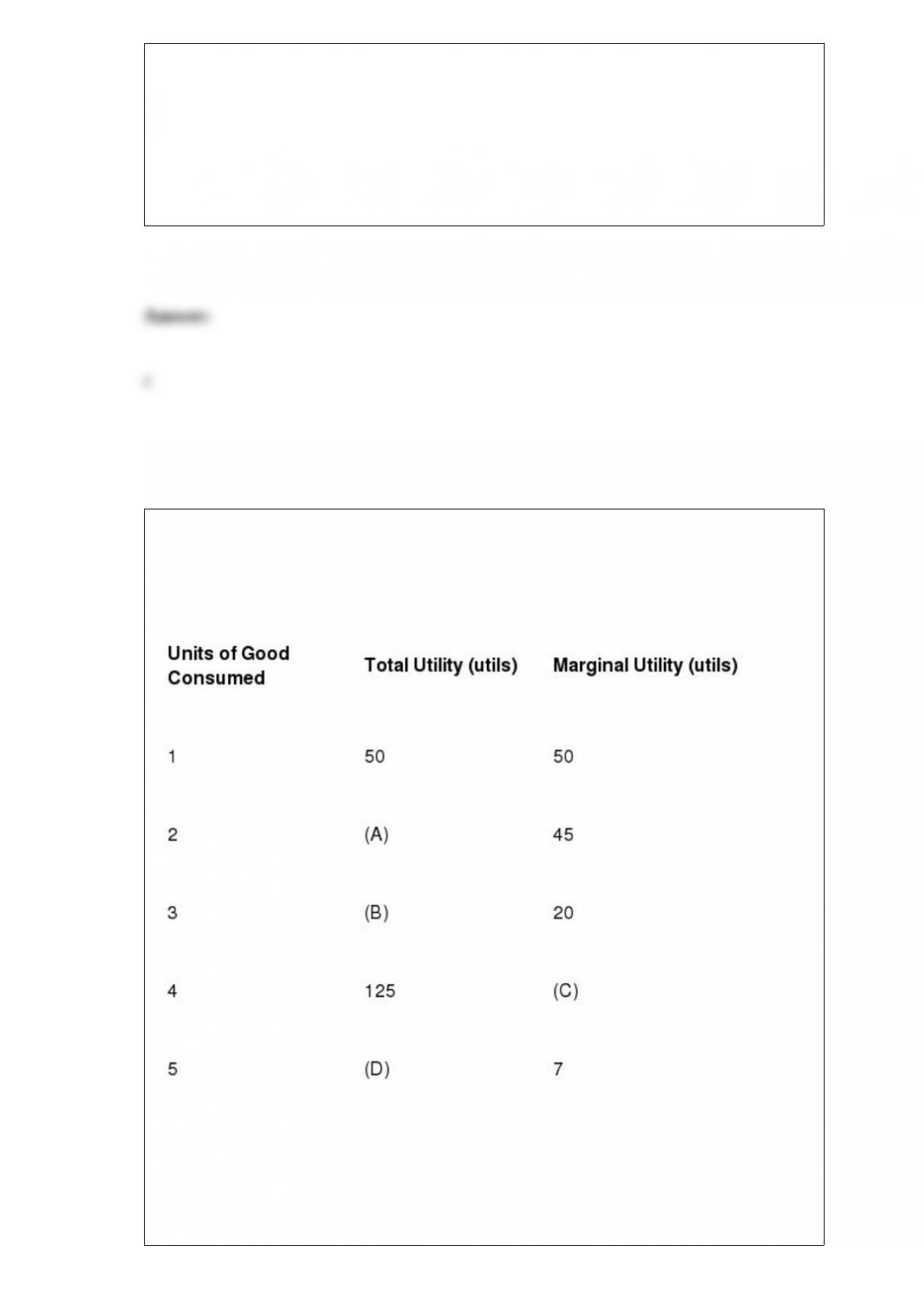
Refer to Exhibit 21-4.What value goes in blank (A)?
Exhibit 21-4
a. 47.5
b. 100

c. 80
d. 95
e. There is not enough information to answer this question.
If private property rights were established in the oceans, there would probably be
a. more ocean pollution.
b. less ocean pollution.
c. the same amount of ocean pollution that exists without private property rights in the
ocean.
d. more ocean voyages on cruise ships.
A good is nonexcludable if no externalities, either negative or positive, are associated
with its production or consumption.
a. True
b. False

A futures contract
a. gives the owner the right, but not the obligation, to buy shares of a stock at a
specified price within the time limits of the contract.
b. gives the owner the right, but not the obligation, to sell shares of a stock at a
specified price within the time limits of the contract.
c. is a contract in which the seller agrees to provide a particular good to the buyer on a
specified future date at an agreed-upon price.
d. gives the owner the right, but not the obligation, to buy or sell shares of a stock at a
specified price within the time limits of the contract.
Perfect price discrimination is discrimination among
a. units.
b. quantities.
c. buyers.
d. prices.
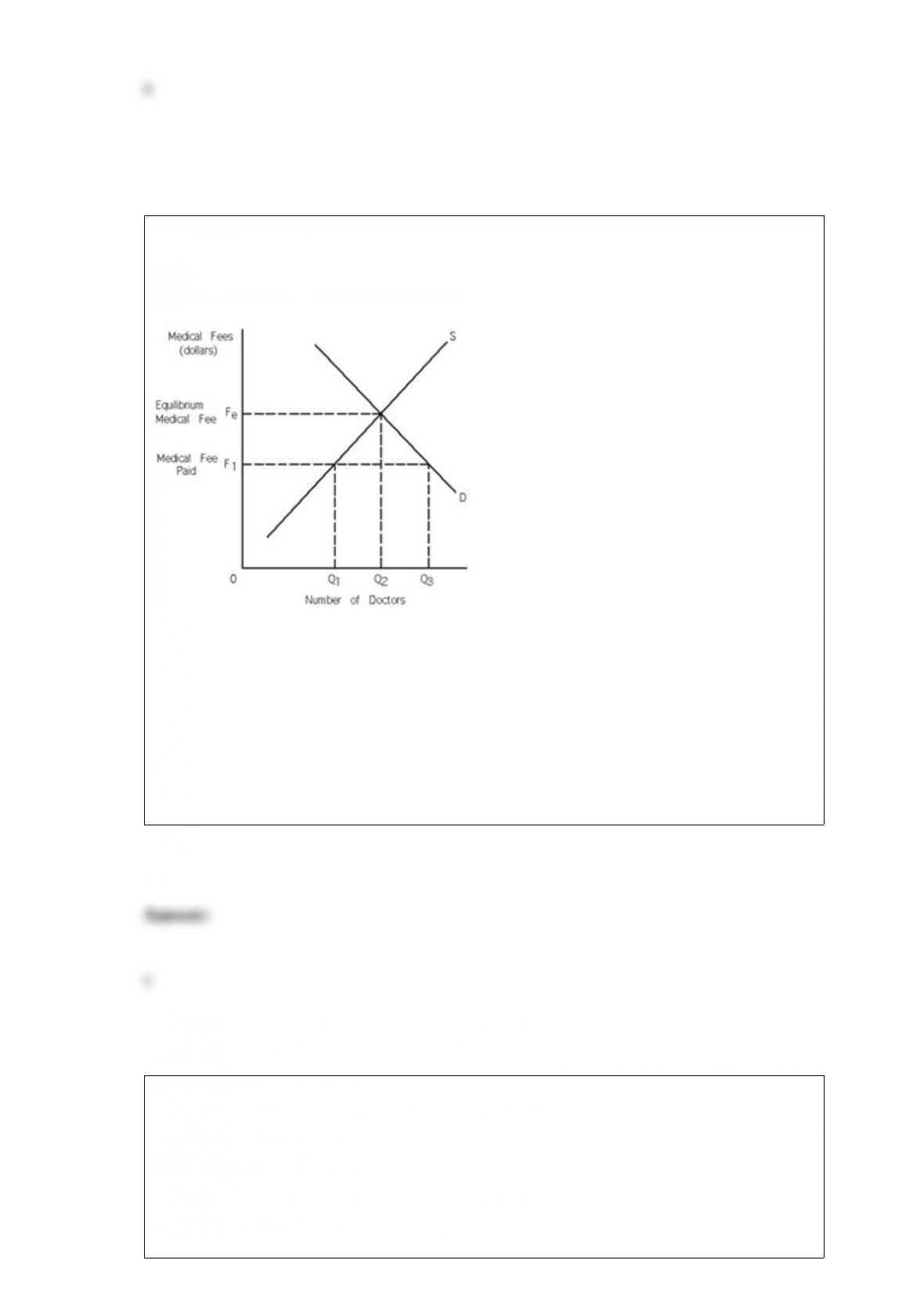
Refer to Exhibit 3-15. In Exhibit 3-15,
Exhibit 3-15
a. Q2 doctors are employed at fee F1.
b. Q3 doctors are employed at fee F1.
c. Q1 doctors are employed at fee F1.
d. the number of doctors employed cannot be determined at any fee.
An “increase in the quantity demanded” means that
a. the demand curve has shifted to the right.
b. the supply curve has shifted to the left.
c. price has declined and consumers therefore want to purchase more of the good.

d. given supply, the price of the good can be expected to rise.
In the past, it was theorized that __________ firms were the most likely to innovate.In
recent years, new information has suggested that __________ firms are greater
innovators. If true, this makes antitrust intervention in the case of mergers __________
important.
a. small; large; more
b. small; large; less
c. large; small; more
d. large; small; less
Government wants to maximize its tax revenue and it can only place a $2 per-unit tax
on one of two goods. It should place the tax (on the production) of the good whose
demand curve has the
a. higher price elasticity of demand.
b. lower price elasticity of demand.
c. greater length.
d. shorter length.
e. a or c
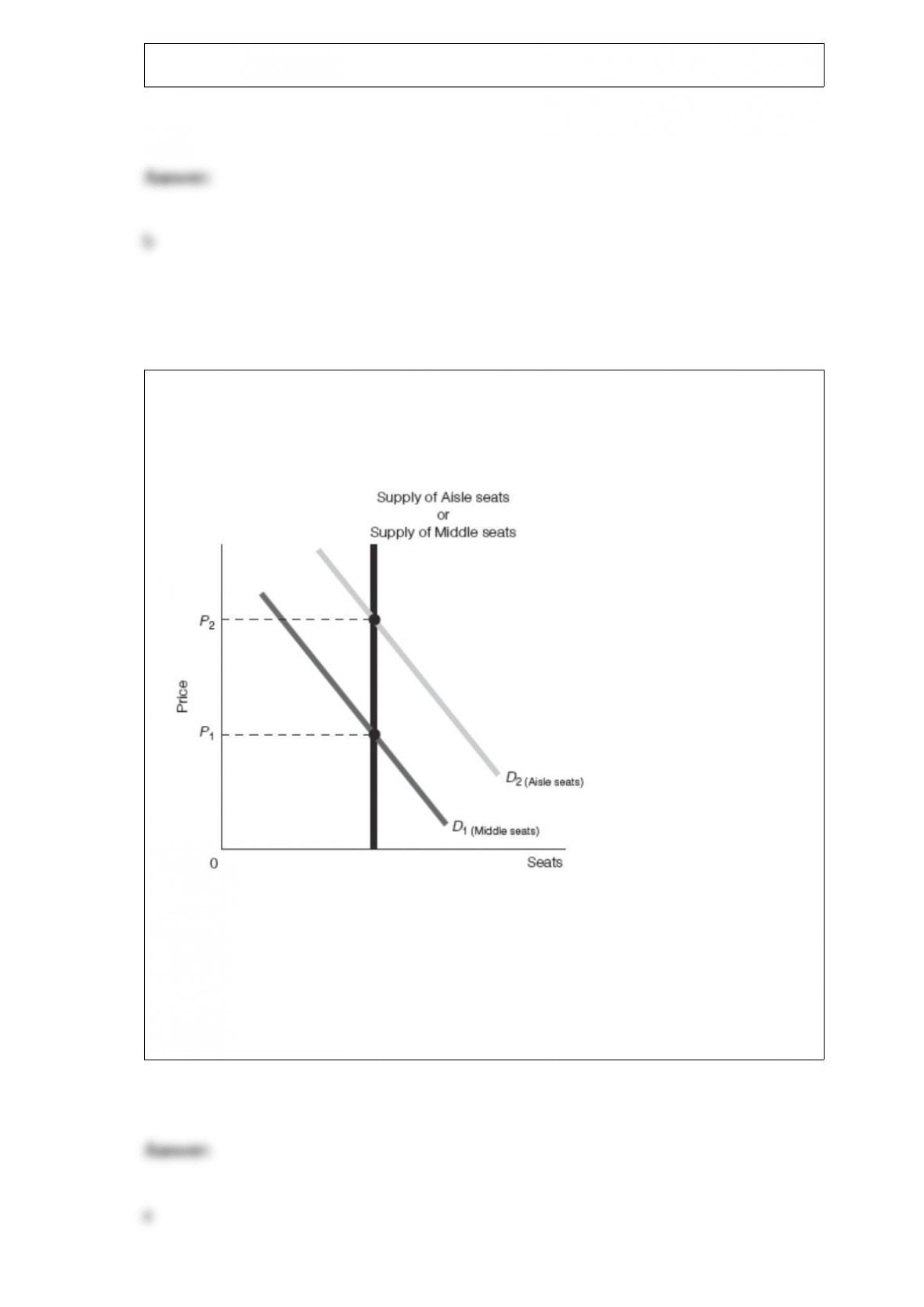
Refer to Exhibit 5-5. If the airline charges price P2 for both aisle seats and middle seats,
the result will be
Exhibit 5-5
a. a surplus of middle
seats and the equilibrium quantity of aisle seats.
b. a surplus of aisle seats and the equilibrium quantity of middle seats.
c. a shortage of middle seats and the equilibrium quantity of aisle seats.
d. a shortage of aisle seats and the equilibrium quantity of middle seats.

Suppose the production of a good results in positive externalities. If output occurs at the
intersection of the marginal social benefits curve and the supply curve, then
a. output will be at a higher level than if all benefits were not taken into account.
b. output will be at a lower level than the socially optimal level.
c. the marginal private benefit curve will lie above and to the right of the marginal
social benefit curve.
d. there will be underproduction.
e. all of the above
Smith and Jones work at very similar jobs, but Smith earns almost 30 percent more a
day than Jones. This is a case of __________ discrimination.
a. gender
b. religious
c. wage
d. ethnic
e. There is not enough information to answer the question.