
1) When financial institutions are able to reduce the costs of information for each
service they offer by applying the same information source to each service, we say that
the financial institution is realizing
A) economies of scope
B) economies of scale
C) increasing returns
D) diminishing marginal returns
2) An increase in U.S. Treasury deposits at the Fed reduces both ________ and the
________.
A) reserves; monetary base
B) Fed liabilities; money multiplier
C) Fed assets; monetary base
D) Fed assets; money multiplier
3) A financial crisis is
A) not possible in the modern financial environment
B) a major disruption in the financial markets
C) a feature of developing economies only
D) typically followed by an economic boom
4) The specialty of Lloyd’s of London is
A) annuities
B) hedge funds
C) mutual funds
D) reinsurance
5) In the Baumol-Tobin analysis of transactions demand, scale economies imply that an
increase in real income increases the quantity of money demanded ________, while an
increase in the price level increases the quantity of money demanded ________.
A) proportionately; less than proportionately
B) more than proportionately; proportionately
C) less than proportionately; proportionately

D) proportionately; more than proportionately
6) Which of the following policy measures prohibited compliance officers from being
involved in producing or selling credit ratings?
A) The Dodd-Frank Wall Street Reform and Consumer Protection Act of 2010
B) Sarbanes-Oxley Act of 2002
C) Global Legal Settlement of 2002
D) Gramm-Leach-Bliley Act of 1999
E) Riegle-Neal Act of 1994.
7) Evidence against market efficiency includes
A) failure of technical analysis to outperform the market
B) the random walk behavior of stock prices
C) the inability of mutual fund managers to consistently beat the market
D) the January effect
8) In the bond market, the bond demanders are the ________ and the bond suppliers are
the ________.
A) lenders; borrowers
B) lenders; advancers
C) borrowers; lenders
D) borrowers; advancers
9) Economies of scale enable financial institutions to
A) reduce transactions costs
B) avoid the asymmetric information problem
C) avoid adverse selection problems
D) reduce moral hazard

10) Suppose the U.S. economy is operating at potential output. A negative supply shock
that is accommodated by an open market purchase by the Federal Reserve will cause
________ in real GDP in the long run and ________ in inflation in the long run,
everything else held constant.
A) no change; an increase
B) no change; a decrease
C) an increase; an increase
D) a decrease; a decrease
11) The theory of PPP suggests that if one country’s price level rises relative to
another’s, its currency should
A) depreciate in the long run
B) appreciate in the long run
C) depreciate in the short run
D) appreciate in the short run
12) External financing by ________ should be more important in developing countries
than in industrialized countries because information about private firms is more difficult
to collect in developing countries.
A) financial intermediaries
B) bonds
C) stock
D) direct lending
13) When the Federal Reserve purchases a government bond from a bank, reserves in
the banking system ________ and the monetary base ________, everything else held
constant.
A) increase; increases
B) increase; decreases
C) decrease; increases
D) decrease; decreases
14) Suppose a person cashes his payroll check and holds all the funds in the form of

currency. Everything else held constant, total reserves in the banking system ________
and the monetary base ________.
A) remain unchanged; increases
B) decrease; increases
C) decrease; remains unchanged
D) decrease; decreases
15) A rise in stock prices ________ the net worth of firms and so leads to ________
investment spending because of the reduction in moral hazard.
A) raises; higher
B) raises; lower
C) reduces; higher
D) reduces; lower
16) Financial markets promote economic efficiency by
A) channeling funds from investors to savers
B) creating inflation
C) channeling funds from savers to investors
D) reducing investment
17) Which of the following are investment intermediaries?
A) Life insurance companies
B) Mutual funds
C) Pension funds
D) State and local government retirement funds
18) For the classical economists, the quantity theory of money provided an explanation
of movements in the price level. Changes in the price level result
A) from proportional changes in the quantity of money
B) primarily from changes in the quantity of money
C) only partially from changes in the quantity of money
D) from changes in factors other than the quantity of money

19) Which of the following is a depository institution?
A) A life insurance company
B) A credit union
C) A pension fund
D) A mutual fund
20) High interest rates might ________ purchasing a house or car but at the same time
high interest rates might ________ saving.
A) discourage; encourage
B) discourage; discourage
C) encourage; encourage
D) encourage; discourage
21) The research document given to the Federal Open Market Committee that contains
information on the state of the economy in each Federal Reserve district is called the
A) beige book
B) green book
C) blue book
D) black book
22) When the price of a bond decreases, all else equal, the bond demand curve
A) shifts right
B) shifts left
C) does not shift
D) inverts
23) Which of the following policy measures created an Office of Credit Ratings at the
SEC with its own staff and the authority to fine credit-rating agencies and to deregister
an agency if it produces bad ratings?

A) The Dodd-Frank Wall Street Reform and Consumer Protection Act of 2010
B) Sarbanes-Oxley Act of 2002
C) Global Legal Settlement of 2002
D) Gramm-Leach-Bliley Act of 1999
E) Riegle-Neal Act of 1994
24) The Fed’s support of the Depository Institutions Deregulation and Monetary Control
Act of 1980 stemmed in part from its
A) concern over declining Fed membership
B) belief that all banking regulations should be eliminated
C) belief that interest rate ceilings were too high
D) belief that depositors had to become more knowledgeable of banking operations
25) A business cycle expansion increases income, causing money demand to ________
and interest rates to ________, everything else held constant.
A) increase; increase
B) increase; decrease
C) decrease; decrease
D) decrease; increase
26) When the European System of Central Banks uses main refinancing operations, it is
similar to the Federal Reserve using
A) dynamic open market operations
B) defensive open market operations
C) discount policy
D) reserve requirements
27) The number and availability of discount brokers has grown rapidly since the
mid-1970s. The efficient markets hypothesis predicts that people who use discount
brokers
A) will likely earn lower returns than those who use full-service brokers
B) will likely earn about the same as those who use full-service brokers, but will net
more after brokerage commissions

C) are going against evidence suggesting that full-service brokers can help outperform
the market
D) are likely to outperform the market by a wide margin
28) Well-functioning financial markets promote
A) inflation
B) deflation
C) unemployment
D) growth
29) There is ________ for any bond whose time to maturity matches the holding period.
A) no interest-rate risk
B) a large interest-rate risk
C) rate-of-return risk
D) yield-to-maturity risk
30) If a $10,000 face-value discount bond maturing in one year is selling for $5,000,
then its yield to maturity is
A) 5 percent
B) 10 percent
C) 50 percent
D) 100 percent
31) A problem for equity contracts is a particular type of ________ called the ________
problem.
A) adverse selection; principal-agent
B) moral hazard; principal-agent
C) adverse selection; free-rider
D) moral hazard; free-rider

32) If real GDP grows from $10 trillion in 2002 to $10.5 trillion in 2003, the growth
rate for real GDP is
A) 5%
B) 10%
C) 50%
D) 0.5%
33) Explain the complete formula for the M1 money supply, and explain how changes
in required reserves, excess reserves, the currency ratio, the nonborrowed base, and
borrowed reserves affect the money supply.
34) Your favorite uncle advises you to purchase long-term bonds because their interest
rate is 10%. Should you follow his advice?
35) Banking crises have occurred throughout the world. What similarities do we find
when we look at the different countries?
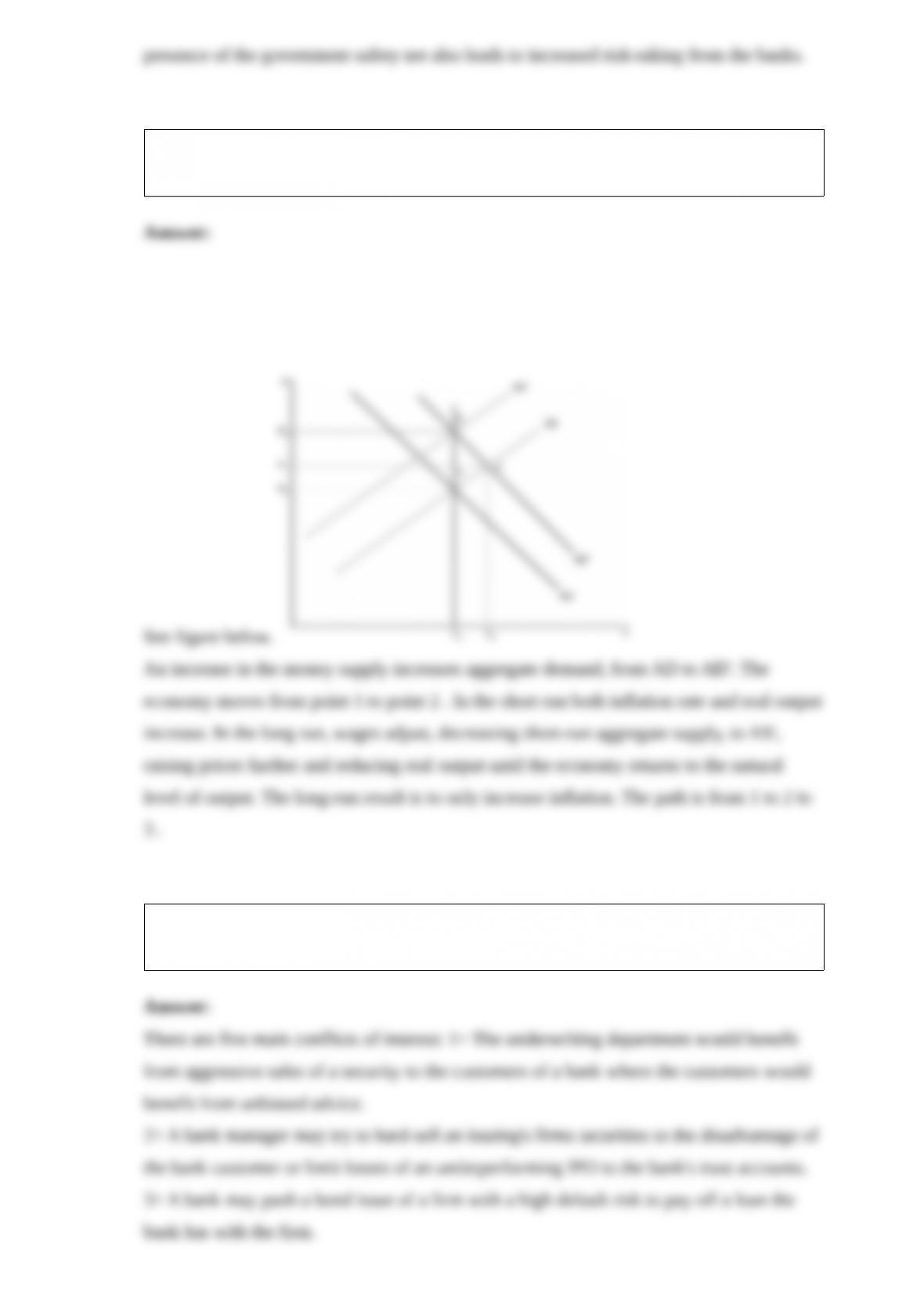
36) Using the aggregate demand-aggregate supply model, explain and demonstrate
graphically the short-run and long-run effects of an increase in the money supply.
37) Explain the type of conflicts of interest that can arise from the development of
universal banking.

38) What factors have slowed down the movement to a system where all payments are
made electronically?
39) Explain how the market can reduce the incentive for credit-rating firms to take
advantage of conflicts of interest.
40) Explain an additional disadvantage for a country undergoing dollarization compared
to a currency board or other exchange-rate targeting regimes.
41) Explain the Federal Reserve’s “just do it” approach to monetary policy. What are the
advantages and disadvantages to this type of strategy?
42) Explain the problems that necessitate insurance management, and three methods
insurance companies use to address these problems. Identify the problem that each
practice addresses.