
Elasticity of demand for labor measures the percentage change in quantity demanded of
labor that is brought about by a percentage change in the
a. demand for the product produced by labor.
b. price of the product.
c. quantity supplied of labor.
d. wage rate.
e. price of substitute factors.
Government always makes individuals better off when it removes them from a
prisoner€s dilemma setting.
a. True
b. False
Exhibit 35-4
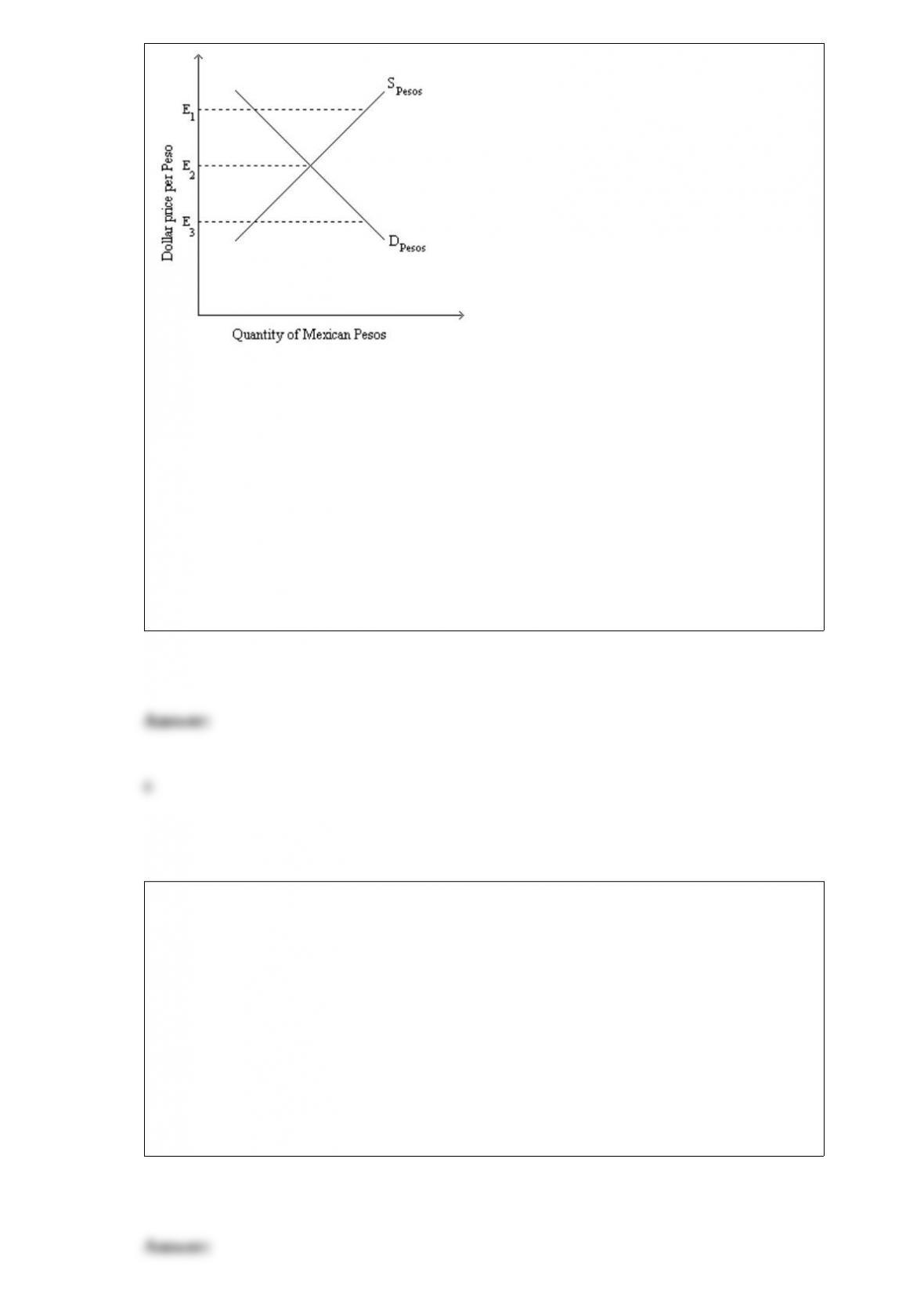
Under a fixed exchange rate system, at the exchange rate of E3, the dollar is
__________ and there is a __________.
a. overvalued; surplus of dollars
b. undervalued; shortage of pesos
c. overvalued; shortage of dollars
d. undervalued; surplus of pesos
Every time you make a __________, you incur a(n) __________.
a. decision; efficient effect
b. choice; opportunity cost
c. competitive move; price
d. decision; mistake
e. none of the above

Exhibit 1-3
Based on the data provided in this table,if these data were plotted in a two-variable
diagram the result would be a ______________ sloping
a. downward; (nonlinear) curve.
b. downward; (straight) line.
c. upward; (nonlinear) curve.
d. upward; (straight) line.
e. none of the above
Which of the following is least likely to be an effect of scarcity?
a. rationing device
b. choice
c. opportunity cost
d. dollar price
e. utility

The type of merger most likely to reduce competition in an industry is a(n) __________
merger.
a. horizontal
b. vertical
c. conglomerate
d. international
A cost that is incurred when an actual monetary payment is made is a(n) __________
cost.
a. explicit
b. implicit
c. positive
d. expressed
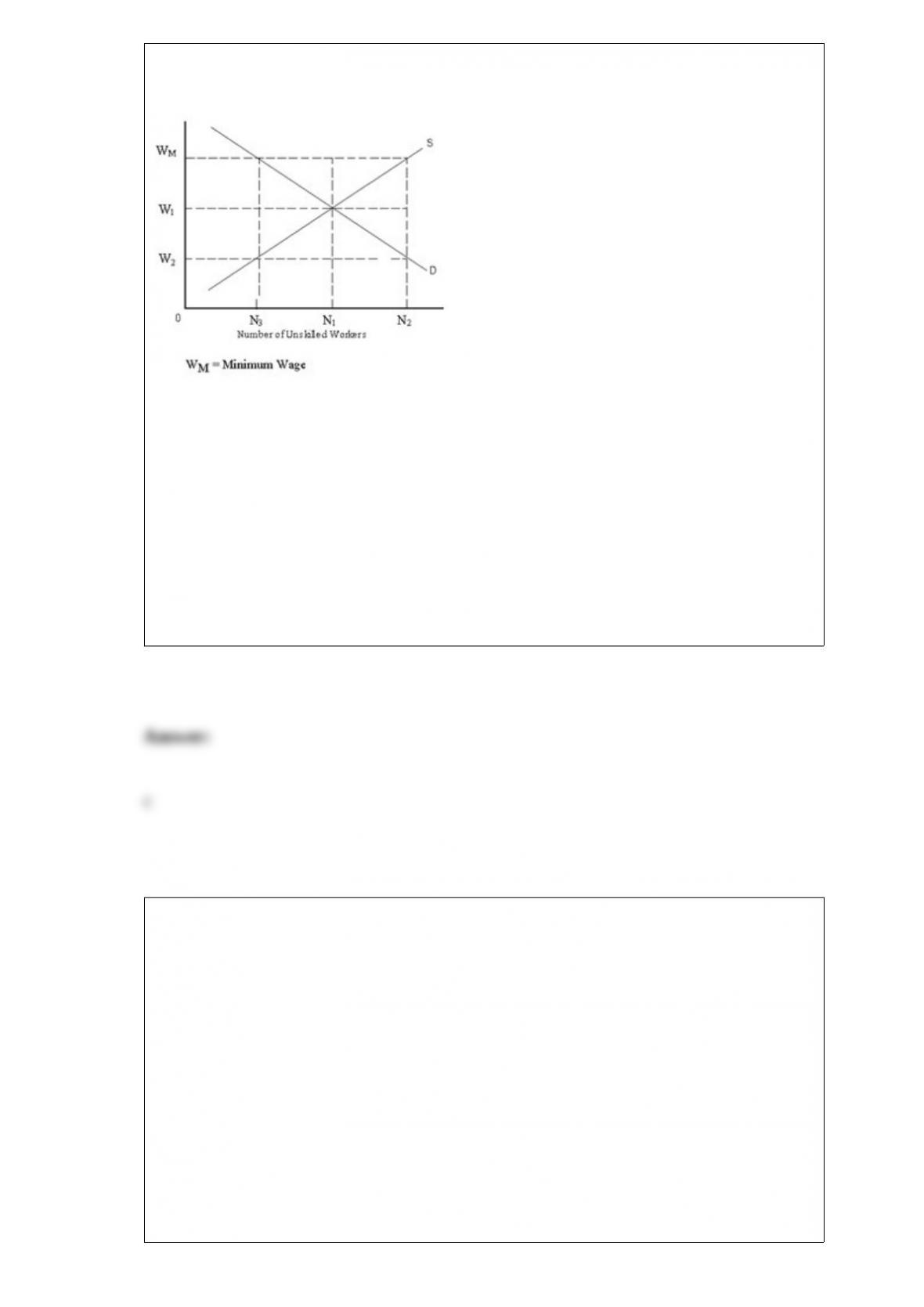
Exhibit 4-7
The number of unskilled workers who want to work at the minimum wage is
a. N3.
b. N1.
c. N2.
d. N2 – N1.
Currently an economy is producing (at a point on its production possibilities frontier)
100 units of good X and the opportunity cost of producing 1X is 3Y. If good X is
produced at increasing opportunity costs, then when the economy produces 120 units of
good X (on the same PPF) the opportunity cost of producing 1Y (not 1X) could be
a. 1/4X.
b. 1/3X.
c. 1/2X.
d. 1X.
e. none of the above

A perfectly competitive firm faces a __________ demand curve.
a. nonlinear
b. downward-sloping
c. perfectly elastic
d. perfectly inelastic
e. unit-elastic
Suppose that the total utility from consuming one unit of good X is 54 utils, the total
utility of two units of good X is 74 utils, and the total utility of three units of good X is
84 utils.The marginal utility of the third unit is
a. 10 utils.
b. 70.67 utils.
c. 12.25 utils.
d. 20 utils.

If an industry advertises, then it
a. is definitely not a perfectly competitive industry.
b. must be a perfectly competitive industry.
c. may or may not be a perfectly competitive industry.
d. is not using its resources wisely.
e. will surely be able to increase its sales.
Which of the following is descriptive of the law of diminishing marginal utility?
a. The third hamburger consumed provides less utility than the second hamburger
consumed.
b. The third hamburger is priced higher than the first hamburger.
c. As price falls, quantity demanded rises, ceteris paribus.
d. The price of a good rises as the costs of producing that good rise.
e. none of the above
When a firm decides whether or not to relocate its production to another country, they
must consider both the pay of the workers and the marginal productivity of the workers.

a. True
b. False
The Lorenz curve is a graph of the __________ of the population.
a. age distribution
b. income distribution
c. wealth distribution
d. racial composition
Jerry has $50,000 in his savings account and the average new car price is $23,000. Does
Jerry have a demand for a new car?
a. Yes, since Jerry can afford a new car.
b. Not necessarily. Jerry has the ability to buy a new car, but we don’t know if he also
has the willingness to buy a new car.
c. Yes, since Jerry’s savings is more than double the average new car price.
d. none of the above

Diseconomies of scale are present when the __________ average total cost curve is
__________.
a. short-run; falling
b. short-run; rising
c. long-run; falling
d. long-run; rising
e. b and d