
One major fault with factor pricing analysis is that marginal productivity theory merely
attempts to justify the income distribution that the capitalist system yields.
a. True
b. False
A recessionary gap exists when potential GDP
a. falls short of equilibrium GDP.
b. exceeds equilibrium GDP.
c. equals equilibrium GDP.
d. All of the above are correct.
Regulating firms so that they always receive a guaranteed profit rate will lead to
greatest efficiency.
a. True
b. False

If an oligopolistic manufacturer believes that he faces a kinked demand curve for his
product, he thinks his competitors will ____ if he lowers his price and ____ if he raises
his price.
a. lower their prices; raise their prices.
b. lower their prices; not raise their prices
c. not lower their prices; raise their prices
d. not lower their prices; not raise their prices
In contrast to richer countries, most residents of poorer nations will have
a. only some primary education.
b. primary and secondary education.
c. higher education.
d. higher levels of productivity.
When a motorist speeds down the road at well above the posted limit, economists
believe that the principle of ____ may be directing his actions.
a. rent seeking
b. defective telescopic faculty
c. moral hazard
d. resource misallocation
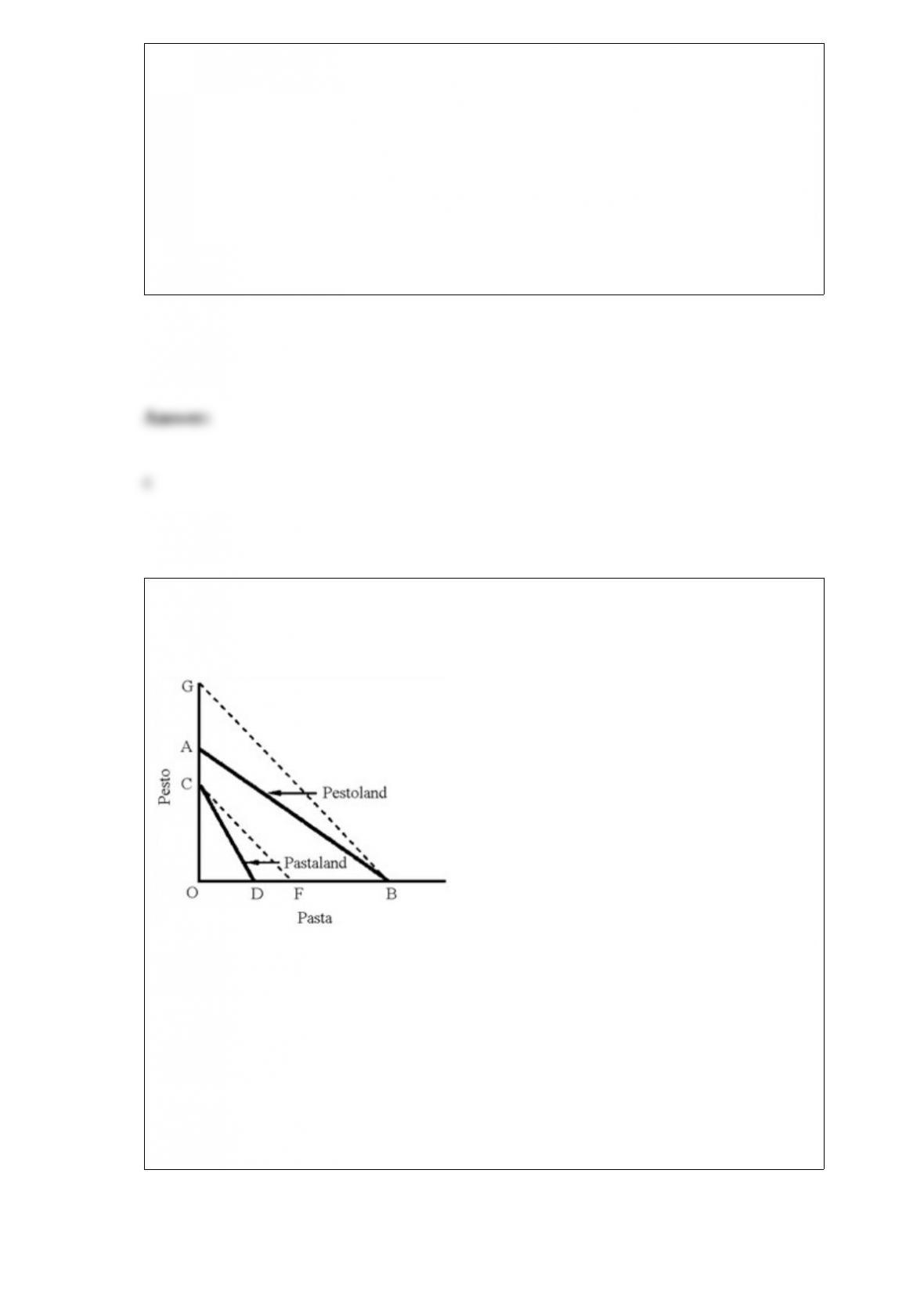
Figure 22-7
In Figure 22-7, it is probably true that wages are
a. equal in Pestoland and Pastaland.
b. greater in Pestoland than Pastaland.
c. greater in Pastaland than in Pestoland.
d. higher in pasta production than in pesto production in both countries.

Increasing productivity in a society
a. always results in a better quality of life as society views it.
b. can never make a nation poorer.
c. guarantees that personal services will cost less.
d. makes improved personal services available to everyone.
For a given price level, an upward shift of the expenditures schedule corresponds to an
a. inward shift of the aggregate demand curve.
b. outward shift of the aggregate demand curve
c. outward shift of the aggregate supply curve.
d. inward shift of the aggregate supply curve.

The first signs of major financial problems associated with the financial sector and real
estate investment appeared in 2009.
a. True
b. False
Most Americans
a. have accurate perceptions of the level of corporate profits.
b. underestimate corporate profits.
c. overestimate corporate profits.
d. believe that corporations earn zero profit.
In the rational expectations model, government control over aggregate demand
a. can affect real output only if policies are unexpected.
b. has potential to change real output as long as aggregate supply is vertical.
c. gives it the ability to change real output and employment.
d. does not influence the economic behavior of individuals.

The fiscal stimulus bills of 2001, 2008, and 2009 were unusual examples of rapid
implementation of fiscal policy.
a. True
b. False
As the price level rises, the demand for money
a. decreases because interest rates also increase.
b. decreases because consumers buy fewer goods and services.
c. increases because more money is needed for each transaction.
d. increases because investment spending will also increase.

College graduates now earn nearly five times as much as their high school-educated
peers but the gap is falling.
a. True
b. False
In 2010, in order to stimulate capital investment, President Obama proposed
a. a reduction in real interest rates.
b. an increase in the money supply.
c. increased write-offs for businesses purchasing equipment.
d. an increase in the tax on capital gains.
Zero profit in the economic sense means that firms are earning a normal rate of return.
a. True
b. False
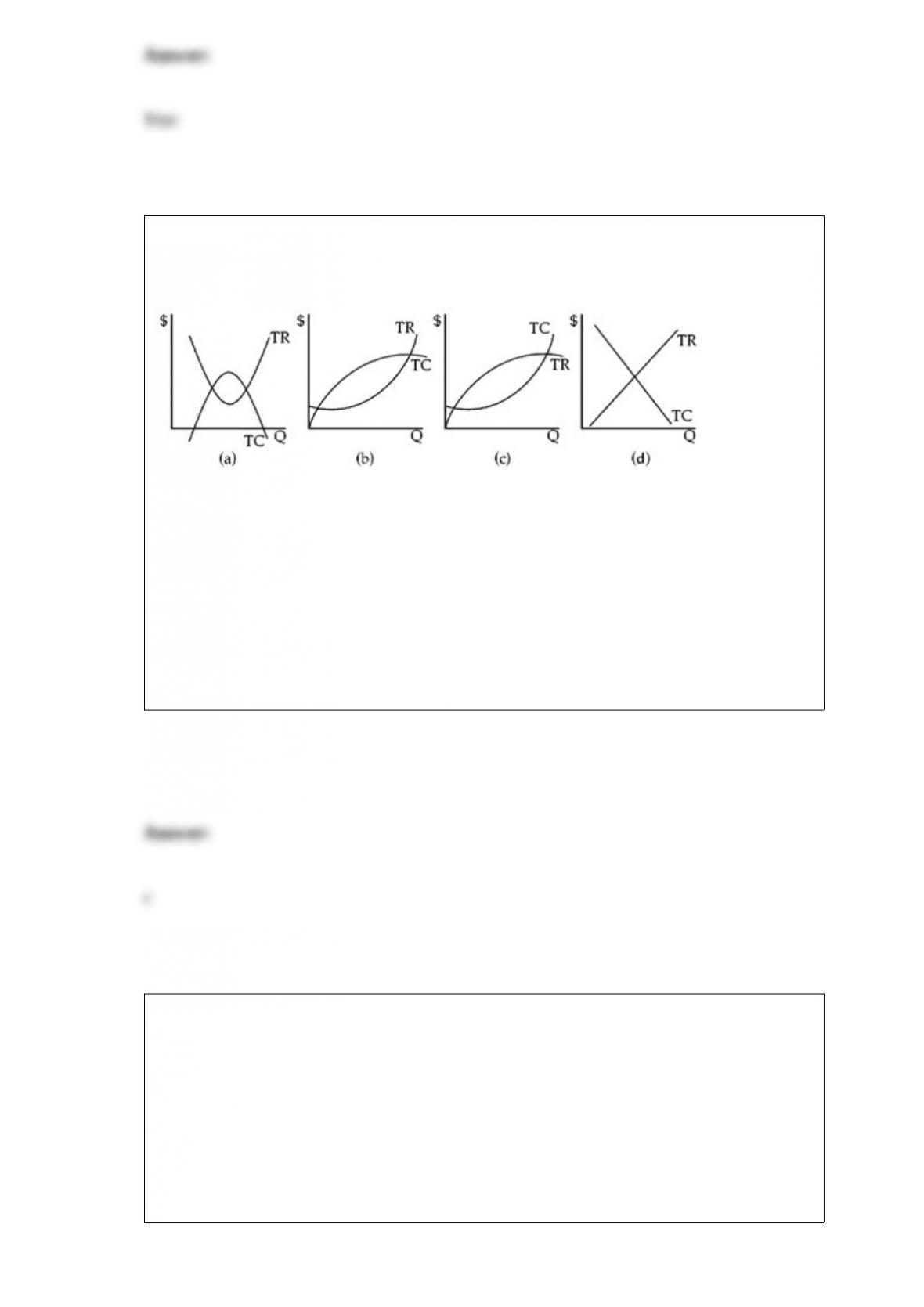
Figure 8-1
Which graph in Figure 8-1 shows a typical firm’s total revenue and total cost curves?
a. (a)
b. (b)
c. (c)
d. (d)
Which of the following is an unconventional monetary policy?
a. lending to banks in unprecedented volume
b. lending to companies other than banks
c. reducing the federal funds rate to zero
d. All of these are unconventional monetary policies.

If the value of the multiplier is smaller, the economy
a. becomes less stable because automatic stabilizers have a larger impact.
b. becomes more stable because automatic stabilizers have a larger impact.
c. becomes more volatile because automatic stabilizers have a lesser impact.
d. is subject to larger fluctuations because automatic stabilizers have no impact.
The demand for a new effective drug for the cure of AIDS would most likely be
a. elastic.
b. unit elastic.
c. perfectly elastic.
d. highly inelastic.

The least scrutiny of management’s operations occurs when ____ is the method used in
corporate financing.
a. stock issue
b. bond issue
c. plowback
d. watering
If an individual possesses an ability that others cannot acquire, payment to that
individual is
a. partly economic rent.
b. a return called the real wage.
c. a return from investment in human capital.
d. comparable to the return to well-trained nurses.
Real GDP differs from nominal GDP in that nominal GDP measures
a. output adjusted for inflation.

b. real output of goods and services.
c. output of goods and services at current prices.
d. real income adjusted for changes in the price level.
A line that is perfectly elastic has an elasticity of demand of zero.
a. True
b. False
When all prices are set equal to marginal costs,
a. consumers buy more than they should.
b. consumers will get less utility.
c. markets are giving correct signals to consumers.
d. producers make excessive profits.

The law of diminishing marginal utility states that total utility will increase at a
decreasing rate as additional units of a commodity are acquired.
a. True
b. False
If the price of pizzas has risen from $4 to $5 at the same time that the price of an hour
of spinning class has risen from $20 to $30, then
a. pizzas have become relatively more expensive.
b. spinning classes have become relatively more expensive.
c. the relative prices of pizzas and spinning classes have remained constant.
d. workers’ real income must have decreased.
As the interest rate increases, the velocity of money will increase as well.

a. True
b. False
Historical data representing consumption and disposable income reveals that
a. during the 1930s, U.S. saving was at a high level.
b. U.S. citizens increased saving during World War II.
c. there is no systematic relationship between the two.
d. consumption rises faster than disposable income during recessions.
In the simplified circular flow diagram, leakage can occur when consumers save some
income.
a. True
b. False

One problem that haunts most antitrust litigation is that:
a. the government seldom wins.
b. the appearance of vigorous competition resembles acts that undermine competition.
c. it has the effect of preventing firms from being tough on their rivals.
d. the defendant firm may be destroyed.
Moral hazard encourages people to take risks.
a. True
b. False
Distinguish between invention and innovation.
Explain why national income and domestic product must be equal.
Explain why greater equality is inevitably gained at the expense of efficiency.

Why does the economy’s aggregate demand curve have a negative slope?
Given a demand curve, explain how total revenue may be calculated.
Does inflation always cause workers losses due to decreases in real wages? Why or why
not?
Why doesn’t a perfectly competitive firm charge a price slightly higher than the industry
price in order to earn extra profit?
Under what conditions might a monopoly be more efficient than a perfectly competitive
firm?
Did President Obama’s $787 billion fiscal stimulus package of early 2009 work? Name

several facts in support of the proposition that it did. Also, list the arguments of the
skeptics.
Contrast the shapes of the supply curves for financial capital and land.

Discuss the three principles of equity applied to taxation in the text.
Name some important lessons learned from the financial crisis.
Under what conditions is it likely that the labor supply curve may become backward
bending? What roles do the income and substitution effects play?

What is the euro and why has it been created? How has its value changed relative to the
U.S. dollar since its inception?
Using aggregate demand and aggregate supply analysis, explain why increases in oil
did not lead to stagflation in 2006-2008 but did lead to stagflation in the 1970s and
early 1980s.
List appropriate criteria for deciding whether a merger of two firms producing similar
products should be permitted.
Compare the U.S. health care system to that of other countries. Are we getting superior
health care for the money we spend?

From the Industrial Revolution to the present, innovation has played a major role in the
growth of output. What do the leading analysts of economic growth argue were some of
the most significant innovations of this period?