
1) which of the following statements is not correct?
a.a reduction in money income will shift the budget line to the right.
b.a reduction in money income accompanied by an increase in product prices will
necessarily shift the budget line to the left.
c.an increase in product prices will shift the budget line to the left.
d.an increase in money income will shift the budget line to the right.
2)
3) if a regulatory commission imposes upon a nondiscriminating natural monopoly a
price that is equal to marginal cost and below average total cost at the resulting output,
then:
a.the firm will realize an economic profit.
b.the firm will earn only a normal profit.
c.allocative efficiency will be worsened.
d.the firm must be subsidized or it will go bankrupt.
4) Price supports in agriculture have been criticized because they:
A.have hastened the exodus of labor from agriculture.
B.subsidize consumers at the expense of farmers.
C.help large farmers more than small farmers.
D.create product shortages.
5) the following information for a pure monopolist:
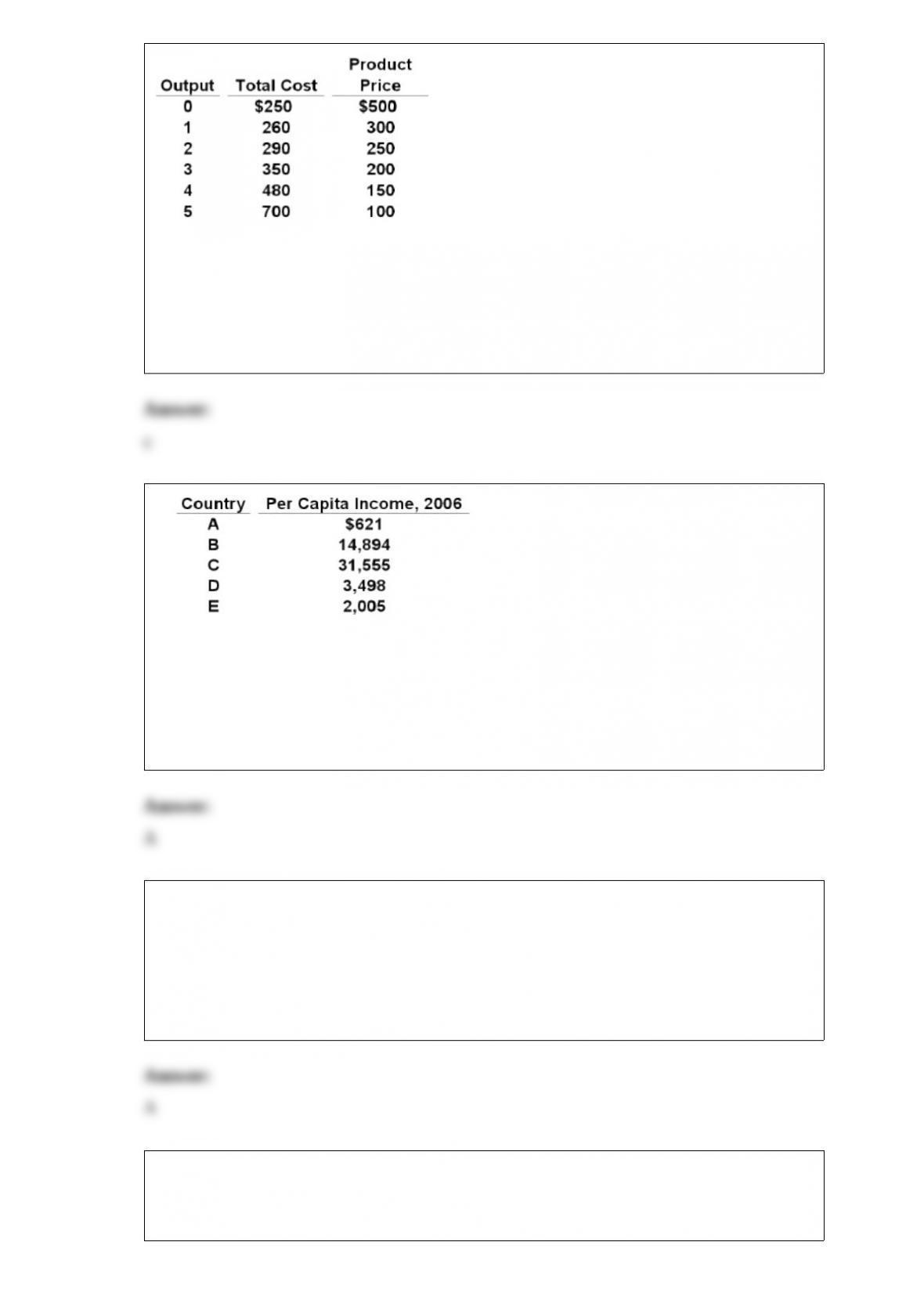
how many units would the above profit-maximizing nondiscriminating monopolist
produce?
a.1
b.2
c.3
d.4
6)
Which of the above nations would be low-income developing countries (DVCs),
according to the World Bank?
A.country A only
B.countries A, D, and E
C.countries A and E
D.countries A, B, D, and E
7) When the elasticity coefficient for resource demand is less than one, resource
demand is:
A.inelastic.
B.elastic.
C.unit elastic.
D.infinitely elastic.
8) Suppose a commercial bank has checkable deposits of $100,000 and the legal reserve
ratio is 10 percent. If the bank’s required and excess reserves are equal, then its actual
reserves:

A.are $30,000.
B.are $10,000.
C.are $20,000.
D.cannot be determined from the given information.
9) The Fed’s initial step in pursuing restrictive monetary policy using the Federal funds
rate is to:
A.announce a higher target.
B.sell bonds to banks and the public.
C.raise the discount rate.
D.raise the prime interest rate.
10) The marginal productivity theory of income distribution suggests that:
A.government should subsidize the most productive workers through a system of
transfer payments.
B.each individual should receive income based on his contribution to total output.
C.resource owners should receive income based on the idea of “from each according to
his ability, to each according to his wants.”
D.resource owners should receive income based upon their needs.