
Intended investment in a given year
a. leads to stagflation in a subsequent year.
b. reduces the productivity of the labor force.
c. raises the following year’s full-employment level of GDP.
d. reduces the amount of investment possible in a future year.
e. is higher when consumption represents a higher percentage of GDP.
Social Security payments by the government are NOT included in GDP because
a. Social Security was not yet in place when procedures for calculating GDP were
devised.
b. Social Security is counted as an economic cost and subtracted from output in
determining GDP.
c. income received through Social Security is not directly related to contributions to
production.
d. income received through Social Security is too small to affect GDP.
e. these payments are in current dollars and GDP is measured in constant dollars.
The multiple by which the commercial banking system can expand the money supply is
equal to the reciprocal of the
a. marginal propensity to save.
b. discount rate.
c. rate of inflation.
d. rate of unemployment.
e. legal reserve ratio.
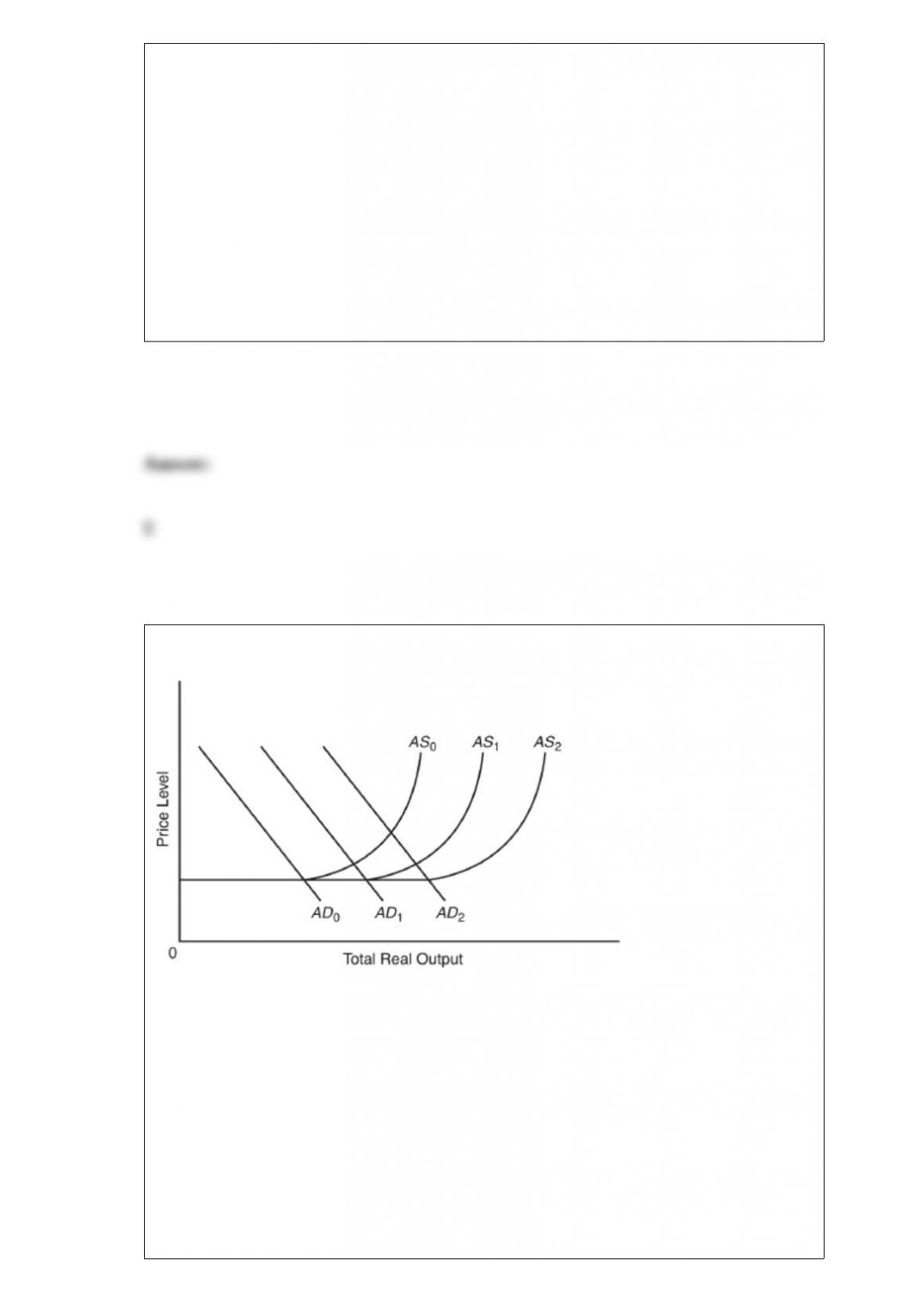
The next question is based on the following figure:
It has been estimated that the full economic effects of monetary policy are
a. realized almost immediately.
b. realized in slightly over one year.
c. realized in about one to three months.
d. unnoticed because money policy has little overall economic effect.
e. imperceptible because of the relatively minor nature of these policies.

Conservatives
a. argue that the government can do a great deal to overcome the limitations of the price
system.
b. view massive government intervention as necessary to ensure economic and political
freedom.
c. support the notion that government bureaucracies respond rapidly to new situations.
d. are skeptical about the government’s ability to solve social and economic problems.
e. point out that the price system is a form of unfair coercion.
According to Malthus, the human race in the long run would
a. enjoy increasing levels of affluence.
b. disappear entirely.
c. be forced to endure subsistence levels of living.
d. have a standard of living above subsistence but remaining constant, neither
improving nor worsening.
e. on average produce more goods and services, but these would become distributed
more and more unevenly.

Implementing which of the following policies would make it most difficult to predict
the impact on the level of pollution?
a. direct regulation
b. transferable emissions permits
c. effluent fees
d. banning the use of certain substances
e. establishing overall limits to atmospheric levels of certain substances
Under a price system, the four basic tasks are performed by
a. balloting.
b. nonprofit organizations.
c. markets.
d. government decree.
e. the bureaucracy.

If an economy is operating at a point on the C + I line that lies below the 45-degree line
a. the economy is in equilibrium.
b. the C + I line shifts down.
c. GDP will rise.
d. unwanted inventories will accumulate.
e. intended saving equals intended investment.
When a decision is made to undertake a particular course of action, its opportunity cost
a. is either zero or irrelevant.
b. disappears if the course of action is chosen voluntarily.
c. is measured by the amount of gain from the course of action.
d. may be computed by adding the gain from that action to the gains possible from
alternate actions.
e. is that which is made impossible by the course of action.

The price of an input, fixed in supply, its limits established by nature, is called
a. land.
b. profit.
c. interest.
d. entitlements.
e. rent.
Smaller auto firms such as Studebaker were unable to survive after World War II
because
a. of Japanese competition.
b. of antitrust actions by the U.S. Department of Justice.
c. the reliability and durability of their cars were unsatisfactory.
d. they were not able to achieve a scale of production that would lower unit costs.
e. they were organized as proprietorships rather than corporations.
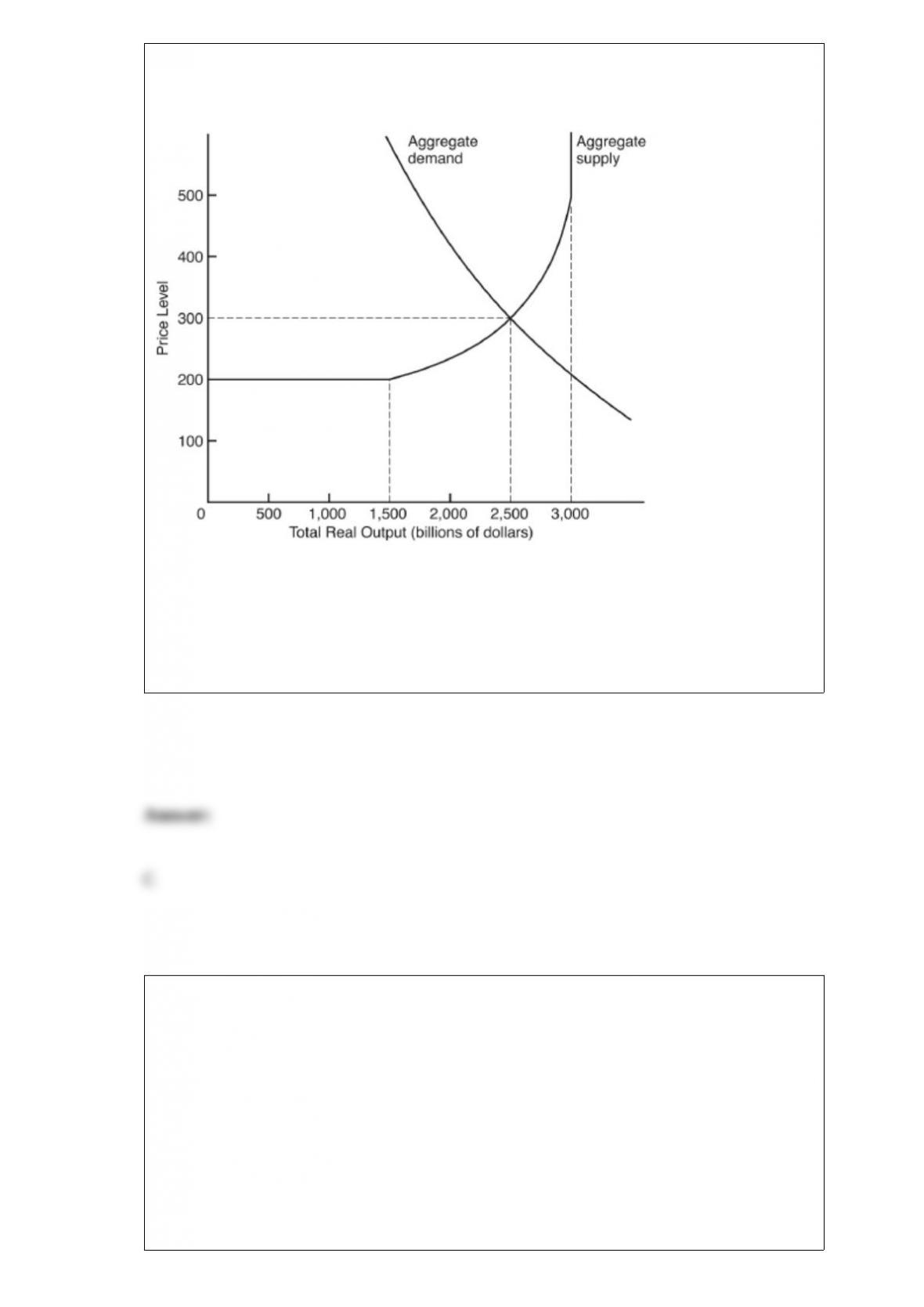
The following questions are based on the following diagram:
At equilibrium, the price level and the level of real national output are, respectively
a. 100 and $0.
b. 200 and $1,500 billion.
c. 300 and $2,500 billion.
d. 400 and $2,000 billion.
e. 500 and $3,000 billion.
Utility is a measure of
a. output.
b. usefulness.
c. satisfaction.
d. indifference.
e. demand.

A mandatory neighborhood recycling program is an example of dealing with an
environmental pollution problem by using
a. the price system.
b. tax incentives.
c. effluent fees.
d. direct regulation.
e. dumping duties.
Tariff protection to limit the degree to which we are dependent on foreign sources of a
critical material is often justified on the grounds of
a. the infant industry argument.
b. protecting our workers from low-wage competition.
c. national defense.
d. keeping both the goods and the money from hostile nations.
e. the terms of trade argument.

Excessive unemployment is a sign of a(n)
a. vertical short-run aggregate supply curve.
b. automatic stabilizer.
c. rapidly increasing price level.
d. recessionary gap.
e. excessive amount of total aggregate spending.
A rising marginal cost curve intersects the
a. average fixed cost curve at its minimum point.
b. total cost curve at its minimum point.
c. production function at its maximum point.
d. average variable and average total cost curves at their minimum points.
e. explicit and implicit cost curves at their maximum points.

The marginal tax rate for the federal personal income tax
a. increases as income rises.
b. is 90 percent for income over $10 million per year.
c. is equal to the average tax rate for all income brackets.
d. is constant for all income levels.
e. is structured to increase after-tax income.
The law of diminishing marginal returns means that as you increase the number of units
of a variable input, after some point ________ will fall.
a. total output
b. costs of production
c. demand
d. marginal output
e. employment

Cutting an English class to prepare for an economics exam is an example of
a. normative economics.
b. the fallacy of composition.
c. a nonproductive activity.
d. an inverse relationship.
e. opportunity cost.
The more sophisticated quantity theory of money most accurately predicts a change in
the nominal value of GDP resulting from a change in the money supply when
a. price levels remain constant.
b. the level of output remains constant.
c. velocity remains constant.
d. unemployment remains constant.
e. average prices and output both remain constant.
The major component of the 9.5 percent unemployment rate in 1981″82 was most likely

________ unemployment.
a. frictional
b. structural
c. cyclical
d. global
e. inflationary
Pollution control programs can lead to an adverse redistribution of income when
a. low-income neighborhoods are in close proximity to industrial pollution.
b. polluting goods and services play a bigger role in the budgets of the poor than of the
rich.
c. such programs result in increased employment opportunities for low-income
individuals.
d. the total cost of such programs is paid almost entirely by upper-income groups.
e. the social benefits of control programs fall disproportionately on the poor.
If Carolyn’s consumption rises by $5,000 as her income increases from $26,000 to
$32,000 per year, her marginal propensity to consume is
a. 0.16.
b. 19.

c. 0.83.
d. 1.20.
e. impossible to determine from the data.
In 1997 the U.S. Treasury for the first time in its history issued bonds that were
a. available in denominations smaller than $2,500.
b. without a fixed maturity date.
c. payable in gold at maturity.
d. specifically targeted for foreign lenders.
e. indexed for inflation.
At present, the major means by which government intervenes to remedy the country’s
pollution problem is
a. effluent fees.
b. direct regulation.
c. pollution taxes.

d. tax credits for pollution control equipment.
e. issuance of certificates or licenses to pollute.
The Trigger Price Mechanism
a. raised tariffs on imported steel.
b. was used by U.S. steel makers as a noncollusive way to set their prices.
c. is used to establish currency prices in foreign exchange markets.
d. tied imported steel prices to U.S. unemployment rates in the steel industry.
e. used the Japanese costs of producing steel as the guide for starting dumping
investigations.
If oligopolists can form a cartel, their profit-maximizing action is to
a. act like monopolists with a number of plants or divisions, each of which is a member
firm.
b. have only the most efficient firm undertake production.
c. produce at minimum average cost.
d. allocate sales among the cartel members so that the average cost of each is the same.
e. dramatically increase production.
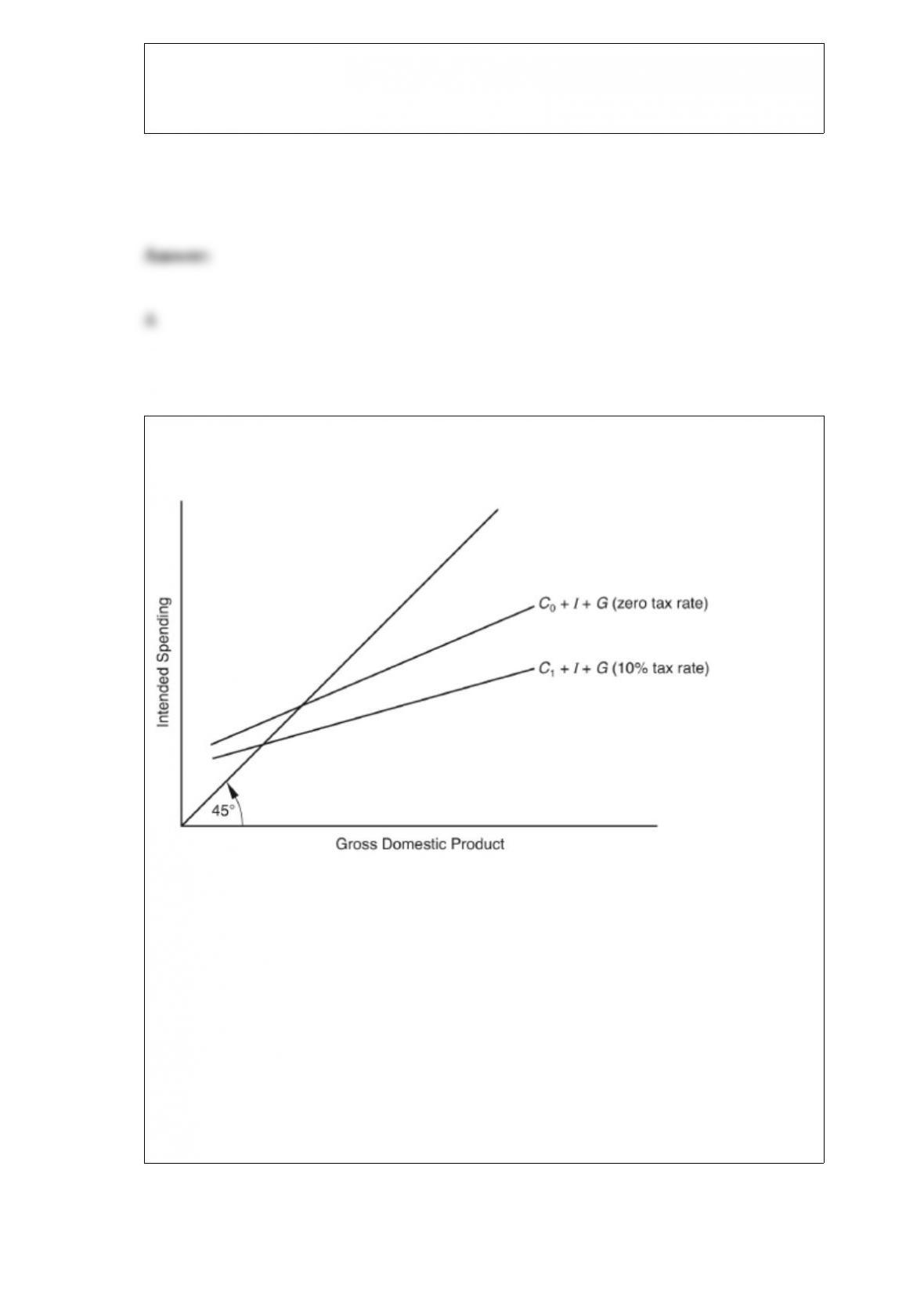
The preceding diagram shows that a(n)
a. decrease in the tax rate results in a desire to spend less out of each level of GDP.
b. decrease in the tax rate leads to an equilibrium in which GDP diverges from intended
spending.
c. decrease in the tax rate induces an increase in the equilibrium value of GDP.
d. increase in the tax rate induces an increase in the equilibrium value of GDP.
e. increase in the tax rate causes a decline in government expenditures.

The tax cut of 1964
a. represents one of the few failures of modern fiscal policy.
b. was a factor leading to increased consumption expenditures.
c. was passed over the objections of President Kennedy.
d. was enacted to reduce inflationary pressures.
e. induced a decline in investment expenditures.
If the exchange rate is $0.75 U.S. dollar to 1 Canadian dollar, then in terms of the
Canadian dollar to the U.S. dollar, it is
a. 0.75 to 1.
b. 0.33 to 1.
c. 1.33 to 1.
d. 1.75 to 1.
e. 3 to 1.

How many sellers constitute a monopoly market?
a. 1
b. 2 or 3
c. between 5 and 10
d. between 10 and 50
e. many
The debt incurred in World War II
a. was fully paid by taxes.
b. was paid by war bonds in the 1940s.
c. has never been fully paid and continues to be part of our current national debt.
d. was negligible because the war effort was covered by our excess military capacity.
e. was paid off by reparations payments from the defeated nations.

The difference between the value of exports and the value of imports is called
a. depreciation.
b. capital accumulation.
c. net exports.
d. the balance of payments.
e. the terms of trade.