Based on the income data presented for the U.S. (in your text) the Gini coefficient was
around 0.45 in 2007, which is higher than it was in 1947.
a. True
b. False
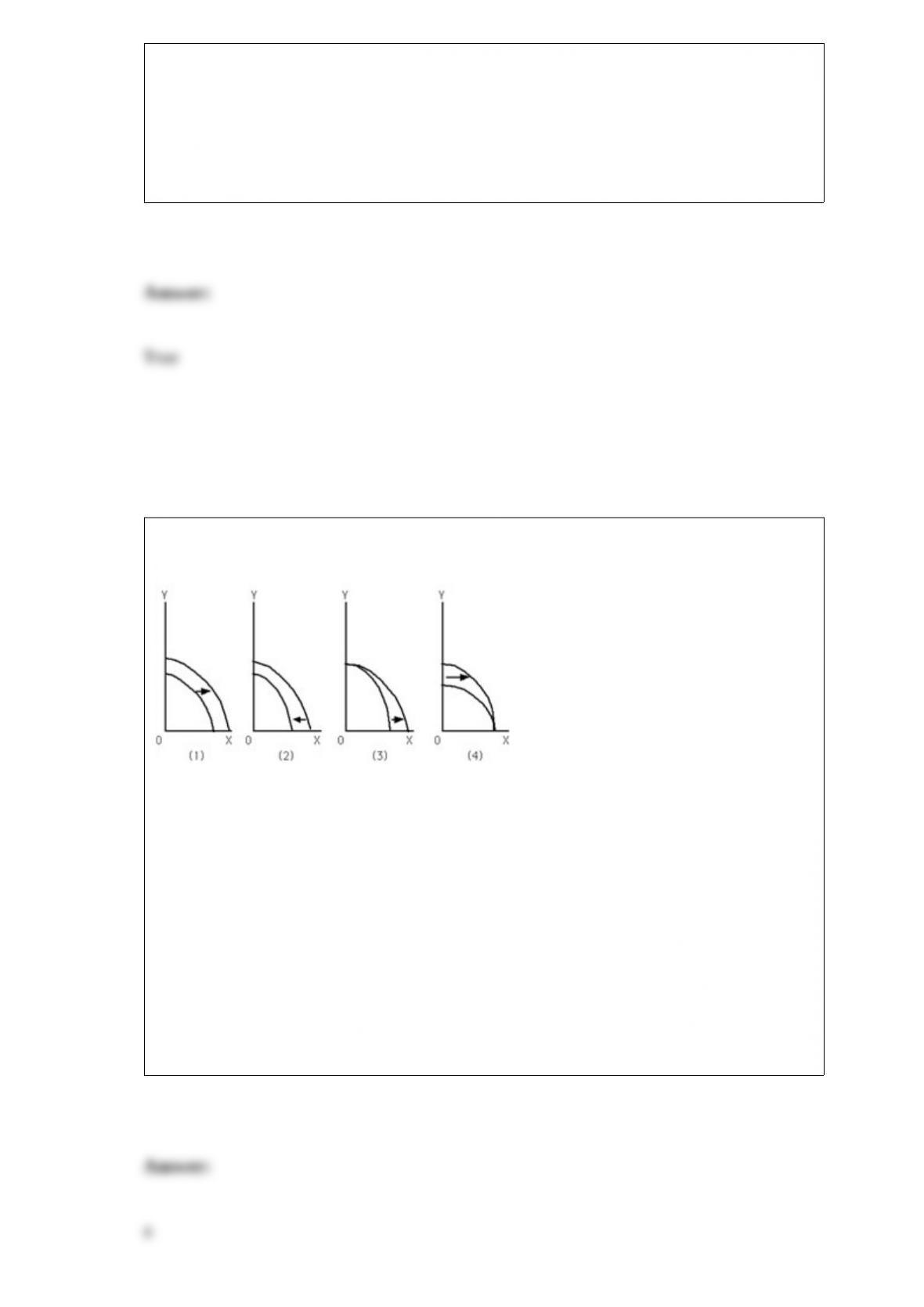
Exhibit 2-6
Which graph depicts a discovery of a new cheap source of energy that assists in the
production of both good X and good Y?
a. (1)
b. (2)
c. (3)
d. (4)
e. none of the above

The term “arbitrage” refers to
a. buying a good in a market where its price is high and selling the good in another
market where its price is lower.
b. buying a good in a market where its price is low and selling the good in another
market where its price is higher.
c. selling a good in a market where its price is high.
d. selling a good in a market where its price is low.
Which of the following statements is false?
a. The perfectly competitive firm’s demand curve is horizontal at the market price.
b. The theory of perfect competition is completely and accurately descriptive of most
real-world firms.
c. If Firm X does not strictly meet all the assumptions of the theory of perfect
competition, but behaves as if it does, then the theory of perfect competition is relevant
to it.
d. In perfect competition, the market price is established at the intersection of the
market demand and market supply curves.
Which of the following can change the wage rate in labor market A?

a. An increase in the price of the product that employees in labor market A produce.
b. A negative change in the working conditions in labor market A.
c. A rise in the wage rate in related labor market B.
d. a and c
e. a, b, and c
If natural monopolies are regulated to produce where there is resource-allocative
efficiency, they produce where
a. price equals average total cost.
b. marginal revenue equals marginal cost.
c. price equals marginal cost.
d. marginal revenue equals average total cost.
“Tying contracts” are
a. agreements between unions and businesses such that when a labor contract is signed,
the union and the firm are bound by its terms.
b. selling to a retailer on the condition that the retailer not resell the product to another
business.

c. selling to a retailer on the condition that the retailer not carry any rival products.
d. arrangements whereby the sale of one product is dependent on the purchase of some
other product.
Resource allocative efficiency exists for a perfectly competitive firm because
a. price equals marginal revenue and the firm equates marginal revenue and marginal
cost to maximize profits.
b. price equals average total cost and the firm equates marginal revenue and average
total cost to maximize profits.
c. price is greater than marginal revenue and the firm equates marginal revenue with
average total cost to maximize profits.
d. price is less than marginal revenue and the firm equates marginal cost and marginal
revenue to maximize profits.
e. none of the above
The sum of consumers’ surplus and producers’ surplus is maximized at equilibrium.
a. True
b. False
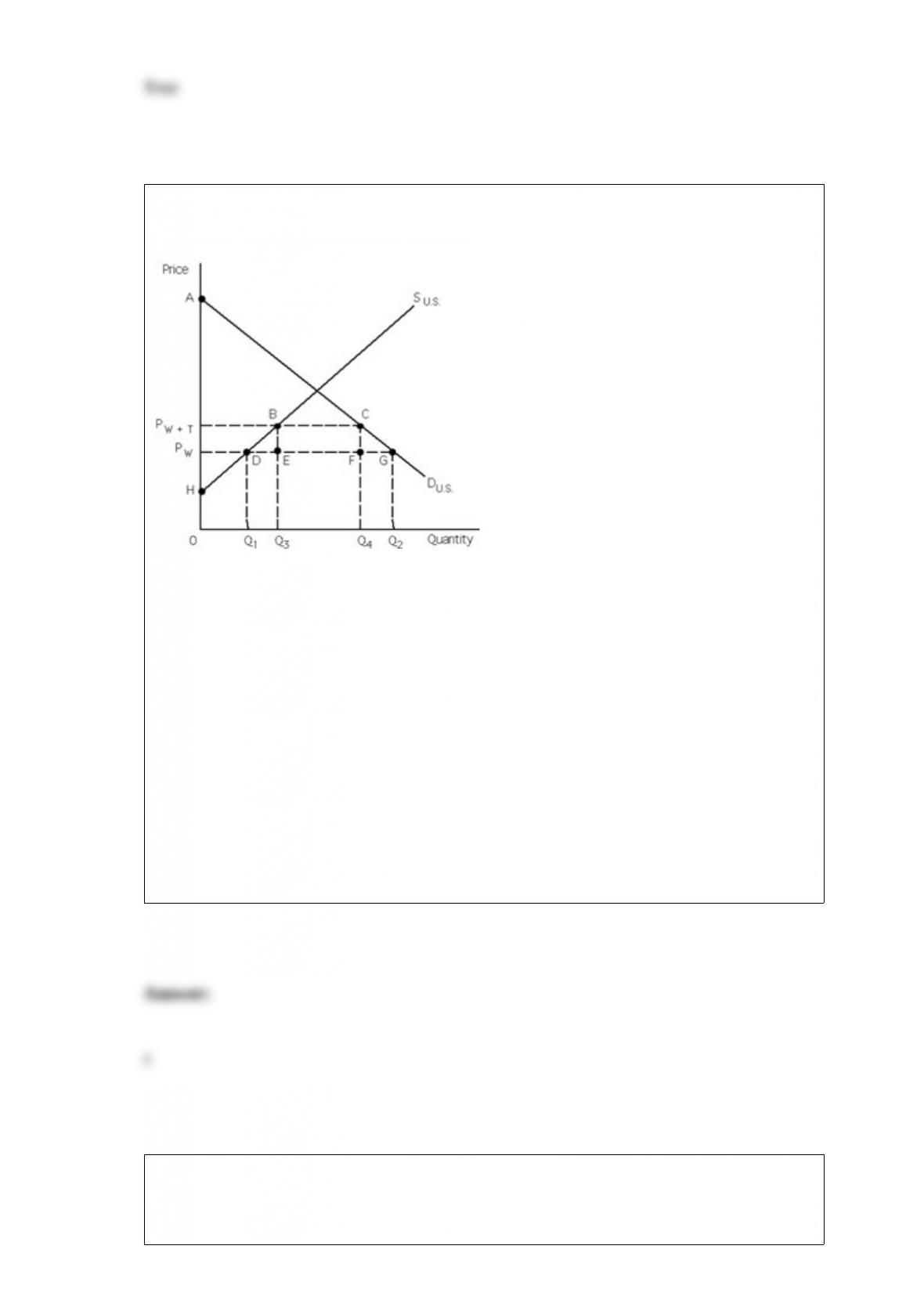
Exhibit 34-11
A tariff raises the price in the market from PW to PW + T. As a result, U.S. domestic
sales rise from __________.
a. Q1 to Q4
b. Q3 to Q2
c. Q1 to Q3
d. Q4 to Q2
e. Q3 to Q4
A productive efficient society
a. produces at a point on its PPF.

b. can produce more of one good only by giving up some of another good.
c. cannot produce unlimited amounts of a good.
d. still has to make choices.
e. all of the above
If the demand for a good is perfectly inelastic, then
a. the percentage change in quantity demanded is greater than the percentage change in
price.
b. the percentage change in quantity demanded is less than the percentage change in
price.
c. the percentage change in quantity demanded is equal to the percentage change in
price.
d. quantity demanded is extremely responsive to changes in price.
e. quantity demanded is not responsive to changes in price.
Which of the following statements is true?
a. The people that make up the top 5 percent of all income earners are all millionaires.
b. In 2009, the lowest 20 percent of all income earners earned less than 5 percent of the
total money income.

c. The income distribution in the United States is completely equal.
d. Between 1967 and 2009, the income distribution in the United States became more
equal.
If a small increase in the price of a good reduces quantity demanded to zero, demand is
________________ and the price elasticity of demand is equal to _______________.
a. perfectly inelastic; zero
b. perfectly elastic; infinity
c. unit elastic; one
d. perfectly elastic; zero

For Maya, the opportunity cost of producing one unit of good Y is ___________ unit(s)
of good X.
a. 2.00
b. 1.00
c. 10.00
d. 0.50
If the demand for consumption loans rises, this could be the result of
a. the discovery of new roundabout methods of production.
b. a higher rate of time preference in society.
c. an increase in (people) saving.
d. a higher interest rate.
e. a and c
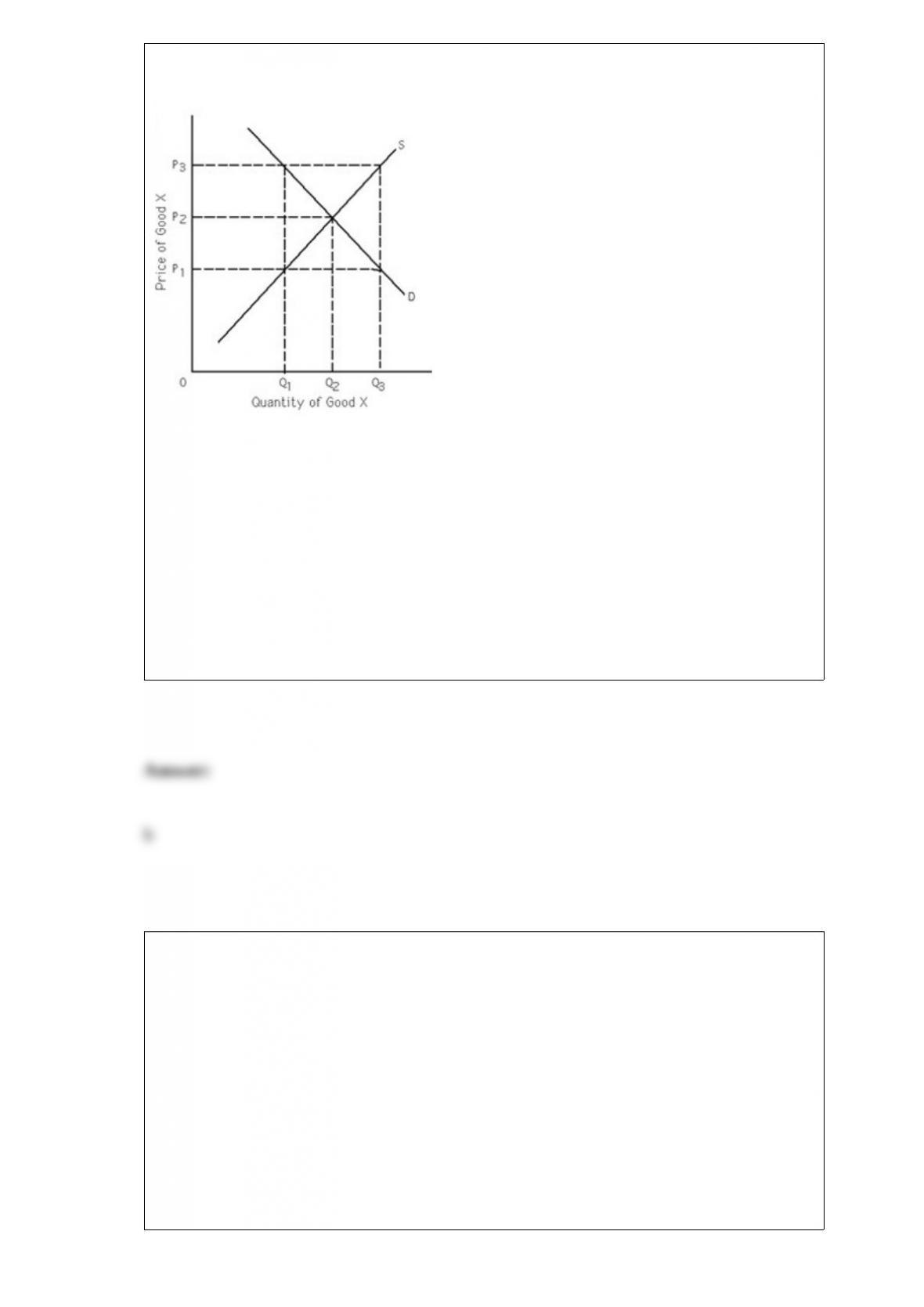
Exhibit 4-3
Which of the following is true?
a. If price P3 is set as a price ceiling it will have an effect on the market for good X.
b. If price P3 is set as a price floor it will have an effect on the market for good X.
c. Price P3 is the equilibrium price for good X.
d. Price P3 is the highest price that can legally be charged in the market for good X.
If the seller of good X raises the price of good X, it follows that the total revenue of
good X will __________, if demand is __________.
a. rise; inelastic
b. rise; elastic
c. fall; unit elastic
d. fall; elastic
e. a and d

Airlines that try to lower fares in order to increase revenue must believe that the
demand for airline service is
a. price inelastic.
b. income elastic.
c. income inelastic.
d. price elastic.
e. cross-price elastic.
Saying “the marginal costs are greater than the marginal benefits” is the same as saying
a. the average costs are greater than the average benefits.
b. the total costs are greater than the average benefits.
c. the benefits are greater than the costs.
d. the additional costs are greater than the additional benefits.
e. the costs minus the benefits equal the net costs.