As Lynn eats more pizza, we would typically expect her marginal utility from eating
pizza to:
A. increase.
B. decrease.
C. stay the same.
D. equal the price of pizza.
Skill-biased technological has different effects on the marginal products of ______
workers and ______ workers.
A. male; female
B. union; nonunion
C. government; private-sector
D. higher-skilled; lower-skilled
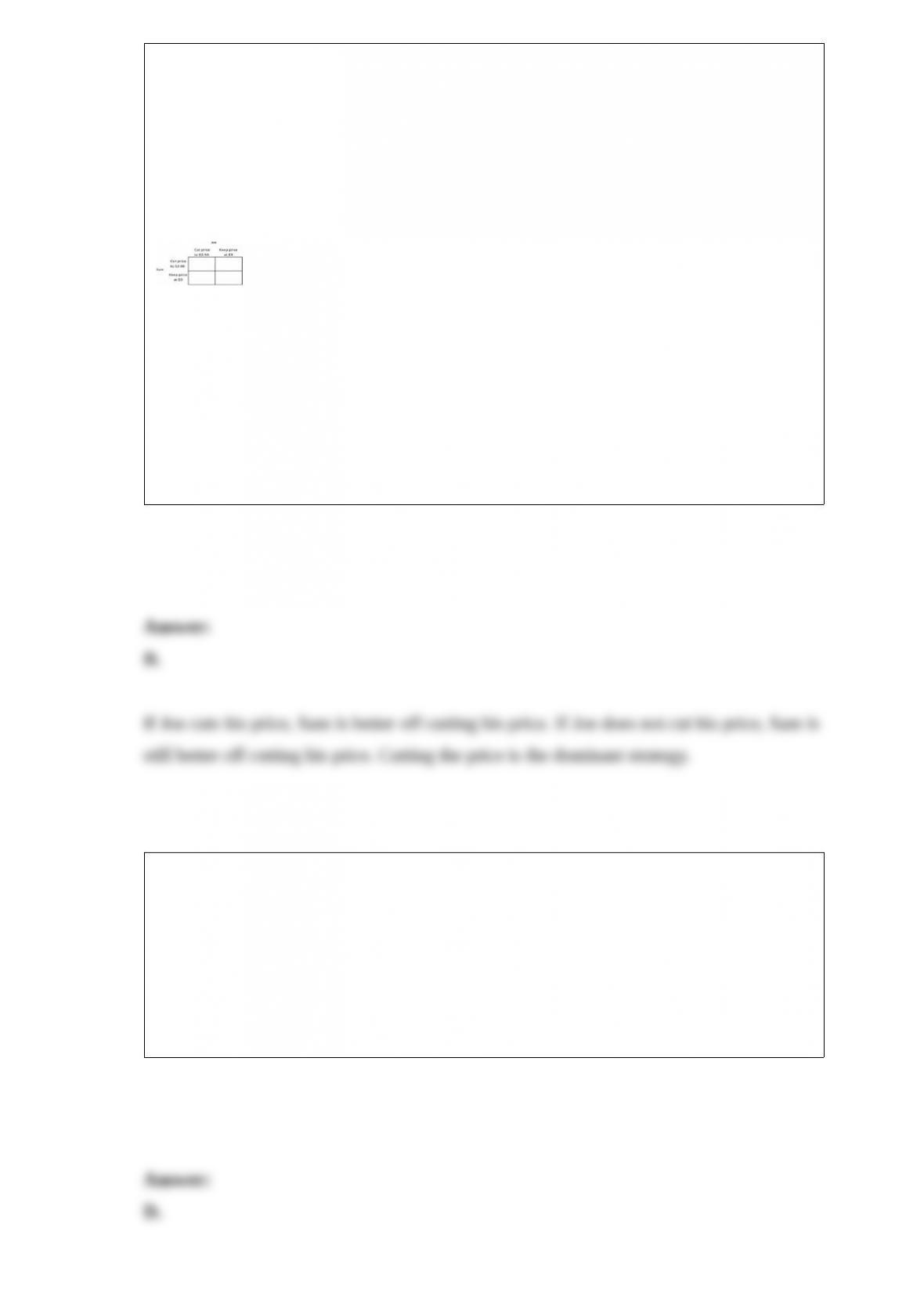
Joe is the owner of the 7-11 Mini Mart, Sam is the owner of the SuperAmerica Mini
Mart, and together they are the only two gas stations in town. Currently, they both
charge $3 per gallon, and each earns a profit of $1,000. If Joe cuts his price to $2.90 and
Sam continues to charge $3, then Joe’s profit will be $1,350, and Sam’s profit will be
$500. Similarly, if Sam cuts his price to $2.90 and Joe continues to charge $3, then
Sam’s profit will be $1,350, and Joe’s profit will be $500. If Sam and Joe both cut their
price to $2.90, then they will each earn a profit of $900. You may find it easier to
answer the following questions if you fill in the payoff matrix below.
For Sam, cutting his price to $2.90 per gallon is a:
A. revenue-maximizing strategy.
B. dominant strategy.
C. dominated strategy.
D. profit-maximizing strategy.
Consumption expenditures include spending by households on:
A. exports.
B. inventories.
C. residential housing.
D. services.
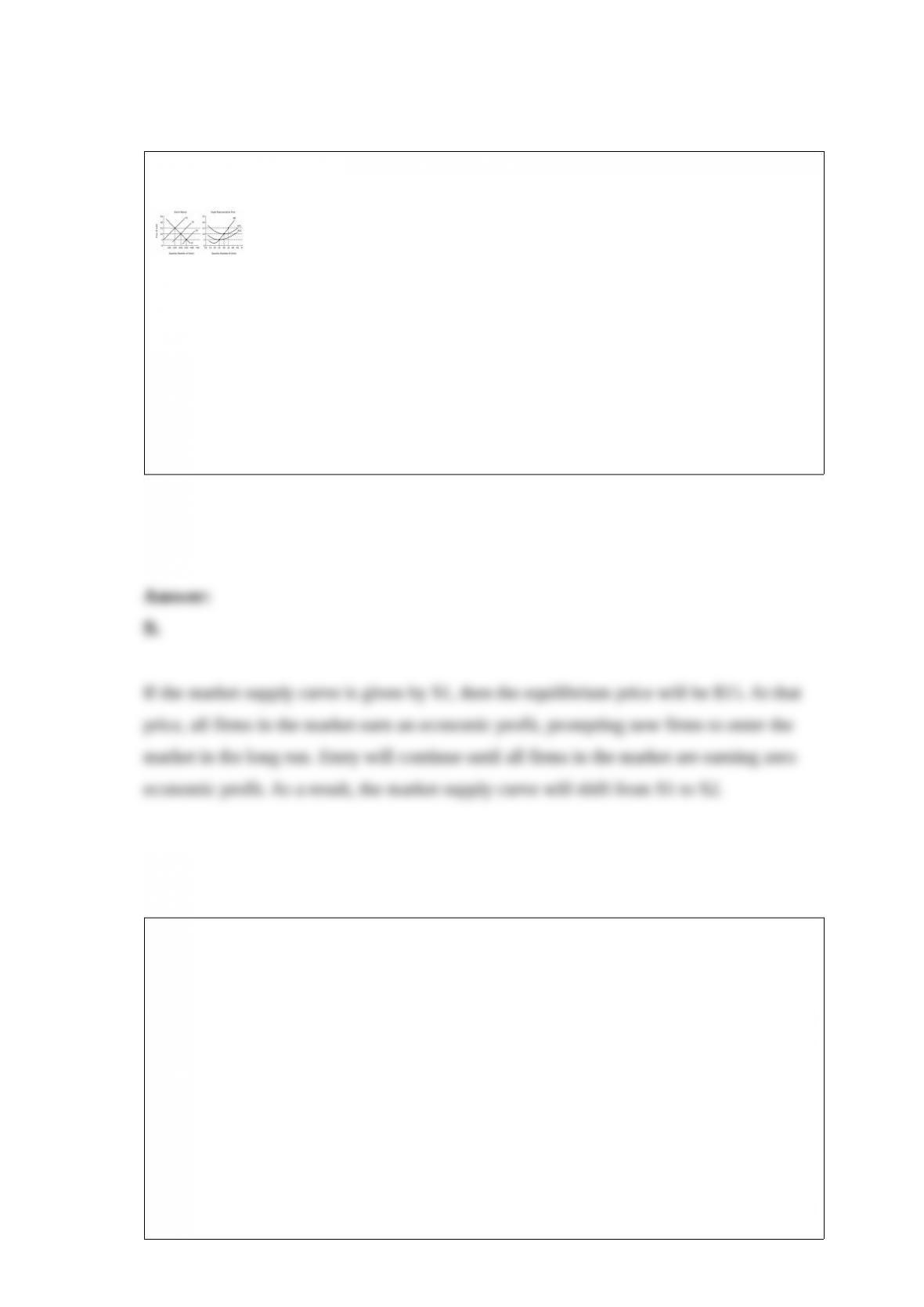
Assume that all firms in this industry have identical cost curves, and that the market is
perfectly competitive.
If the market supply curve is given by S1, then in the long run firms will:
A. enter the market, leading the market supply curve to shift out to S3.
B. enter the market, leading the market supply curve to shift out to S2.
C. exit the market, leading the market supply curve to shift out to S2.
D. neither enter nor exit the market, so the market supply curve will remain at S1.
Suppose that the salary range for recent college graduates with a bachelor’s degree in
economics is $30,000 to $50,000, with 25 percent of jobs offering $30,000 per year, 50
percent offering $40,000 per year and 25 percent offering $50,000 per year and that in
all other respects, the jobs are equally satisfying. Assume that in this market, a job offer
remains open for only a short time so that continuing to search requires an applicant to
reject any current job offer. Who will accept an offer of $30,000?
A. Graduates who have been searching the longest
B. Graduates who enjoy taking risks
C. Graduates who are either risk-neutral or risk-averse
D. Graduates who are risk-averse
Suppose a profit-maximizing firm in a perfectly competitive market is collecting $1,999
in total revenues. If the total cost of its fixed factors of production falls from $500 to
$400, the firm will:
A. expand its output.
B. lower its price.
C. earn greater profits or smaller losses.
D. earn smaller profits or larger losses.
In a perfectly competitive labor market, if the value of marginal product of the last
worker hired is $20 and the wage rate is $25, then the firm should:
A. hire fewer workers.
B. hire more workers.
C. not change the number of workers it hires.
D. either hire more or fewer workers, depending on the price of the firm’s output.
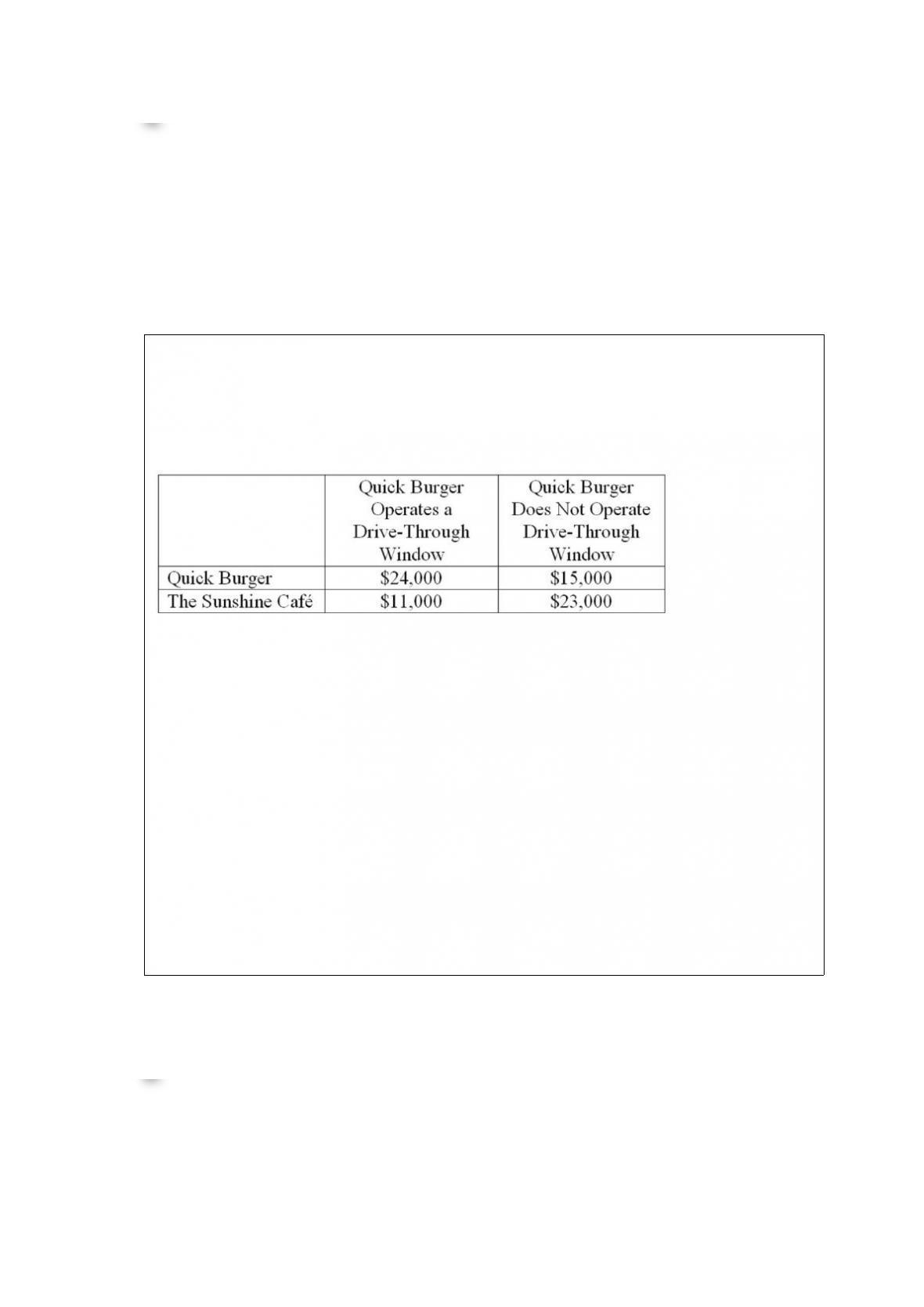
Consider two restaurants located next door to each other: Quick Burger and The
Sunshine Café. If Quick Burger opens a drive-through window, the increased traffic and
noise will bother customers seated outside at The Sunshine Café. The table below
shows the monthly payoffs to Quick Burger and The Sunshine Café when Quick Burger
does and does not operate a drive-through window.
Suppose Quick Burger has the legal right to operate a drive-through window, and Quick
Burger and the Sunshine Café can negotiate with each other at no cost. Which of the
following arrangements would lead to the socially optimal outcome?
A. Quick Burger pays The Sunshine Café $12,500 per month to operate the
drive-through window.
B. Quick Burger pays The Sunshine Café $10,500 per month to operate the
drive-through window.
C. The Sunshine Café pays Quick Burger $12,500 per month not to operate the
drive-through window.
D. The Sunshine Café pays Quick Burger $10,500 per month not to operate the
drive-though window.

You notice that your grocery store always has day-old bakery products at a reduced
price. Why might that be?
A. At the original price, the quantity demanded was greater than the quantity supplied.
B. At the original price, there was a shortage of bakery products.
C. The original price was an equilibrium price because it was established in a free
market.
D. At the original price, quantity supplied was greater than quantity demanded.
A flexible exchange rate is an exchange rate whose value:
A. is determined by the law of one price.
B. varies according to supply and demand for the currency in the foreign exchange
market.
C. is established annually by the International Monetary Fund.
D. reflects the comparative advantage of the home country versus other foreign
countries.
The outside lag of macroeconomic policy is the:

A. time between a shift in aggregate demand and a shift in aggregate supply.
B. delay between when a policy change is needed and the policy is implemented.
C. difference between actual inflation and the target rate of inflation.
D. delay between when a policy change is implemented and when most of the effects of
policy have occurred in the economy.
Suppose that at a price of 25 cents per orange, 500 consumers each demand 4 oranges,
and at a price of 20 cents per orange, 750 consumers each demand 5 oranges. Therefore,
the market demand for oranges is ______ at a price of 25 cents per orange and ______
at a price of 20 cents per orange.
A. 4; 5
B. 500; 750
C. 1250; 1500
D. 2000; 3750
As U.S. real GDP falls, poorer households may decide to buy ______ foreign goods and
assets, which would cause a(n) ______ of the U.S. dollar.
A. more; appreciation

B. more; depreciation
C. fewer; appreciation
D. fewer; depreciation
The marginal product of labor is the additional:
A. wage paid for an additional hour of work.
B. wage paid for an additional worker employed.
C. labor employed to produce one more unit of output.
D. output produced by one more worker.
Larry has a comparative advantage over his classmates in writing term papers if he:
A. can write term papers faster than his classmates.
B. has an absolute advantage in writing term papers.
C. always earns an A on his term papers.
D. has a lower opportunity cost of writing term papers than his classmates.
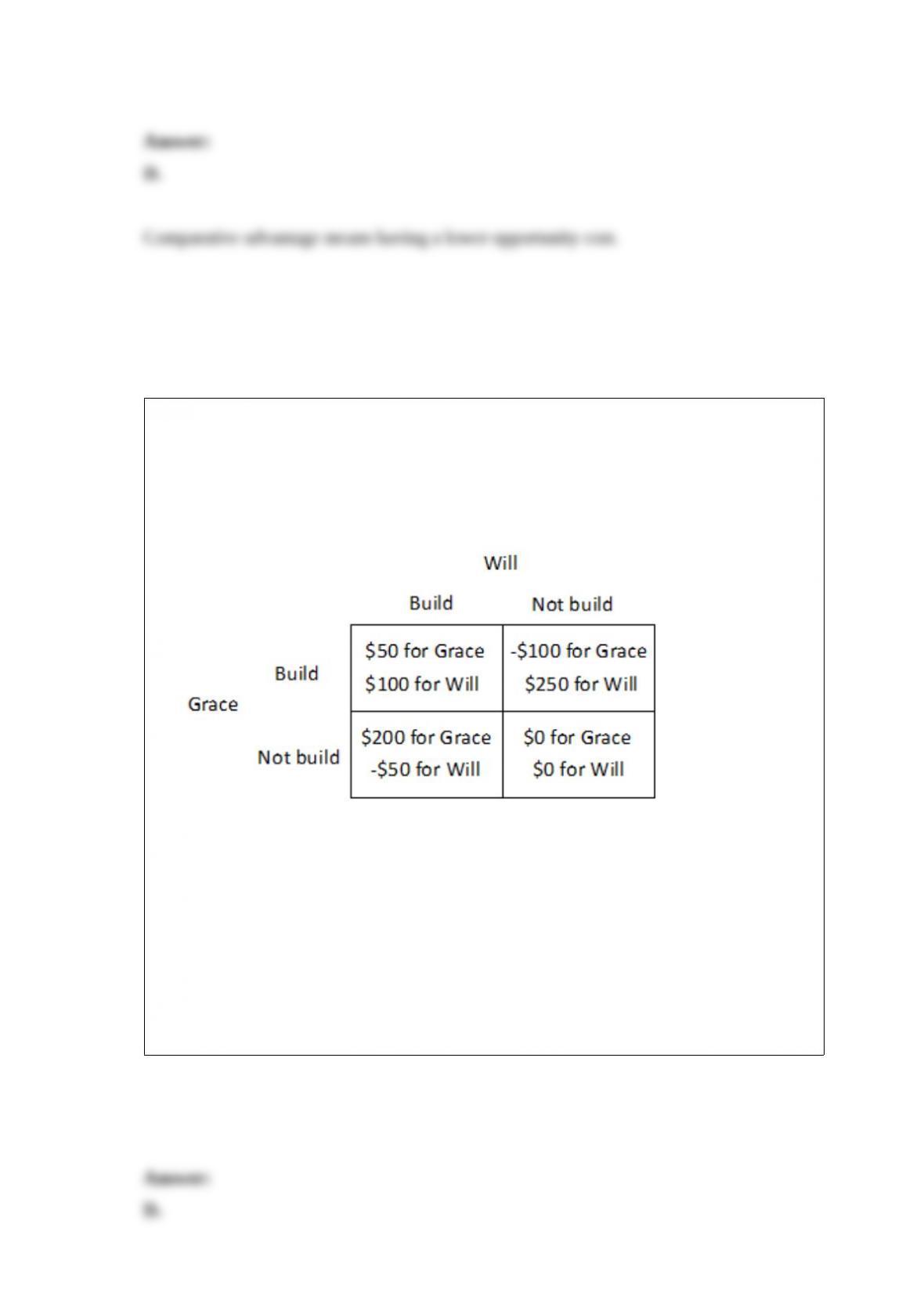
Will and Grace have adjoining unfenced back yards and each has just adopted a new
puppy. Will values a fence between their yards at $250 and Grace values a fence
between their yards at $200. The cost of building the fence is $300, which will be split
equally if they both agree to build the fence. Therefore, their payoff matrix is as
follows.
In the Nash equilibrium of this game:
A. Will and Grace will both build the fence and split the cost.
B. Will will build the fence by himself.
C. the fence will be built, but it is uncertain who will build it.
D. no fence will be built.

An individual has an absolute advantage in producing pizzas if that individual:
A. has a lower opportunity cost of producing pizzas than anyone else.
B. can produce more pizzas in a given amount of time than anyone else.
C. has a higher opportunity cost of producing pizzas than anyone else.
D. charges the lowest price for pizzas.
One thing that distinguishes normative economic principles from positive economic
principles is that:
A. normative principles are pessimistic and positive principles are optimistic.
B. normative principles reflect social norms, and positive principles reflect universal
truths.
C. normative principles tell us how people should behave, and positive principles tell us
how people will behave.
D. normative principles tell us how people will behave, and positive principles tell us
how people should behave.

The total market value of production in an economy must equal total:
A. profits.
B. revenues from all transactions.
C. consumption.
D. spending on final goods and services.
Given that most people like the smell of baking cinnamon rolls and dislike the smell of
burning tires, baking cinnamon rolls generates ______ externality, and burning tires
generates ______ externality.
A. a positive; a negative
B. a negative; a positive
C. a positive, no
D. no; a negative

Suppose the natural rate of unemployment is 4 percent. What is the actual rate of
unemployment if actual output is 2 percent below potential output?
A. 3 percent
B. 5 percent
C. 6 percent
D. 8 percent
A change in consumers’ incomes causes a change in:
A. demand.
B. supply.
C. the demand for normal goods but not the demand for inferior goods.
D. the cross-price elasticity of demand.
Suppose you want to maximize your total utility. If your marginal utility per dollar
spent is higher for one good than for all others, then you should:
A. reallocate your spending away from that good.
B. reallocate your spending towards that good.
C. spend more on all goods.
D. spend less on all goods.
Which of the following would cause an increase in quantity supplied of wheat?
A. The price farmers receive for their wheat rises.
B. The price of fertilizer farmers’ use in their fields decreases.
C. The price firms pay for liability insurance falls.
D. New, better technology for farming is introduced.
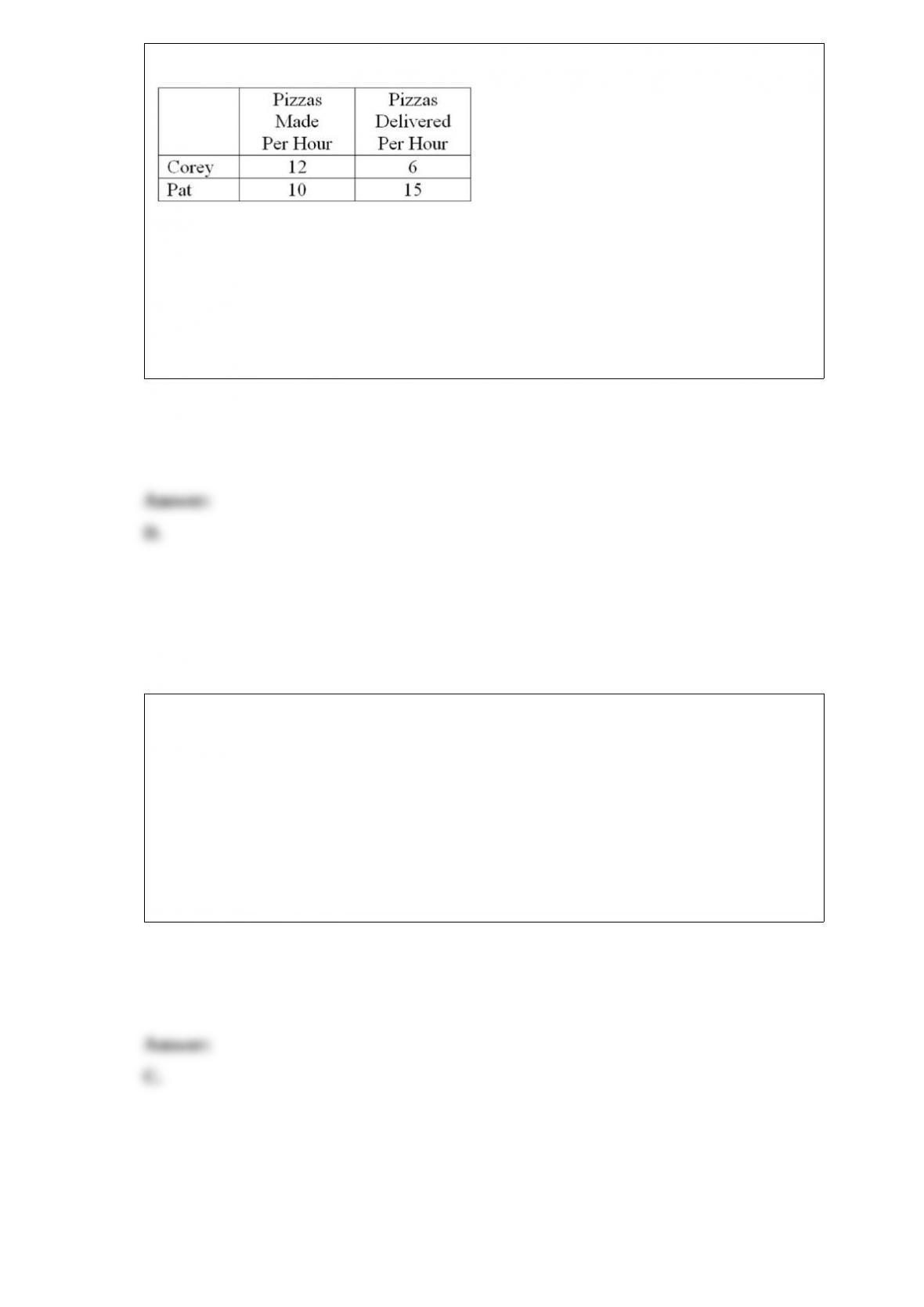
Refer to the table below. Corey’s opportunity cost of making of a pizza is delivering:
A. 2 pizzas.
B. 3/2 of a pizza.
C. 2/3 of a pizza.
D. 1/2 of a pizza.
If there is 2 percent frictional unemployment, 3 percent structural unemployment, and 1
percent cyclical unemployment, then the natural rate of unemployment equals:
A. 3%.
B. 4%.
C. 5%.
D. 6%.

On a graph of a production possibilities curve, if a point is attainable, then it:
A. must be efficient.
B. might or might not be efficient.
C. is efficient only if it does not exhaust all currently available resources.
D. must completely exhaust all currently available resources.
Mexico and the members of OPEC produce crude oil. Realizing that it would be in their
best interests to form an agreement on production goals, a meeting is arranged and an
informal, verbal agreement is reached. If both Mexico and OPEC abide by the
agreement, then OPEC’s profit will be $200 million and Mexico’s profit will be $100
million. If both Mexico and OPEC cheat on the agreement, then OPEC’s profit will be
$175 million and Mexico’s profit will be $80 million. If only OPEC cheats, then
OPEC’s profit will be $185 million, and Mexico’s profit will be $60 million. If only
Mexico cheats, then Mexico’s profit will be $110 million, and OPEC’s profit will be
$150 million. You may find it helpful to fill in the payoff matrix below.
Which of the following statements is correct?
A. Mexico does not have dominant strategy.
B. Mexico’s dominant strategy is to abide by the agreement.
C. Mexico does not have a dominated strategy.
D. Mexico’s dominant strategy is to cheat on the agreement.

To correct a nominal quantity for changes in the price level, one should:
A. add a price index to it.
B. subtract a price index from it.
C. divide it by a price index.
D. multiply it by a price index.
Medical insurance covering routine medical care became common:
A. around 1900.
B. in the 1920’s.
C. after World War II.
D. during the 1980’s.
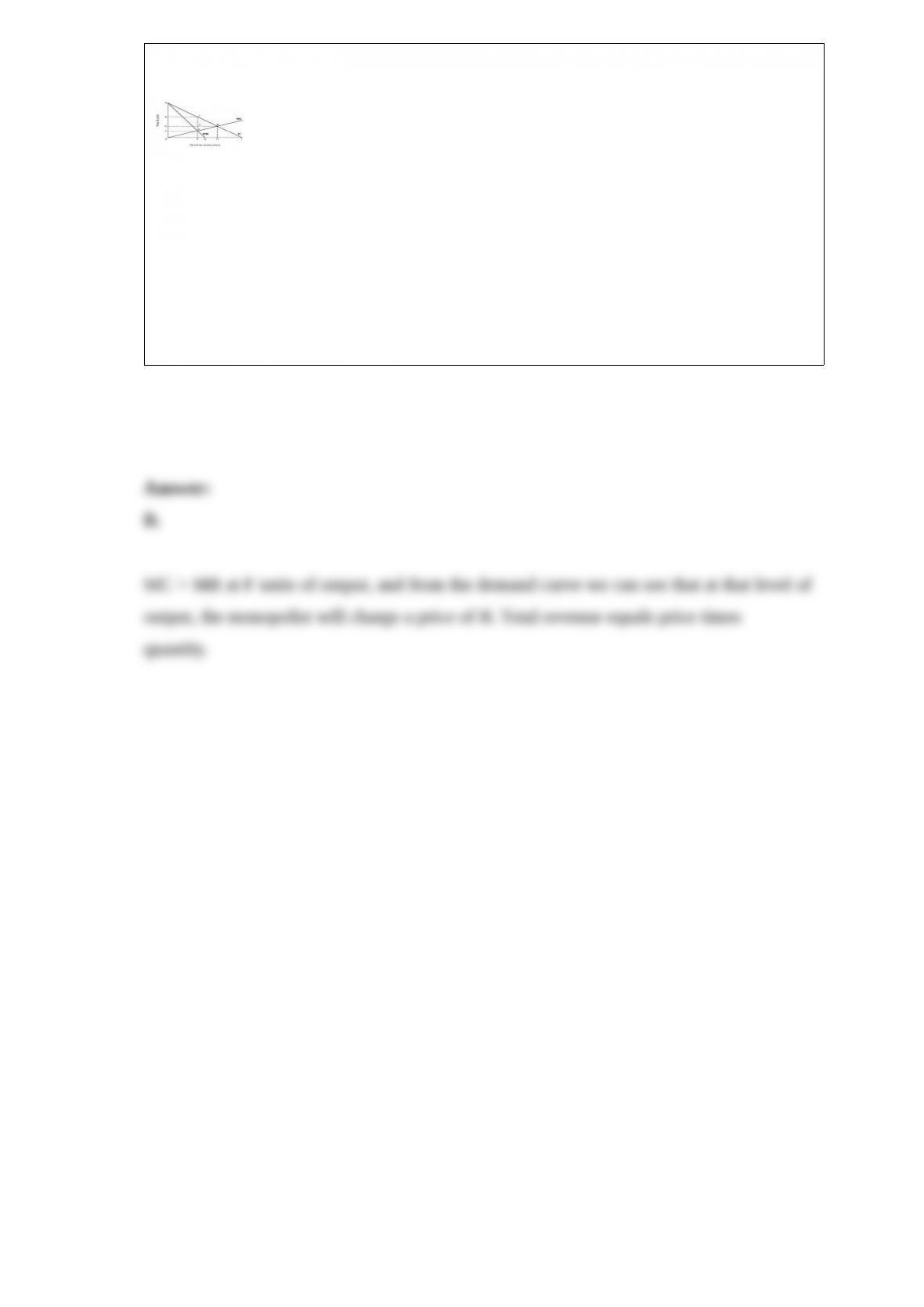
Suppose the figure below shows the demand curve, marginal revenue curve and
marginal cost curve for a monopolist.
At this monopolist’s profit-maximizing level of output, its total revenue equals the area:
A. 0HNC.
B. 0FJB.
C. 0FLE.
D. ELJB.