
Scenario 10.2:
A monopolist faces the following demand curve, marginal revenue curve, total cost
curve and marginal cost curve for its product:
Q = 200 – 2P
MR = 100 – Q
TC = 5Q
MC = 5
Refer to Scenario 10.2. Suppose that in addition to the tax, a business license is required
to stay in business. The license costs $1000. What happens to profit?
A) It increases by $1000.
B) It decreases by $1000.
C) It decreases by less than $1000.
D) It stays the same.
The presence of deposit insurance in the savings and loan industry
A) created an adverse selection problem because good S&Ls were forced out of the
market.
B) solved its own adverse selection problem because it pushed badly managed S&Ls
out of the market.
C) contributed to “depositor moral hazard” but did not involve a moral hazard problem
with owners.
D) contributed to “moral hazard by owners” but did not involve a moral hazard problem
with depositors.

E) contributed to both “depositor moral hazard” and “moral hazard by owners.”
Electric power utility companies use various fuel sources (e.g., coal, natural gas,
nuclear) to generate electricity for their customers. What happens to the demand for
natural gas used to generate electricity as we move from a short-run planning horizon to
a long-run planning horizon? Why?
A) Demand becomes more inelastic over time because the other fuel sources become
more scarce, so there are fewer options available for electric power utilities in the long
run.
B) Demand becomes more inelastic over time because all of the power generation
plants tend to choose the same technology, which makes the industry less responsive to
prices in the long run.
C) Demand becomes more elastic over time because the electric plant’s technology
becomes obsolete, and the power company has less flexibility to adjust to changes.
D) Demand becomes more elastic over time because the power companies have more
options available and can adopt new generating technologies or substitutes for natural
gas over the long run.
Consider the following information:
The probability of a fire in a factory without a fire prevention program is 0.01. The
probability of a fire in a factory with a fire protection program is 0.001. If a fire
occurred, the value of the loss would be $300,000. A fire prevention program would

cost $80 to run.
. Moral hazard would be eliminated in this situation if
A) the insurer would always charge $300.
B) the insurer would always charge $6000.
C) the insurer could costlessly monitor whether a fire prevention program has been
implemented, and adjust the premium upward if it is not.
D) the insurer could costlessly monitor whether a fire prevention program has been
implemented, and adjust the premium downward if it is not.
E) the fire did not occur.
Firms face trade-offs in production, including decisions related to:
A) which products to produce.
B) how much of a particular product to produce.
C) the best way to produce a given amount of output.
D) all of the above
Which of the following would cause a shift to the right of the supply curve for

gasoline?
I. A large increase in the price of public transportation.
II. A large decrease in the price of automobiles.
III. A large reduction in the costs of producing gasoline.
A) I only
B) II only
C) III only
D) II and III only
Denise is shopping for lobsters and eclairs. When she faces budget line b1, she chooses
market basket A over market basket B. When she faces budget line b2, she chooses
basket B over basket C. Which assumption of consumer theory helps us determine
Denise’s preference ordering over basket A and basket C?
A) Completeness
B) More is better than less
C) Transitivity
D) Convexity

Scenario 1:
It is the factory’s choice whether to install a filter. It is the choice of the nearby
fishermen whether to install a treatment plant. Dollar figures show profit. The factory
and the fishermen can negotiate costlessly, and no one else is affected by the result.
Factory Fishermen
A: No filter or treatment plant $10,000 $2,000
B: Filter; no treatment plant $6,000 $10,000
C: No filter; treatment plant $10,000 $4,000
D: Filter; treatment plant $6,000 $6,000
the Coase theorem specifies that
A) the result will be different if the fishermen are given the right to clean water than it
will be if the factory is given the right to use the water as it sees fit, but the result will
be inefficient in either case.
B) the efficient result will occur whether the fishermen are given the right to clean
water or the factory is given the right to use the water as it sees fit.
C) economic efficiency requires that the fishermen be given the right to clean water.
D) economic efficiency requires that no one may contaminate the water.
E) economic efficiency requires that the fishermen be given the right to clean water and
that the factory be given the right to use the water as it sees fit.
Club Med, which operates a number of vacation resorts, offers vacation packages at a
lower price in the winter (i.e., the “off season”) than in the summer. This practice is an
example of:
A) peak-load pricing.

B) intertemporal price discrimination.
C) two-part tariff.
D) bundling.
E) Both A and B are correct.
Suppose a competitive industry produces output, Q, using some input, i, where the price
of the output is PQ and the input price is Pi. Efficient use of resources requires that
A) MRPi = MPi.
B) MRPi = Mpi/PQ.
C) MRPi = MPi PQ.
D) MRPi = Pi.
The maximum price that a consumer is willing to pay for a good is called:
A) the reservation price.
B) the market price.
C) the first-degree price.

D) the block price.
E) the choke price.
Suppose biochemists discover an enzyme that can double the amount of ethanol that
may be derived from a given amount of biomass. Based on this technological
development, we expect the:
A) supply curve for ethanol to shift leftward.
B) supply curve for ethanol to shift rightward.
C) demand curve for ethanol to shift leftward.
D) demand curve for ethanol to shift rightward.
Which of the following is an example of anchoring in retail prices?
A) Price tags on the merchandise list a “high” price that is charged at a competing
retailer and the a much lower price that the store actually charges.
B) An appliance store lists a commercial-quality coffee maker that has high capacity
and is very expensive, and all of the other coffee makers are smaller and less expensive.
C) Restaurant menus include a premium entree like a steak and lobster dinner that is
very expensive, and all of the other entree choices are priced at lower values.

D) all of the above
As interest rates fall,
A) the values of bonds rise.
B) the values of bonds fall.
C) the values of bonds are unchanged.
D) the value of perpetuities are unchanged, but the value of other bonds change in
value.
E) the value of all bonds except perpetuities change.
An improvement in technology would result in
A) upward shifts of MC and reductions in output.
B) upward shifts of MC and increases in output.
C) downward shifts of MC and reductions in output.
D) downward shifts of MC and increases in output.
E) increased quality of the good, but little change in MC.

Which of the following is a negative externality connected to attending college?
A) The fact that completion of a college degree acts as a signaling mechanism to
employers.
B) The fact that other costs, such as books and materials, are incurred in addition to
tuition and fees.
C) The fact that your college has required that all individuals living in student housing
either get or show they have already obtained vaccinations against all communicable
diseases.
D) The fact that the people in the next room play loud music at hours you want to sleep.
E) The fact that you will get benefits from college that you don’t currently anticipate.
The assumption of transitive preferences implies that indifference curves must:
A) not cross one another.
B) have a positive slope.
C) be L-shaped.
D) be convex to the origin.
E) all of the above

Zinc Communications developed a new type of cellular telephone that has a
three-dimensional (3-D) screen. The company holds a patent on this technology, so they
are the only seller of the 3-D phone when it is introduced. Over time, other companies
introduce phones that are similar but not identical (i.e., they do not violate the patent
held by Zinc). What happens to the demand for 3-D phones facing Zinc and to the
profit-maximizing price for the 3-D phone as these similar products enter the market?
A) Demand becomes less elastic, price increases
B) Demand becomes less elastic, price declines
C) Demand becomes more elastic, price increases
D) Demand becomes more elastic, price declines
A firm uses two factors of production. Irrespective of how much of each factor is used,
both factors always have positive marginal products which imply that
A) isoquants are relevant only in the long run
B) isoquants have negative slope
C) isoquants are convex
D) isoquants can become vertical or horizontal
E) none of the above

If the MSB/MCA graph indicates that an emissions fee of $10 per unit would lead to the
optimum level of emissions, but the government set a fee of $5 per unit, emissions
would
A) not be reduced at all.
B) not occur at all.
C) be above the optimum level, but curtailed somewhat from what they would have
been with no fee at all.
D) be above the optimum level by 50%.
E) be below the optimum level by 50%.
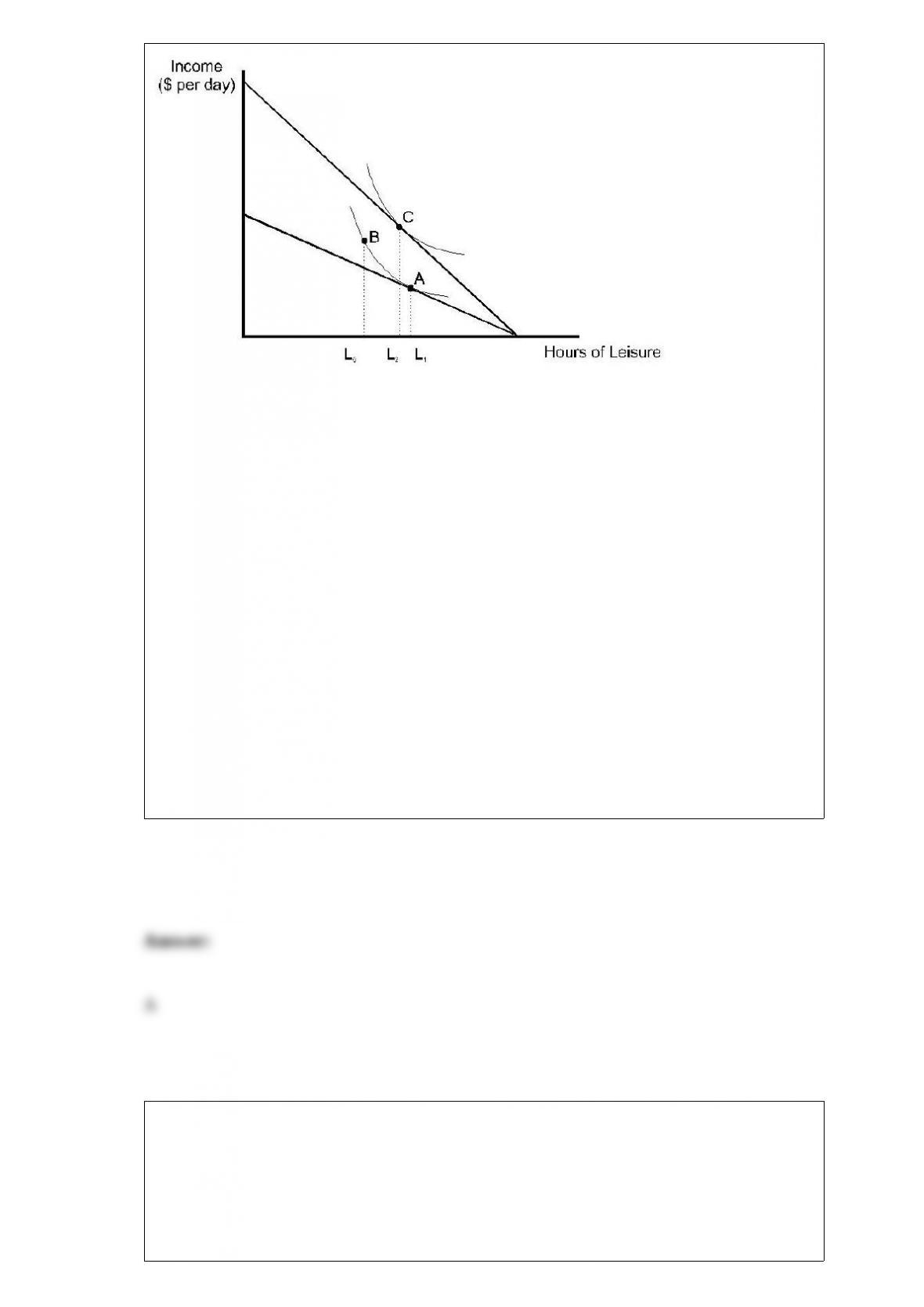
Figure 14.1
A consumer’s original utility maximizing combination of income and leisure is shown
in the diagram above as point A. After a wage increase, the consumer’s utility
maximizing combination changes to point C.
Refer to Figure 14.1. The substitution effect of the wage increase on the amount of
hours of leisure is:
A) L1 to L0
B) L1 to L2.
C) L0 to L2.
D) L0 to L1.
E) none of the above
A multiplant firm has equated marginal costs at each plant. By doing this
A) profits are maximized.
B) costs are minimized given the level of output.
C) revenues are maximized given the level of output.
D) none of the above
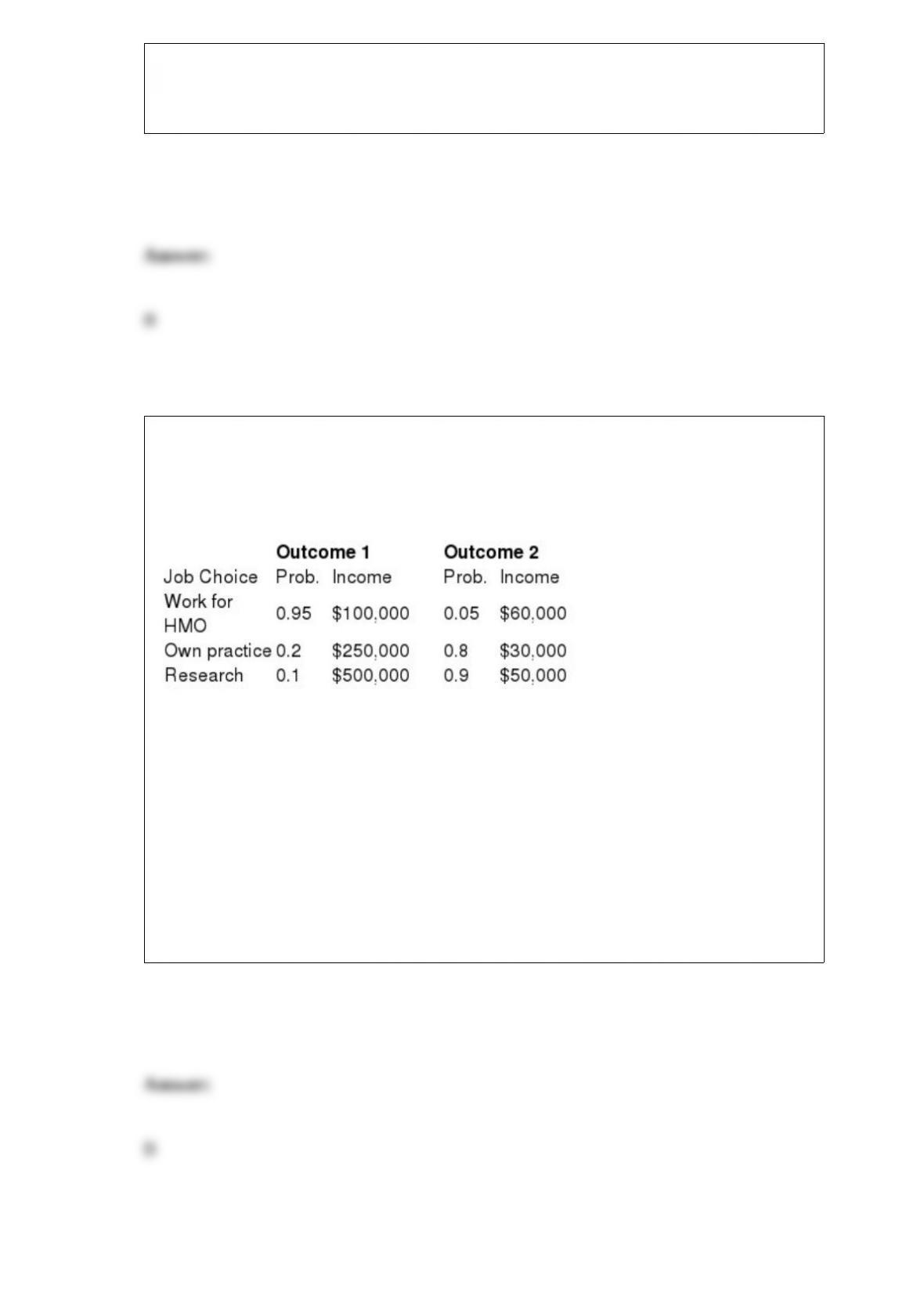
The information in the table below describes choices for a new doctor. The outcomes
represent different macroeconomic environments, which the individual cannot predict.
Table 5.3
Refer to Table 5.3. Rank the doctor’s job options in expected income order, highest first.
A) Work for HMO, open own practice, do research.
B) Work for HMO, do research, open own practice.
C) Do research, open own practice, work for HMO.
D) Do research, work for HMO, open own practice.
E) Open own practice, work for HMO, do research.

A production function in which the inputs are perfectly substitutable would have
isoquants that are
A) convex to the origin.
B) L-shaped.
C) linear.
D) concave to the origin.
Which of the following features are relevant for determining the extent of a market?
A) Its geographical boundaries.
B) Technological innovations that would reduce the cost of production.
C) The range of products to be included in it.
D) both A and B
E) both A and C
You manage a new product development team for an electronics manufacturer, and your
firm’s policy is that all new projects must pay for themselves in the first five years. Your
team has projected that the first year of the project requires an initial investment of $2
million with no revenue, the second year loss is $500,000, the net revenue for year 3 is

zero, and you earn $1.8 million in both year 4 and year 5. If the opportunity cost of
capital for your firm is 8%, should you go ahead with this project?
A) No, the expected NPV is negative
B) Yes, the expected NPV is roughly $290,000
C) Yes, the expected NPV is $1.1 million
D) We do not have enough information to answer this question.
Use the following two statements to answer this question:
I. Production functions describe what is technically feasible when the firm operates
efficiently.
II. The production function shows the least cost method of producing a given level of
output.
A) Both I and II are true.
B) I is true, and II is false.
C) I is false, and II is true.
D) Both I and II are false.
Use the data in the table below to answer the following questions about a firm.
Units of Units of Total Marginal Output
Input X Input Y Product Product of X Price
0 25 0 $10
1 25 2 10
2 25 7 10
3 25 14 10
4 25 20 10
5 25 23 10
6 25 24 10
a. Complete the table by calculating the marginal product of input X.
b. Compute the marginal revenue produce of input X.
c. If the price of input X were $30 per unit, how many units should the firm use per unit
of time to maximize profit? Explain why profit is maximized.

The dual approach to the consumer’s problem is to choose:
A) the highest indifference curve that just touches the budget line.
B) the least-cost budget line required to achieve a given level of utility (satisfaction).
C) the maximum income required to achieve a given level of utility (satisfaction).
D) all of the above
Assume that the current market price is below the market clearing level. We would
expect:
A) a surplus to accumulate.
B) downward pressure on the current market price.
C) upward pressure on the current market price.
D) lower production during the next time period.