
1) Suppose Ron is considering developing an asset portfolio. He expects to receive a
return of 15% and is willing to take on a maximum risk premium of 8%.
(a)What is if?
(b)If the Fed engages in open market operations that cause the risk-free interest rate to
change to 9%, how will Rons expected return change?
(c)How will Rons expected return change if they lower it to 5%?
2) (Consider This) In 2005, the company Changing World Technologies:
A.built a 100-square-mile solar collection station in the desert southwest of the U.S.
B.began processing discarded organic matter into fuel oil, replicating the natural
processes that create fossil fuels.
C.opened the world’s first fusion power plant, using cold fusion technologies that
scientists have been developing for decades.
D.began producing an automobile that runs entirely on hydrogen.
3) Suppose the firms in a five-firm industry have market shares of 30, 30, 20, 10, and
10 percent, respectively. The Herfindahl index for the industry is:
A.1,900
B.2,400
C.90
D.10,000
4) if in the short run a firm’s total product is increasing, then its:
a.marginal product must also be increasing.
b.marginal product must be decreasing.
c.marginal product could be either increasing or decreasing.
d.average product must also be increasing.

5) in corporations, owners are __________________ and managers are
________________.
a.agents; principals.
b.stockholders; bondholders.
c.agents; employees.
d.principals; agents.
6) when patents on new medications expire, the market for those drugs:
a.change from being monopolistic to being competitive.
b.change from being competitive to being monopolistic.
c.collapse.
d.encourage firms to leave the market.
7) in the short run a purely competitive firm will always make an economic profit if:
a.p = atc.
b.p > avc.
c.p = mc.
d.p > atc.
8) market failure occurs when:
a.not every consumer can buy as much of a good as they want at the price they want it.
b.the competitive market system produces too much or too little of a good.
c.competitive market forces produce incomes that are unequal.
d.government interferes with competitive market forces.
9) in which price range of the accompanying demand schedule is demand elastic?
a.$4-$3
b.$3-$2
c.$2-$1
d.below $1
10) which of the following is most likely to be a fixed cost?
a.shipping charges
b.property insurance premiums
c.wages for unskilled labor
d.expenditures for raw materials
11) The table below shows the marginal utility schedules for old product X and new
product Y for a hypothetical consumer. The price of X is $4 and the price of good Y is
$2. The income of the consumer is $20.
(a)If the consumer can only buy old product X, how much will the consumer buy and
what will be the total utility per dollar spent?
(b)If the consumer buys both old product X and new product Y, how much will the
consumer buy of each to maximize utility?
(c)If the consumer purchases the utility-maximizing combination of old product X and
new product Y, total utility will be ___________.
(d)The consumer was originally limited to purchasing old product X but now can also
purchase new product Y. What is the increase in total utility from the original situation
when the consumer purchases the utility-maximizing combination of both X and Y?
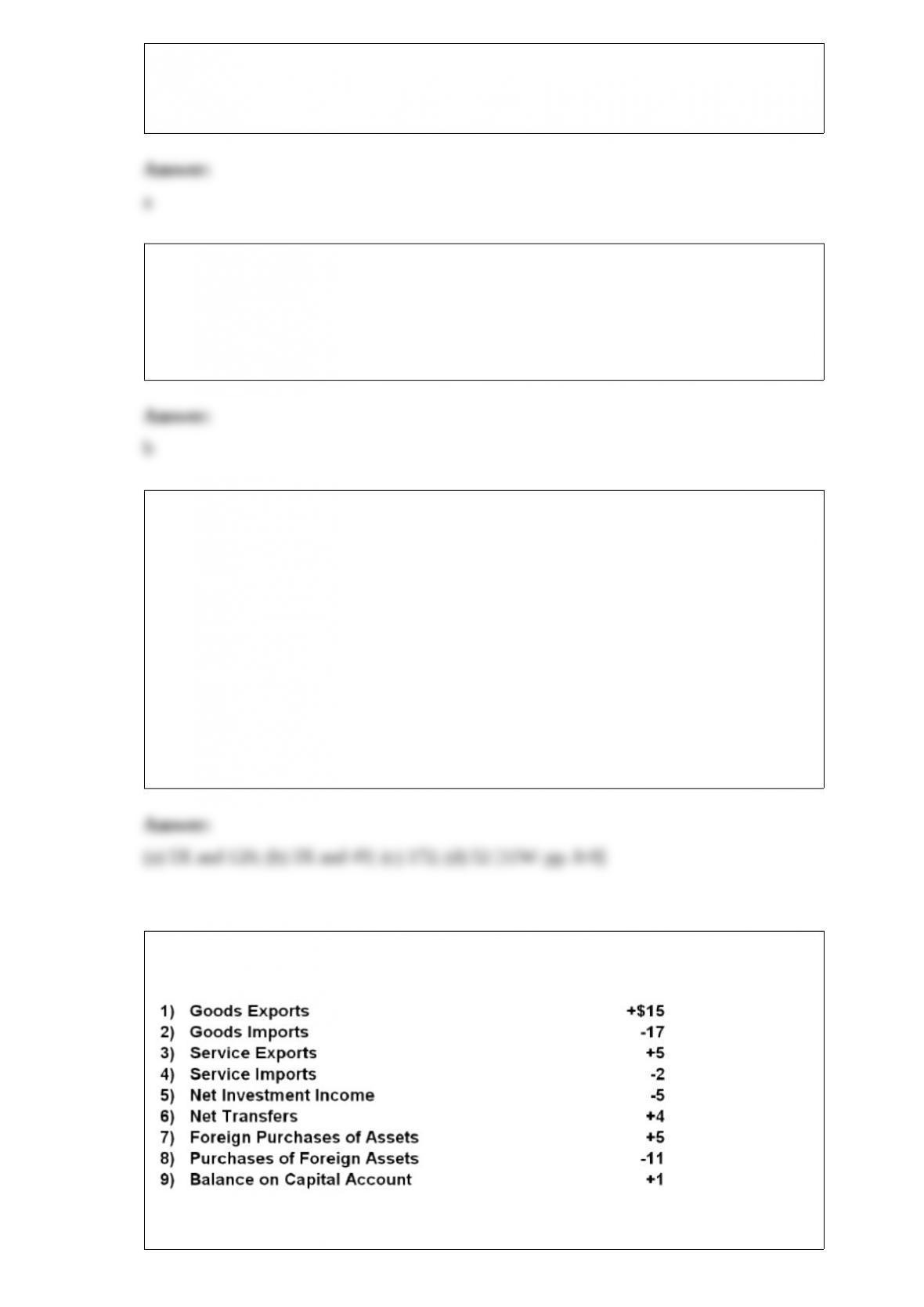
12) The following 2008 balance of payments statement for Transylvania. All figures are
in billions of dollars.
Refer to the above data. Transylvania realized a financial and capital account deficit in
2008.

13) Suppose population A, consisting of Al, Bob, Curt, Doris, and Ellie, receive annual
incomes of $5,000, $2,500, $1,250, $750, and $500, respectively.
Refer to the above information. Population B, consisting of Fred, George, Holly, Irma,
and Joan, receive incomes of $4,000, $3,000, $1,250, $950, and $800, respectively. We:
A.can say that the income of population B is less equally distributed than that of
population A.
B.can say that the income of population B is more equally distributed than that of
population A.
C.cannot make a meaningful comparison of the income distributions of populations A
and B.
D.can say that the poorest quintile of population B receives 12 percent of total income.
14) the demand for commodity x is represented by the equation p = 10 – 0.2q and
supply by the equation p = 2 + 0.2q.
refer to the above information. if demand changed from p = 10 – .2q to p = 7 – .3q, the
new equilibrium quantity is:
a.10.
b.20.
c.15.
d.30.