Wage rates may vary among labor markets for each of the following reasons, except
one. Which is the exception?
A firm that sells its output and hires its labor in perfectly competitive markets
Even though households do not actually purchase certain items, the government
estimates and adds to the consumption component what the household would pay for
these items in the marketplace. An example of this type of item is
a. a car that an individual builds from parts of old cars
b. food that a farm family grows for themselves
c. a pond that a household member digs by hand
d. police and fire protection
e. a barn that a household builds on their own property

Which of the following could cause a decrease in labor supply?
a. An increased preference for working in the labor market
b. An increase in the number of two-family households
c. An increased preference for enjoying leisure time
d. A trend toward less schooling and toward earlier entrance into the labor market
e. An increase in the retirement age
Cyclical unemployment is a problem because
a. it reflects lost output
b. workers are not compensated have no income support at all while they are
unemployed
c. it will never reach zero
d. cyclically-unemployed individuals do not have the skills needed for available jobs
e. we do not know how to reduce it
A firm that operates in a perfectly competitive market
The three primary systems for allocating resources are
Higher education creates

In the 2000s, government budget deficits became larger as a percent of GDP.
When measuring GDP, economists count only the values of final goods and services
because
a. the final value is taxable
b. adding the values of intermediate products is too difficult a task
c. the value of all intermediate products is automatically included in the value of those
final goods
d. intermediate products are overpriced
e. the final cost is the selling price, which is what economists want to know
In what year was the Federal Reserve System created?
a. 1790
b. 1861
c. 1879
d. 1913
e. 1935
As the market wage rate increases, it will exceed more individuals’ reservation wage
rates; this ensures the market supply of labor curve will be upward sloping.
If the Fed reduces the money supply, there will be a decline in
a. government purchases
b. unemployment
c. purchases of consumer durables
d. demand for bonds
e. deflationary pressures
Bob gives up his factory job in order to open a bait-and-tackle shop. The earnings from
his factory job represent
In the short run, the impact of a $50 billion spending package on GDP will be
a. greater than $50 billion because of the multiplier effect
b. less than $50 billion because of the tax code
c. greater than $50 billion because of the tax code
d. exactly $50 billion
e. greater than $50 billion because of crowding out
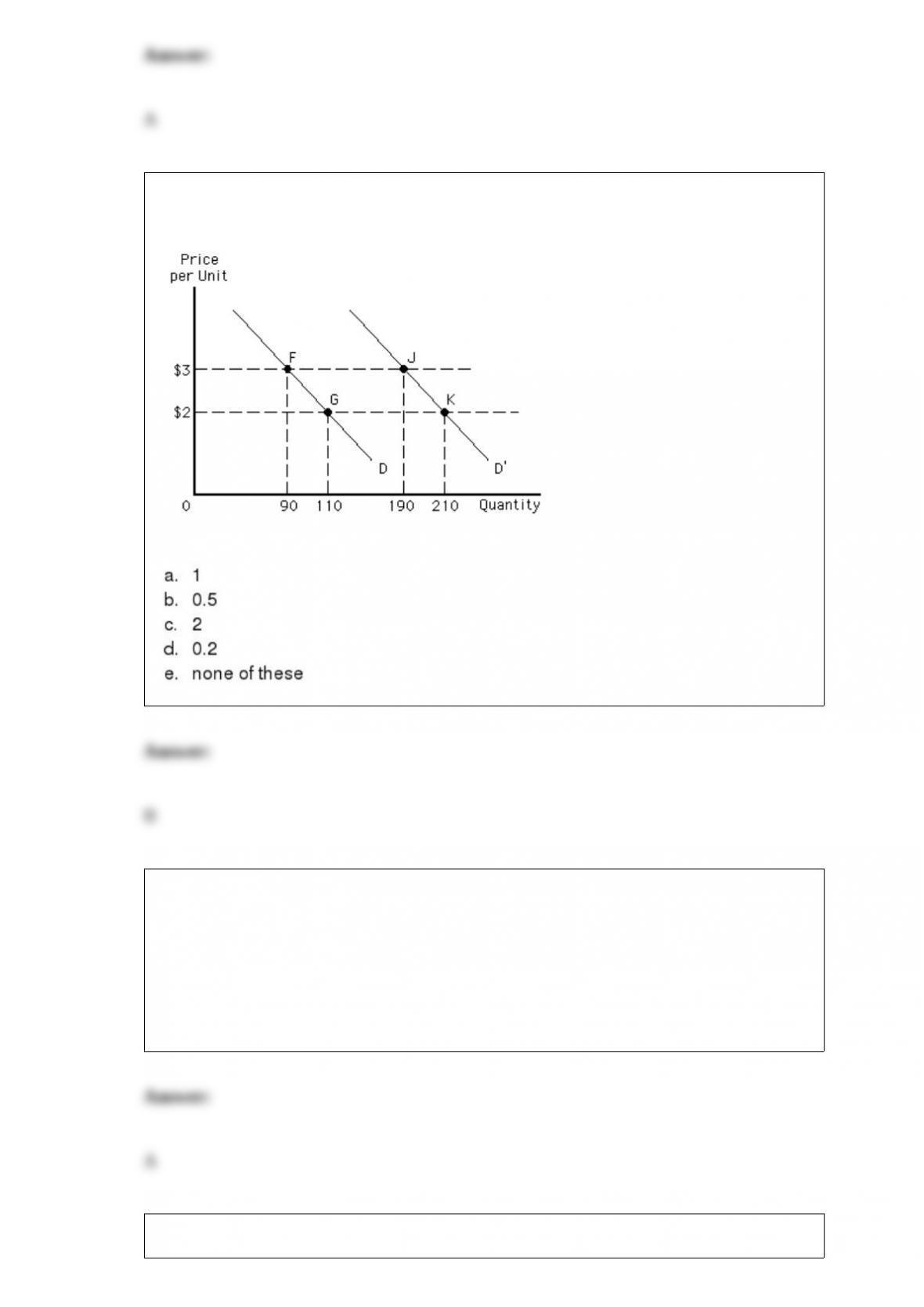
Consider demand curve D in Figure 5-2. Between points F and G, the price elasticity of
demand is
Figure 5-2
Which of the following is a possible cure for ongoing inflation?
a. The Fed could pursue anti-cyclical monetary policy.
b. The Fed could increase money supply whenever the AD curve shifts to the right.
c. The Fed could maintain a constant interest rate target regardless of economic
circumstances.
d. The Fed could always try to keep the unemployment rate below the natural rate.
e. The Fed could pursue anti-cyclical fiscal policy.
When the inflation rate ends up being lower than expected,

a. everyone benefits because money is cheaper
b. everyone benefits because prices do not increase
c. lenders of fixed-rate mortgages generally benefit because they will make higher
profits than they had calculated
d. borrowers with fixed-rate loans will benefit because their purchasing power will not
decline as much
e. no one benefits because everyone made financial calculations based on the projected
interest rate