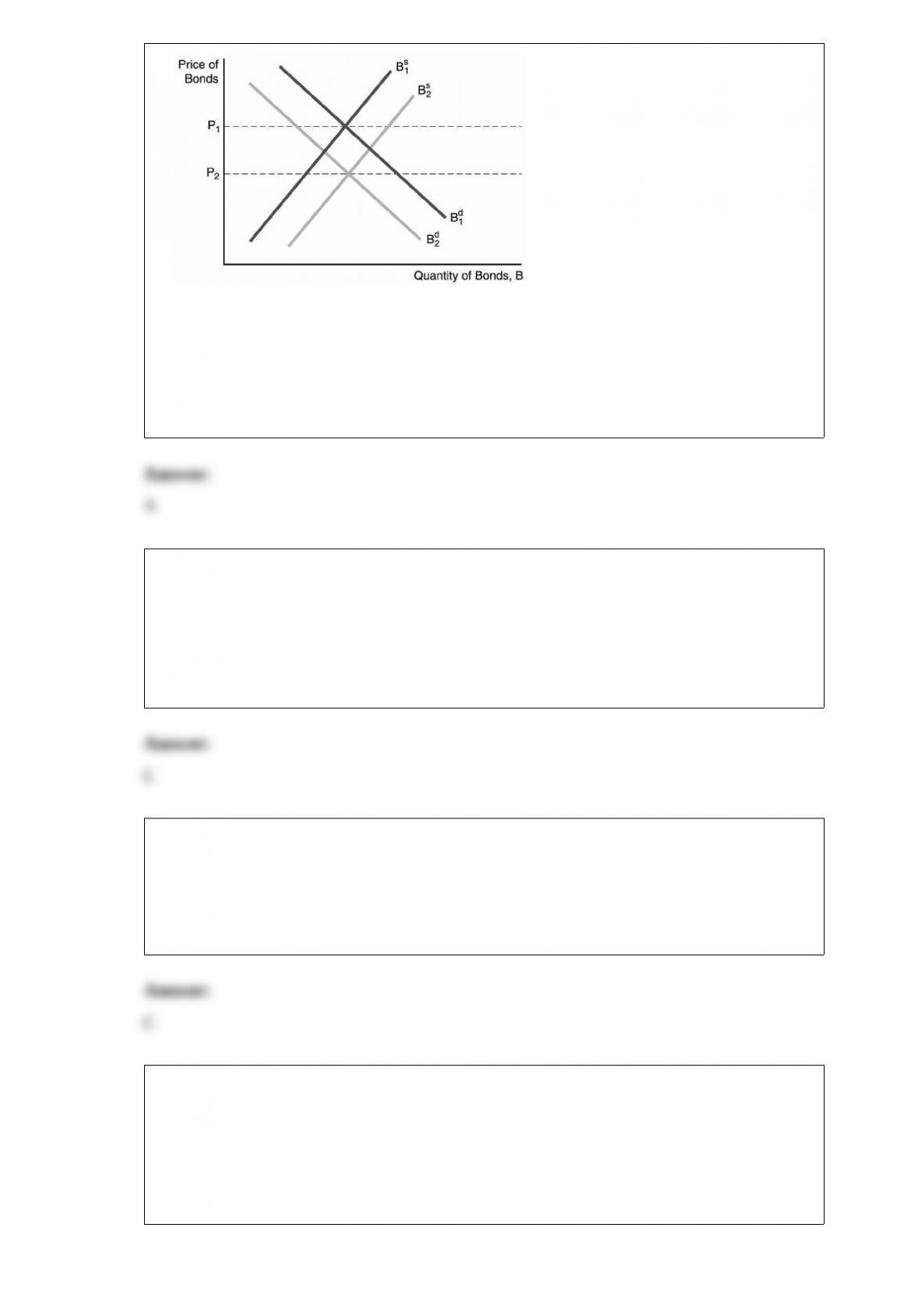
1)
In the figure above, the price of bonds would fall from P1 to P2 when
A) inflation is expected to increase in the future
B) interest rates are expected to fall in the future
C) the expected return on bonds relative to other assets is expected to increase in the
future
D) the riskiness of bonds falls relative to other assets
2) Due to the lack of timely data for the price level and economic growth, the Fed’s
strategy
A) targets the exchange rate, since the Fed can control this variable
B) targets the price of gold, since it is closely related to economic activity
C) uses an intermediate target, such as an interest rate
D) stabilizes the consumer price index, since the Fed can control the CPI
3) Which of the following are not traded in a capital market?
A) U.S. government agency securities
B) State and local government bonds
C) Repurchase agreements
D) Corporate bonds
4) Of the following sources of external finance for American nonfinancial businesses,
the least important is
A) loans from banks
B) stocks
C) bonds and commercial paper
D) loans from other financial intermediaries

5) The portfolio theories of money demand state that the demand for real money
balances is ________ related to income and ________ related to the nominal interest
rate.
A) positively; negatively
B) positively; positively
C) negatively; negatively
D) negatively; positively
6) A key assumption in the segmented markets theory is that bonds of different
maturities
A) are not substitutes at all
B) are perfect substitutes
C) are substitutes only if the investor is given a premium incentive
D) are substitutes but not perfect substitutes
7) A weakness of the Bretton Woods system was that the ________ had no way to force
surplus countries to either revalue their exchange rates upwards or pursue more
expansionary policies.
A) IMF
B) World Bank
C) European Exchange Rate Mechanism (ERM)
D) Bank of International Settlements
8) Which of the following statements comparing the European System of Central Banks
and the Federal Reserve System is TRUE?
A) The budgets of the Federal Reserve Banks are controlled by the Board of Governors,
while the National Central Banks control their own budgets and the budget of the
European Central Bank
B) The European Central Bank has similar power over the National Central Banks
when compared to the level of power the Board of Governors has over the Federal
Reserve Banks
C) Just like the Federal Reserve System, monetary operations are centralized in the
European System of Central Banks with the European Central Bank
D) The European Central Bank’s involvement in supervision and regulation of financial

institutions is comparable to the Board of Governors’ involvement
9) At the time of the South Korean financial crisis, the government allowed many
chaebol owned finance companies to convert to merchant banks. Finance companies
________ allowed to borrow abroad and merchant banks ________.
A) were not; could borrow abroad
B) were not; could not borrow abroad
C) were; could borrow abroad
D) were; could not borrow abroad
10) The Depository Institutions Deregulation and Monetary Control Act of 1980
A) restricted thrift institutions to making loans for home mortgages
B) restricted the use of ATS accounts
C) imposed restrictive interest-rate ceilings on large agricultural loans
D) increased deposit insurance from $40,000 to $100,000
11) International policy coordination refers to
A) central banks in major nations acting without regard to the global consequences of
their policies.
B) central banks in major nations pursuing only domestic objectives
C) central banks adopting policies in pursuit of joint objectives
D) central banks all adopting identical policies
12) The Basel Committee ruled that regulators in other countries can ________ the
operations of a foreign bank if they believe that it lacks effective oversight.
A) restrict
B) encourage
C) renegotiate
D) enhance

13) Most mutual funds are
A) no-load funds
B) load funds
C) large-load funds
D) small-load funds
14) Since the Federal Reserve sets the required reserve ratio to less than one, one dollar
of reserves can support ________ of checkable deposits.
A) exactly one dollar
B) less than one dollar
C) more than one dollar
D) exactly twice the amount
15) If you sell a $100,000 interest-rate futures contract for 105, and the price of the
Treasury securities on the expiration date is 108, your ________ is ________.
A) profit; $3000
B) loss; $3000
C) profit; $8000
D) loss; $8000
16) A long contract requires that the investor
A) sell securities in the future
B) buy securities in the future
C) hedge in the future
D) close out his position in the future
17) If the aggregate price level adjusts slowly over time, then an expansionary
monetary policy lowers
A) only the short-term nominal interest rate
B) only the short-term real interest rate
C) both the short-term nominal and real interest rates
D) the short-term nominal, the short-term real, and the long-term real interest rates

18) “Bureaucratic gambling” refers to
A) the strategy of thrift managers that they would not be audited by thrift regulators in
the 1980s due to the relatively weak bureaucratic power of thrift regulators
B) the risk that thrift regulators took in publicizing the plight of the S&L industry in the
early 1980s
C) the strategy adopted by thrift regulators of lowering capital requirements and
pursuing regulatory forbearance in the 1980s in the hope that conditions in the S&L
industry would improve
D) the risk that regulators took in going to Congress to ask for additional funds
19) If the deficit is financed by selling bonds to the ________, the money supply will
________, increasing aggregate demand, and leading to a rise in the price level.
A) public; rise
B) public; fall
C) central bank; rise
D) central bank; fall
20) Financial intermediaries’ low transaction costs allow them to provide ________
services that make it easier for customers to conduct transactions.
A) liquidity
B) conduction
C) transcendental
D) equitable
21) To say that stock prices follow a “random walk” is to argue that stock prices
A) rise, then fall, then rise again
B) rise, then fall in a predictable fashion
C) tend to follow trends
D) cannot be predicted based on past trends

22) If the liquidity effect is smaller than the other effects, and the adjustment to
expected inflation is slow, then the
A) interest rate will fall
B) interest rate will rise
C) interest rate will initially fall but eventually climb above the initial level in response
to an increase in money growth
D) interest rate will initially rise but eventually fall below the initial level in response to
an increase in money growth
23) Everything else held constant, an increase in government spending ________
aggregate ________.
A) increases; demand
B) decreases; demand
C) decreases; supply
D) increases; supply
24) Under the Bretton Woods system, the United States was designated as the
A) reserve-currency country
B) fixed-rate country
C) par-standard country
D) dollar-standard country
25) If the yield curve is flat for short maturities and then slopes downward for longer
maturities, the liquidity premium theory (assuming a mild preference for shorter-term
bonds) indicates that the market is predicting.
A) a rise in short-term interest rates in the near future and a decline further out in the
future
B) constant short-term interest rates in the near future and a decline further out in the
future
C) a decline in short-term interest rates in the near future and a rise further out in the
future
D) a decline in short-term interest rates in the near future and an even steeper decline
further out in the future

26) Due to asymmetric information in credit markets, monetary policy may affect
economic activity through the balance sheet channel, where an increase in the money
supply
A) raises stock prices, lowering the cost of new capital relative to firms’ market value,
thus increasing investment spending
B) raises firms’ net worth, decreasing adverse selection and moral hazard problems,
thus increasing banks’ willingness to lend to finance investment spending
C) raises the level of bank reserves, deposits, and bank loans, thereby raising spending
by those individuals who do not have access to credit markets
D) lowers the value of the dollar, increasing net exports and aggregate demand
27) Equity instruments are traded in the ________ market.
A) money
B) bond
C) capital
D) commodities
28) Which of the following are transaction deposits?
A) Savings accounts
B) Small-denomination time deposits
C) Negotiable order of withdraw accounts
D) Certificates of deposit
29) Suppose that the Bank of Japan buys U.S. dollar assets with yen-denominated
assets. Everything else held constant, this transaction will cause ________ in the
foreign assets held by the Federal Reserve and ________ in the U.S. monetary base.
A) an increase; an increase
B) an increase; a decrease
C) a decrease; an increase
D) a decrease; a decrease