
Of the following high-income countries, which has the lowest mortality ratio for
cancer?
A) Canada
B) Japan
C) the United Kingdom
D) the United States
The paradox of American farming is
A) the demand for imported luxury food products has risen as the demand for domestic
food products has fallen.
B) the demand for food has risen as the number of people who pursue farming as a
career has fallen.
C) food has become cheaper and more abundant as the number of farms has decreased.
D) the amount of food produced has increased as the average farm size has fallen.
The Great Depression of the 1930s with a large number of workers and factories
unemployed would be represented in a production possibilities frontier graph by
A) a point inside the frontier.

B) a point outside the frontier.
C) a point on the frontier.
D) an intercept on either the vertical or the horizontal axis.
The change in a firm’s total cost from producing one more unit of a good or service is
A) the result of economies of scale.
B) the definition of marginal product
C) the definition of marginal cost.
D) impossible to observe in large firms with many manufacturing plants.
What is meant by the term “rational ignorance”?
A) It refers to the absence of a negative incentive, for example, a fine for not voting,
which results in a low voter turnout.
B) It refers to a situation where one policymaker deliberately approves a bill he does
not support in exchange for a future favorable vote for his own cause.
C) It means the lack an economic incentive for voters to become informed about a
pending legislation.

D) It refers to the fact that policymakers and their constituents have different ideas of
what it means to behave rationally and each party deliberately ignores the other’s view.
Which of the following is not a barrier to entry?
A) an inelastic demand curve
B) economies of scale
C) ownership of a key input
D) a patent
An industry’s long-run supply curve shows
A) the relationship in the long run between market price and quantity supplied.
B) how the government determines the price of the product.
C) how average productivity is changing.
D) greater than normal profit.
The attainable production points on a production possibility curve are
A) the horizontal and vertical intercepts.
B) the points along the production possibilities frontier.
C) the points outside the area enclosed by the production possibilities frontier.
D) the points along and inside the production possibility frontier.
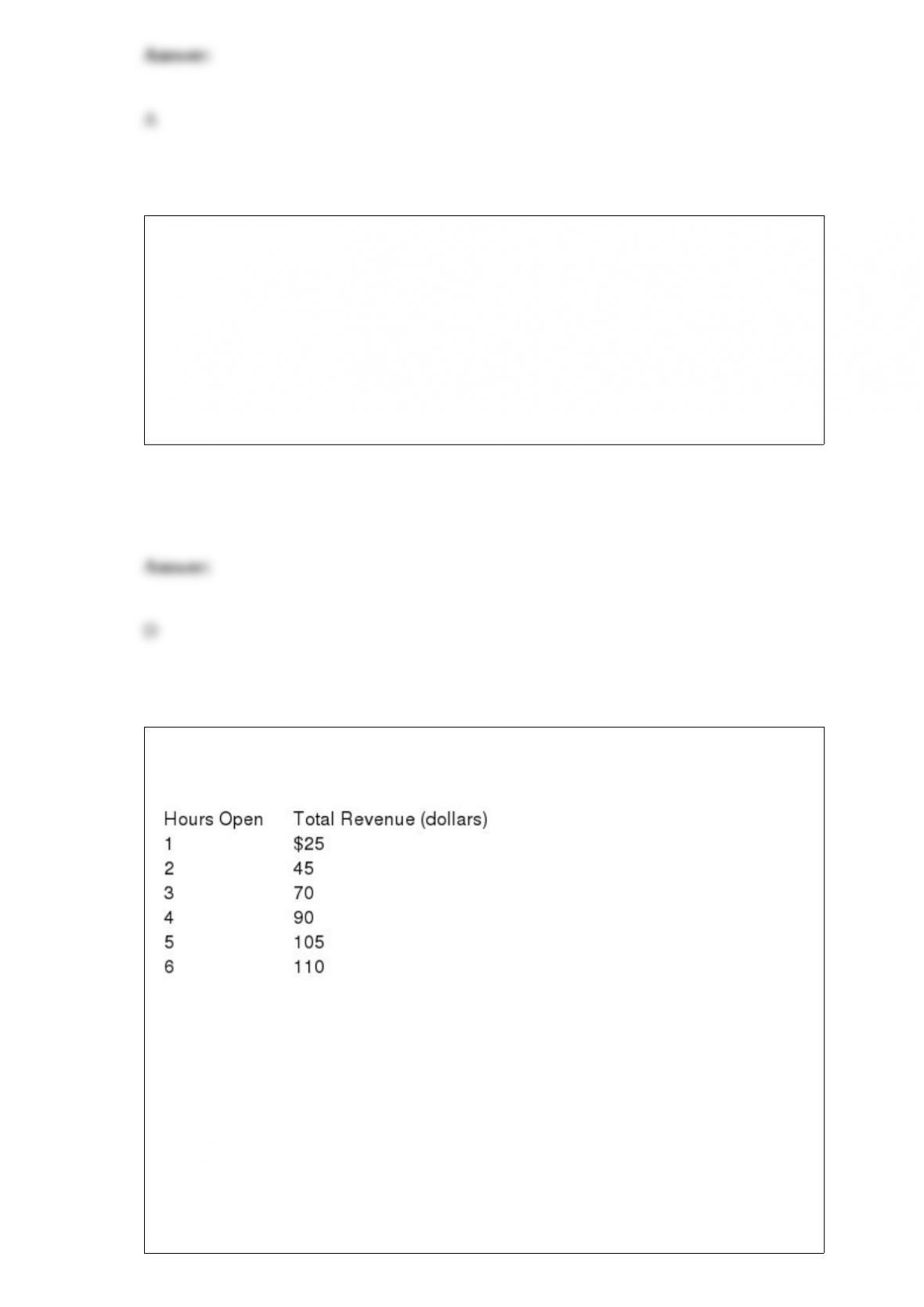
Table 1-2
Thuy Anh runs a small flower shop in the town of Florabunda. She is debating whether
she should extend her hours of operation. Thuy Anh figures that her sales revenue will
depend on the number of hours the flower shop is open as shown in the table above.
She would have to hire a worker for those hours at a wage rate of $16 per hour.
Refer to Table 1-2. Using marginal analysis, how many hours should Thuy Anh extend
her flower shop’s hours of operations?
A) 2 hours
B) 3 hours

C) 4 hours
D) 5 hours
E) 6 hours
If production displays diseconomies of scale, the long run average cost curve is
A) above the short run average total cost curve.
B) above the long run marginal cost curve.
C) upward sloping.
D) downward sloping.
Customer discrimination occurs when
A) a firm pays workers different wages based on irrelevant factors.
B) customers refuse to buy products produced by a racially diverse workforce.
C) customers refuse to buy products they believe to be of poor quality.
D) workers refuse to serve customers of a different race.
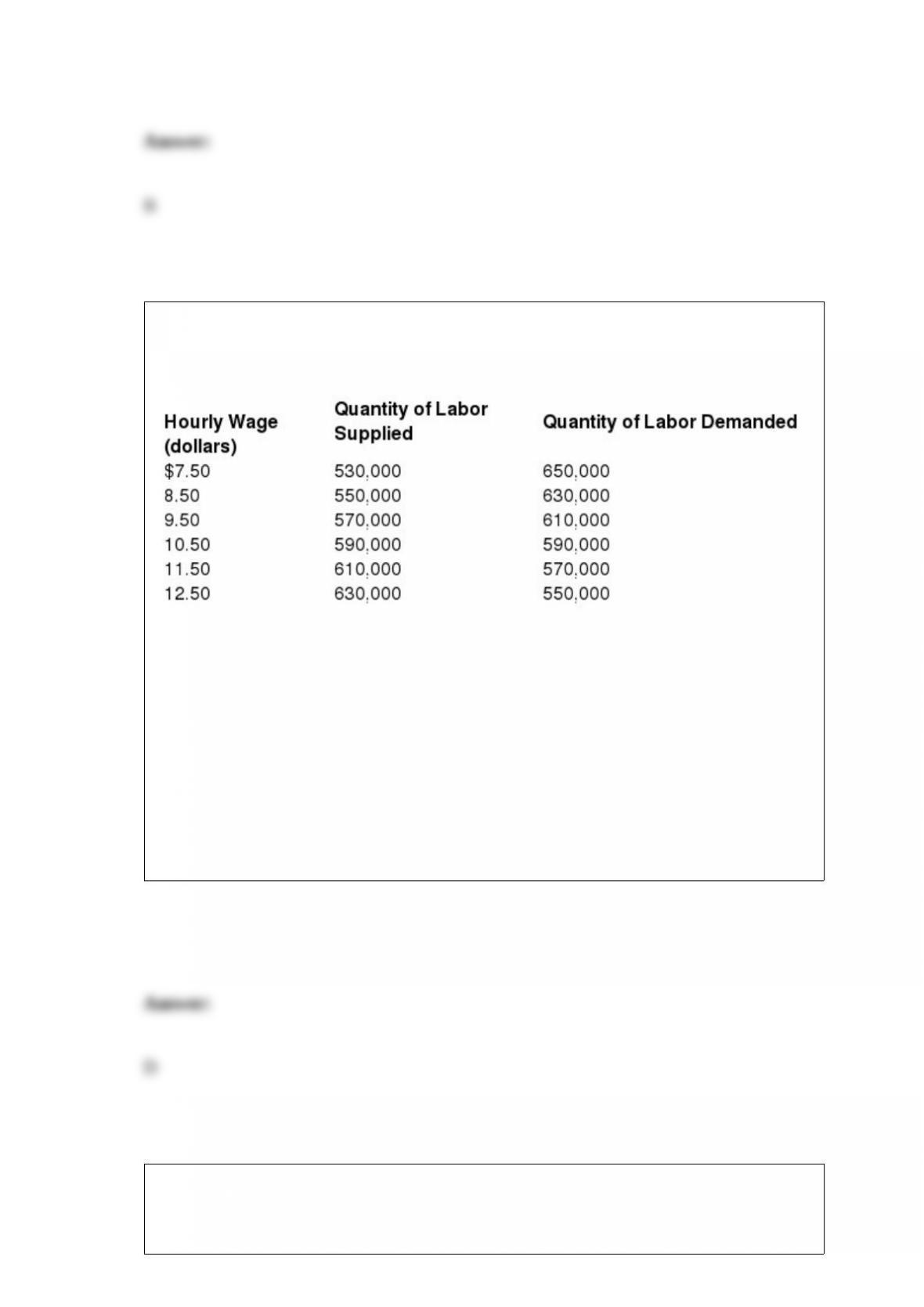
Table 4-4
Table 4-4 shows the demand and supply schedules for labor market in the city of Pixley.
Refer to Table 4-4. If a minimum wage of $12.50 is mandated there will be a
A) shortage of 40,000 units of labor.
B) surplus of 40,000 units of labor.
C) shortage of 80,000 units of labor.
D) surplus of 80,000 units of labor.
Which of the following is a part of the “employer mandate” provision of the Patient
Protection and Affordable Care Act (ACA)?

A) Every firm with more than 3 full-time employees must offer health insurance to its
employees and must automatically enroll them in the plan.
B) small businesses with fewer than 50 employees will be exempt from being required
to participate in the program.
C) Firms with more than 50 full-time employees must offer health insurance or pay a
$3,000 fine to the federal government for every employee who receives a tax credit
from the federal government for obtaining health insurance through a health exchange.
D) Every resident of the United States must have health insurance that meets certain
basic requirements.
If Callum is consuming his utility maximizing bundle and the price of one good rises,
what happens to the marginal utility per dollar spent on this good (MU/P), and what
should Callum do?
A) MU/P has increased and Callum should buy more of this good.
B) MU/P has increased and Callum should buy less of this good.
C) MU/P has decreased and Callum should buy more of this good.
D) MU/P has decreased and Callum should buy less of this good.
A monopoly differs from monopolistic competition in that

A) a monopoly has market power while a firm in monopolistic competition does not
have any market power.
B) a monopoly can never make a loss but a firm in monopolistic competition can.
C) in a monopoly there are significant entry barriers but there are low barriers to entry
in a monopolistically competitive market structure.
D) a monopoly faces a perfectly inelastic demand curve while a monopolistic
competitor faces an elastic demand curve.
A major flaw of the original General Agreement on Tariffs and Trade (GATT) was that
it lacked the power to ________.
A) displace the WTO
B) reduce nontariff barriers to international trade
C) govern exchange rates
D) enforce world trade rules
If economies of scale are relatively important in an industry, the typical firm’s
A) marginal cost curve will decline continuously until it reaches minimum efficient
scale.

B) long-run average cost curve will begin rising before it reaches minimum efficient
scale.
C) long-run average cost curve will reach a minimum at a level of output that leaves
room for a large number of firms to enter the industry.
D) long-run average cost curve will reach a minimum at a level of output that is a
relatively large fraction of total industry sales.
________ is the ability of an individual, a firm, or a country to produce a good or
service at a lower opportunity cost than competitors.
A) Absolute advantage
B) Specialization
C) Autarky
D) Comparative advantage
The voting paradox suggests that the “voting market,” as represented by elections
A) lead to a superior outcome in representing consumer preferences compared to the
private market for goods and services.
B) may often lead to an inefficient outcome in representing consumer preferences
compared to the private market for goods and services.
C) is no different from the private market for goods and services in terms of
representing consumer preferences.
D) may not lead to an efficient outcome but certainly leads to a more equitable outcome
in terms of distributing goods and services.
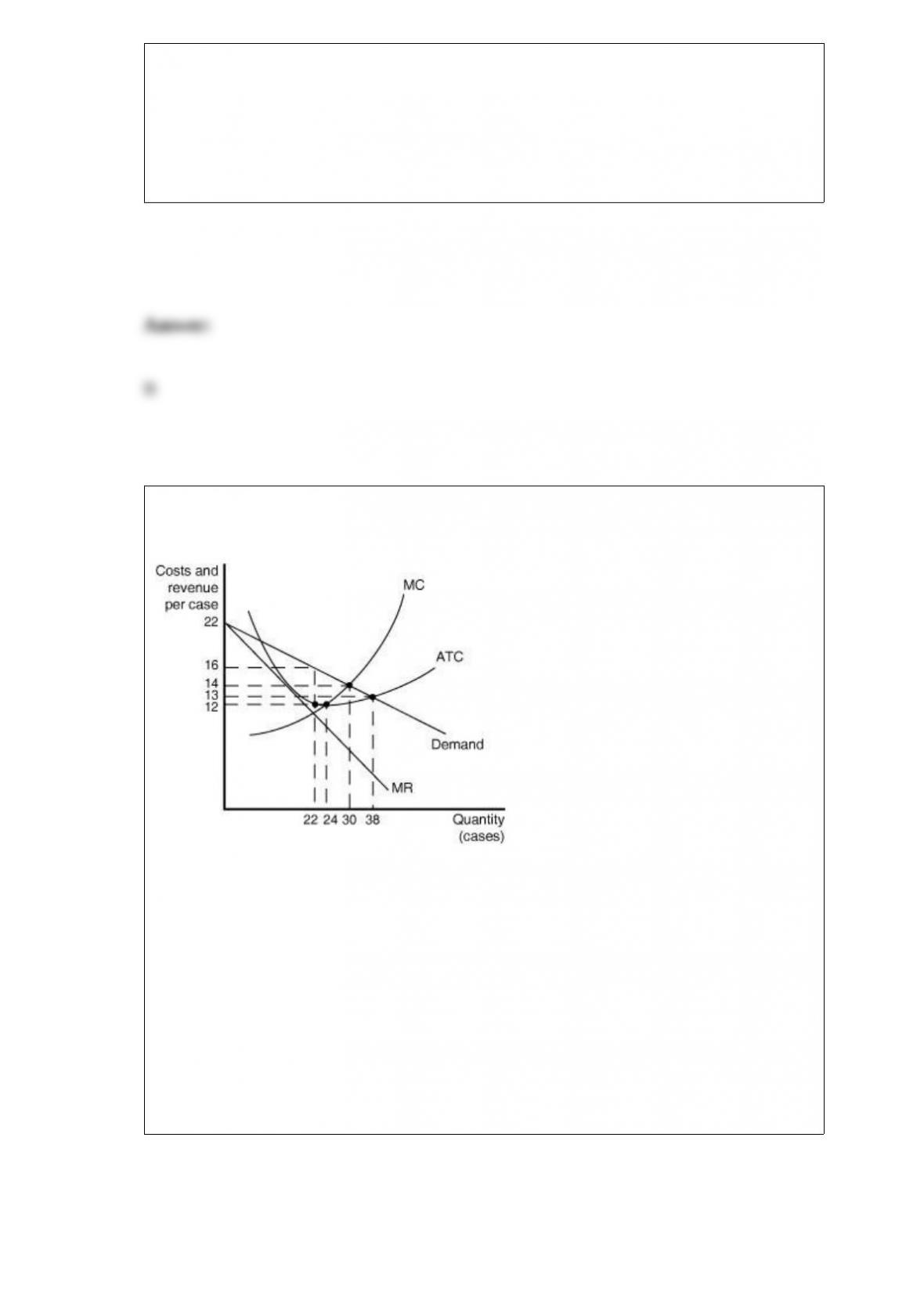
Figure 13-8
Figure 13-8 shows cost and demand curves for a monopolistically competitive producer
of iced tea.
Refer to Figure 13-8. What is the profit-maximizing output level?
A) 22 cases
B) 24 cases
C) 30 cases
D) 38 cases

The “tragedy of the commons” refers to the phenomenon where
A) individuals are free riders.
B) people overuse a common resource.
C) people do not internalize an externality.
D) there is rivalry in consumption.
Article Summary
A growing number of U.S. citizens are going to other countries for elective surgery
procedures. Improved quality and significant cost savings abroad have attracted an
increasing number of what are being referred to as American medical tourists,
especially those who either do not have insurance or whose insurance does not cover
the desired procedure. As few as five years ago, Americans tended to travel to countries
such as Thailand or Mexico for the procedures, but many are now choosing to go to
Europe, where governments and hospitals are now publicizing these services. Many of
the procedures being done overseas are joint replacement, and partly in response to the
number of patients going abroad for these procedures, programs are being developed to
reduce the cost of these surgeries in the United States.
Source: Elizabeth Rosenthal, “The Growing Popularity of Having Surgery Overseas,”
New York Times, August 6, 2013.
Refer to the Article Summary. If more European governments and hospitals begin to
offer and publicize their services to American medical tourists and, due to the growing
number of aging baby boomers, more Americans desire joint-replacement surgery ,
what will happen in the market for joint-replacement surgery as a result of these two
factors?
A) Demand will increase, but these two factors will not shift the supply curve.
B) Supply will increase, but these two factors will not shift the demand curve.
C) Demand and supply will both increase.
D) Demand will increase and supply will decrease.
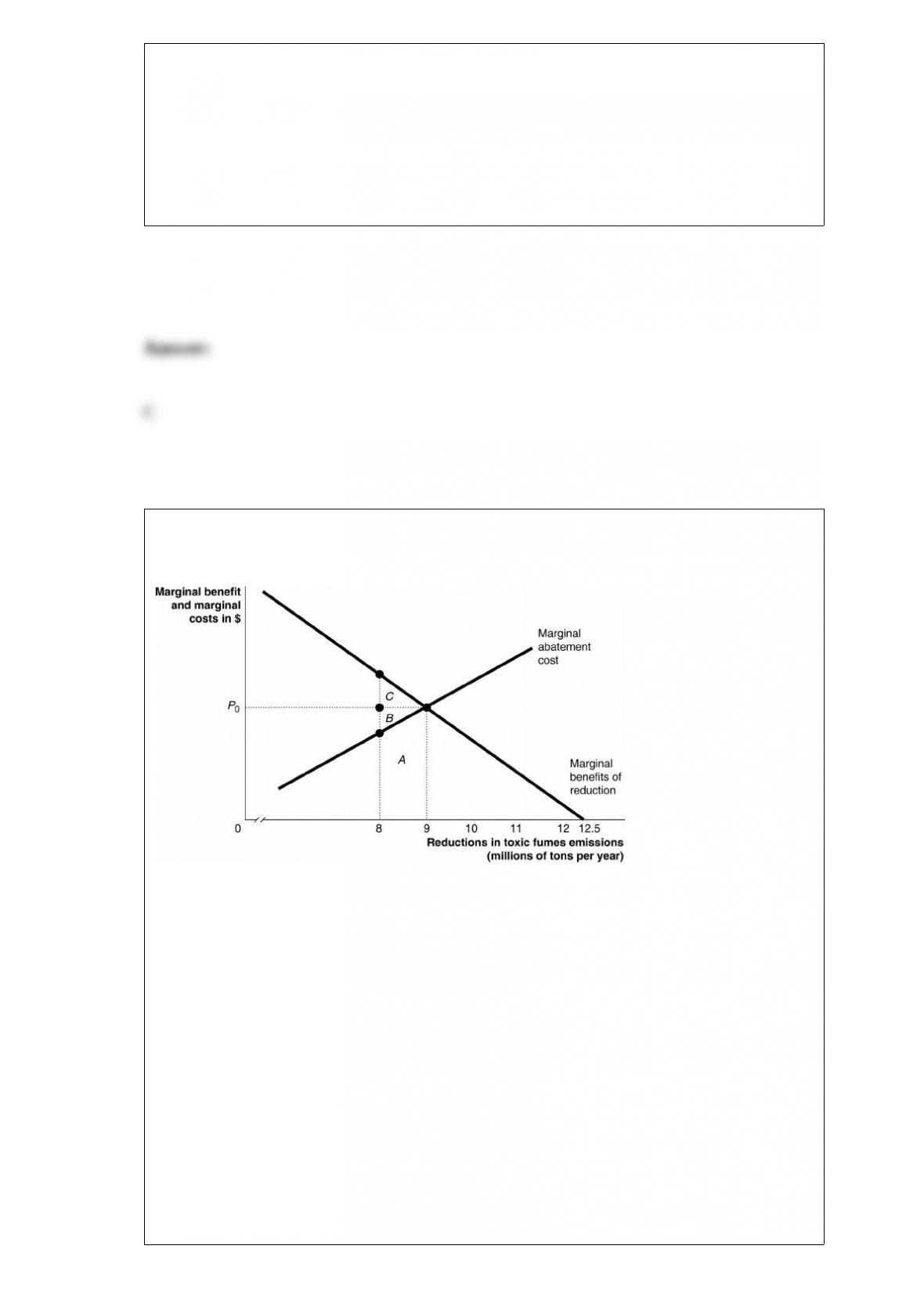
Figure 5-8
Consider a chemical plant that discharges toxic fumes over a nearby community. To
reduce the emissions of toxic fumes the firm can install pollution abatement devices.
Figure 5-8 shows the marginal benefit and the marginal cost from reducing the toxic
fumes emissions.
Refer to Figure 5-8. Suppose the emissions reduction target is currently established at 8
million tons. What is the area that represents the cost of eliminating an additional 1
million tons?
A) A
B) B + C
C) A + B
D) A + B + C

The ratio at which a country can trade its exports for imports from other countries is
called
A) a trade barrier.
B) the terms of trade.
C) autarky.
D) a free trade agreement.
Suppose two countries use different combinations of inputs, such as labor and capital,
to produce the same product. This implies all of the following except that
A) the two countries use different technologies to produce the product.
B) the inputs are not equally productive in the two countries.
C) the prices of the inputs are not the same in the countries.
D) one country is more efficient in the production of the good than the other.
Prices of microbrewery beer (assume that this is a normal good) have risen steadily in
recent years. Over this same period, prices for fermenting vats used in beer making
have also risen and consumer incomes have fallen. Which of the following best explains
the rising prices of microbrewery beer?
A) The supply curve for microbrewery beer has shifted to the left while the demand
curve for microbrewery beer has shifted to the right.
B) The demand curve for microbrewery beer has shifted to the left more than the supply
curve has shifted to the left.
C) The demand curve and the supply curve for microbrewery beer have both shifted to
the right.
D) The supply curve for microbrewery beer has shifted to the left more than the demand
curve has shifted to the left.
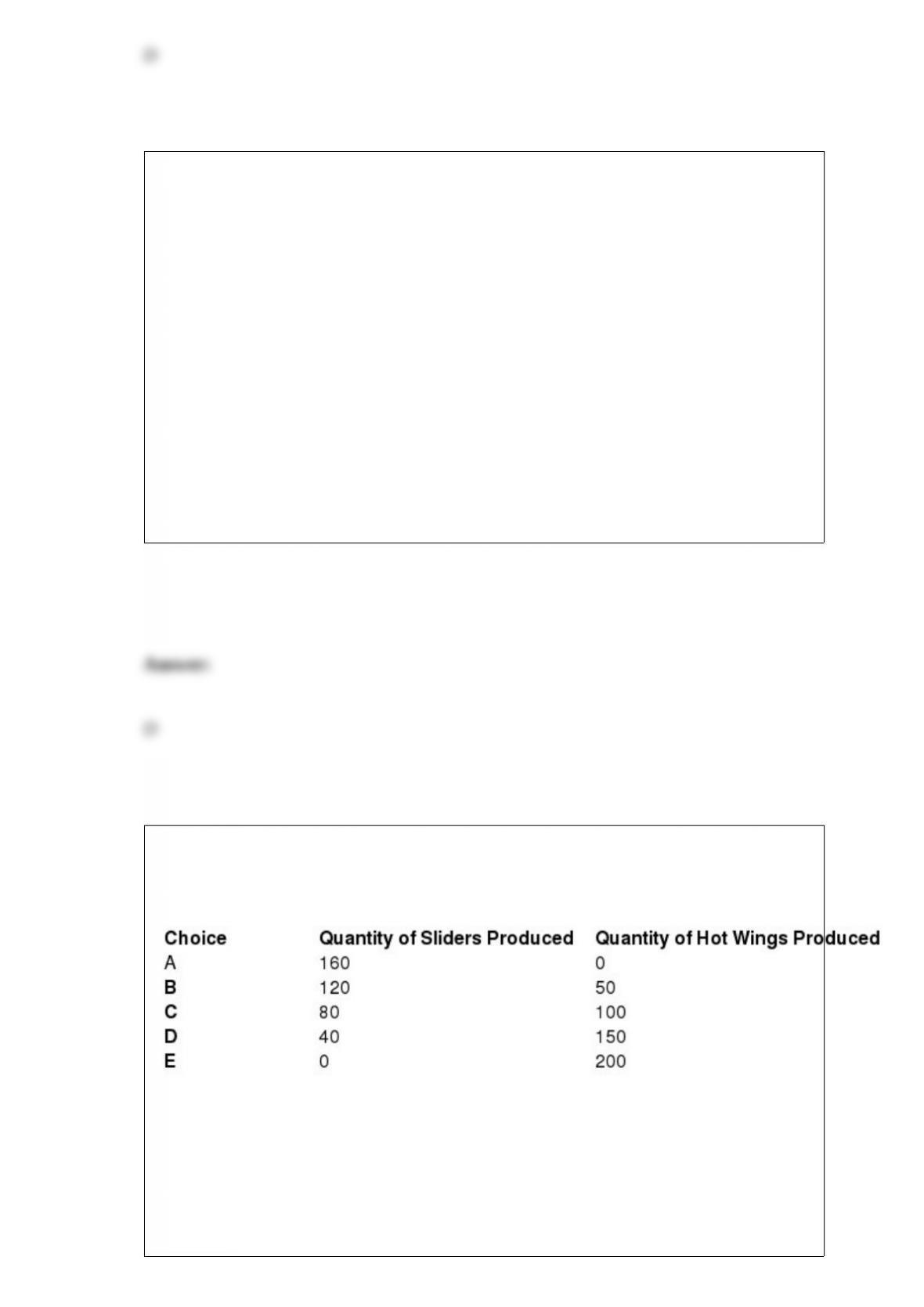
Table 2-3
Production Choices for Dina’s Diner
Refer to Table 2-3. Assume Dina’s Diner only produces sliders and hot wings. A
combination of 80 sliders and 100 hot wings would appear
A) along Dina’s production possibilities frontier.
B) inside Dina’s production possibilities frontier.

C) outside Dina’s production possibilities frontier.
D) at the vertical intercept of Dina’s production possibilities frontier.
The entry and exit of firms in a monopolistically competitive market guarantee that
A) marginal revenue equals marginal cost and average total cost is minimized.
B) firms can earn economic profits in the long run.
C) price equals average total cost in the long run.
D) firms can earn economic profits in the short run.
Table 12-1
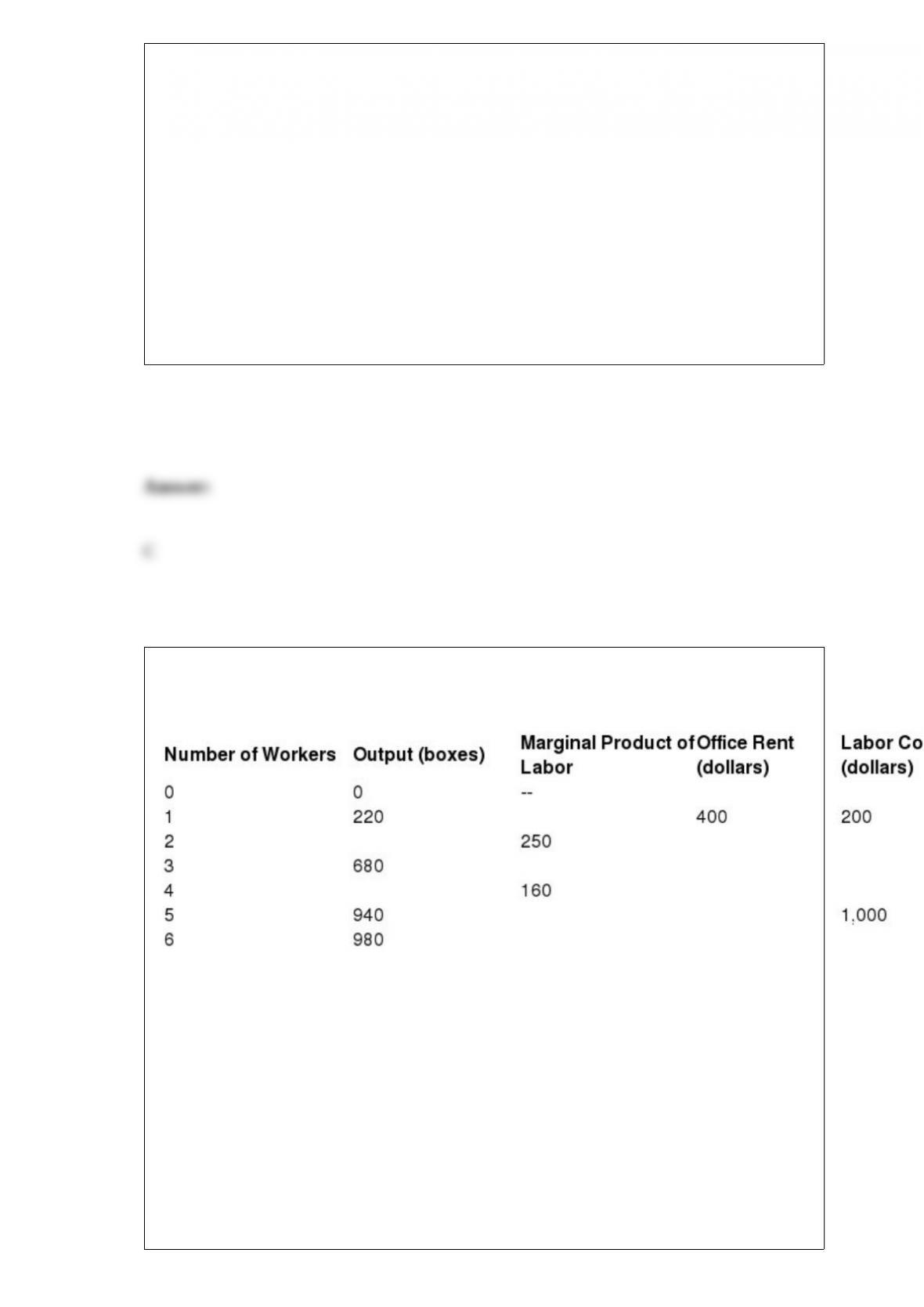
Table 12-1 shows the short-run cost data of a perfectly competitive firm that produces
plastic camera cases. Assume that output can only be increased in batches of 100 units.
Refer to Table 12-1. Suppose the fixed cost of production rises by $500 and the price
per unit is still $8. What happens to the firm’s profit-maximizing output level?
A) It must fall.
B) It must rise to offset the increased cost.
C) It will remain the same.
D) The firm will shut down.
Table 11-5
Refer to Table 11-5. Suzette’s Fancy Packaging subcontracts with Sunshineland Pecans
to box dried fruit and nuts for Suzette’s mail order business. Suzette rents space for her
factory for $400 a week in a nearby strip mall. She can hire temporary workers for $200
a week. Table 11-5 above shows her output and cost data. Use the table to answer
questions a-e.
a. Complete the table.
b. In the last week of summer Suzette closes her business to go on a family vacation.
What are her costs during that week?
c. In one week Suzette exactly breaks even. If her revenue for the week is $1,200, how
many boxes of fruit and nuts did she produce?
d. Judging from the marginal product of labor data, would you say that Suzette had to
settle for increasingly unproductive workers? Explain your answer.
e. Suzette has received an order for 1,500 boxes of nuts per week for the next 3 months.
If she expects the trend in the marginal product of labor will continue in the same
direction, what do you think she should do? Should she not commit until she can move
to a larger space or should she just hire more workers? Explain your answer.
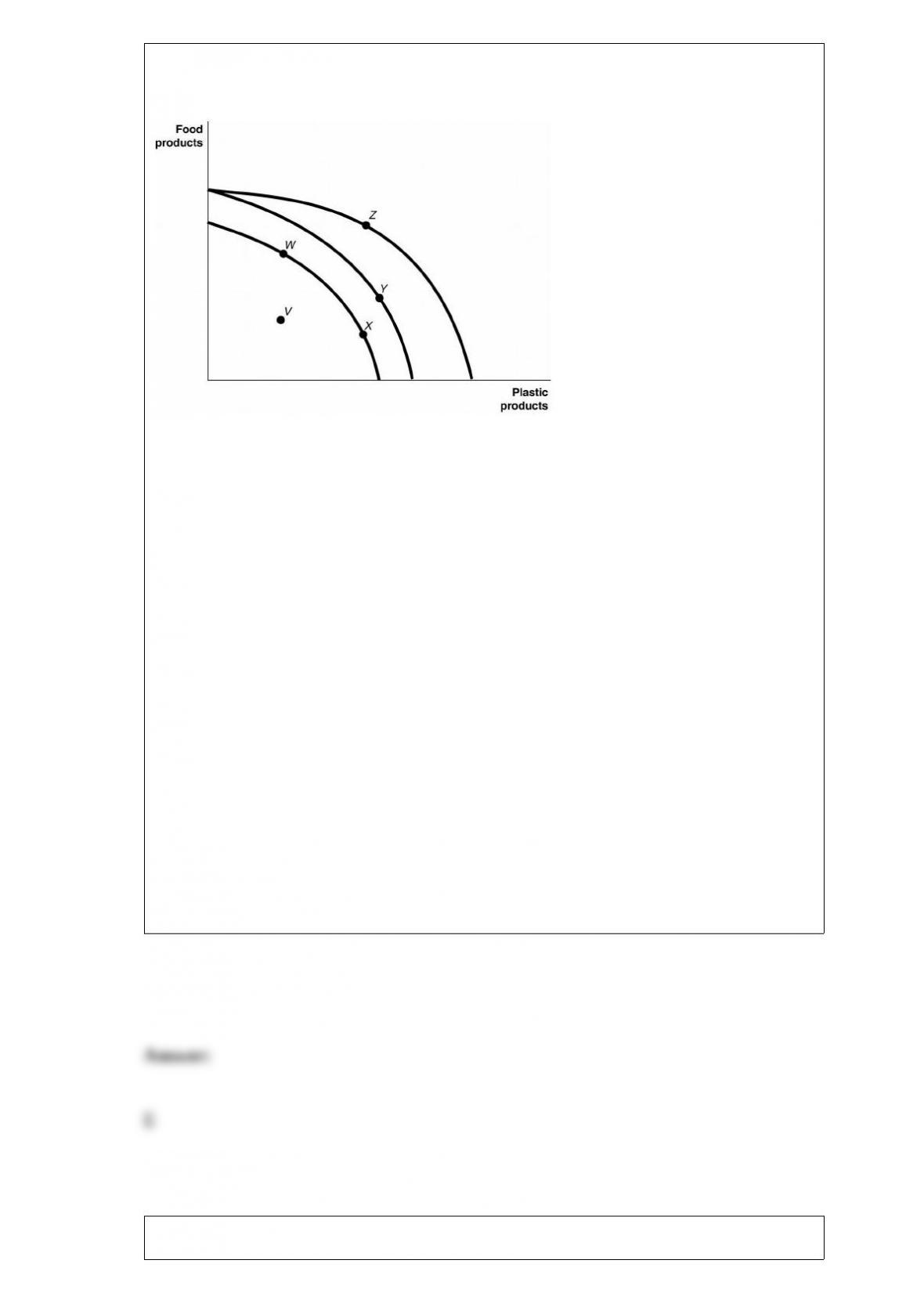
Figure 2-4
Figure 2-4 shows various points on three different production possibilities frontiers for
a nation.
Refer to Figure 2-4. Consider the following events:
a. a decrease in the unemployment rate
b. an increase in a nation’s money supply
c. an influx of immigrant workers
Which of the events listed above could cause a movement from X to Z?
A) a, b and c
B) a and b only
C) a and c only
D) a only
E) c only
On a balance sheet, short-term debts such as accounts payable are listed as

A) current assets.
B) current liabilities.
C) stockholder’s equity.
D) goodwill.
For allocative efficiency to hold
A) price must equal marginal revenue of the last unit sold.
B) price must equal the marginal cost of the last unit produced.
C) average variable cost is minimized in production.
D) average total cost is minimized in production.
A horizontal merger
A) is a merger between firms in the same industry.
B) results in a trust (for example, the Standard Oil Company).
C) is a merger between firms at different stages of production of a good.

D) was illegal in the United States until the Federal Trade Commission Act was passed
by Congress in 1914.
Jake sells Star Wars memorabilia on eBay. His annual revenue is $42,000 per year, the
explicit costs of his business are $10,000, and the opportunity costs of his business are
$18,000 per year. What is his economic profit?
A) $14,000
B) $24,000
C) $32,000
D) $34,000