1) Graphically, cost-push inflation is shown as a:
A.leftward shift of the AD curve.
B.rightward shift of the AS curve.
C.leftward shift of AS curve.
D.rightward shift of the AD curve.
2) When the level of domestic output is $500 billion, the level of aggregate
expenditures:
A.may be greater than, less than, or equal to $500 billion.
B.must be greater than $500 billion, because investment will occur.
C.must be less than $500 billion, because saving will occur.
D.must also be $500 billion.
3) an increase in the price of product a will:
a.increase the marginal utility per dollar spent on a
b.decrease the marginal utility per dollar spent on a
c.not affect the marginal utility per dollar spent on a
d.cause utility-maximizing consumers to buy more of a
4) If the United States wants to increase its net exports, it might take steps to:
A.increase its GDP.
B.reduce existing tariffs and import quotas.
C.decrease the dollar price of foreign currencies.
D.increase the dollar price of foreign currencies.
5) economic theories:
a.are useless because they are not based on laboratory experimentation.
b.that are true for individual economic units are never true for the economy as a whole.
c.are generalizations based on a careful observation of facts.
d.are abstractions and therefore of no application to real situations.
6) because of unseasonably cold weather, the supply of oranges has substantially
decreased. this statement indicates that:
a.the demand for oranges will necessarily rise.
b.the equilibrium quantity of oranges will rise.
c.the amount of oranges that will be available at various prices has declined.
d.the price of oranges will fall.
7)
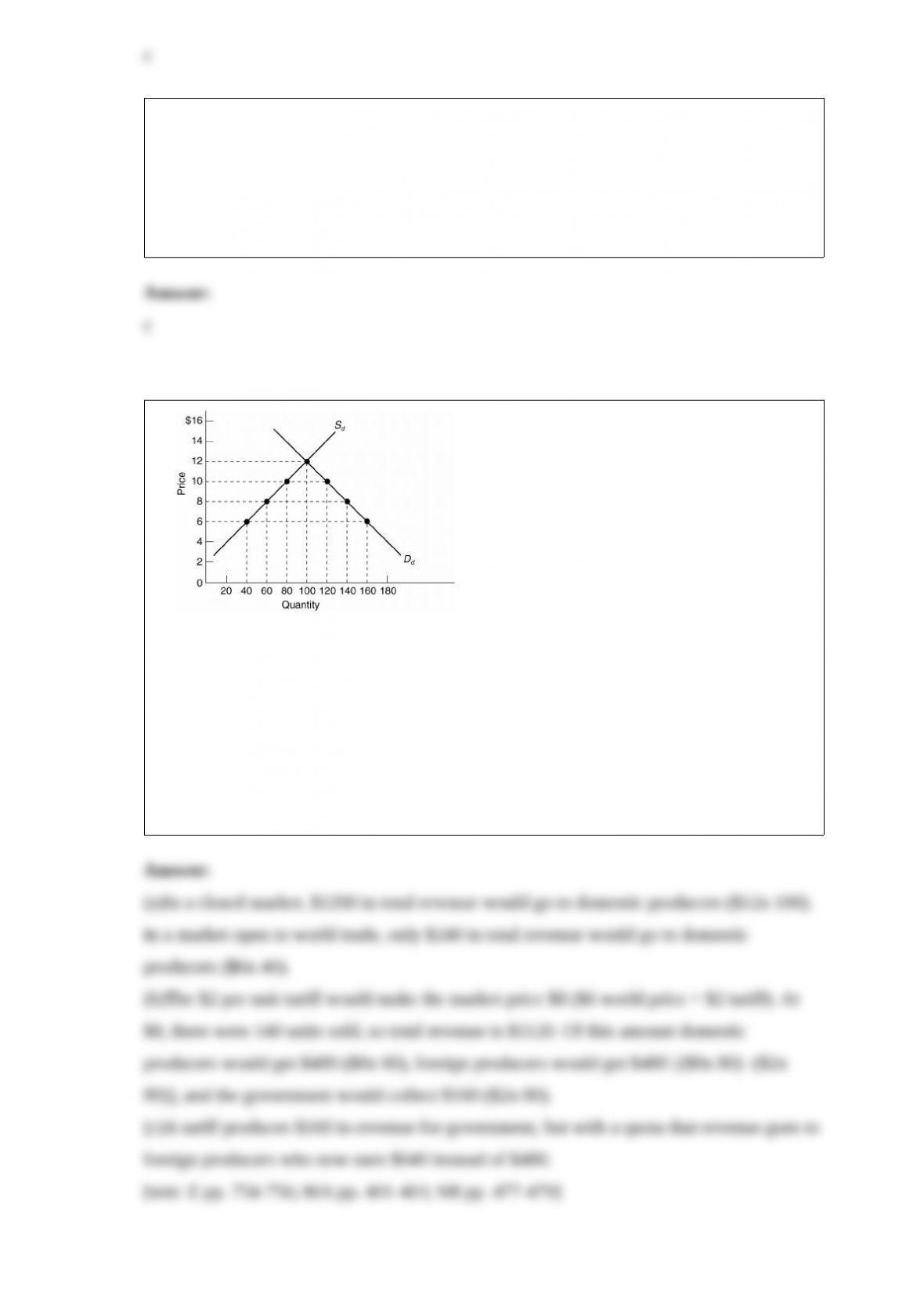
The next three questions refer to the below graph, where Sd and Dd are the domestic
supply and demand for a product. The world price of the product is $6.
(a)How much total revenue would go to domestic producers if the market were closed
to international trade compared to a market open to international trade? Explain.
(b)If the economy is open to trade, but a $2 per unit tariff were applied, what would be
the total revenue going to domestic producers, foreign producers (after-tax revenue),
and to the government? Explain.
(c)What would be the difference in revenue with a tariff of $2 per unit versus a quota of
80 units?
8) in moving along a stable demand curve which of the following is not held constant?
a.the price of the product for which the demand curve is relevant.
b.price expectations.
c.consumer incomes.
d.the prices of complementary goods.
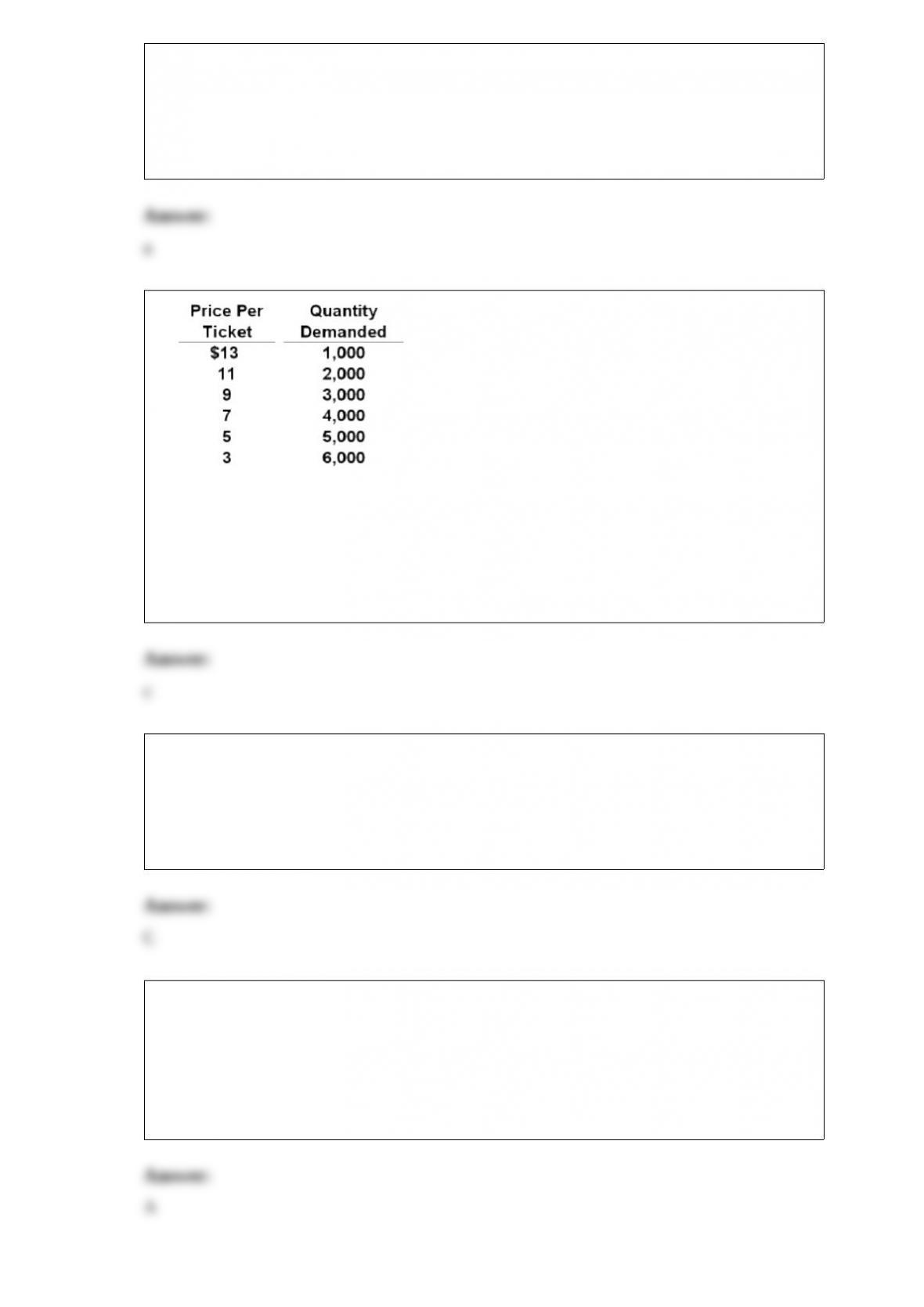
9)
refer to the above information and assume the stadium capacity is 5,000. if the
mudhens’ management charges $7 per ticket:
a.some fans who want to see the game will find that tickets are not available.
b.there will be 2,000 empty seats.
c.there will be 1,000 empty seats.
d.the game will be sold out.
10) Which of these sets of nations are considered high-income economies?
A.Brazil, Poland, South Africa
B.China, India, and Russia
C.Canada, Switzerland, and France
D.United States, South Korea, and Mexico
11) The amount to which some current amount of money will grow as interest
compounds over time is known as:
A.the future value of that sum of money.
B.the present value of that sum of money.
C.compound interest.
D.the time-value of money.
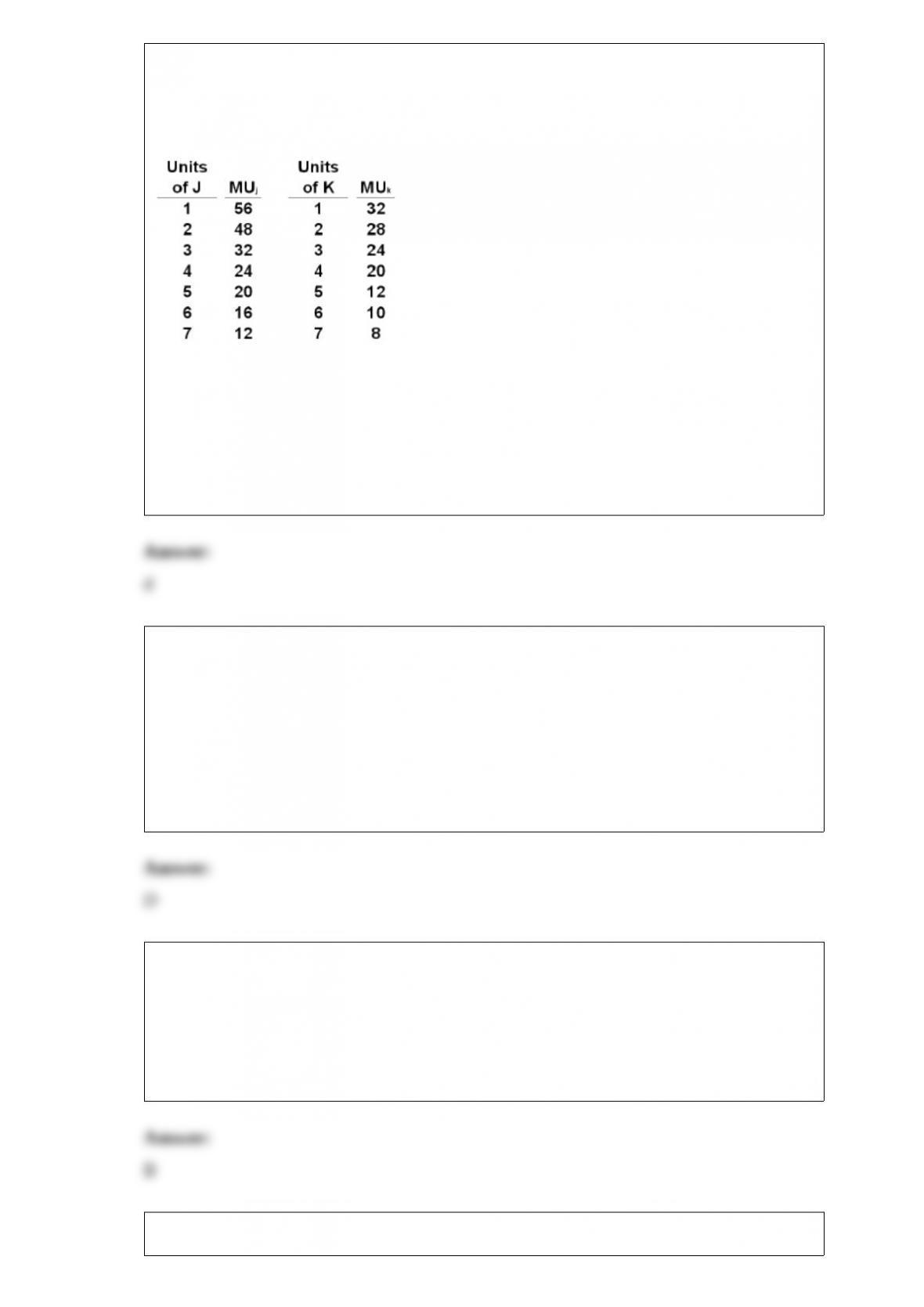
12) the following two schedules which show the amounts of additional satisfaction
(marginal utility) which a consumer would get from successive quantities of products j
and k.
refer to the above data. if the consumer’s money income were cut from $52 to $28, and
the prices of j and k remain at $8 and $4 respectively, she would maximize her
satisfaction by purchasing:
a.3 units of j and 3 units of k.
b.1 unit of j and 3 units of k.
c.4 units of j and 1 unit of k.
d.2 units of j and 3 units of k.
13) Suppose Steve Stone takes a job with Zemo Manufacturing, whose labor contract
with its unions has an agency shop clause (30 days). Steve:
A.must join the union within 30 days.
B.can decide against joining the union and place the union dues in a retirement account.
C.can decide against joining the union but then will not receive any union-negotiated
wage increases.
D.can decide against joining the union but nevertheless will have to pay union dues or
donate an equivalent amount to an approved charity.
14) If actual reserves in the banking system are $8,000, checkable deposits are $70,000,
and the legal reserve ratio is 10 percent, then excess reserves are:
A.zero.
B.$1,000.
C.$2,000.
D.$500.
15) Use the following data to answer the question.
How many units of labor will this firm hire in maximizing its profits?
16) How have the values of nominal GDP, real GDP and GDP price index changed in
the United States since the year 2000?
17) If nominal GDP is $1344 billion, and velocity of money is 6, how much is the
money supply? If the GDP price index is 160, what is real GDP here?
18) Describe the economic effects of occupational segregation on the wages of women
and minorities. How does this type of segregation affect the domestic output of the
economy?
19) What contributed to stagflations demise between 1982 and 1989? How did these
events affect aggregate supply and the Phillips Curve?
20) Explain the relationship between the price elasticity of demand and price
discrimination. Give two examples.
21) Why is the monopolistic competitors demand curve more elastic than a pure
monopolists, but less elastic than a pure competitors? What factors determine the price
elasticity of demand for a monopolistic competitor?
22) What factors might increase the demand for carpenters in a medium-sized town? Be
specific.
23) What may be the complementary relationship, in terms of employment, between
illegal fruit pickers and domestic-born truck drivers?