
Which of the following statements is false?
a. Specialization and trade allow a country’s inhabitants to consume at a level beyond its
production possibilities frontier.
b. Some of the goods the U.S. exports include cars, coal, and wheat.
c. Some of the goods the U.S. imports include cars, oil, and coffee.
d. A country has a comparative advantage in producing that good it can produce at
lower opportunity cost than another country.
e. none of the above
If a union seeks to maximize the total wage bill received by its members, then it should
negotiate the
a. highest possible wage rate.
b. wage rate at which all of its members are employed.
c. wage rate that maximizes the firm’s profits.
d. wage rate at which the elasticity of demand for workers is 1.
e. wage rate at which the elasticity of demand for workers is at its highest.
Suppose that the exchange rate between the U.S. dollar and the Mexican peso starts out
at $0.12 per peso, and then changes to $0.09 per peso.The result will be that Americans
will buy __________ pesos because Mexican goods become relatively __________

expensive.
a. fewer; more
b. fewer; less
c. more; more
d. more; less
A person is said to be in consumer equilibrium if she
a. equates marginal utilities per dollar spent.
b. has diminishing marginal utility of money.
c. purchases only normal goods.
d. has an incentive to redirect her purchases.
Exhibit 3-10
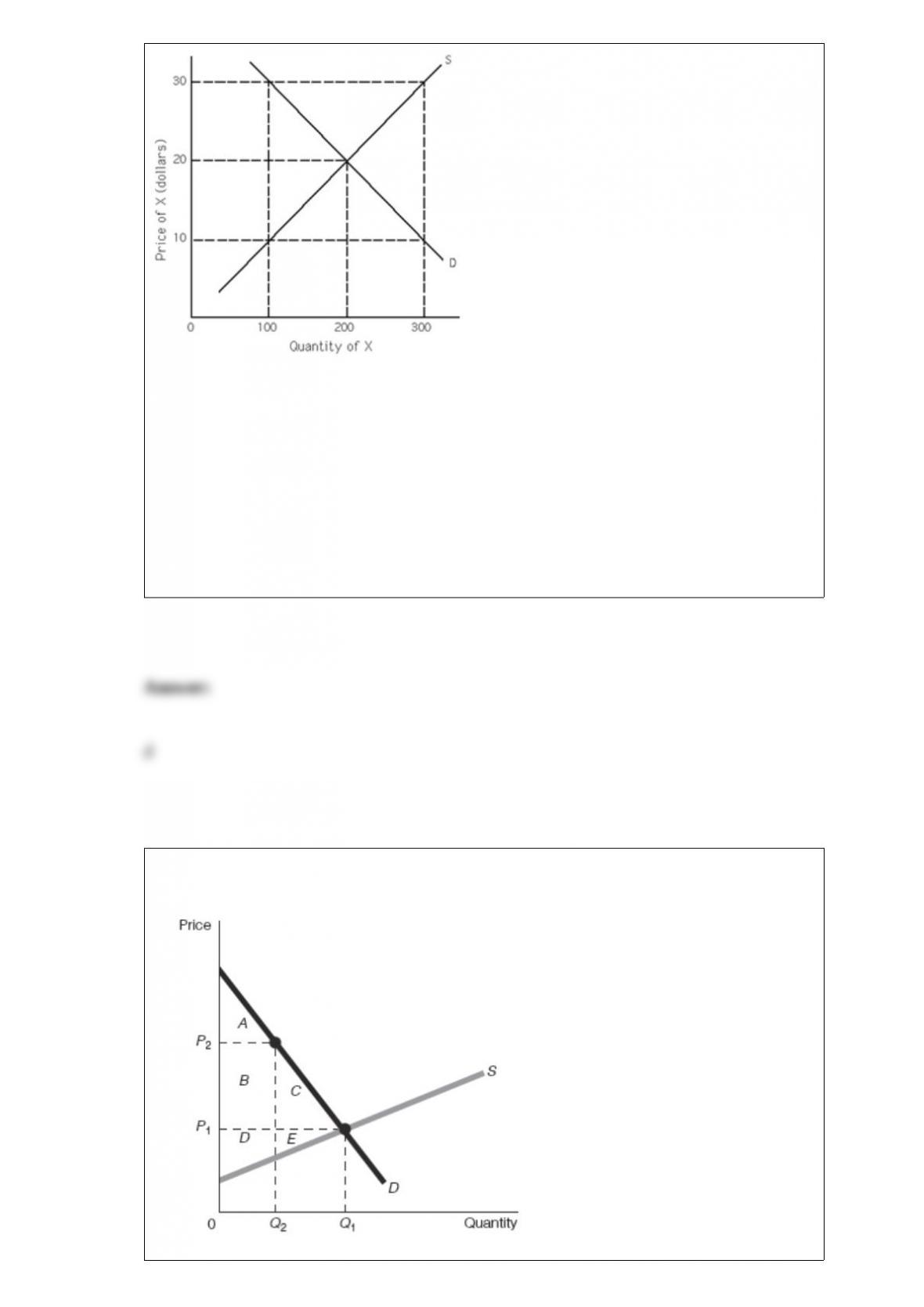
300 units of X will be exchanged in this market if the price is
a. $30.
b. $20.
c. $10.
d. none of the above
Exhibit 32-4

At the market equilibrium price of the good, consumers€ surplus is the area
a. D + E
b. A + B + C + D + E
c. A + B + C
d. C + E
e. none of the above
Exhibit 2-5
Given available resources and technology, this economy can produce 50,000 television
sets and 50,000 fax machines only if it chooses to
a. have an equal distribution of goods.
b. operate at both points C and D, simultaneously.
c. produce at point C.
d. produce at point D.

e. none of the above
The closer the Gini coefficient is to zero, the
a. greater the degree of income inequality.
b. less the degree of income inequality.
c. greater the degree of discrimination.
d. less the degree of discrimination.
In a perfectly competitive market, firms face no barriers to entry or exit.
a. True
b. False
Which of the following is not a characteristic of perfect competition?

a. buyers and sellers having no influence on price
b. there are no barriers to entry or exit
c. sellers produce and sell a heterogeneous product
d. buyers and sellers have access to all relevant information
e. none of the above