
The part of a graph that is most applicable to marginal analysis is the
a. origin
b. slope
c. horizontal axis
d. dependent variable
e. inverse relation
Economists believe that people respond in a predictable way to changes in costs and
benefits. The term that best describes this phenomenon is
a. opportunity cost
b. scarcity
c. innovation
d. marginal analysis
e. other things equal (or ceteris paribus)
Exhibit 10-15

Exhibit 10-15 depicts the payoff matrix facing Eagle Tobacco and Dan”l Boone
Tobacco with respect to their decisions to advertise or not. What strategies will
maximize their joint profit?
a. Eagle advertise and Dan”l Boone doesn”t
b. both advertise
c. Eagle doesn”t advertise and Dan”l Boone does
d. neither advertises
e. can”t tell
Special-interest groups, such as the pharmaceutical lobby, often get what they demand
because
a. politicians are rationally ignorant
b. voters are rationally ignorant
c. they engage in logrolling
d. they represent the median voter
e. none of the above

Which of the following is not a criticism of flexible exchange rates?
a. All of the following.
b. They are volatile, which increases risks for importers and exporters.
c. They could affect employment and increase demand for trade restrictions.
d. They do not allow for discretionary monetary policy.
e. They allow central banks to follow expansionary monetary policies.
If an industry is a constant-cost industry
a. prices of its inputs increase even though output remains constant
b. it uses inputs at higher levels of output
c. prices of its inputs rise at a constant rate as it uses more inputs
d. prices of its inputs remain constant as the number of firms increases
e. firms in the industry experience economies of scale
Gasoline taxes illustrate the benefits-received principle of taxation.
a. True
b. False
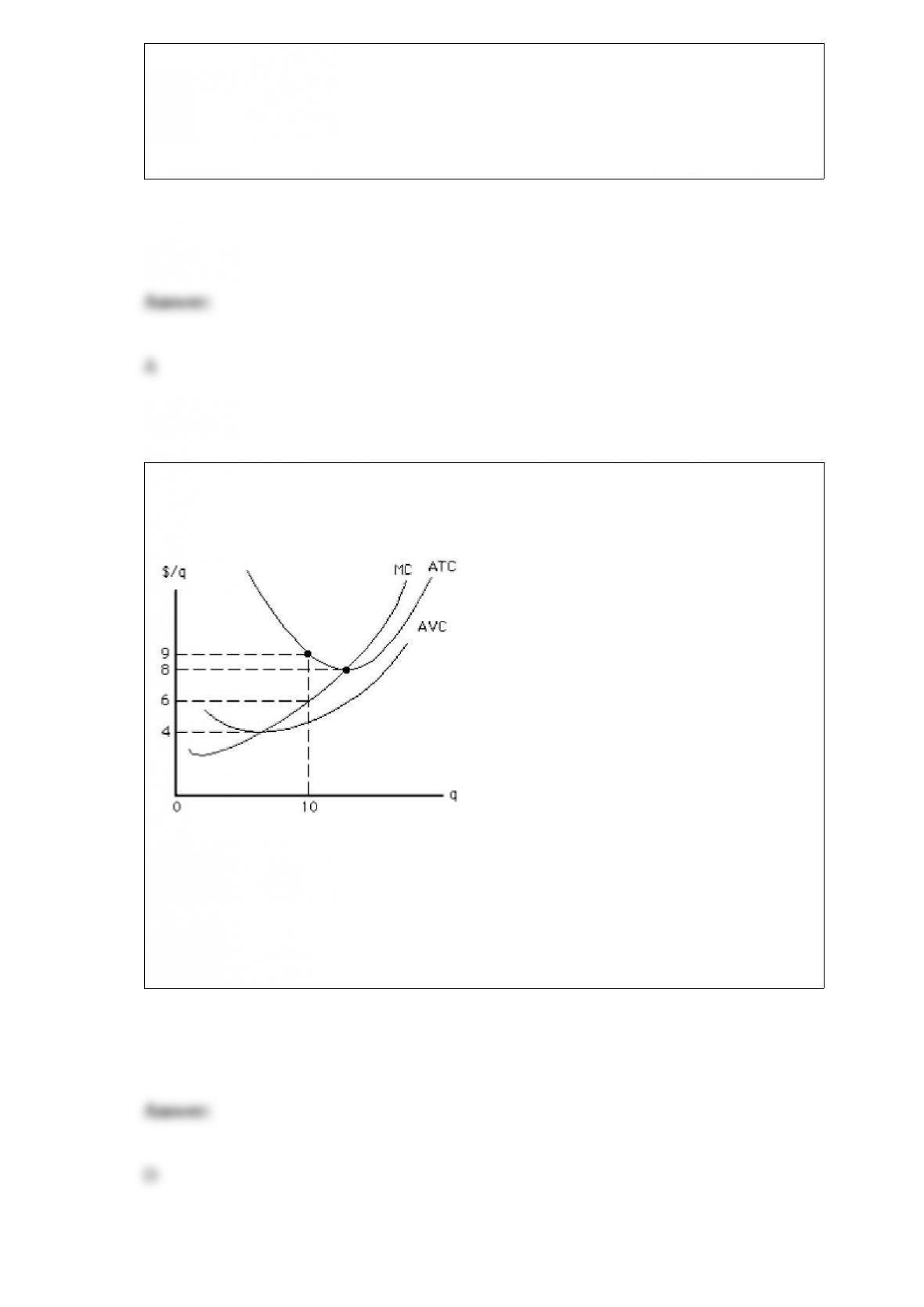
Exhibit 8-13
If the market price in Exhibit 8-13 is $6, what is the greatest possible short-run profit
for this perfectly competitive firm?
a. $3
b. $30
c. -$3
d. -$30
e. $20

Most labor negotiations in the United States end without a strike.
a. True
b. False
Perfectly competitive firms and monopolist firms bothmaximize profit where
a. price equals marginal cost
b. total revenue is maximized
c. average total cost is minimized
d. marginal cost equals marginal revenue
e. price is as high as possible
Other things equal, the supply of labor will be higher to a job that
a. requires a supervisor to closely monitor employee performance
b. provides few opportunities for training
c. has a starting time of midnight
d. requires advanced skills or education
e. has more amenities

If nonmarket work is a normal good, then an increase in income __________ the time
allocated to __________.
a. decreases; market work
b. decreases; leisure
c. increases; market work
d. increases; leisure
e. increases; nonmarket work
The income effect of a decrease in the price of legal services (a normal good) is a(n)
a. decrease in the demand for legal services
b. decrease in the quantity demanded of legal services
c. increase in the demand for legal services
d. increase in the quantity demanded of legal services
e. new demand curve because everything else is no longer constant

If the U.S. dollar depreciates relative to the Swiss franc, then
a. Swiss goods become more expensive in the U.S.
b. U.S. goods become more expensive in Switzerland
c. Swiss investors will pay more Swiss francs to buy each U.S. dollar
d. the U.S. will import more from Switzerland
e. the U.S. dollar-Swiss franc exchange rate will decrease
According to the Coase theorem, externality problems may be solved if the parties
involved can negotiate. Which of the following is also needed?
a. clearly defined bargaining costs
b. enforceable bargaining costs
c. clearly defined, enforceable property rights and low bargaining costs
d. a property right that cannot be bought or sold
e. government regulation
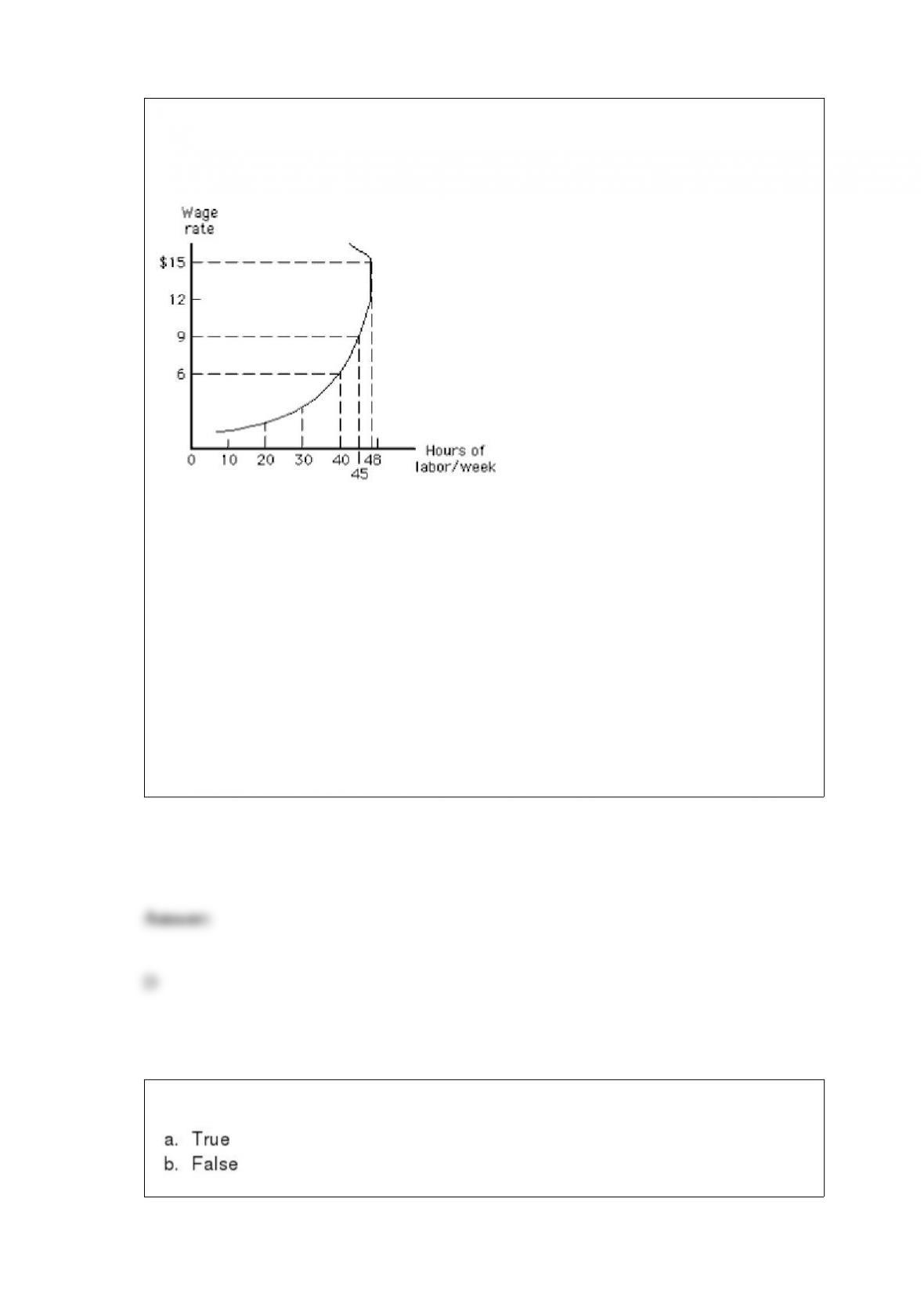
Exhibit 12-4
In Exhibit 12-4, how much will the employer have to pay per hour to get this worker to
work 48 hours per week?
a. $6
b. $7
c. $9
d. $12
e. less than $12
A firm can increase output by moving along a given isoquant.

Eileen has a comparative advantage over Jan in piano tuning but not in shoe polishing.
Therefore,
a. Jan must have an absolute advantage in piano tuning
b. Eileen must have an absolute advantage in shoe polishing
c. Jan must have a lower opportunity cost of shoe polishing
d. Eileen must have an absolute advantage in shoe polishing and in piano tuning
e. Eileen must have an absolute advantage in piano tuning
Government regulation of the prices charged by monopolies is an example of
a. safety regulation
b. economic regulation
c. Herfindahl regulation
d. antitrust regulation
e. antimerger regulation

The international financial system operated under a gold standard
a. from the 1500s through the present
b. from 1879 through the present
c. from 1879 to 1914
d. from 1914 to 1939
e. never
Which of the following illustrates the concept of “more is better”?
a. An increase in income shifts the budget line to the right.
b. Consumers moving along an indifference curve.
c. Higher indifference curves yield higher utility.
d. Budget lines closer to the origin represent lower income.
e. Sam’s indifference curves are steeper than Frazier’s.

Unlike implicit costs, explicit costs
a. reflect opportunity costs
b. include the value of the owner’s time
c. are not included in a firm’s accounting statements
d. are actual cash payments
e. do not change as a firm’s output changes
Household production increases when there is a stronger desire to avoid taxation.
a. True
b. False
The substitution effect in the labor supply decision refers to
a. substituting leisure for work as the wage rate rises
b. substituting market work for nonmarket work as the wage rate falls
c. working more hours as the wage rate falls

d. working fewer hours as the wage rate rises
e. substituting market work for leisure or nonmarket work as the wage rate rises
Average revenue equals the change in total revenue divided by the change in the
quantity of output produced.
a. True
b. False
To achieve allocative efficiency, firms
a. strive to minimize fixed costs
b. strive to maximize profits
c. produce at their minimum long-run average cost
d. produce at their minimum long-run marginal cost
e. produce the output consumers want most

An effective import quota is one that
a. reduces imports to zero
b. increases exports
c. reduces the price of an imported good below the world price
d. limits imports to less than what would be imported under free trade
e. reduces demand for a good to zero
Which of the following describes the relationship among market price (P), average
revenue (AR), and marginal revenue (MR) for a firm in monopolistic competition.
a. P = AR = MR
b. P > AR = MR
c. P = AR > MR
d. P > AR > MR
e. P = AR < MR

For firms in an oligopoly to be interdependent,
a. goods must be undifferentiated
b. goods must be differentiated
c. firms must be small
d. barriers to entry must be minimal
e. goods can be either undifferentiated or differentiated
A resource’s earnings are all economic rent when the resource has no alternative uses.
a. True
b. False
If a market is allocatively efficient,
a. firms are minimizing marginal cost
b. firms are minimizing total cost
c. consumers are minimizing expenditures
d. it must be impossible to increase total utility
e. it must be impossible to decrease output