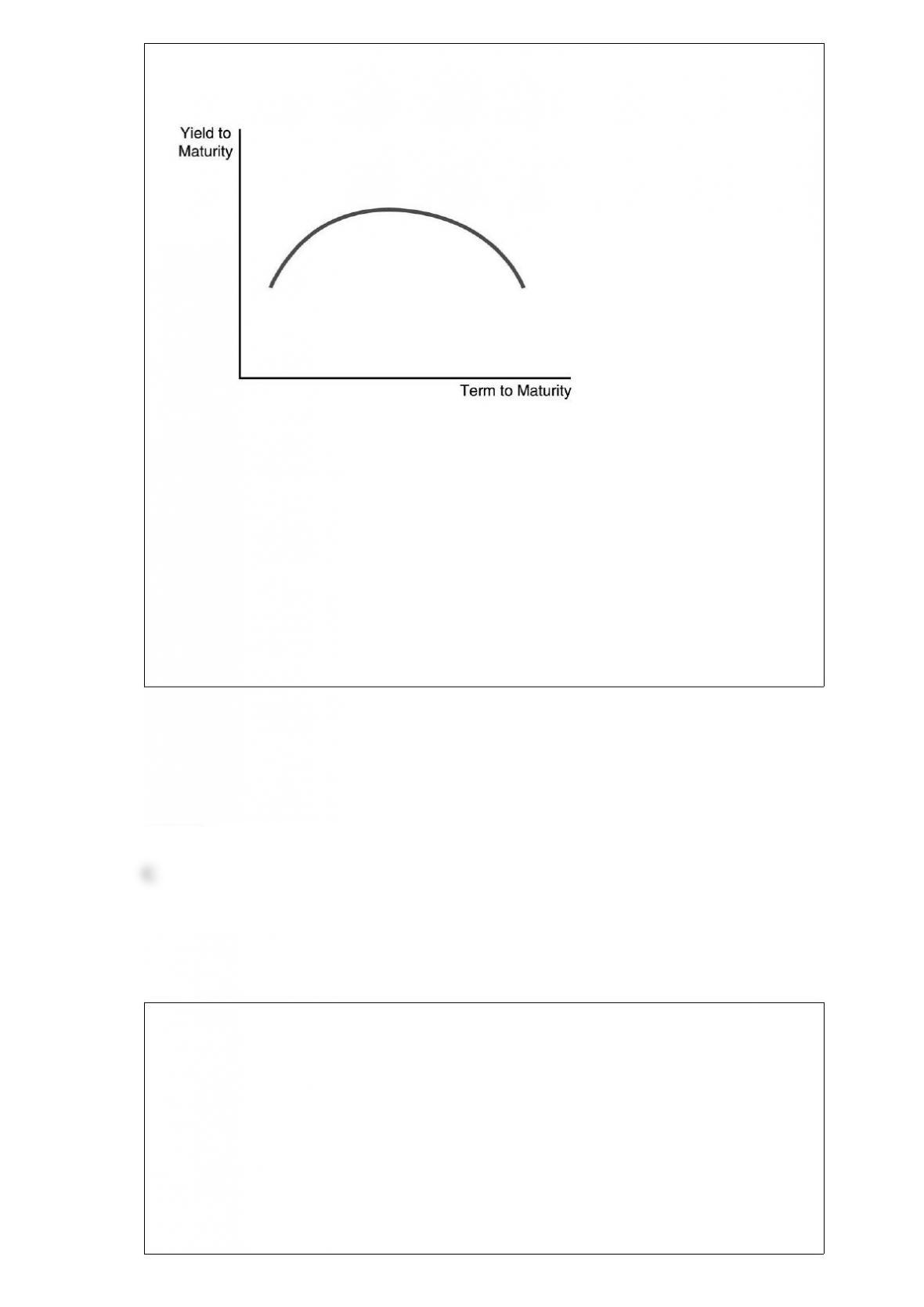
The mound-shaped yield curve in the figure above indicates that the inflation rate is
expected to
A. remain constant in the near-term and fall later on.
B. fall moderately in the near-term and rise later on.
C. rise moderately in the near-term and fall later on.
D. remain unchanged in the near-term and rise later on.
Answer:
A bond with default risk will always have a ________ risk premium and an increase in
its default risk will ________ the risk premium.
A. positive; raise
B. positive; lower
C. negative; raise
D. negative; lower

Answer:
The largest percentage of banks’ holdings of securities consist of
A. Treasury and government agency securities.
B. tax-exempt municipal securities.
C. state and local government securities.
D. corporate securities.
Answer:
The time it takes for policy makers to change policy instruments once they have
decided on the new policy is called
A. the data lag.
B. the recognition lag.
C. the legislative lag.
D. the implementation lag.
E. the effectiveness lag.

Answer:
An important characteristic of the modern payments system has been the rapidly
increasing use of
A. checks and decreasing use of currency.
B. electronic fund transfers.
C. commodity monies.
D. fiat money.
Answer:
The marginal propensity to consume (mpc) can be defined as the fraction of
A. a change in income that is spent.
B. a change in income that is saved.
C. income that is spent.
D. income that is saved.
Answer:

Bonds with relatively high risk of default are called
A. Brady bonds.
B. junk bonds.
C. zero coupon bonds.
D. investment grade bonds.
Answer:
Banks that actively manage liabilities will most likely meet a reserve shortfall by
A. calling in loans.
B. borrowing federal funds.
C. selling municipal bonds.
D. seeking new deposits.
Answer:

A financial market in which only short-term debt instruments are traded is called the
________ market.
A. bond
B. money
C. capital
D. stock
Answer:
In the one-period valuation model, the value of a share of stock today depends upon
A. the present value of both the dividends and the expected sales price.
B. only the present value of the future dividends.
C. the actual value of the dividends and expected sales price received in one year.
D. the future value of dividends and the actual sales price.
Answer:
Suppose, at a given federal funds rate, there is an excess supply of reserves in the
federal funds market. If the Fed wants the federal funds rate to stay at that level, then it
should undertake an open market ________ of bonds, everything else held constant. If

the Fed does nothing, however, the federal funds rate will ________.
A. sale; increase
B. purchase; increase
C. sale; decrease
D. purchase; decrease
Answer:
Net profit after taxes per dollar of assets is a basic measure of bank profitability called
A. return on assets.
B. return on capital.
C. return on equity.
D. return on investment.
Answer:
The efficient markets hypothesis implies that future changes in exchange rates should
for all practical purposes be
A. unpredictable.

B. set by each country.
C. increasing.
D. pegged to a standard such as the U.S. dollar or the Euro.
Answer:
If the required reserve ratio is one-third, currency in circulation is $300 billion, and
checkable deposits are $900 billion, then the money supply is ________ billion.
a. $2700
b. $3000
c. $1200
d. $1800
Answer:
Everything else held constant, if a central bank makes an unsterilized ________ of
foreign assets, then the domestic money supply will increase and the domestic currency
will ________.
A) purchase; appreciate

B) purchase; depreciate
C) sale; appreciate
D) sale; depreciate
Answer:
Complete Milton Friedman’s famous statement, “Inflation is always and everywhere a
________ phenomenon.”
A. recessionary
B. discretionary
C. repressionary
D. monetary
Answer:
Holding all else constant, when a bank receives the funds for a deposited check
A. cash items in the process of collection fall by the amount of the check.
B. bank assets increase by the amount of the check.
C. bank liabilities decrease by the amount of the check.

D. bank reserves increase by the amount of required reserves.
Answer:
Typically, borrowers have superior information relative to lenders about the potential
returns and risks associated with an investment project. The difference in information is
called
A. moral selection.
B. risk sharing.
C. asymmetric information.
D. adverse hazard.
Answer:
A simple deposit multiplier equal to two implies a required reserve ratio equal to
A. 100 percent.
B. 50 percent.
C. 25 percent.
D. 0 percent.

Answer:
Keynes’s theory of the demand for money is consistent with ________ movements in
________.
A. countercyclical; velocity
B. procyclical; velocity
C. countercyclical; expectations
D. procyclical; expectations
Answer:
________ theory relates the quantity of money and monetary policy to changes in
aggregate economic activity and inflation.
A. Monetary
B. Fiscal
C. Financial
D. Systemic

Answer:
Everything else held constant, if aggregate output is to the left of the LM curve, then
there is an excess ________ of money which will cause the interest rate to ________.
A. supply; fall
B. supply; rise
C. demand; fall
D. demand; rise
Answer:
A criticism of the monetarist autonomous spending variable is that
A. some types of autonomous spending do not affect aggregate demand.
B. some types of autonomous spending affect aggregate demand before the spending
occurs. Some types of autonomous spending affect aggregate demand when they occur.
C. some types of autonomous spending affect aggregate demand only long after they
occur.
D. Keynesians do not think that autonomous spending affects aggregate demand.
Answer:

The Fed prefers that ________ so that ________.
A. banks borrow reserves from each other; banks can monitor each other for credit risk
B. banks borrow reserves from each other; the Fed can monitor banks for credit risk
C. banks borrow reserves from the Fed; banks can monitor each other for credit risk
D. banks borrow reserves from the Fed; the Fed can monitor banks for credit risk
Answer:
A financial innovation that developed as a result of banks avoidance of bank branching
restrictions was
A) money market mutual funds.
B) commercial paper.
C) junk bonds.
D) bank holding companies.
Answer:

Which of the following is most likely to lead to inflationary monetary policy?
A. declining oil prices
B. resolution of conflict in the Middle East
C. the enactment of a free-trade agreement with Mexico
D. rising unemployment
Answer:
Equilibrium output is reduced by an increase in
A. planned investment.
B. taxes.
C. government spending.
D. net exports.
Answer:
The government institution that has responsibility for the amount of money and credit
supplied in the economy as a whole is the
A. central bank.

B. commercial bank.
C. bank of settlement.
D. monetary fund.
Answer:
With the creation of the Federal Deposit Insurance Corporation, member banks of the
Federal Reserve System ________ to purchase FDIC insurance for their depositors,
while non-member commercial banks ________ to buy deposit insurance.
A. could choose; were required
B. could choose; were given the option
C. were required, could choose
D. were required; were required
Answer:
Methods of financing government spending are described by an expression called the
government budget constraint, which states the following
A. the government budget deficit must equal the sum of the change in the monetary
base and the change in government bonds held by the public.

B. the government budget deficit must equal the difference between the change in the
monetary base and the change in government bonds held by the public.
C. the government budget deficit must equal the difference between the change in the
monetary base and the change in government bonds held by the Fed.
D. the government budget deficit must equal the difference between the change in the
monetary base and the change in government bonds held by the Treasury.
Answer:
If prices in the bond market become more volatile, everything else held constant, the
demand curve for bonds shifts ________ and interest rates ________.
A. left; rise
B. left; fall
C. right; rise
D. right; fall
Answer: