
1) According to rational expectations theory, forecast errors of expectations
A) are more likely to be negative than positive
B) are more likely to be positive than negative
C) tend to be persistently high or low
D) are unpredictable
2) If the interest rate on euro-denominated assets is 13 percent and it is 15 percent on
peso-denominated assets, and if the euro is expected to appreciate at a 4 percent rate,
for Manuel the Mexican the expected rate of return on euro-denominated assets is
A) 11 percent
B) 13 percent
C) 17 percent
D) 19 percent
3) The bond demand curve is ________ sloping, indicating a(n) ________ relationship
between the price and quantity demanded of bonds.
A) downward; inverse
B) downward; direct
C) upward; inverse
D) upward; direct
4) Everything else held constant, an increase in the required reserve ratio will mean
________ in the M2 money multiplier and ________ in the M2 money supply.
A) an increase; an increase
B) an increase; a decrease
C) a decrease; an increase
D) a decrease; a decrease
5) Most of a bank’s operating income results from
A) interest on assets
B) service charges on deposit accounts
C) off-balance-sheet activities
D) fees from standby lines of credit

6) Which of the following instruments are traded in a capital market?
A) Corporate bonds
B) U.S. Treasury bills
C) Negotiable bank CDs
D) Repurchase agreements
7) With a 10 percent interest rate on dollar deposits, and an expected appreciation of 7
percent over the coming year, the expected return on dollar deposits in terms of the
foreign currency is
A) 3 percent
B) 10 percent
C) 13.5 percent
D) 17 percent
8) Between 1950 and 1980 in the U.S., interest rates trended upward. During this same
time period,
A) the rate of money growth declined
B) the rate of money growth increased
C) the government budget deficit (expressed as a percentage of GNP) trended
downward
D) the aggregate price level declined quite dramatically
9) China chooses to have ________ and ________ and therefore, cannot have free
capital mobility at the same time.
A) a fixed exchange rate, no control of monetary policy
B) a fixed exchange rate, an independent monetary policy
C) a flexible exchange rate, an independent monetary policy
D) a flexible exchange rate, no control of monetary policy
10) Suppose that from a new checkable deposit, First National Bank holds eight million
dollars on deposit with the Federal Reserve, nine million dollars in excess reserves, and
faces a required reserve ratio of ten percent. Given this information, we can say First
National Bank has ________ million dollars in required reserves.
A) one
B) two
C) nine
D) ten
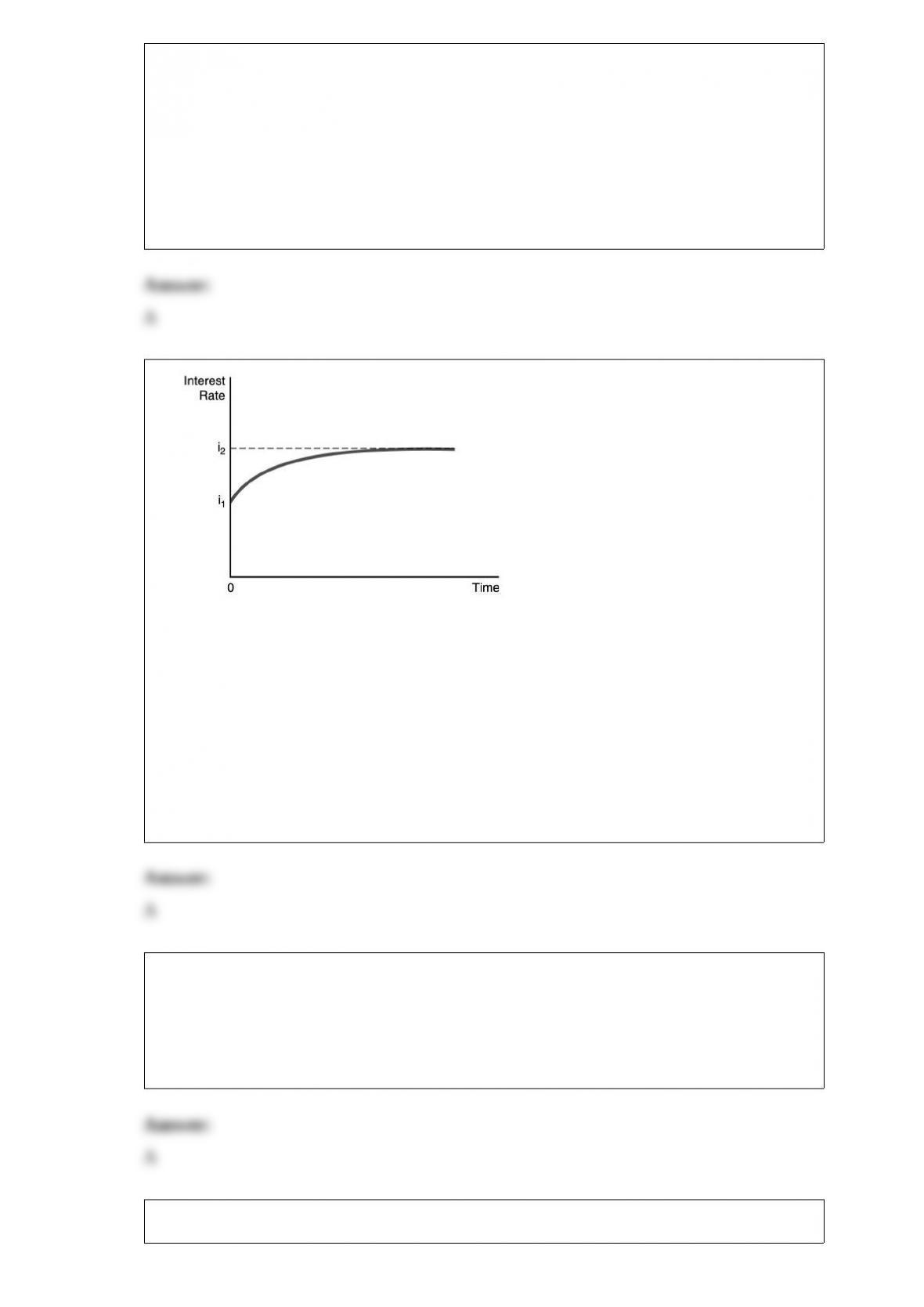
11)
The figure above illustrates the effect of an increased rate of money supply growth at
time period 0 . From the figure, one can conclude that the
A) liquidity effect is smaller than the expected inflation effect and interest rates adjust
quickly to changes in expected inflation
B) liquidity effect is larger than the expected inflation effect and interest rates adjust
quickly to changes in expected inflation
C) liquidity effect is larger than the expected inflation effect and interest rates adjust
slowly to changes in expected inflation
D) liquidity effect is smaller than the expected inflation effect and interest rates adjust
slowly to changes in expected inflation
12) Which of the following bonds would you prefer to be buying?
A) A $10,000 face-value security with a 10 percent coupon selling for $9,000
B) A $10,000 face-value security with a 7 percent coupon selling for $10,000
C) A $10,000 face-value security with a 9 percent coupon selling for $10,000
D) A $10,000 face-value security with a 10 percent coupon selling for $10,000
13) When the expected inflation rate increases, the real cost of borrowing ________ and

bond supply ________, everything else held constant.
A) increases; increases
B) increases; decreases
C) decreases; increases
D) decreases; decreases
14) Forty or so dealers establish a “market” in these securities by standing ready to buy
and sell them.
A) Secondary stocks
B) Surplus stocks
C) U.S. government bonds
D) Common stocks
15) Compared to an electronic payments system, a payments system based on checks
has the major drawback that
A) checks are less costly to process
B) checks take longer to process, meaning that it may take several days before the
depositor can get her cash
C) fraud may be more difficult to commit when paper receipts are eliminated
D) legal liability is more clearly defined
16) If an individual moves money from currency to a demand deposit account,
A) M1 decreases and M2 stays the same
B) M1 stays the same and M2 increases
C) M1 stays the same and M2 stays the same
D) M1 increases and M2 stays the same
17) A contract that requires the investor to sell securities on a future date is called a
A) short contract
B) long contract
C) hedge
D) micro hedge

18) If you buy a call option on Treasury futures at 115, and at expiration the market
price is 110, the ________ will ________ exercised.
A) call; be
B) put; be
C) call; not be
D) put; not be
19) The problem faced by the lender that the borrower may take on additional risk after
receiving the loan is called
A) adverse selection
B) moral hazard
C) transactions costs
D) diversification
20) Of the sources of external funds for nonfinancial businesses in the United States,
stocks account for approximately ________ of the total.
A) 2%
B) 11%
C) 20%
D) 40%
21) The discount rate is kept ________ the federal funds rate because the Fed prefers
that ________
A) below; banks borrow reserves from each other
B) below; banks borrow reserves from the Fed
C) above; banks borrow reserves from each other
D) above; banks borrow reserves from the Fed
22) An increase in Treasury deposits at the Fed causes

A) the monetary base to increase
B) the monetary base to decrease
C) Fed assets to increase but has no effect on the monetary base
D) Fed assets to decrease but has no effect on the monetary base
23) Because of the “lemons problem” the price a buyer of a used car pays is
A) equal to the price of a lemon
B) less than the price of a lemon
C) equal to the price of a peach
D) between the price of a lemon and a peach
24) When banks offer borrowers smaller loans than they have requested, banks are said
to
A) shave credit
B) rediscount the loan
C) raze credit
D) ration credit
25) The Fed’s use of the federal funds rate as an operating target in the 1970s resulted in
A) countercyclical monetary policy
B) too slow growth in M1 throughout the decade
C) procyclical monetary policy
D) too rapid growth in M1 throughout the decade
26) A decrease in the riskiness of corporate bonds will ________ the price of corporate
bonds and ________ the price of Treasury bonds, everything else held constant.
A) increase; increase
B) reduce; reduce
C) reduce; increase
D) increase; reduce

27) An analysis of the political economy of the savings and loan crisis helps one to
understand
A) why politicians aided the efforts of thrift regulators, raising regulatory
appropriations and encouraging closing of insolvent thrifts
B) why thrift regulators were so quick to inform Congress of the problems that existed
in the thrift industry
C) why thrift regulators willingly acceded to pressures placed upon them by members
of Congress
D) why politicians listened so closely to the taxpayers they represented
28) Which of the following are reported as liabilities on a bank’s balance sheet?
A) Discount loans
B) Reserves
C) U.S. Treasury securities
D) Loans
29) Explain and demonstrate graphically the effects of a negative supply shock in both
the short-run and long-run.
30) The monetary base increased by 20% during the contraction of 1929-1933, but the
money supply fell by 25%. Explain why this occurred. How can the money supply fall
when the base increases?
31) Everything else held constant, would an increase in volatility of stock prices have
any impact on the demand for rare coins? Why or why not?
32) Explain two concepts of central bank independence. Is the Fed politically
independent? Why do economists think central bank independence is important?