
1) illegal immigrants displace domestic-born workers on a one-for-one basis.
2) when the dollar price of yen rises, the dollar appreciates in value relative to the yen.
3) Mainstream macroeconomists see two main sources of macroeconomic instability:
changes in investment spending and, occasionally, adverse aggregate supply shocks.
4) as a consumer moves down a given indifference curve, his or her total utility will
diminish.
5) the greater the ease of shifting resources from product x to y in the production
process, the greater is the elasticity of supply of product y.
6) The per capita public debt doubled between 1990 and 2000.
7) Alan Greenspan is the current chair of the Board of Governors.
8) The equation of exchange is MV = PQ.

9) Diffusion is the first successful commercial introduction of a product, the use of a
new method, or the creation of new form of business enterprise.
10) A current account deficit will reduce U.S. foreign indebtedness.
11) a progressive tax takes relatively more from the rich than it does from the poor.
12) interest on the public debt is included as a part of government purchases in
determining gdp by the expenditures method.
13) during recent years the u.s. unemployment rate has been substantially higher than
the rate in most of the other major industrial nations.
14) If the economy is operating in the relative flat (lower) part of its aggregate supply
curve, a restrictive monetary policy will increase real output but not the price level.
15) The “brain drain” problem in the DVCs refers to the fact the best-educated workers:
A.are reluctant to become entrepreneurs.
B.are concentrated in rural areas where their skills are underutilized.
C.often emigrate to industrialized countries.

D.are reluctant to work in the public sector.
16) stocks are:
a.promises to repay a loan.
b.also known as bonds.
c.issued by sole proprietorships.
d.shares of ownership of a corporation.
17) if the production of a good or service creates sizable positive externalities,
government might correct for the:
a.underallocation of resources to its production by imposing an excise tax.
b.overallocation of resources to its production by imposing an excise tax.
c.underallocation of resources to its production by granting a subsidy.
d.overallocation of resources to its production by granting a subsidy.
18) suppose that coffee growers sell 200 million pounds of coffee beans at $2 per pound
in 2007, and sell 240 million pounds for $3 per pound in 2008. based on this
information we can conclude that the:
a.law of supply has been violated.
b.law of demand has been violated.
c.demand for coffee beans has increased.
d.supply of coffee beans has increased.
19) the maximum federal marginal tax rate on taxable personal income is currently
(2008):
a.50 percent.
b.35 percent.
c.45 percent.
d.28 percent.
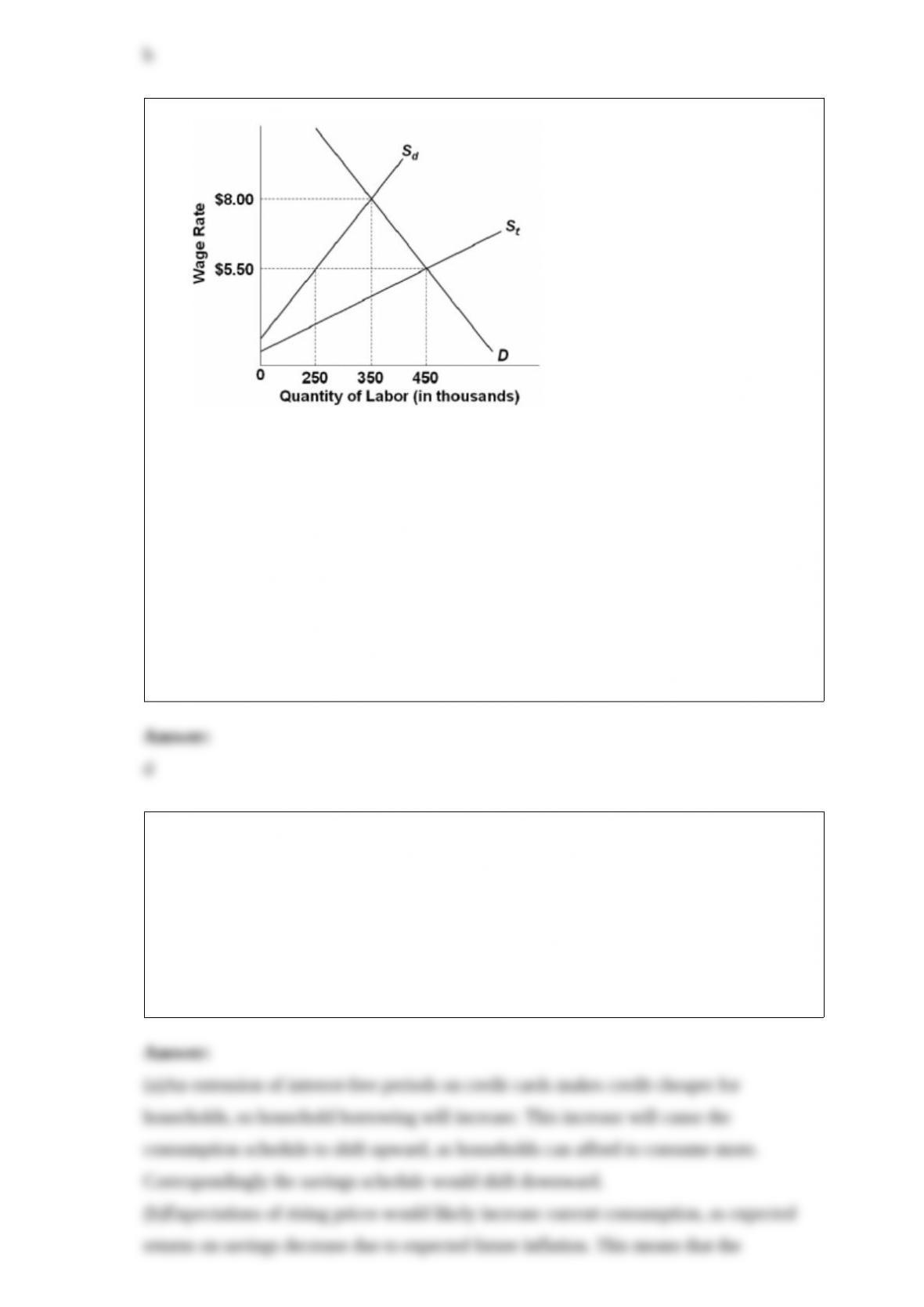
20)
assumptions: 1) employers in this market are willing and able to ignore minimum wage
laws; 2) sd represents the supply of domestically-born (and legal immigrant) workers;
3) st represents the total supply of workers in this labor market (sd plus illegal
immigrants); and 4) unless otherwise stated, illegal immigration is not effectively
blocked by the government.
refer to the above figure. the equilibrium wage and level of employment are,
respectively:
a.$5.50 and 250,000
b.$5.50 and 350,000
c.$8 and 350,000
d.$5.50 and 450,000
21) Other things being constant, what will be the effect of each of the following on
consumption and saving schedules?
(a)Credit card companies increase the interest-free periods on their cards to compete for
customers.
(b)Concern grows over rising prices.
(c)A weakening of the housing market lowers home values.
(d)Real interest rates fall.
(e)Congress officially approves the Presidents plan for tax cuts.
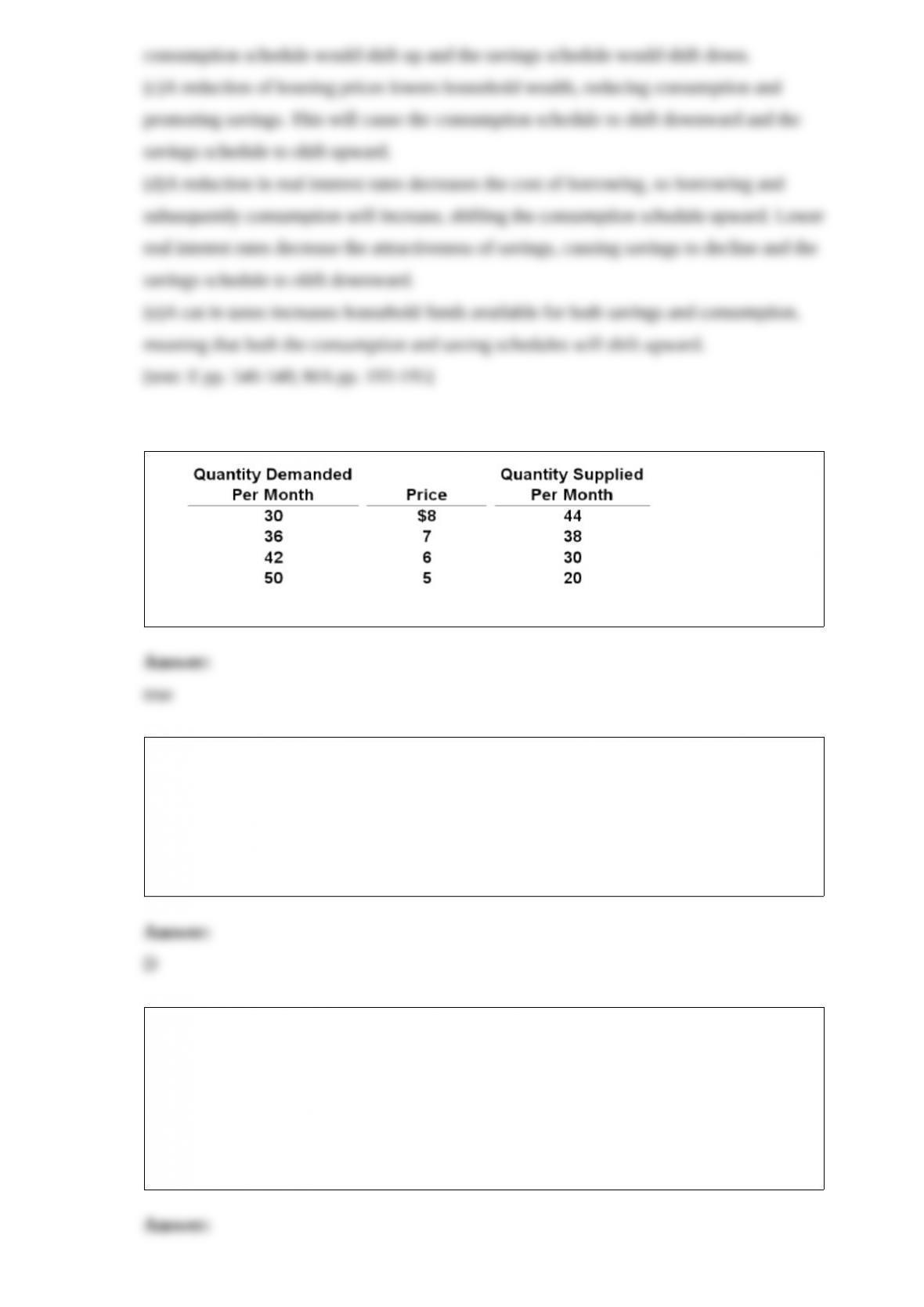
22)
refer to the above data. the demand for this product is elastic in the $8-$7 price range.
23) If in the market for money the amount of money supplied exceeds the amount of
money households and businesses want to hold, the interest rate will:
A.fall, causing households and businesses to hold less money.
B.rise, causing households and businesses to hold less money.
C.rise, causing households and businesses to hold more money.
D.fall, causing households and businesses to hold more money.
24) The following table shows government spending and tax revenue for a hypothetical
economy over a five-year period. All figures are in billions.
(a)In what years were there budget deficits and what were the amounts?
(b)In what year was there a budget surplus and what was the amount?
(c)What is the public debt in this economy over the five years?
(d)If the size of the economy (GDP) was $6000 billion what would the public debt in
year 5 as a percentage of GDP.
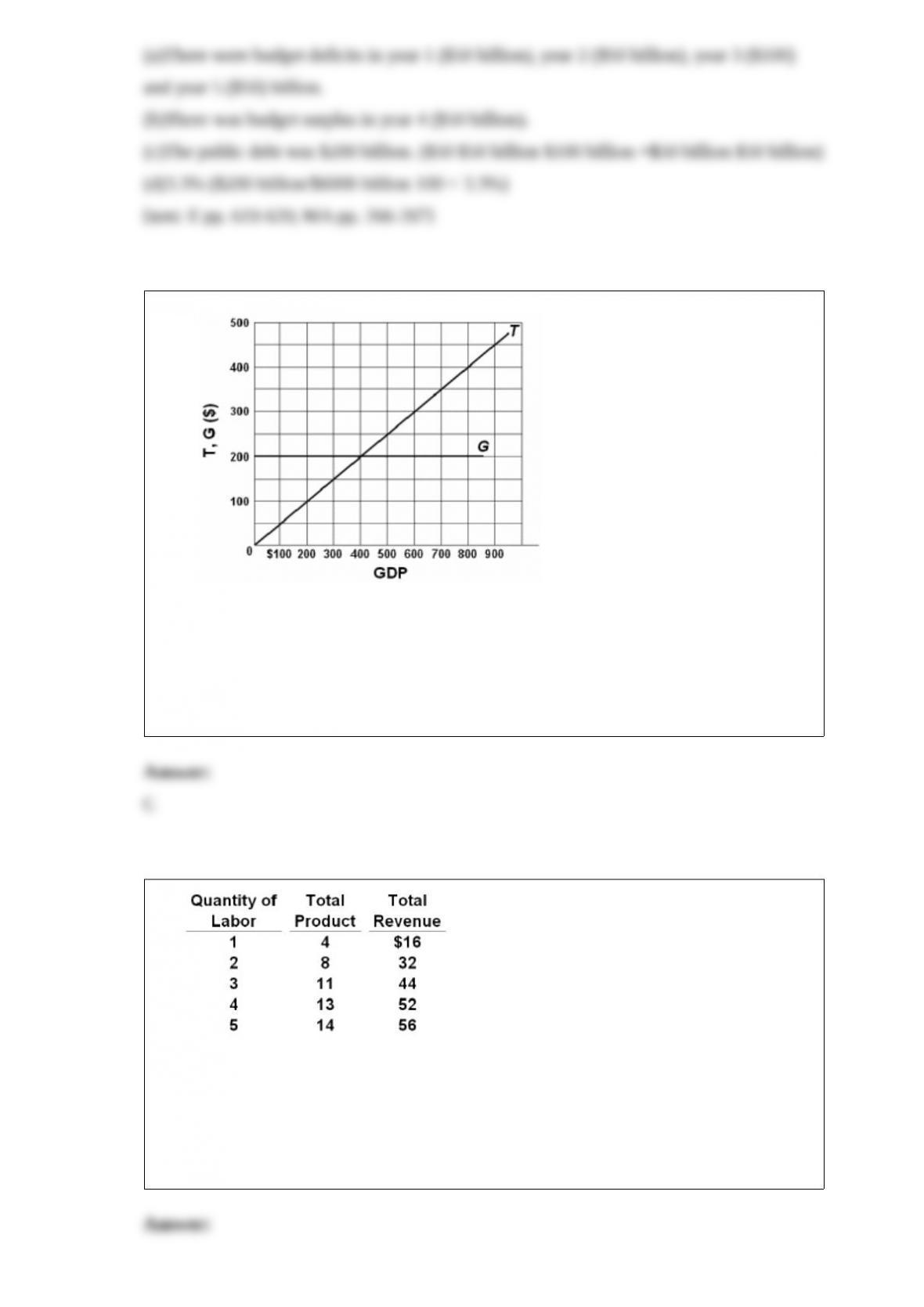
25)
Refer to the above diagram in which T is tax revenues and G is government
expenditures. All figures are in billions. If GDP is $400:
A.there will be a budget deficit.
B.there will be a budget surplus.
C.the budget will be balanced.
D. the macroeconomy will be in equilibrium.
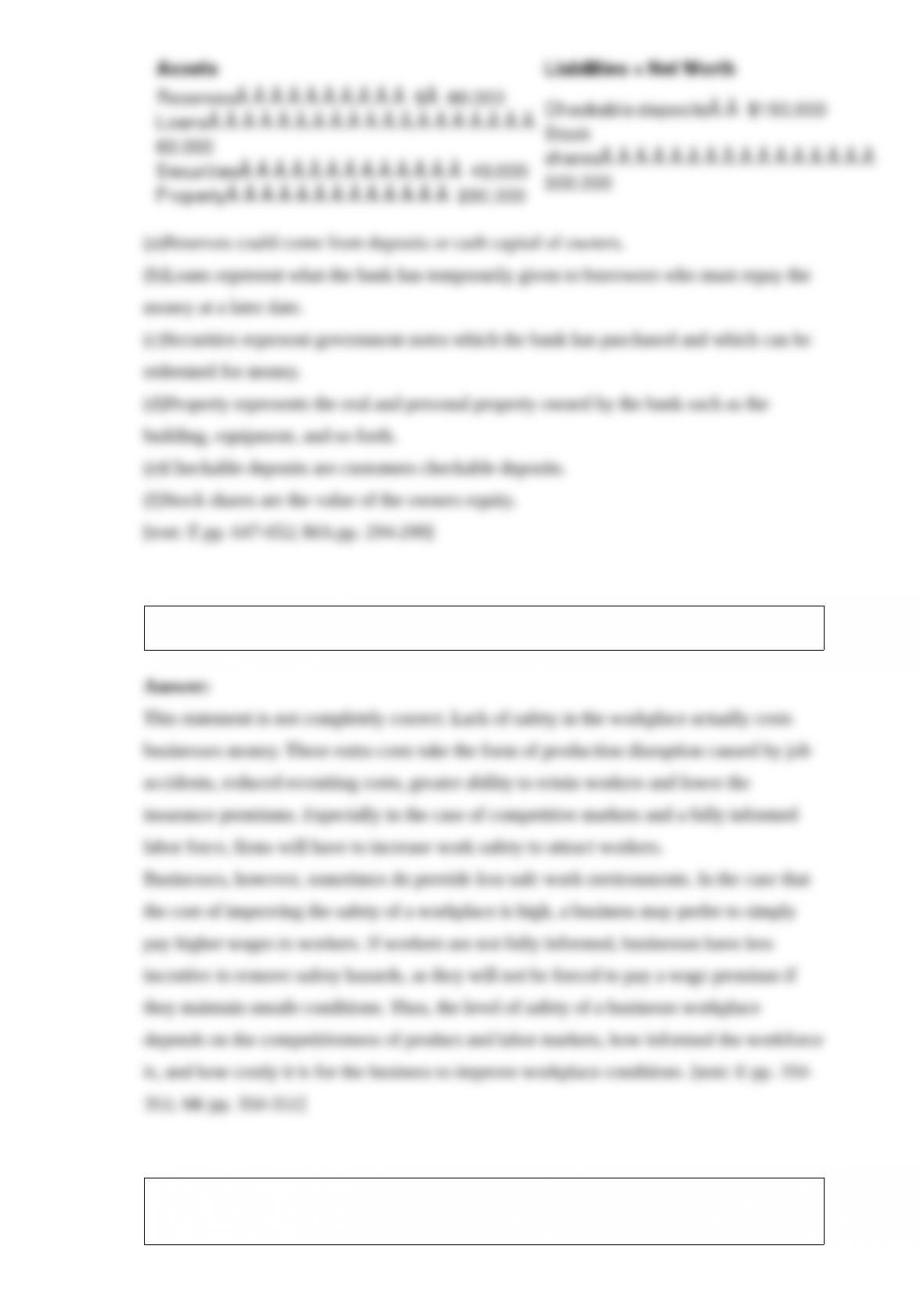
26)
Refer to the above data. If this firm can hire as few or many workers as it wants at $8, it
is:
A.hiring labor in a monopsony labor market.
B.hiring labor in a purely competitive labor market.
C.selling its product in a monopolized product market.
D.selling its product in a purely competitive product market.

27) if consumer incomes increase, the demand for product x:
a.will necessarily remain unchanged.
b.may shift either to the right or left.
c.will necessarily shift to the right.
d.will necessarily shift to the left.
28) which of the following statements is correct?
a.united states exports and imports have been decreasing as a percentage of u.s. gdp but
the u.s. share of total world trade has been increasing.
b.united states exports and imports have been decreasing as a percentage of u.s. gdp and
the u.s. share of total world trade has been declining.
c.united states exports and imports have been expanding as a percentage of u.s. gdp and
the u.s. share of total world trade has been increasing.
d.united states exports and imports have been expanding as a percentage of u.s. gdp but
the u.s. share of total world trade has been declining.
29) government may lessen income inequality by:
a.providing transfer payments to the poor.
b.directly modifying market prices as, for example, by establishing a legal minimum
wage.
c.using the tax system to tax the wealthy relatively more heavily than the poor.
d.doing all of these.
30) Arrange the following items in the form of a commercial banks balance sheet, and
explain how each might come into being.
Stock shares, $300,000; Reserves, $60,000; Property, $290,000; Checkable deposits,
$150,000; Securities, $40,000; Loans, $60,000
31) Business will always choose the least safe work environment to cut costs. Evaluate.
32) Assume that a purely competitive firm has the schedule of costs given in the table
below.
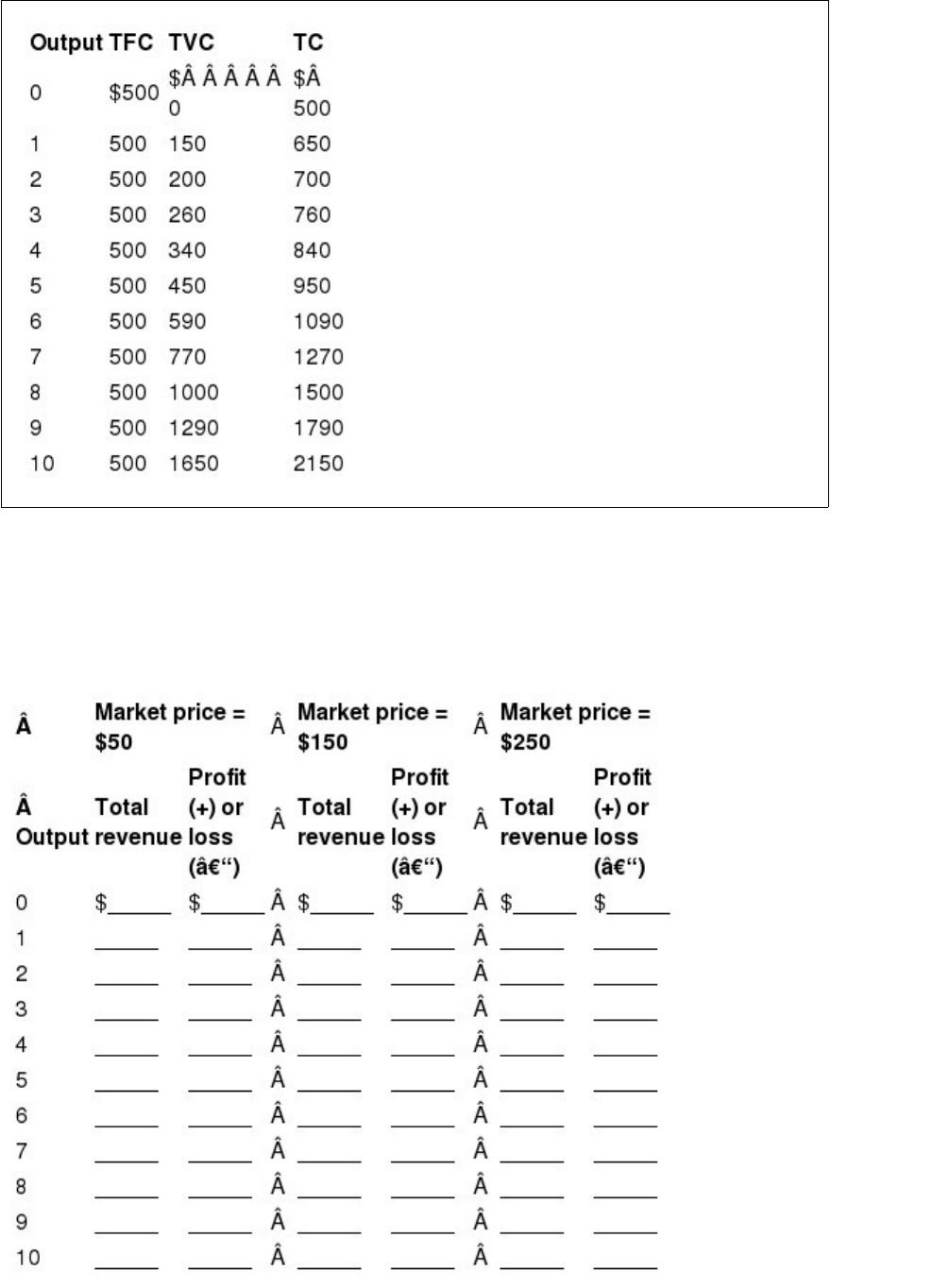
•Complete the table below to show the total revenue and total profit of the firm at
each level of output the firm might produce. Assume market prices of $50, $150,
and $250.
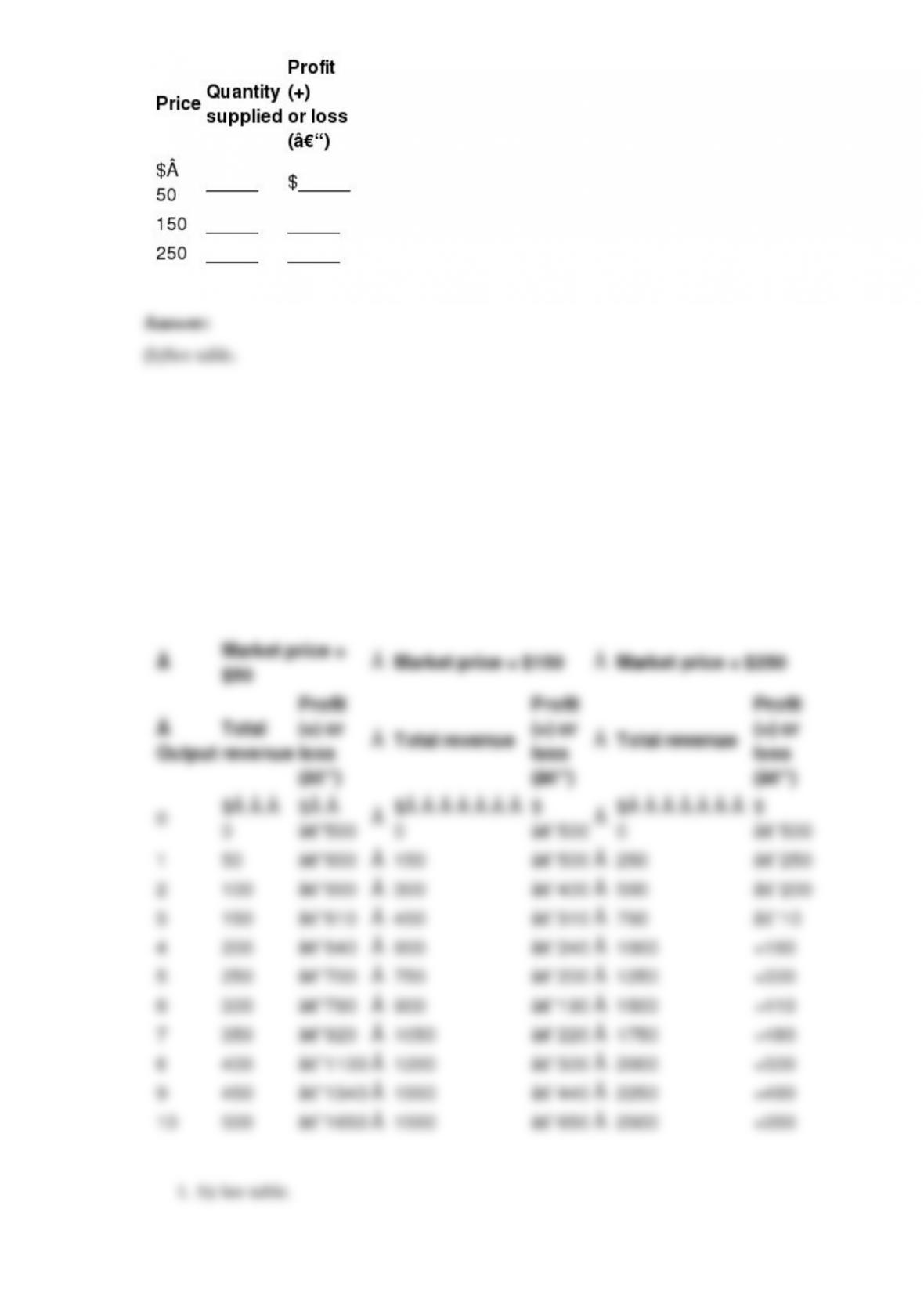
•Indicate what output the firm would produce and its profits in the following table.
33) How do you calculate personal income from national income? Disposable income
from national income?
34) In the table below are statistics showing the labor force and total employment in
month 1 and month 2 of the same year. Make the computations necessary to complete
the table. (Number of persons is in thousands.)