
If the average variable cost curve is above the marginal cost curve, then
A) marginal costs must be decreasing.
B) average variable costs must be increasing.
C) marginal costs must be increasing.
D) marginal costs can be either increasing or decreasing.
In the mid-1990s, cattle ranchers in the United States kept raising cattle even though
prices were at a ten-year low and below average total cost. What is the likely
explanation for this?
A) Continuing to operate resulted in smaller losses than would have been incurred by
shutting down.
B) The ranchers were hoping to receive government subsidies.
C) The exit costs were too high.
D) Cattle is an important source of protein and its production is essential for the United
States.
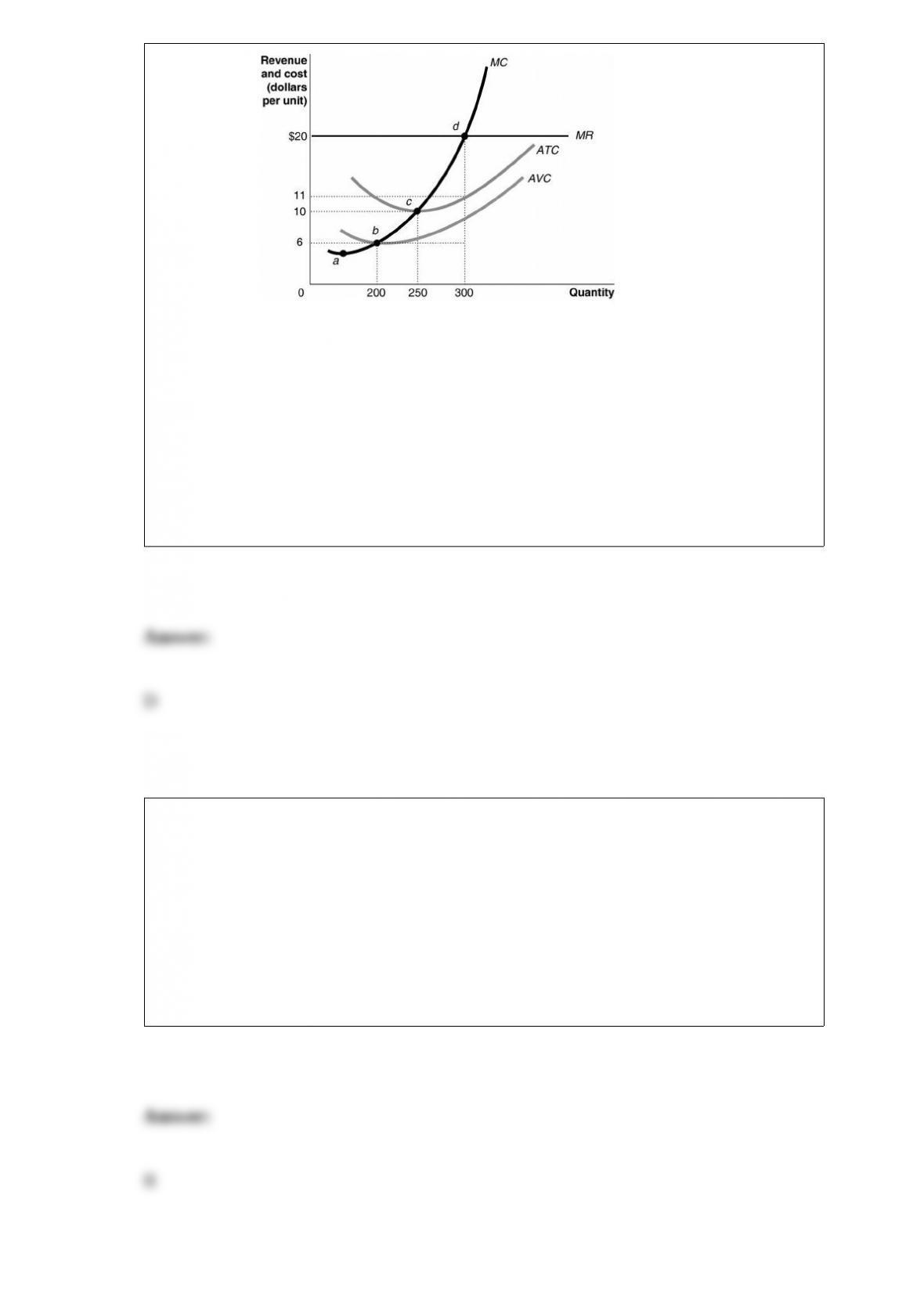
Figure 12-10
At the profit-maximizing output level, the firm earns
A) zero economic profit.
B) a profit of $600.
C) a profit of $1,200.
D) a profit of $2,700.
Which of the following is an example of foreign portfolio investment?
A) the purchase of a U.S. stock by a U.S. citizen
B) the purchase of a U.S. Treasury bond by a German citizen
C) the purchase of a U.S. mutual fund by a U.S. citizen
D) the purchase of a Japanese factory by a Korean citizen

Technological change is a key reason why Wal-Mart has become one of the largest
firms in the world. Which of the following is a change in technology implemented by
Wal-Mart?
A) Wal-Mart developed a supply chain that allows it to manage inventories efficiently.
B) Instead of buying goods it sells from other companies, Wal-Mart makes many of
these goods in its own factories.
C) Wal-Mart employs hundreds of scientists and engineers who develop new
cost-saving techniques.
D) Wal-Mart hires managers from many of the top business schools in the United
States.
If the marginal propensity to save is 0.1, then a $10 million decrease in disposable
income will
A) increase consumption by $9 million.
B) increase consumption by $1 million.
C) decrease consumption by $9 million.
D) decrease consumption by $1 million.
A firm has an incentive to decrease supply now and increase supply in the future if it
expects that
A) more firms will enter the market in the future.

B) the prices of inputs used to produce the product will rise in the future.
C) the price of its product will be lower in the future than it is today.
D) the price of its product will be higher in the future than it is today.
When ________ in a market, the total net benefit to society is maximized.
A) deadweight loss is maximized
B) a competitive equilibrium is achieved
C) consumer surplus is minimized
D) producer surplus is minimized
Marginal cost is the ________ associated with undertaking an activity.
A) total cost
B) extra cost
C) opportunity cost
D) foregone cost

If the tax multiplier is -1.5 and a $200 billion tax increase is implemented, what is the
change in GDP, holding everything else constant? (Assume the price level stays
constant.)
A) a $300 billion decrease in GDP
B) a $300 billion increase in GDP
C) a $30 billion increase in GDP
D) a $133.33 billion decrease in GDP
E) a $133.33 billion increase in GDP