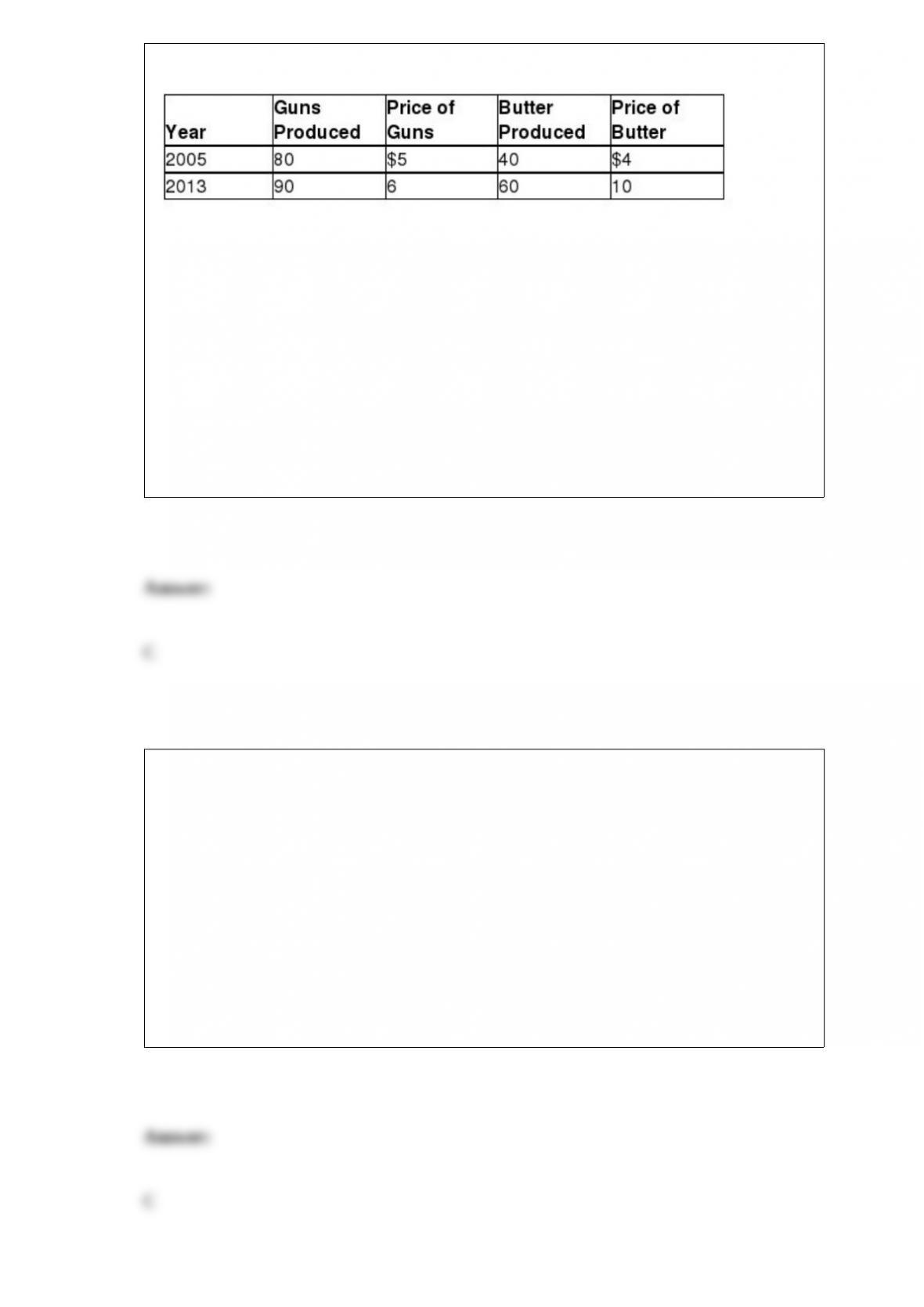
Table 19-11
Consider the following data for Tyrovia, a country that produces only two products:
guns and butter.
Real GDP for Tyrovia for 2013 using 2005 as the base year equals
A) $1,140.
B) $880.
C) $690.
D) $560.
Toot Sweets Bakery sells freshly baked muffins from 6.30 am at $1.20 per muffins. By
4 pm, the remaining muffins are marked down to $0.60 each. Which of the following
statements is true?
A) Toot Sweets engages in price discrimination; a higher price for those who cannot
wait and a lower price for those willing to wait until 4 pm.
B) Toot Sweets is trying to prevent the opportunity to make arbitrage profit.
C) Toot Sweets is trying to minimize its loss.
D) Toot Sweets has underestimated the demand for its muffins.

The individual mandate provision of the ACA requires
A) every U.S. resident to have health insurance.
B) every U.S. company to provide health insurance to its employees.
C) every employed person to pay for his or her own health insurance.
D) every private insurance company to provide free health care to its current policy
holders.
A change in which variable will change the market demand for a product?
A) the price of the product
B) expected future prices
C) the number of firms in the market
D) the quantity supplied of the product
When the price of pistachio nuts is $7.50 per lb., the quantity demanded is 48 lbs. When
the price of peaches is $9.00 per lb., the quantity demanded is 40 lbs. When the
midpoint formula is used to measure the price elasticity of demand we can say that the
demand for pistachio nuts is

A) relatively, but not perfectly, elastic.
B) unit-elastic.
C) completely inelastic.
D) relatively, but not perfectly, inelastic.
Studies have shown that
A) firms often cut nominal wages during recessions and allow inflation to gradually
increase real wages.
B) firms are reluctant to cut nominal wages during recessions but instead increase
workers’ nominal wages and allow inflation to gradually increase real wages.
C) firms are reluctant to cut nominal wages during recessions but instead freeze
workers’ nominal wages and allow inflation to gradually reduce real wages.
D) firms often freeze workers’ nominal wages during a recession and keep the wages
frozen well after the recession has ended.
Which of the following is an example of foreign portfolio investment?
A) the purchase of a U.S. stock by a U.S. citizen
B) the purchase of a U.S. Treasury bond by a German citizen
C) the purchase of a U.S. mutual fund by a U.S. citizen

D) the purchase of a Japanese factory by a Korean citizen
The Congressional Budget Office estimates that most of the increase in federal
spending on Medicare and Medicaid will be due to
A) the aging population.
B) increases in the cost of providing health care.
C) increases in immigration.
D) declining income levels.
Which of the following describes a situation in which every good or service is produced
up to the point where the last unit provides a marginal benefit to consumers equal to the
marginal cost of producing it?
A) productive efficiency
B) allocative efficiency
C) marginal efficiency
D) profit maximization

Trade restrictions are often motivated by a desire to save domestic jobs threatened by
competition from imports. Which of the following counter-arguments is made by
economists who oppose trade restrictions?
A) Statistics show that trade restrictions actually do not save jobs.
B) Consumers pay a high cost for jobs saved through trade restrictions.
C) Trade restrictions have a limited impact because most Americans prefer domestic
goods over imports.
D) Trade restrictions benefit consumers in the short run but not in the long run.
If, as a perfectly competitive industry expands, it can supply larger quantities only at a
higher long-run equilibrium price, it is
A) a constant-cost industry.
B) an increasing-cost industry.
C) a decreasing-cost industry.
D) a fixed-cost industry.
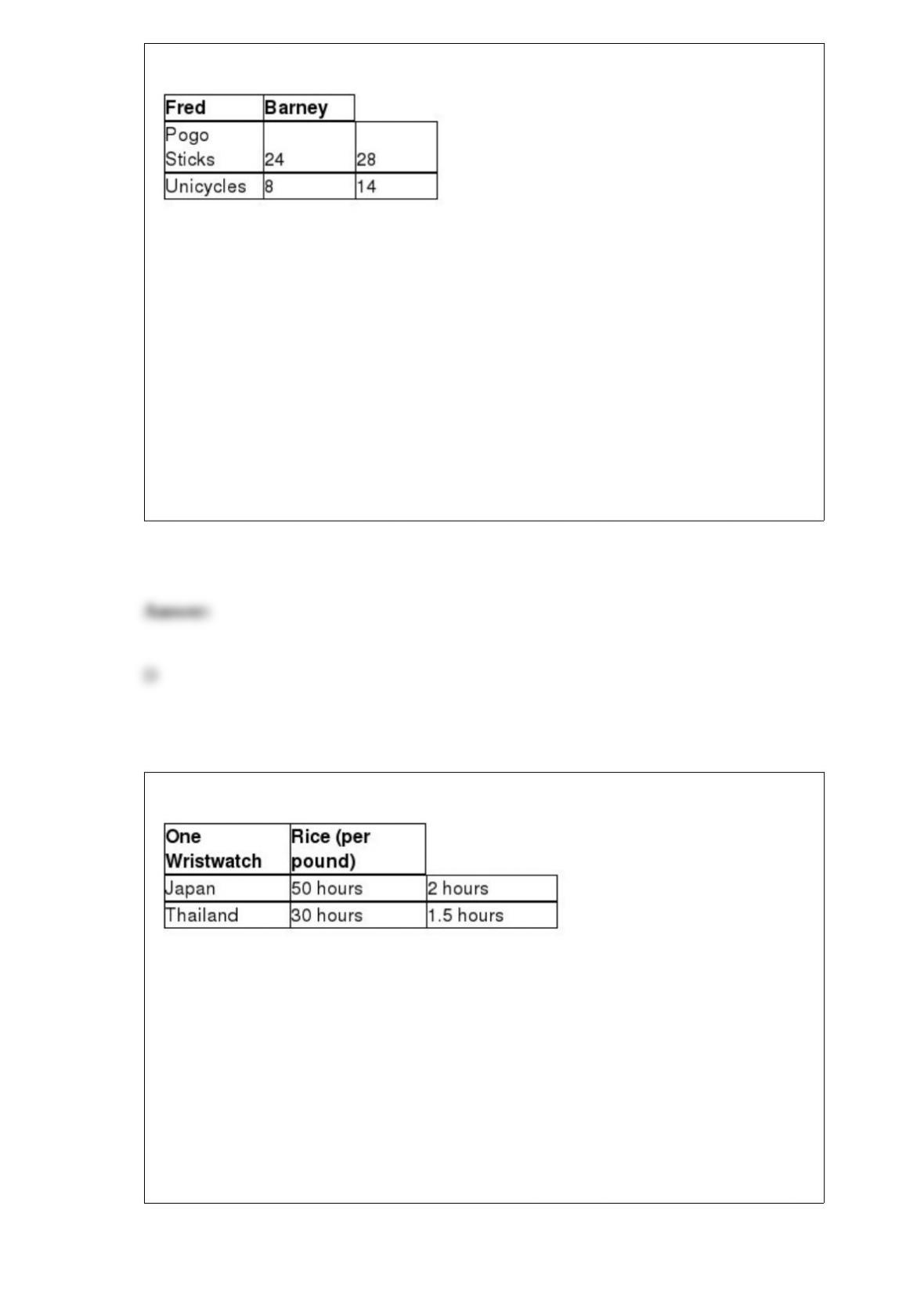
Table 2-7
Table 2-7 shows the output per month of two people, Fred and Barney. They can either
devote their time to making pogo sticks or making unicycles. Which of the following
statements istrue?
A) Fred has a comparative advantage in making both products.
B) Barney has a comparative advantage in making both products.
C) Barney has a comparative advantage in making pogo sticks and Fred in making
unicycles.
D) Barney has a comparative advantage in making unicycles and Fred in making pogo
sticks.
Table 2-9
Table 2-9 shows the number of labor hours required to produce a wristwatch and a
pound of rice in Japan and Thailand. What is Japan’s opportunity cost of producing one
wristwatch?
A) 0.04 pounds of rice
B) 4 pounds of rice
C) 25 pounds of rice
D) 40 pounds of rice
In what ways do economists and policymakers who believe that the federal government
should have a larger role in the health care system criticize the Patient Protection and
Affordable Care Act (ACA)?
If disposable income increases by $100 million, and consumption increases by $90
million, then the marginal propensity to consume is
A) 0.9.
B) 0.8.
C) 0.75.
D) 0.6.

Which of the following statements concerning the federal corporate income tax is true?
A) It is an efficient tax because it imposes a small excess burden relative to the tax
revenue it raises.
B) The incidence of the corporate income tax can be determined by using demand and
supply analysis.
C) Determining the incidence of the corporate income tax is complicated because it is
not certain how corporations respond to the tax.
D) The corporate income tax is an example of the benefits-received principle.