1) to reduce a current account deficit, a country should either decrease the budget
deficit of its government or reduce investment spending relative to saving.
a.true
b.false
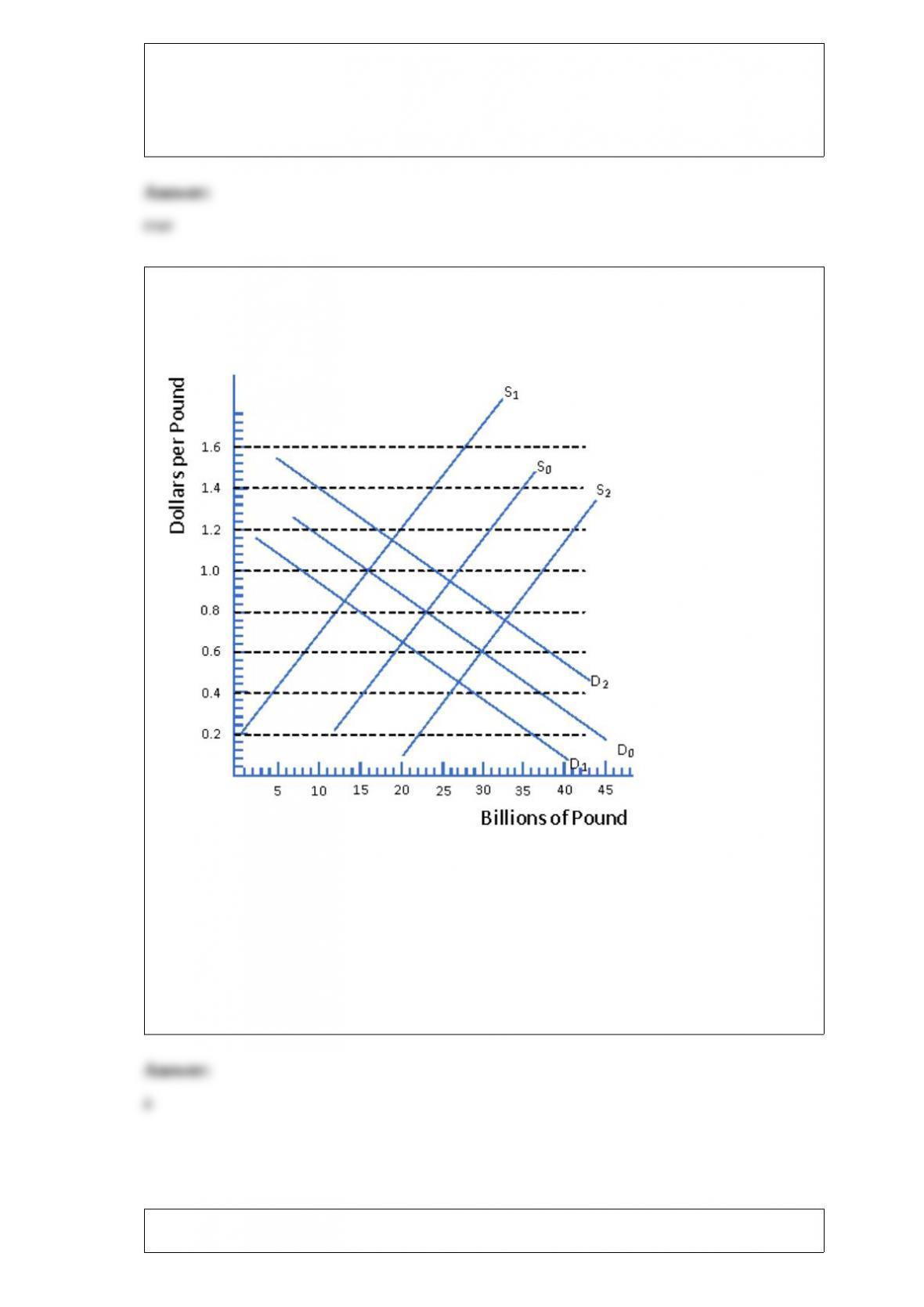
2) figure 12.3market for british pounds
consider figure 12.3.the market is initially governed by demand curve d0 and supply
curve s0.suppose the domestic price level rises rapidly in the united states but stays
relatively constant in the united kingdom, which supply and demand curves depict the
new situation?
a.s1 and d2
b.s2 and d1
c.s0 and d2
d.s0 and d1
3) in 1995 the general agreement on tariffs and trade was replaced by the ____.
a.agency for international development
b.organization for economic cooperation and development
c.united nations center for trade and development
d.world trade organization
4) proponents of freely floating exchange rates maintain that:
a.central banks can easily modify fluctuations in exchange rates
b.the system allows policy makers freedom in pursuing domestic economic goals
c.inelastic demand schedules prevent large fluctuations in exchange rates
d.inelastic supply schedules prevent large fluctuations in exchange rates
5) international trade forces domestic firms to become more competitive in terms of:
a.the introduction of new products
b.product design and quality
c.product price
d.all of the above
6) international trade is based on the idea that:
a.exports should exceed imports
b.imports should exceed exports
c.resources are more mobile internationally than are goods
d.resources are less mobile internationally than are goods
7) in an open trading system, a country will import those commodities that it produces
at relatively low cost while exporting commodities that can be produced at relatively
high cost.
a.true
b.false
8) which of the following is a fixed percentage of the value of an imported product as it
enters the country?
a.specific tariff
b.ad valorem tariff
c.nominal tariff
d.effective tariff
9) under a pegged exchange-rate system, which does not explain why a country would
have a balance-of-payments deficit?
a.very high rates of inflation occur domestically
b.foreigners discriminate against domestic products
c.technological advance is superior abroad
d.the domestic currency is undervalued relative to other currencies
10) for most developing countries:
a.productivity is high among domestic workers
b.population-growth and illiteracy rates are low
c.saving and investment levels are high
d.agricultural goods and raw materials constitute much of domestic output
11) unlike the mercantilists, adam smith maintained that:
a.trade benefits one nation only at the expense of another nation
b.government control of trade leads to maximum economic welfare
c.all nations can gain from free international trade
d.the world’s output of goods must remain constant over time
12) the factor endowment theory states that comparative advantage is explained
a.exclusively by differences in relative supply conditions
b.exclusively by differences in relative national demand conditions
c.both supply and demand conditions
d.none of the above
13) the marshall-lerner condition suggests that if the sum of a country’s elasticity of
demand for imports and the foreign elasticity of demand for the country’s exports
exceeds 1.0, an appreciation of the country’s exchange rate will worsen its balance of
trade.
a.true
b.false
14) the protective effect of a tariff occurs to the extent that less efficient domestic
production is substituted for more efficient foreign production.
a.true
b.false
15) suppose the exchange value of the british pound is $2 per pound while the exchange
value of the swiss franc is 50 cents per pound. the cross exchange rate between the
pound and the franc is:
a.1 franc per pound
b.2 francs per pound
c.3 francs per pound
d.4 francs per pound

16) the elasticity approach to currency depreciation emphasizes the income effects of
depreciation.
a.true
b.false