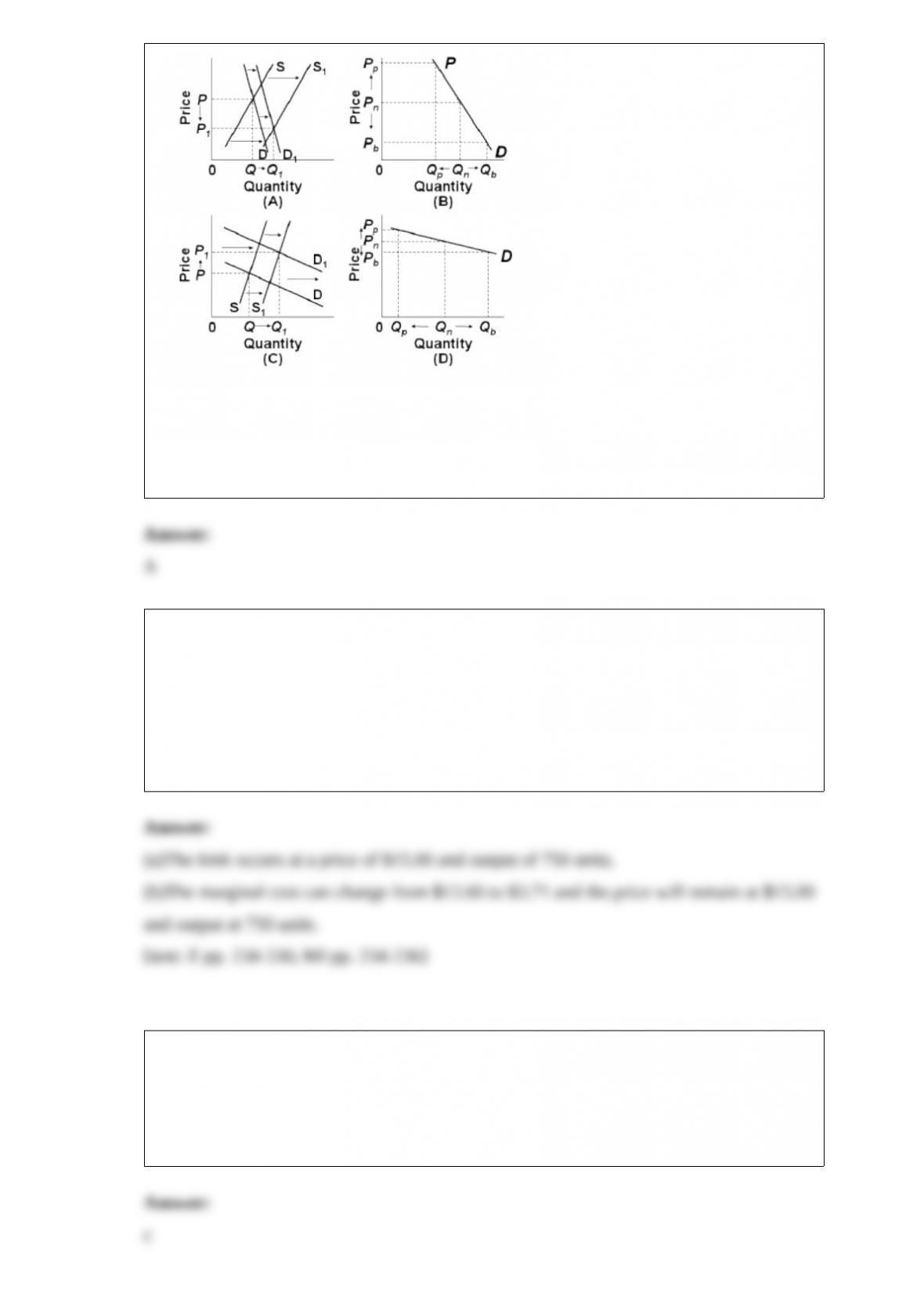
1)
Which diagram above best represents the problem faced by farms in the long-run?
A.A
B.B
C.C
D.D
2) The kinked-demand schedule that an oligopolist believes confronts the firm is given
in the table below. Compute the oligopolists total revenue at each of the nine prices, and
enter these figures in the table. Also compute marginal revenue for each unit between
the nine prices and enter these figures in the table.
(a)Where is the kink in the demand curve? What is the current selling price at that kink
and how much output will be demanded?
(b)What is the range of marginal cost that will keep the price set at the kink?
3) assuming a pure monopolist’s demand curve is downsloping, its total revenue:
a.is rising.
b.is falling.
c.may be either rising or falling.
d.must be negative.
4) Clearly defined property rights and liability rules reduce negative externalities by:
A.threatening the perpetrators with lawsuits.
B.shifting the perpetrators’ market supply curve rightward.
C.shifting the perpetrators’ market demand curve leftward.
D.creating a market for externality rights.
5) Domestic price supports on, say, sugar:
A.generate trade barriers to reduce imports of foreign sugar.
B.increase world sugar prices.
C.keep the domestic price of sugar artificially low.
D.increase the earnings of foreign sugar producers.
6) the price elasticity of demand for beef is about 0.60. other things equal, this means
that a 20 percent increase in the price of beef will cause the quantity of beef demanded
to:
a.increase by approximately 12 percent.
b.decrease by approximately 12 percent.
c.decrease by approximately 32 percent.
d.decrease by approximately 26 percent.
7) real gdp per capita is found by:
a.adding real gdp and population.
b.subtracting population from real gdp.
c.dividing real gdp by population.
d.dividing population by real gdp.
8) The following consolidated balance sheet for the commercial banking system.
Assume the required reserve ratio is 30 percent. All figures are in billions.
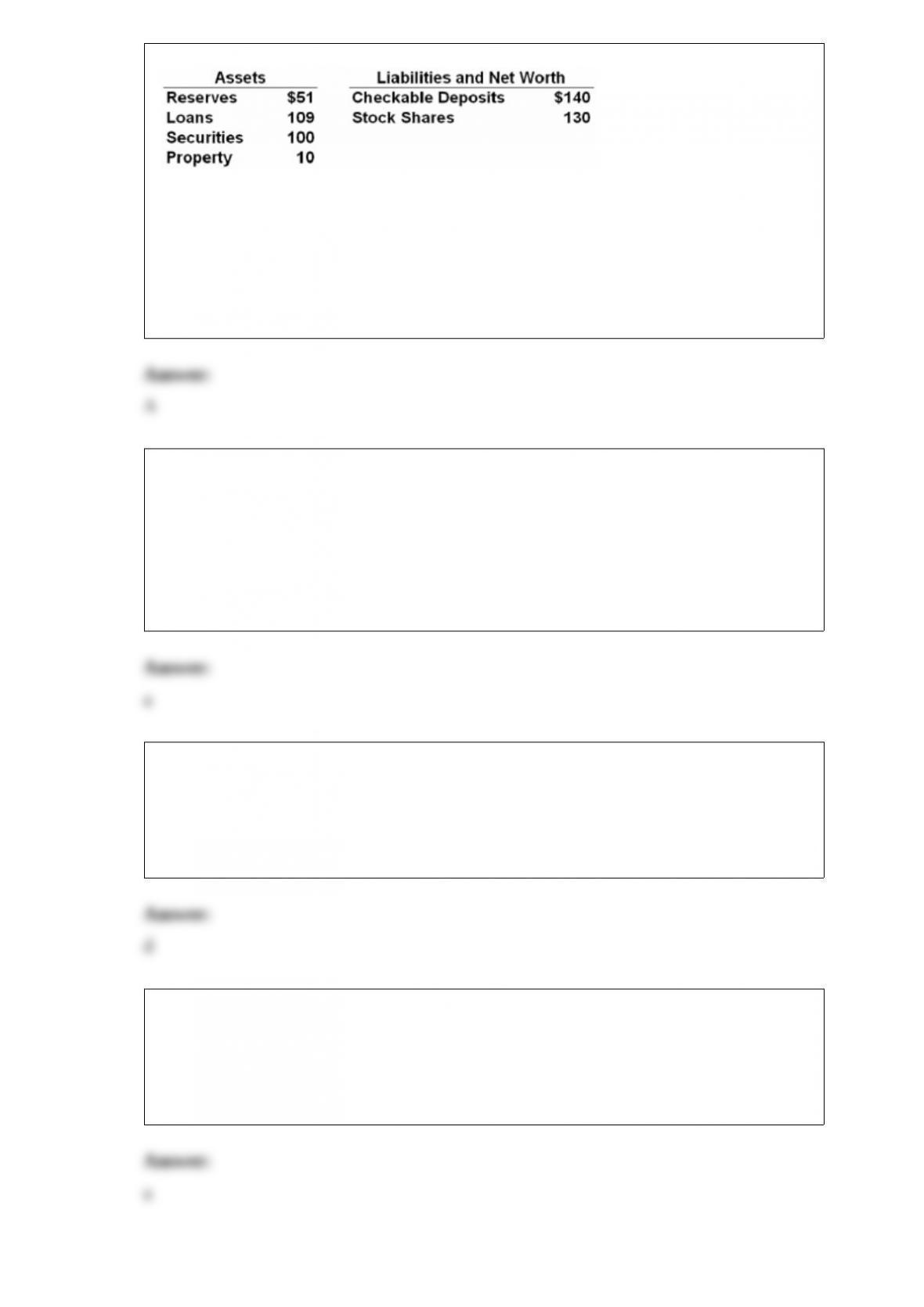
Refer to the above data. The maximum amount by which the commercial banking
system can expand the supply of money by lending is:
A.$30 billion.
B.$23.1 billion.
C.$27 billion.
D.$15 billion.
9) critics of trade adjustment assistance argue that:
a.the small fraction of workers losing jobs to international trade are no more deserving
of assistance than others suffering job loss.
b.it raises price for consumers.
c.it keeps firms operating in industries where they are no longer competitive.
d.it reduces the incentive for firms to invest in new technologies to maintain
competitiveness.
10) suppose that an industry’s long-run supply curve is downsloping. this suggests that:
a.it is an increasing-cost industry.
b.relevant inputs have become more expensive as the industry has expanded.
c.technology has become less efficient as a result of the industry’s expansion.
d.it is a decreasing-cost industry.
11) at an annual growth rate of 4 percent, real gdp will double in about:
a.17 years.
b.20 years.
c.13 years.
d.15 years.
12) Since 1960, real hourly compensation in the United States has approximately:
A.remained the same.
B.risen by 40 percent.
C.doubled.
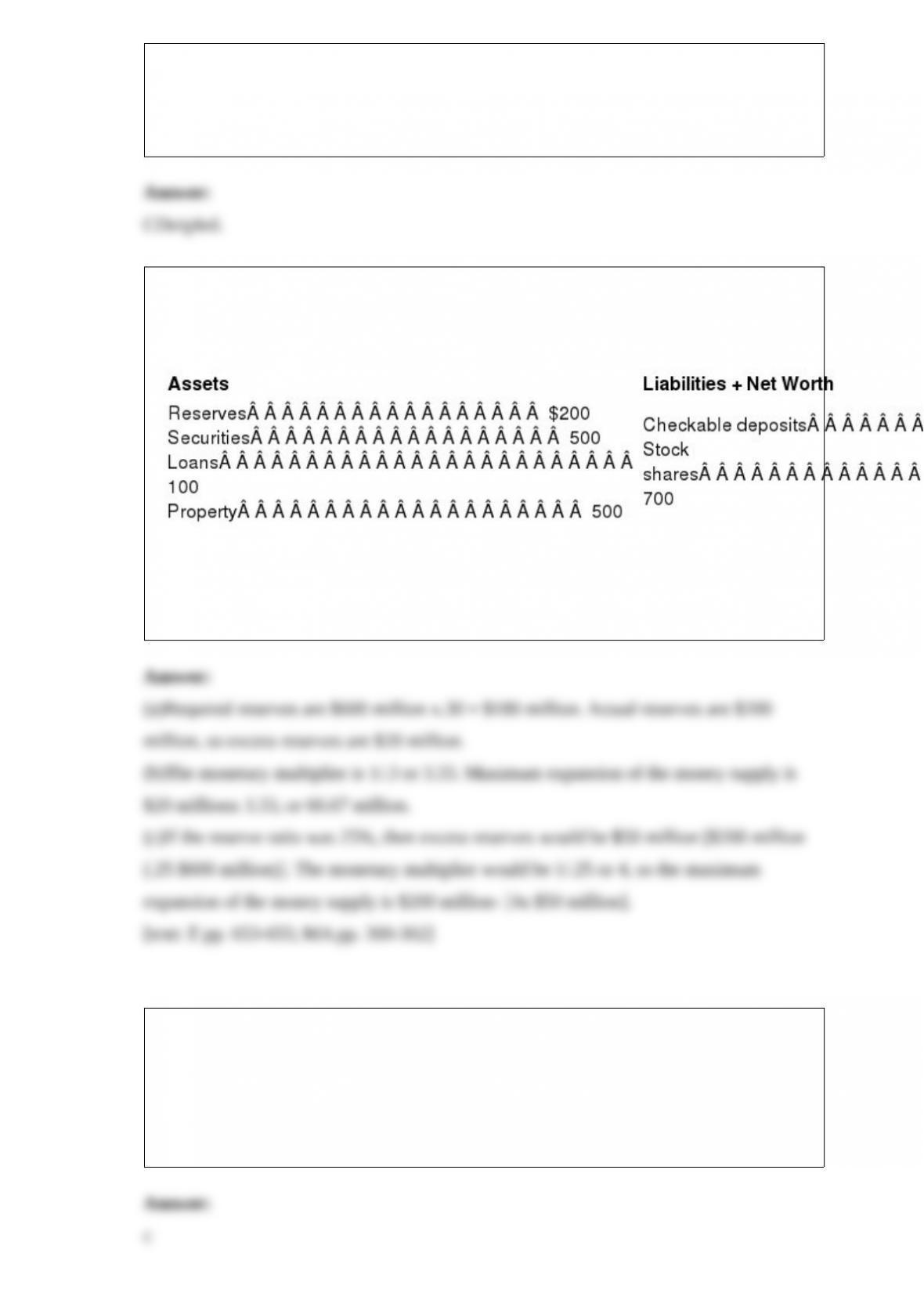
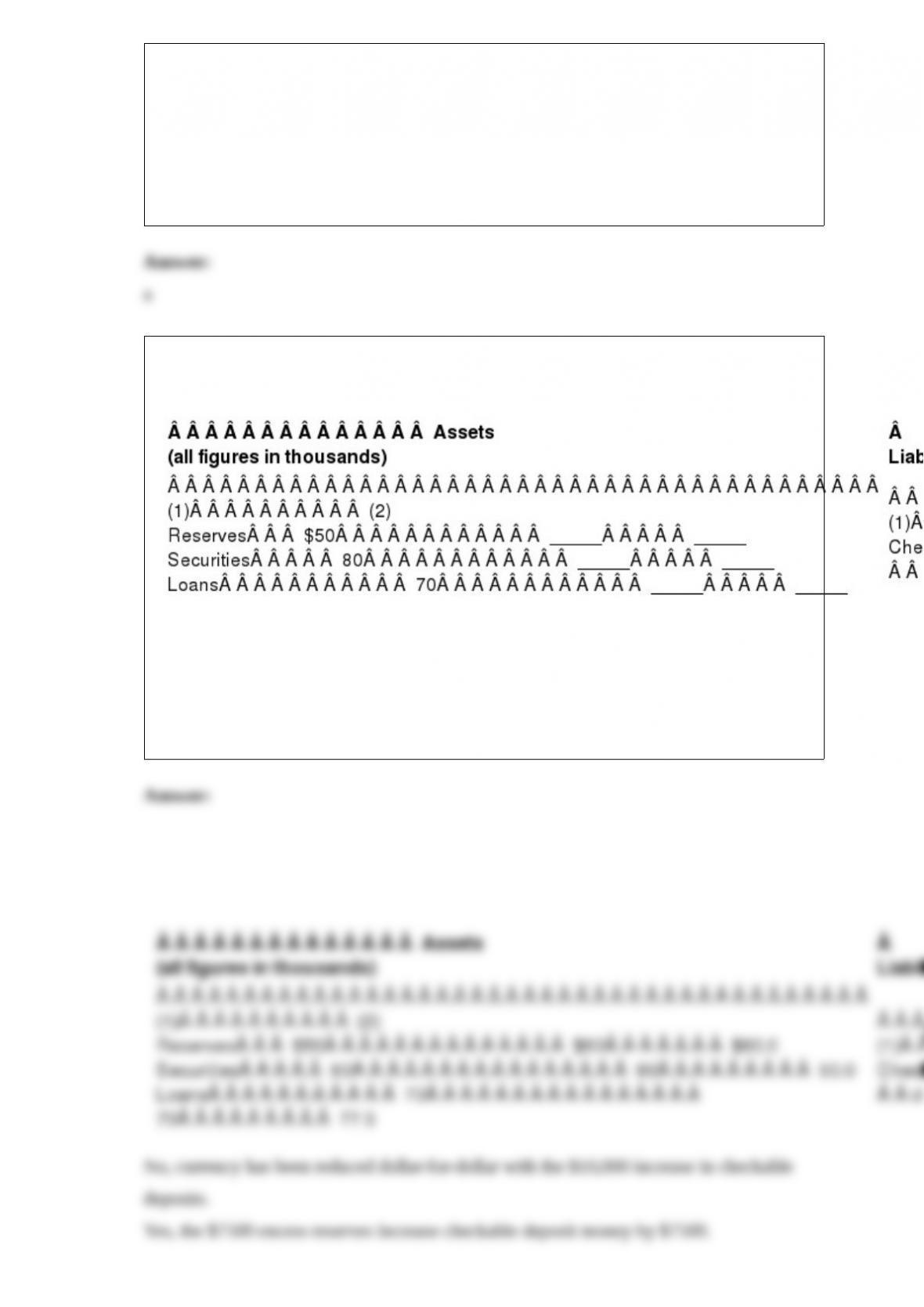
13) Answer the next question based on the following consolidated balance sheet for the
commercial banking system. Assume the required reserve ratio is 30%. All figures are
in millions of dollars.
(a)What is the amount of excess reserves in this commercial banking system?
(b)What is the maximum amount that the money supply can be expanded?
(c)If the reserve ratio fell to 25%, what is now the maximum amount that the money
supply can be expanded?
14) based on the concept of price elasticity of demand, which of the following cases is
most likely to occur?
a.golf courses charging higher prices for golf during the week than on weekends.
b.movie theatres charging higher prices for senior citizens.
c.colleges charging lower tuition for low-income students.
d.airlines charging lower fares for business travelers.
15) Suppose a court rules that the ABC Corporation is in violation of the antitrust laws
because it produces 70 percent of the output of its industry. This decision is consistent
with the:
A.U.S. Steel case.
B.Alcoa case.
C.behavioralist approach to antitrust.
D.legal cartel theory of regulation.
16) In recent years, the United States has had large:
A.current account surpluses.
B.capital and financial account deficits.
C.balance of trade deficits.
D.balance of payments surpluses.
17) Describe each of the following outcomes in terms of shifts in aggregate demand or
aggregate supply curves.
(a)A recession deepens while the rate of inflation increases
(b)The price level rises sharply while real output and employment increase
(c)The price level falls, but the unemployment rate rises
(d)Real output rises, unemployment rate falls, and the price level rises
18) if two variables are inversely related, then as the value of one variable:
a.increases, the value of the other may either increase or decrease.
b.decreases, the value of the other decreases.
c.increases, the value of the other decreases.
d.increases, the value of the other increases.
19) a market externality refers to:
a.economic costs and benefits of market activities that go to those who are not directly
involved in the market transaction.
b.the impact of legal and institutional forces on market behavior.
c.any unanticipated change in market price or output.
d.any noneconomic force, for example, political disruption of the flow of middle east
oil, which has market effects.
20) Suppose the Second National Bank has the following simplified balance sheet. The
reserve ratio is 25%.
Assume that households and businesses deposit $10,000 in this bank and that this
currency is added to the banks reserves.
In column (1) show the banks balance sheet after this occurs. Is there a change in the
money supply?
In column (2) show what would happen if the bank now loans all of its excess reserves
to a depositor. Is there a change in the money supply?
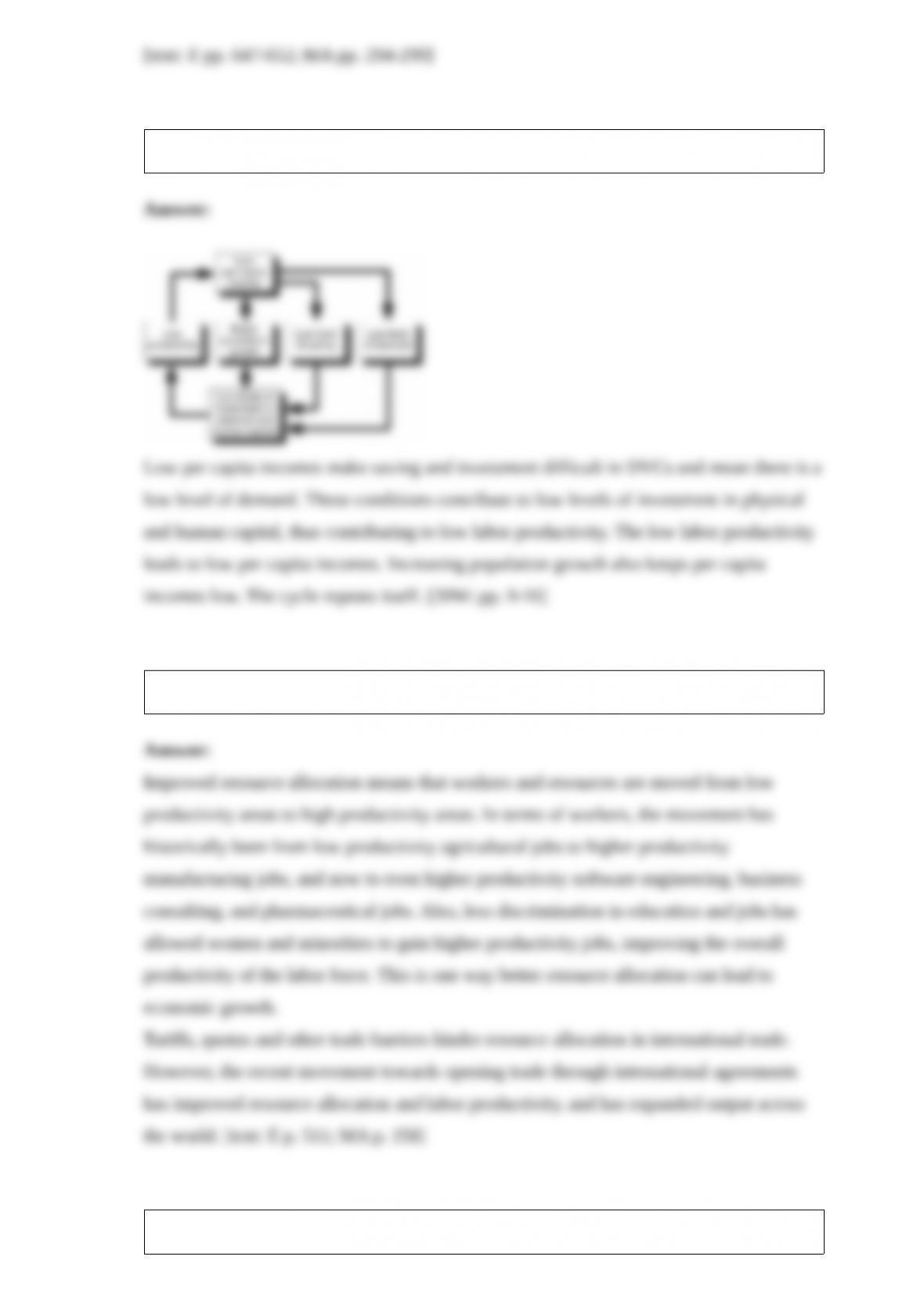
21) Draw and explain a diagram that illustrates the vicious circle of poverty in DVCs.
22) How has improved resource allocation stimulated economic growth?
23) Contrast supply-side economics with demand-side fiscal policy.
24) (Consider This) How is strategic behavior illustrated by the competition among
three sellers of native arts and crafts near a national park?
25) What effects do U.S. trade deficits have on the U.S. economy?
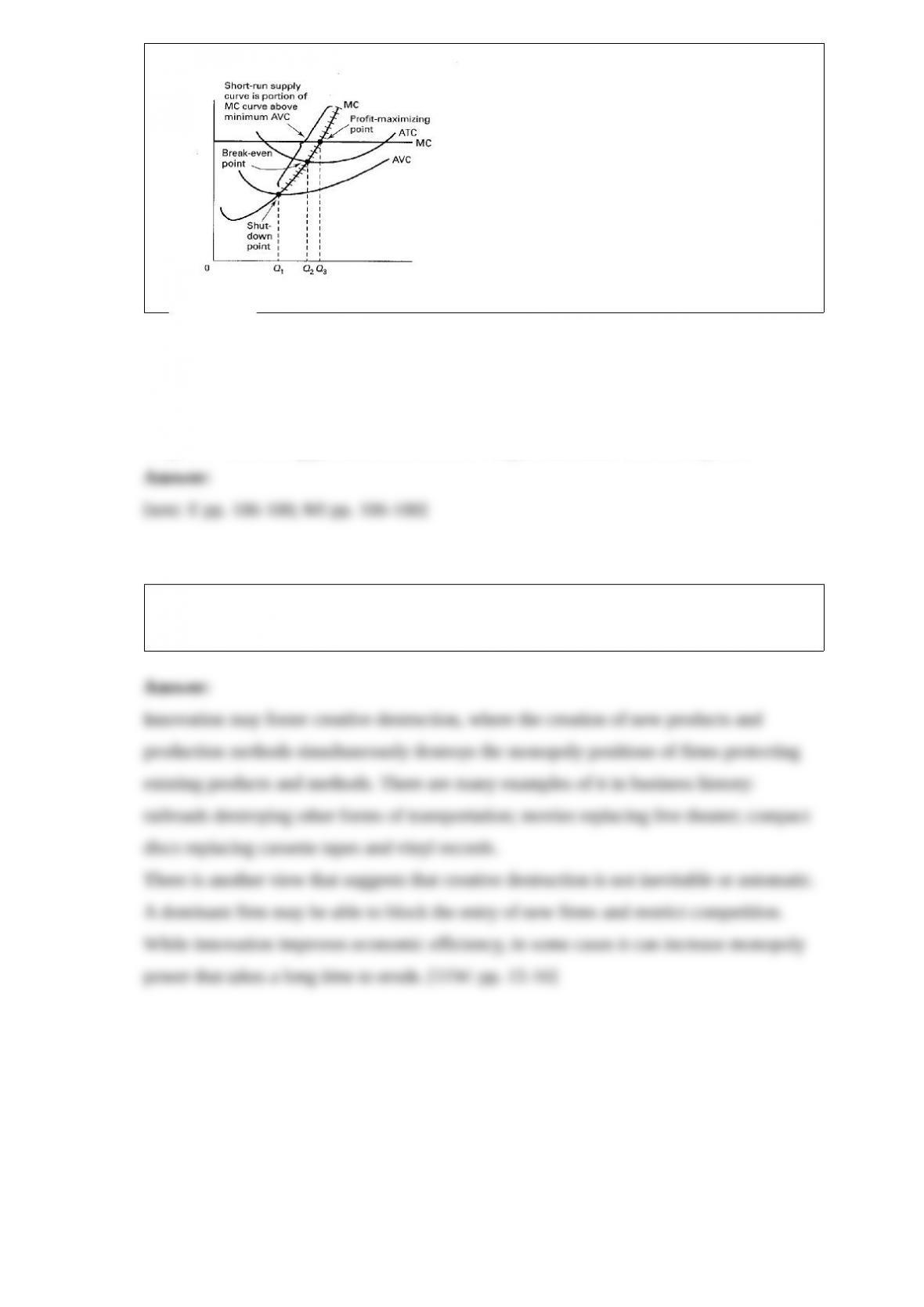
26)
MR
Draw a graph of the short-run cost curves for a purely competitive firm that shows a
short-run supply curve for the individual firm. Identify the shutdown point, the break-even
point, the profit-maximizing point, and the levels of output associated with those points.
27) Explain the idea of creative destruction as championed by Joseph Schumpeter.
What are the objections to that idea?