
The marginal tax rate is:
A. total taxes divided by total before-tax income.
B. the average tax rate divided by the total tax rate.
C. the amount by which taxes increase when before-tax income rises by one dollar.
D. the tax rate at which the benefit of an extra dollar of taxes equals the cost of an extra
dollar of taxes.
The theory that nominal exchange rates are determined so that the law of one price
holds is called:
A. the fixed-exchange-rate rule.
B. the equilibrium principle.
C. the law of supply and demand.
D. purchasing power parity.
Suppose a profit-maximizing firm in a perfectly competitive market is earning an
economic profit of $1,345. If the firm’s fixed cost increases from $200 to $300, the firm
will:
A. reduce its output.
B. raise its price.

C. earn a greater profit.
D. earn a smaller profit.
Consider the labor market below. Suppose the government passes a minimum wage
requiring employers to pay at least $8.00 per hour.
Prior to the imposition of the minimum wage, worker surplus is ______ per day, and
after the imposition of the minimum wage, worker surplus is ______ per day.
A. $9,000; $1,000
B. $9,000; $5,000
C. $18,000; $2,000
D. $18,000; $14,000
If households and firms expect higher rates of inflation, the ______ curve will shift
_____.
A. AD; rightward

B. AS; rightward
C. AS; leftward
D. AD; until it becomes vertical
Holding all else constant, an increase in the preferences of Americans for Mexican
goods will ______ the supply of dollars in the foreign exchange market and ______ the
equilibrium Mexican peso/U.S. dollar exchange rate.
A. increase; increase
B. increase; decrease
C. decrease; decrease
D. decrease; increase
A person 16 years or older who does not work, but is actively looking for work, is
officially classified as:
A. employed.
B. unemployed.
C. chronically unemployed.

D. out of the labor force.
Suppose a small island nation imports sugar for its population at the world price of
$1,500 per ton. The domestic market for sugar is shown below.
With no subsidy, the equilibrium price of sugar is ______ per ton, and the equilibrium
quantity is ______ tons per day.
A. $1,000; 12
B. $1,000; 8
C. $1,500; 12
D. $1,500; 8
Assume that this graph illustrates a perfectly competitive labor market.
If the supply of person-hours in this market shifts to the right, then the equilibrium
wage will ______ and the equilibrium number of person-hours will ______.
A. fall; increase
B. increase; increase
C. stay the same; increase
D. fall; decrease
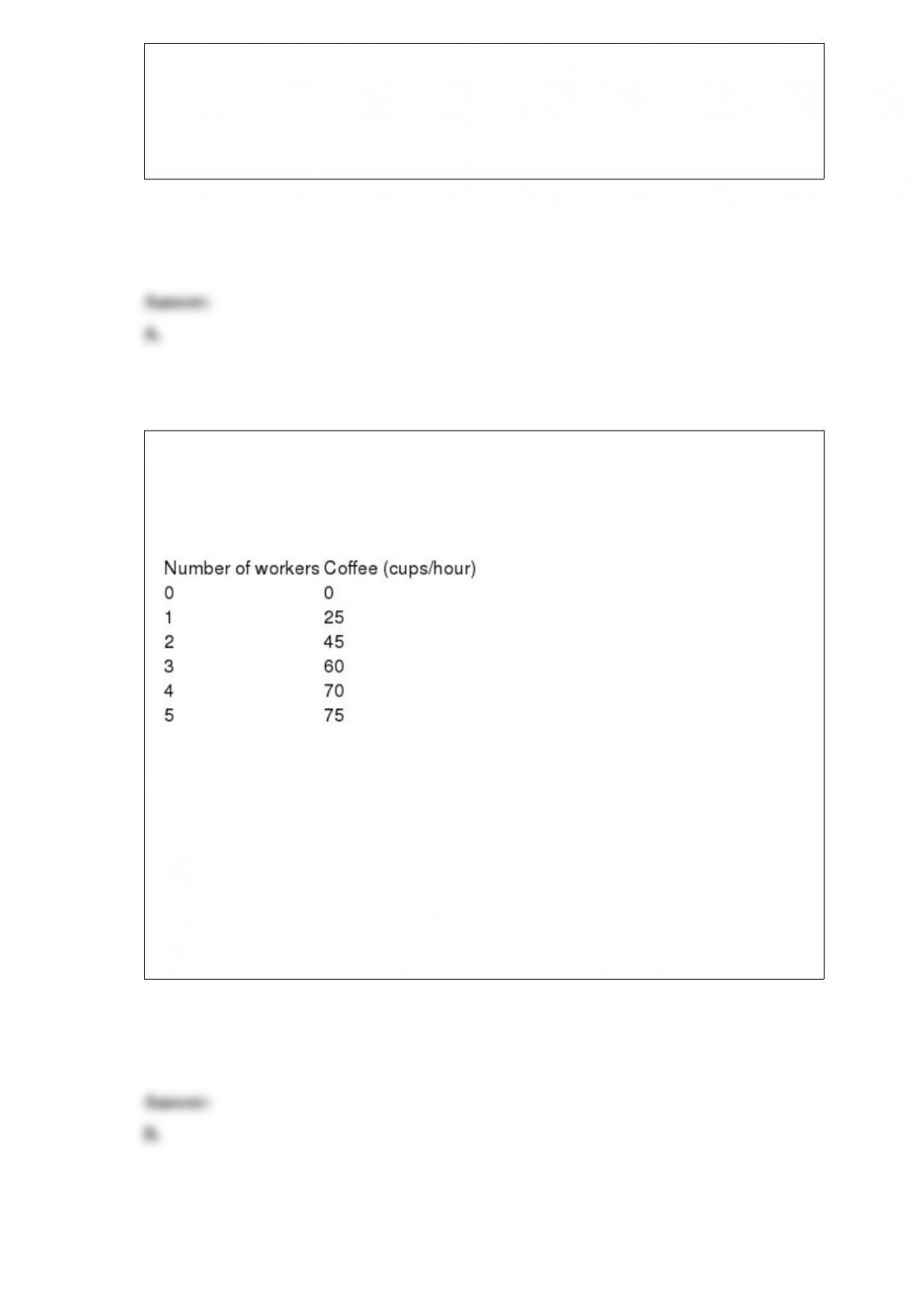
Espresso Yourself Coffee Shop hires workers in a competitive labor market to make
coffee. The ingredients required to make each cup of coffee cost 50 cents. The coffee
shop’s hourly output of coffee varies with the number of workers hired, as shown in the
table below. Each cup of coffee sells for $2.00.
The marginal product of the third worker is ______ than the marginal product of the
second worker, implying that______.
A. greater; diminishing returns are absent
B. less; diminishing returns are present
C. neither greater nor less; the third worker will be hired
D. less; the third worker will never be hired

The table below describes the relationship between the number of workers hired by a
call center each hour and the number of calls the call center can make each hour. The
call center has only 1 telephone. The telephone costs the firm $5/hour (regardless of
how many calls are made), and each worker is paid $10 per hour.
If the price of a telephone increases to from $5 to $10 an hour and nothing else changes,
then:
A. total cost would not change.
B. marginal cost would increase by $5 at every level of output.
C. marginal cost would not change.
D. average total cost would increase by $5 at every level of output.
All else equal, the amount of waste caused by full health insurance is:
A. larger the lower is the price elasticity of demand for medical services.
B. larger the higher is the price elasticity of demand for medical services.
C. larger the lower is the price elasticity of supply for medical services.
D. smaller the higher is the price of medical services.
When actual output is less than potential output there is a(n):

A. budget deficit.
B. budget surplus.
C. trade deficit.
D. recessionary gap.
The supplier of a factor of production has a reservation price of $100. The purchaser of
the factor of production has a reservation price of $200. If the factor of production is
unique, then:
A. there will be no transaction since $200 is greater than $100.
B. a transaction will occur, and the price paid for the factor of production will be $150.
C. a transaction will occur, and the price paid for the factor of production will be $200.
D. a transaction will occur, and the price paid for the factor of production will be $100.

Spending on new capital goods, new homes, and the addition of unsold goods to
company inventories is included in:
A. consumption expenditures.
B. investment spending.
C. government purchases.
D. service spending.
If a monopolist’s marginal revenue exceeds its marginal cost at its current level of
output, then to maximize its profit the monopolist should:
A. do nothing.
B. decrease output in order to increase the gap between marginal revenue and marginal
cost.
C. increase output until marginal revenue equals marginal cost.
D. increase output until price equals marginal cost.

An inflation shock is:
A. the level of inflation consistent with output in a recessionary gap.
B. the level of inflation consistent with output in an expansionary gap.
C. a sudden change in the normal behavior of inflation, unrelated to the nation’s output
gap.
D. a change in the inflation rate generated by excessive aggregate spending.
A price ceiling that is set below the equilibrium price will result in:
A. higher total economic surplus.
B. a shortage of the good.
C. a surplus of the good.
D. higher producer surplus.
Moe divides his time between studying Physics and studying Economics. His
production possibilities curve for his final grade in each class is shown below.
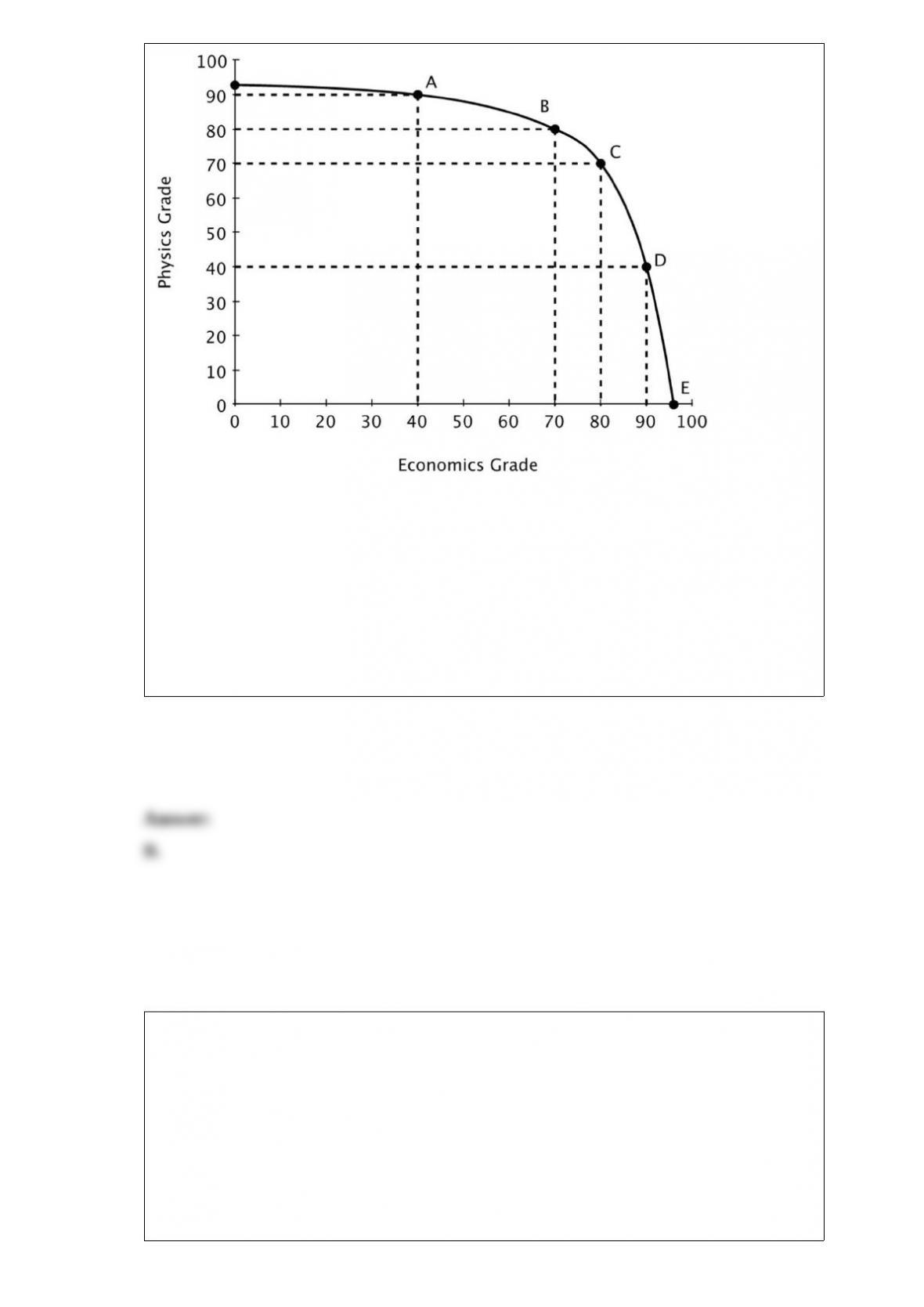
According to Moe’s PPC, moving from a 70 to an 80 in economics:
A. is inefficient.
B. has a lower opportunity cost than moving from an 80 to a 90.
C. is unattainable.
D. has a higher opportunity cost than moving from an 80 to a 90.
There are two employers in Bucolic that hire people who do not have a high school
degree: a grocery store and a hardware store. The grocery store pays $10 per hour and
the hardware store pays $12 per hour. People who work at either store can work as
many hours as they want at those wages. Assume that it takes two hours to interview for
a job. Lee works at the grocery store, but would like to work at the hardware store. If
Lee interviews at the hardware store, there is a 10% probability of being hired. Assume
that Lee is risk-neutral. How many hours must Lee anticipate working at the hardware
store to justify interviewing for the job?
A. 1 hour

B. 10 hours
C. 100 hours
D. 60 hours
Arguments that economic growth must be constrained by environmental problems and
limits of natural resources ignore the fact that economic growth can:
A. be measured in both nominal and real terms.
B. increase both average labor productivity and the share of population employed.
C. take the form of improved quality as well as increased quantity.
D. occur with only benefits and no economic costs.
An increase in the perceived riskiness of Company A stock ______ the risk premium
investors require to purchase Company A stock and ______ the price of Company A
stock.
A. increases; increases
B. increases; decreases

C. decreases; increases
D. decreases; decreases
Peg’s Manicure Manor did 4,000 sets of nails in 2010 and 4,500 sets of nails in 2011.
The price of a set of nails was $20 in 2010 and $22 in 2011. If 2010 is the base year,
Peg’s contribution to nominal GDP in 2010 was ______ and to real GDP in 2010 was
_____.
A. $80,000; $80,000
B. $80,000; $88,000
C. $80,000; $99,000
D. $88,000; $90,000
Lane and Riley are the only two residents in a neighborhood, and they share the same
driveway. They would like to have the driveway paved. The value of the paved
driveway is $1,500 to Lane and $900 to Riley. Regardless of who pays for the paving
both people will benefit from it.
If the cost of paving the driveway is $2,000, then it is ______ for the driveway to be
paved because total economic surplus would ______.
A. inefficient; fall by $1,100

B. efficient; increase by $400
C. inefficient; fall by $500
D. efficient; increase by $1,100
Cory gets 18, 23, and 25 units worth of total utility from consuming 10, 11, and 12 raw
oysters, respectively, and the price per oyster is 25 cents. Thus, one can infer that Cory:
A. is not maximizing his utility.
B. is experiencing diminishing marginal utility.
C. should not consume any more oysters.
D. has consumed too many oysters.
Compared to older workers, younger workers change jobs more frequently, so they are
more prone to ________ unemployment; also, younger workers have fewer skills, so

they are more prone to ________ unemployment.
A. cyclical; frictional
B. frictional; structural
C. structural; frictional
D. frictional; cyclical
The “true” costs of inflation are:
A. higher relative prices.
B. lower relative prices.
C. reduced economic growth and efficiency.
D. a higher overall price level.
Factors increasing the U.S. labor supply and thereby contributing to the slowdown in
real-wage growth that began in the 1970s include ______ and _____.
A. skill-biased technological change; globalization
B. increased labor force participation by women; the coming-of-age of the baby-boom
generation

C. technological progress; diminishing returns to labor
D. increasing wage inequality; globalization
The aging of the labor force in the United States is likely to ________ the natural rate
of unemployment; an increase in the efficiency of the labor market is likely to
________ the natural rate of unemployment.
A. decrease; decrease
B. increase; increase
C. increase; decrease
D. decrease; increase
National saving is saving by:
A. households for retirement.
B. the government.
C. households and firms
D. the entire economy.