
The additional revenue generated by a firm by hiring one more unit of a factor of
production is the
a. MFC.
b. MC.
c. MR.
d. MRP.
e. MPP.
In 2014 a woman won a $100 million lottery. Her income is (most likely) largely due to
her
a. hard work.
b. education.
c. highly marketable innate abilities.
d. good luck.
e. none of the above
Sometimes, when goods are produced and consumed, side effects are felt by people
who are not directly involved in the market exchanges. In general, these side effects are
called
a. Coase effects.
b. externalities.
c. public goods.
d. internalities.
e. none of the above
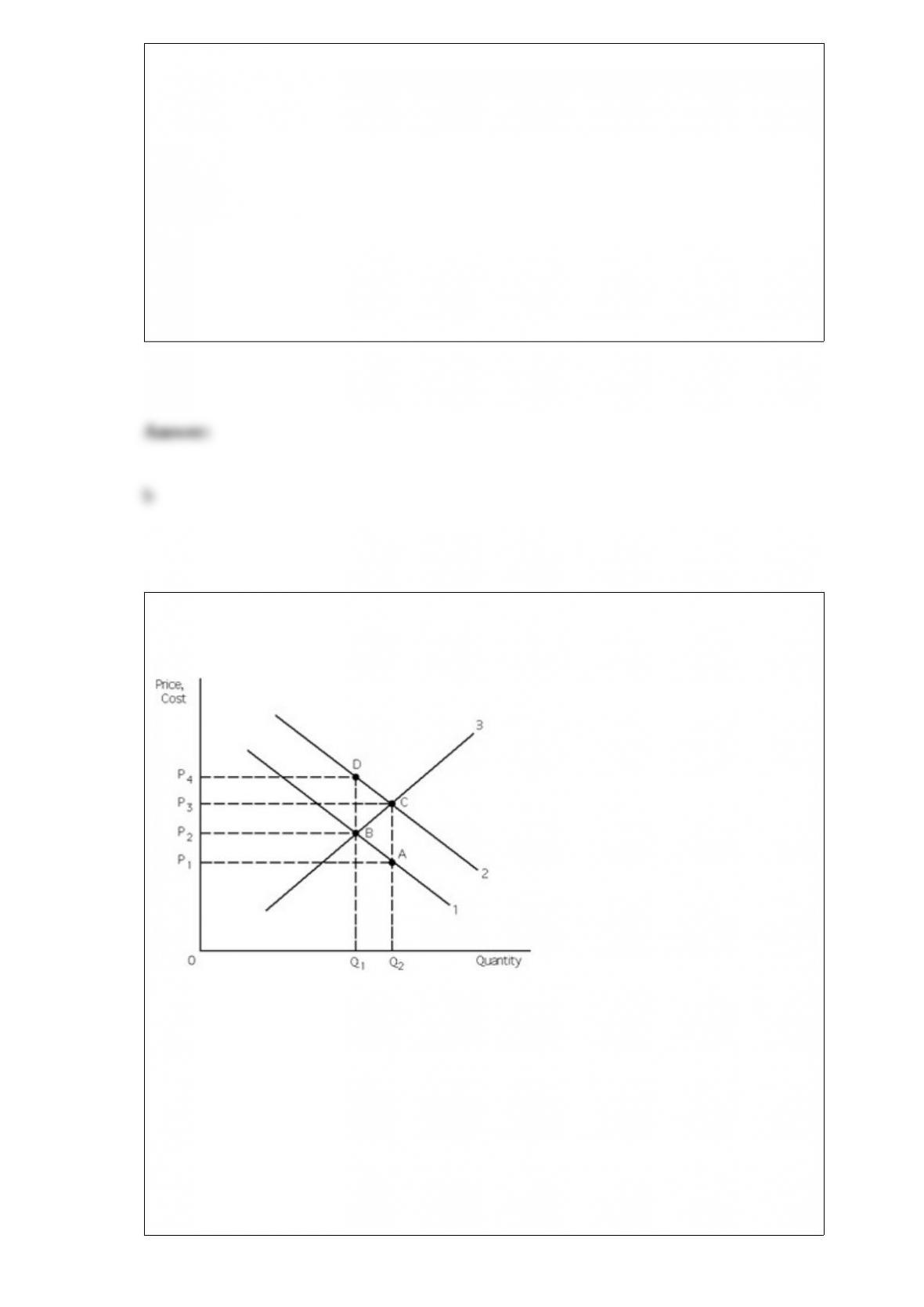
Exhibit 31-5
If a positive externality exists, then the external benefits associated with the positive
externality equal
a. P4 – P2.
b. P3 – P1.
c. P2 – P1.

d. P3 – P2.
e. a and b
In reading the stock market quotes in the newspaper, the column with the heading “P/E”
gives the
a. number of shares of the stock traded that day.
b. dividend per share divided by the closing price per share.
c. stock symbol for the company.
d. latest closing price per share divided by the latest available earnings per share.
Economist A believes that the case for government is a strong one, but she doesn’t
always say, when it comes to negative externalities, that government can turn an
inefficient market outcome into an efficient outcome.Which statement is economist A
most likely to make?
a. If the tax placed on the activity that generates the negative externality is too large, we
are not likely too move from inefficiency to efficiency.
b. If the subsidy placed on the activity that generates the negative externality is too
small, we are not likely to move from inefficiency to efficiency.
c. If there is a free rider problem, then government cannot solve the problem of negative
externalities.
d. a and b

e. none of the above
Which of the following statements is true?
a. The nominal interest rate is always higher than the real interest rate since the nominal
interest rate equals the real interest rate plus the expected inflation rate.
b. The nominal interest rate is always lower than the real interest rate since the nominal
interest rate equals the real interest rate minus the expected inflation rate.
c. The nominal interest rate can equal the real interest rate, but to do so the expected
inflation rate must be zero percent.
d. It is the nominal interest rate-not the real interest rate-that matters to borrowers.
Given the choice between a sure-thing option and a gamble option with the same
expected payoff, a____________ person will choose the sure thing.
a. risk averse
b. risk loving
c. risk neutral
d. risk enjoying
e. none of the above

Something that provides utility is called a
a. good.
b. bad.
c. want.
d. need.
e. a and d
Exhibit 22-3
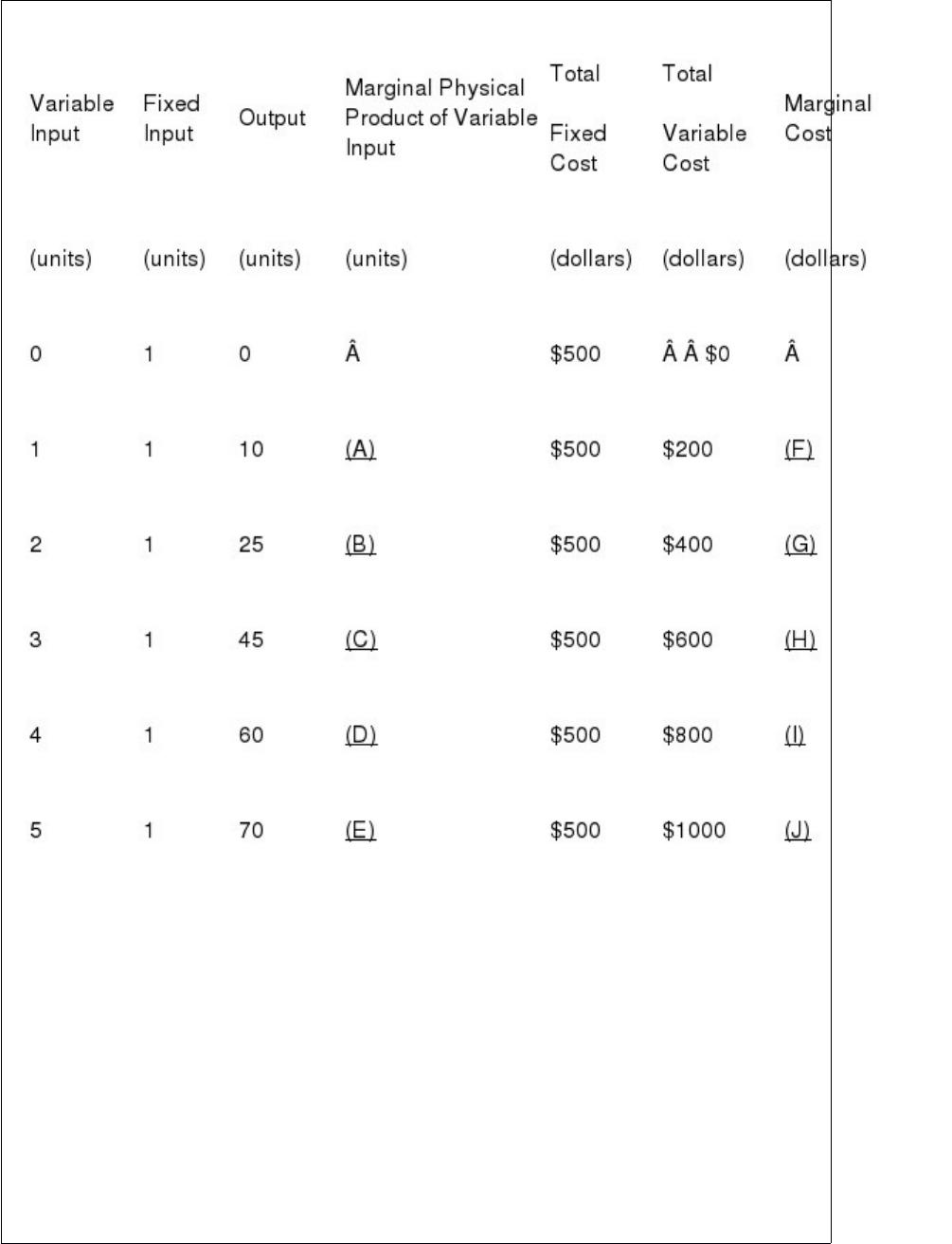
What level of output exhibits the lowest average total cost?
a. 10 units
b. 25 units
c. 45 units
d. 60 units
e. 70 units
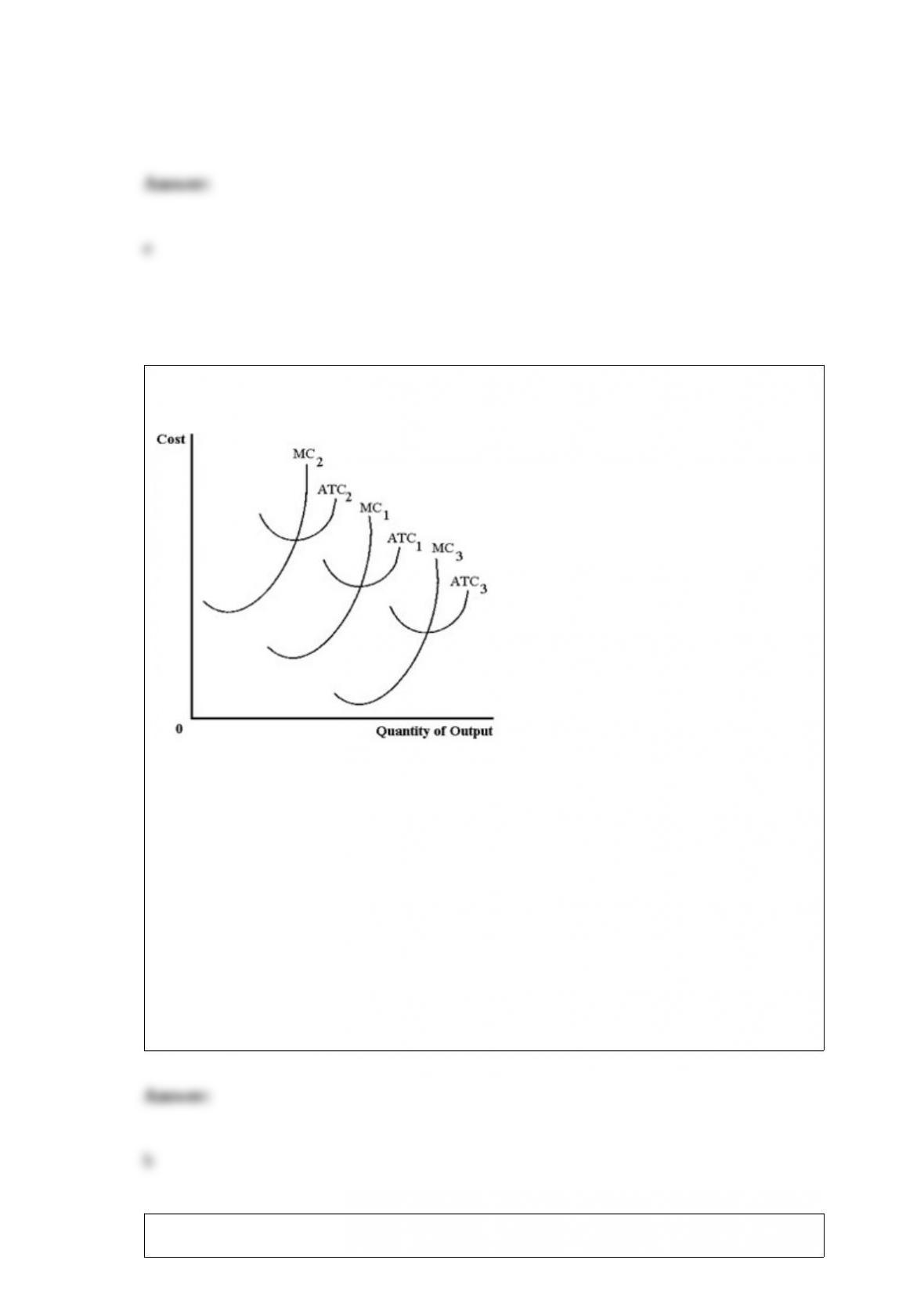
Exhibit 22-9
Let MC1 and ATC1 represent the initial cost curves of a peanut butter producer. In
which of the following cases is it most likely that the firm€s curves will shift leftward
to MC2 and ATC2?
a. The market price of peanuts decreases.
b. The market price of peanuts increases.
c. The government lowers taxes paid by peanut butter producers.
d. a and c
The median voter model predicts that

a. both candidates in a two-person race will definitely move toward the middle of the
political spectrum as the election approaches.
b. the candidate (in a two-person race) closer to the middle of the political spectrum
(closer to the median voter) on election day will win the election.
c. conservatives have a higher probability of winning elections than liberals.
d. liberals have a higher probability of winning elections than conservatives.
e. voters will often be rationally ignorant of important political issues.
Decision making “at the margin” means making a choice based on __________ of a
decision.
a. the total benefits
b. the total costs
c. comparing the total benefits and costs
d. comparing the additional benefits and costs
Low voter turnouts that appear to be a result of voter apathy may instead be a result of
a. government intervention.
b. special interest group activity.
c. cost-benefit calculations.
d. a and b
e. a, b, and c