
Which of the following is a result of government price controls?
A) Some people win and some people lose.
B) Price controls benefit poor consumers but harm producers and wealthy consumers.
C) Price controls increase economic efficiency.
D) The deadweight loss from price ceilings is greater than the deadweight loss from
price floors.
Which of the following is not a major function of the Federal Reserve System?
A) lender of last resort
B) clearing checks between banks
C) setting income tax rates
D) controlling the money supply
In 2013, Caterpillar laid off employees who produced mining machinery at its South
Milwaukee plant. The laid-off employees who were not able to find jobs at another
factory due to a permanent decline in demand in the mining industry would be
considered
A) structurally unemployed.
B) frictionally unemployed.

C) seasonally unemployed.
D) cyclically unemployed.
Which of the following criteria would make gold a poor medium of exchange?
A) Its value depends on its purity, and its purity is not easy to visibly identify.
B) durability so that value is not lost by spoilage
C) value relative to its weight so that amounts large enough to be useful in trade can be
easily transported
D) divisibility because different goods are valued differently
Recent estimates put the size of the underground economy in the United States at
________ of measured GDP.
A) 2 percent
B) 8 percent
C) 13 percent
D) over 50 percent

The purchase of Treasury securities by the Federal Reserve will, in general,
A) not change the money supply.
B) not change the quantity of reserves held by banks.
C) increase the quantity of reserves held by banks.
D) decrease the quantity of reserves held by banks.
What is the largest component of spending in the United States?
A) consumption spending
B) investment spending
C) government spending
D) net investment spending
Figure 13-1
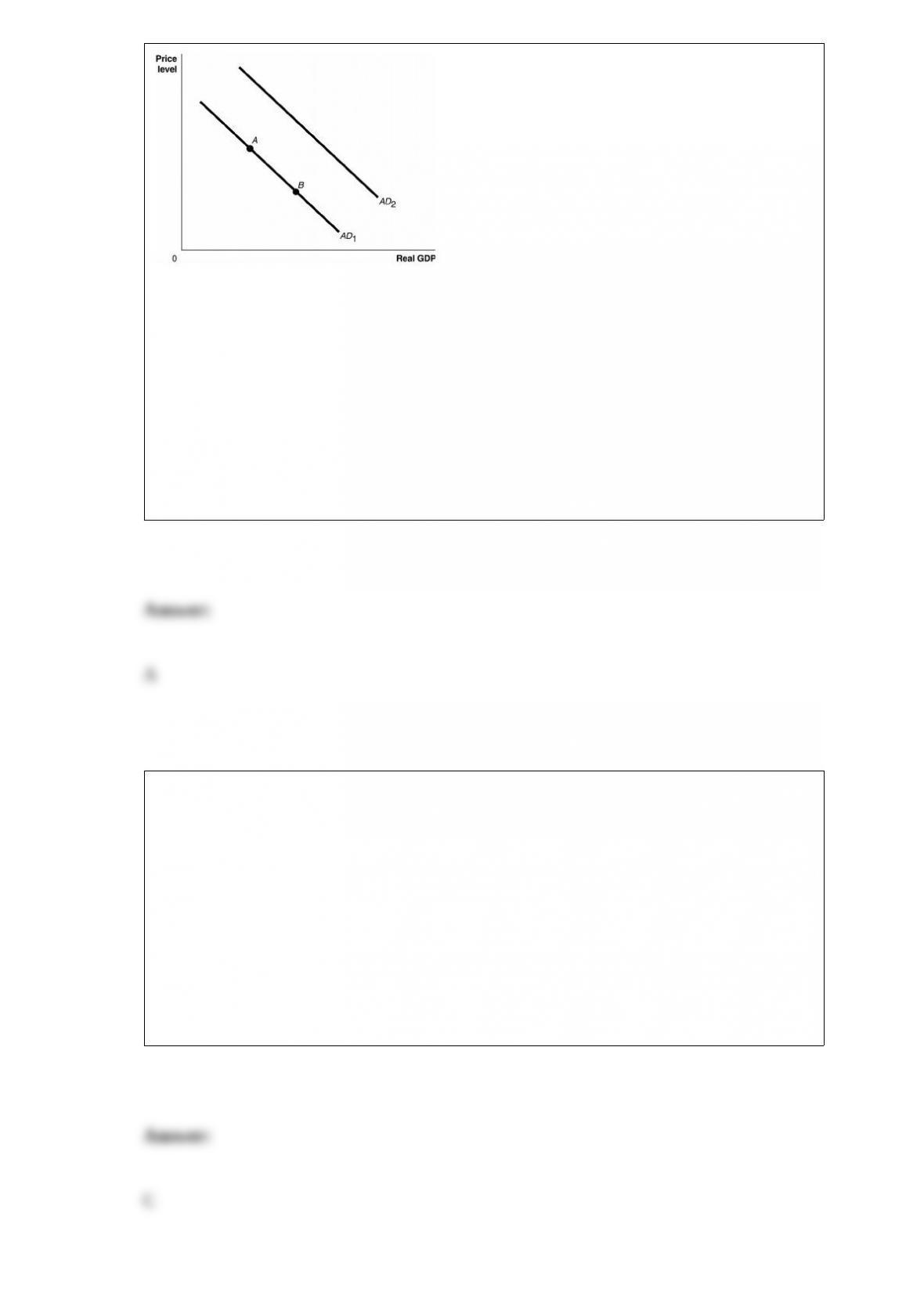
Refer to Figure 13-1. Ceteris paribus, a decrease in the growth rate of domestic GDP
relative to the growth rate of foreign GDP would be represented by a movement from
A) AD1 to AD2.
B) AD2 to AD1.
C) point A to point B.
D) point B to point A.
An increase in government purchases of $200 billion will shift the aggregate demand
curve to the right by
A) $200 billion.
B) less than $200 billion.
C) more than $200 billion.
D) None of the above are correct. This policy shifts the long-run aggregate supply
curve.

If GDP is currently $13 trillion and is growing at a rate of 2.3% per year, how long will
it take GDP to reach $26 trillion?
A) about 15 years
B) about 17 years
C) about 25 years
D) about 30 years
Which of the following statements about positive economic analysis is true ?
A) Positive analysis uses an economic model to estimate the costs and benefits of
different course of actions.
B) There is much less disagreement among economists over normative economic
analysis than over positive economic analysis.
C) There is much more disagreement among economists over positive economic
analysis than over normative economic analysis.
D) Unlike positive economic analysis, normative economic analysis can be tested.
When the Fed embarked on a policy known as quantitative easing, they
A) slowly lowered the federal funds rate target until it was equal to zero.
B) reduced the required reserve ration by one-quarter point per month for 12 months.
C) bought longer-term securities than are usually bought in open market operations.
D) opened up lending to primary dealers, commercial banks, and investment banks.
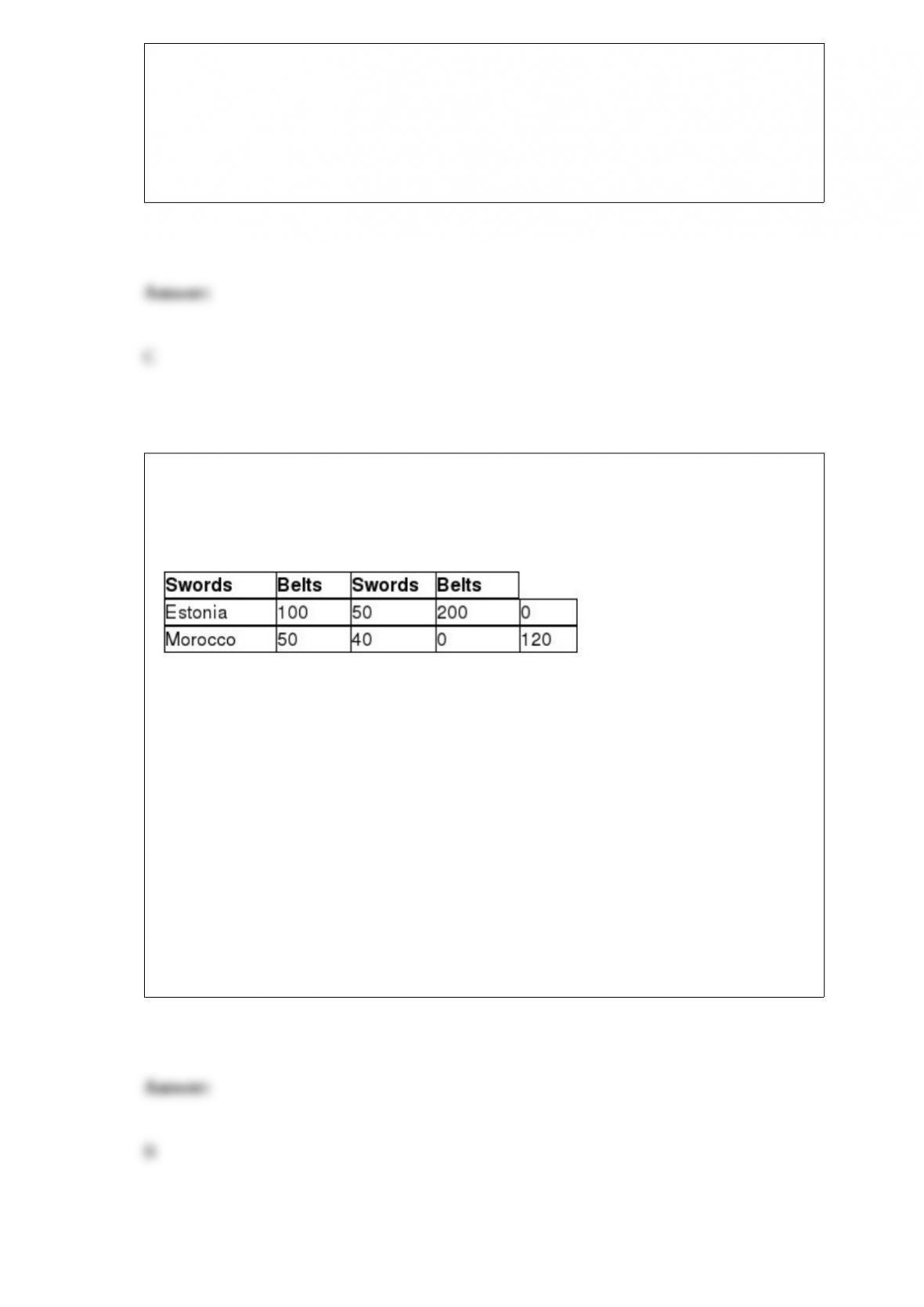
Table 7-6
Production and
Consumption Production
Without Trade With Trade
Estonia and Morocco can produce both swords and belts. Table 7-6 shows the
production and consumption quantities without trade, and the production numbers with
trade.
Refer to Table 7-6. If the actual terms of trade are 1 belt for 1.5 swords and 70 belts are
traded, how many swords will Morocco gain compared to the “without trade” numbers?
A) 5
B) 45
C) 105
D) 150

When prices are rising, which of the following will be true?
A) The real interest rate will be lower than the nominal interest rate.
B) The real interest rate will be negative.
C) The real interest rate will be higher than the nominal interest rate.
D) The nominal interest rate will be negative.