
In a perfectly competitive industry, there is a motive for __________ to advertise in
order to induce a rightward shift of the demand curve.
a. the typical firm
b. the industry as a whole
c. both the typical firm and the industry as a whole
d. neither the typical firm nor the industry as a whole
The profit-maximizing monopolistic competitor produces where price
a. equals marginal cost and marginal revenue.
b. is less than marginal cost and marginal revenue.
c. is greater than both marginal cost and marginal revenue.
d. equals marginal cost and is less than marginal revenue.
e. equals marginal cost and is greater than marginal revenue.
Given a 10 percent decrease in wages, firm A hires more labor than firm B. It follows
that, ceteris paribus,
a. the elasticity of demand for the product that firm A produces is likely lower than the
elasticity of demand for the product that firm B produces.
b. firm A likely has a lower labor cost-total cost ratio than firm B.

c. firm A likely has more substitutes for labor than firm B.
d. firm A likely has higher per-unit costs than firm B.
e. none of the above
In the theory of perfect competition, the assumptions of many buyers and sellers, the
production of a homogeneous product, and the possession of all relevant information by
buyers and sellers imply that the perfectly competitive firm
a. sets the price it wishes.
b. has a demand curve that is downward sloping.
c. has a demand curve that is perfectly elastic.
d. a and b
e. a and c
If the cross elasticity of demand for good A with respect to good B is -0.87, then good A
is
a. an inferior good.
b. a normal good.
c. a substitute for good B.
d. a complement to good B.
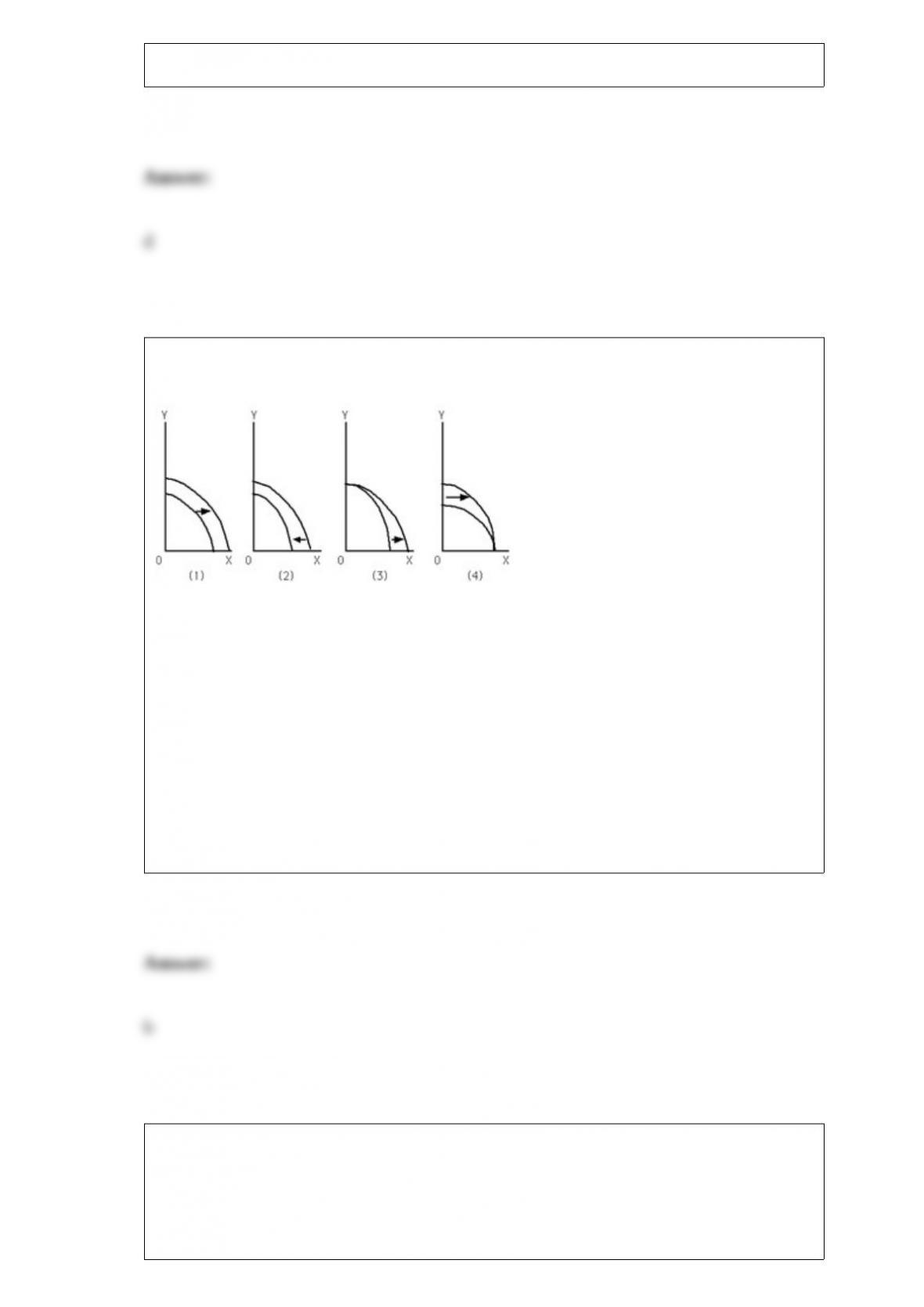
Exhibit 2-6
Which graph best depicts the consequence of a large-scale natural disaster?
a. (1)
b. (2)
c. (3)
d. (4)
e. none of the above
A perfectly competitive market is initially in long-run competitive equilibrium. Each
firm in the market is earning zero economic profit. The owner of one firm decides to
discriminate against employees of race X by not hiring them, or by firing those
employees of race X who currently work for him. If employees of race X are
high-quality employees, and other firms hire them, then the owner of the discriminating

firm will soon find that his costs rise (above that of other firms) and he will begin
earning
a. below normal profits.
b. normal profits.
c. positive economic profits.
d. losses.
e. a and d
Since workers today can move from city to city (quite easily) and from firm to firm
(again, quite easily), it is unlikely that there are very many pure
a. monopsony firms.
b. oligopoly firms.
c. monopoly firms.
d. perfectly competitive firms.
e. factor price takers.
Consumers’ surplus is the difference between the price
a. sellers receive for a good and the maximum price they would have paid for the good.

b. sellers receive for a good and the minimum price for which they could have sold the
good.
c. buyers pay for a good and the maximum price they would have paid for the good.
d. buyers pay for a good and the minimum price for which they would have sold the
good.
Which of the following statements is false?
a. A subsidy can be used to internalize a negative externality; a tax can be used to
internalize a positive externality.
b. Ronald Coase stressed the reciprocal nature of externalities.
c. One way to deal with negative externalities is for government to apply regulations
directly to the activity that generates the externalities.
d. Simply because taxes and subsidies are sometimes used to adjust for negative and
positive externalities, respectively, it does not necessarily follow that the socially
optimal level of output will be reached.
If a college sets its tuition __________ the equilibrium tuition, then it will have to use
some form of nonprice-rationing device to determine who will be accepted for
admission to the college.
a. above
b. below

c. equal to
d. all of the above
Abigail has a high rate of time preference while Cynthia has a low rate of time
preference. If the interest rate payable on savings accounts increases from 5 percent to 7
percent, then
a. Abigail would find it easier than Cynthia to cut back on consumption and increase
her savings.
b. Cynthia would find it easier than Abigail to cut back on consumption and increase
her savings.
c. neither Abigail nor Cynthia would decrease her consumption and increase her savings
because relative time preferences have little to do with the interest rate.
d. Abigail and Cynthia would probably decrease their consumption and increase their
savings by the same amount because the higher interest rate will affect them both to the
same degree regardless of their time preferences.
The marginal utility curve for units 6 through 8 of good Z lies below the horizontal
axis.What does this imply must be true about the total utility curve for units 6 through 8
of good Z?
a. That portion of good Z’s total utility curve must be upward sloping.
b. That portion of good Z’s total utility curve must be downward sloping.
c. That portion of good Z’s total utility curve must be horizontal.

d. That portion of good Z’s total utility curve must also lie below the horizontal axis.
When a perfectly competitive firm (that sells its good for $20 per unit) hires 1 unit of
factor X it produces 70 units of output and when it hires 2 units of factor X it produces
85 units of output. Marginal revenue product of the second unit of factor X is equal to
a. $30.
b. $530.
c. $265.
d. $300.
e. none of the above
The Coase theorem
a. shows that under certain conditions the market can internalize externalities.
b. states that economic units should specialize in the production of those goods in which
they have a comparative advantage.

c. asserts that the firm should produce that output at which marginal cost is equal to
marginal revenue.
d. holds that the firm should produce that output at which marginal factor cost is equal
to marginal revenue product.
Country X has a high unemployment rate. It follows that country X is operating
a. beyond its production possibilities frontier (PPF).
b. on its PPF.
c. inside (below) its PPF.
d. at a productive efficient point.
e. b and d
The Gini coefficient is a number between
a. 0 and 1.
b. 1 and 10.
c. 0 and 100.
d. -1 and 1.

Modern Justice Department guidelines evaluate mergers according to how they would
change the industry’s
a. Herfindahl index.
b. four-firm concentration ratio.
c. eight-firm concentration ratio.
d. twelve-firm concentration ratio.
Which of the following can a homebuyer pay for indirectly when purchasing a home?
a. good weather
b. a good school district
c. a nice view
d. all of the above