
1) (Last Word) According to economists Aryes and Levitt, the total benefits of Lojack
and other car retrieval system are divided:
A.90 percent to the owners and 10 percent to other car owners in the community.
B.50 percent to the owners and 50 percent to other car owners in the community.
C.0 percent to the owners and 100 percent to other car owners in the community.
D.10 percent to the owners and 90 percent to other car owners in the community.
2) the elasticity of demand for a product is likely to be greater:
a.if the product is a necessity, rather than a luxury good.
b.the greater the amount of time over which buyers adjust to a price change.
c.the smaller the proportion of one’s income spent on the product.
d.the smaller the number of substitute products available.
3) (Consider This) The main idea highlighted in the story about artist Pablo Picasso is:
A.derived demand.
B.human capital.
C.opportunity cost.
D.occupational licensure.
4) Population will necessarily fall if the:
A.birthrate exceeds the replacement rate.
B.replacement rate exceeds the birthrate.
C.birthrate exceeds the total fertility rate.
D.total fertility rate exceeds the birthrate.
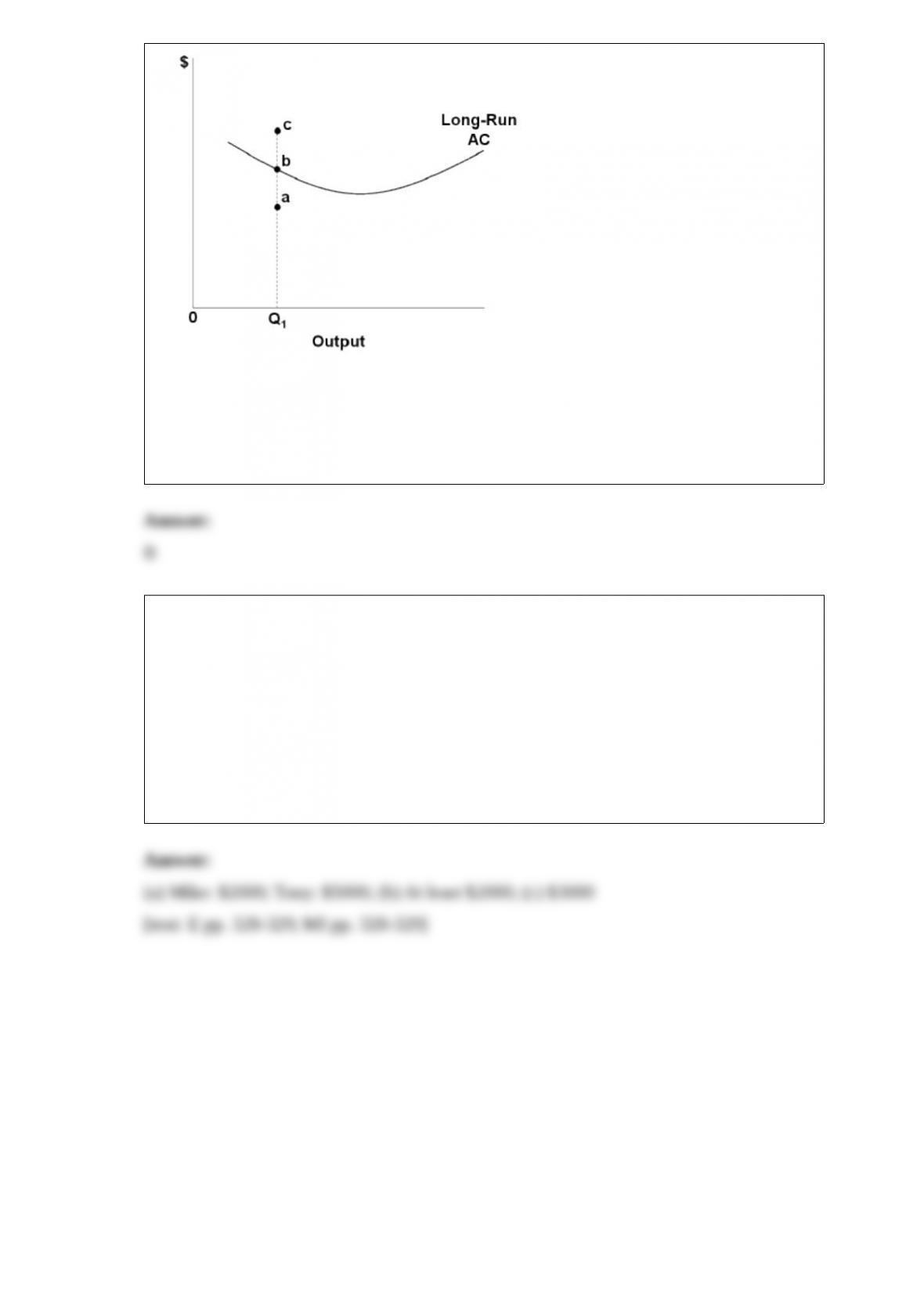
5)
Refer to the above diagram. If a firm produces output Q1 at a unit cost of b, then the:
A.firm is not fulfilling the least-cost rule in employing resources.
B.firm may or may not be maximizing profits.
C.marginal product per dollar’s worth of each resource employed is not the same.
D.firm has achieved minimum efficient scale.
6) Fisher Mike can catch salmon for $11 per ton and fisher Tony can catch salmon for
$8 per ton. Both Mike and Tony have an individual transferable quota (ITQ) to catch
1000 tons of salmon. The market price of salmon is $13 per ton.
(a)If both Mike and Tony catch fish that year, what will be the profit for Mike and what
will be the profit for Tony?
(b)If next year, Mike trades his quota for the year to Tony, how much should Mike be
paid for the quota to make more than he can by fishing?
(c)Mike decides to trade his ITQ for the year to Tony. What will be the reduction in
fishing cost to society now that only Tony is doing the fishing?
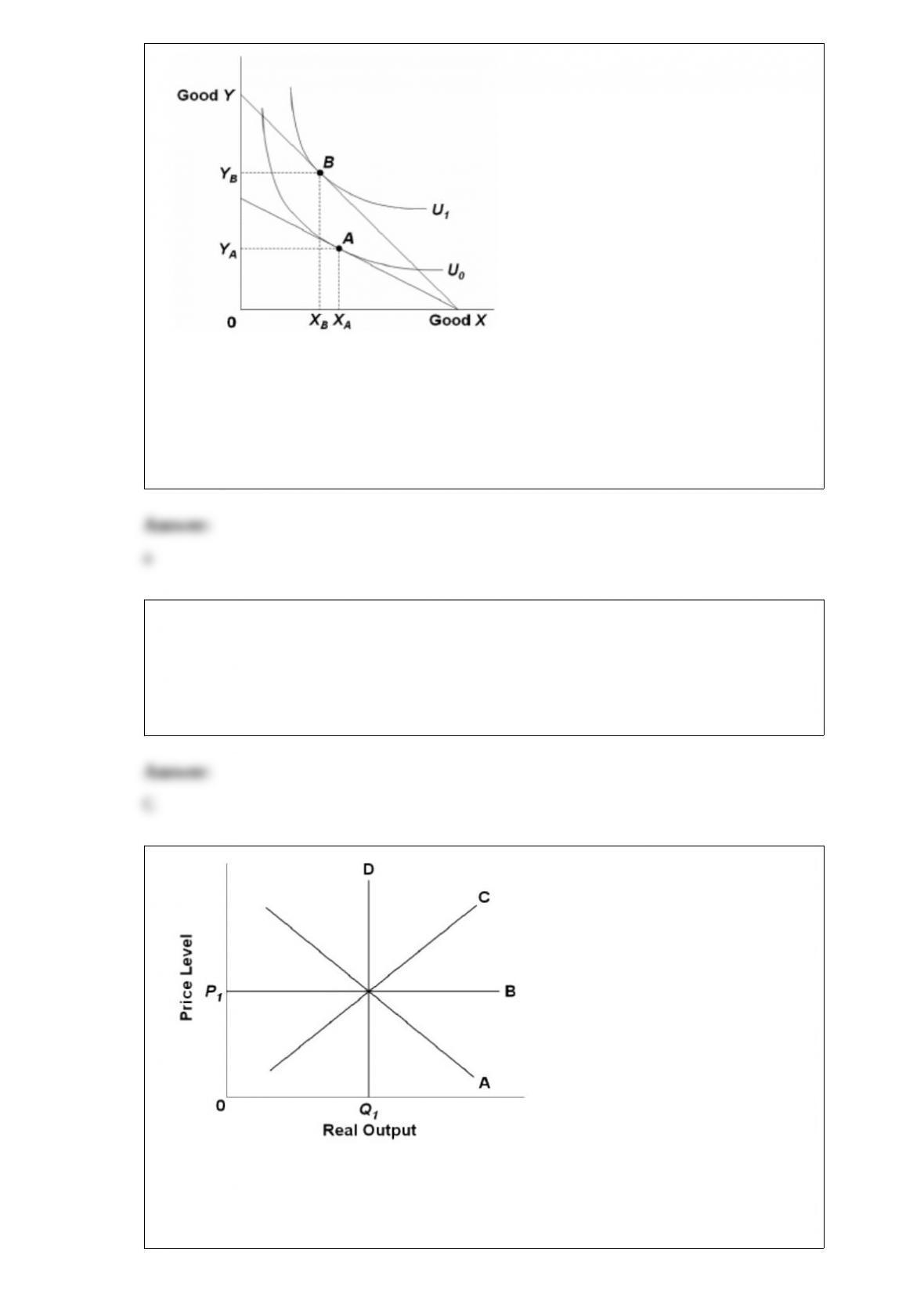
7)
refer to the above diagram. the budget line shift which moves the consumer’s
equilibrium position from point a to point b suggests:
a.an increase in the quantity of y demanded.
b.a decrease in the quantity of y demanded.
c.a leftward shift in the demand curve for y.
d.a rightward shift in the demand curve for y.
8) Commercial banks create money when they:
A.accept cash deposits from the public.
B.purchase government securities from the central banks.
C.create checkable deposits in exchange for IOUs.
D.raise their interest rates.
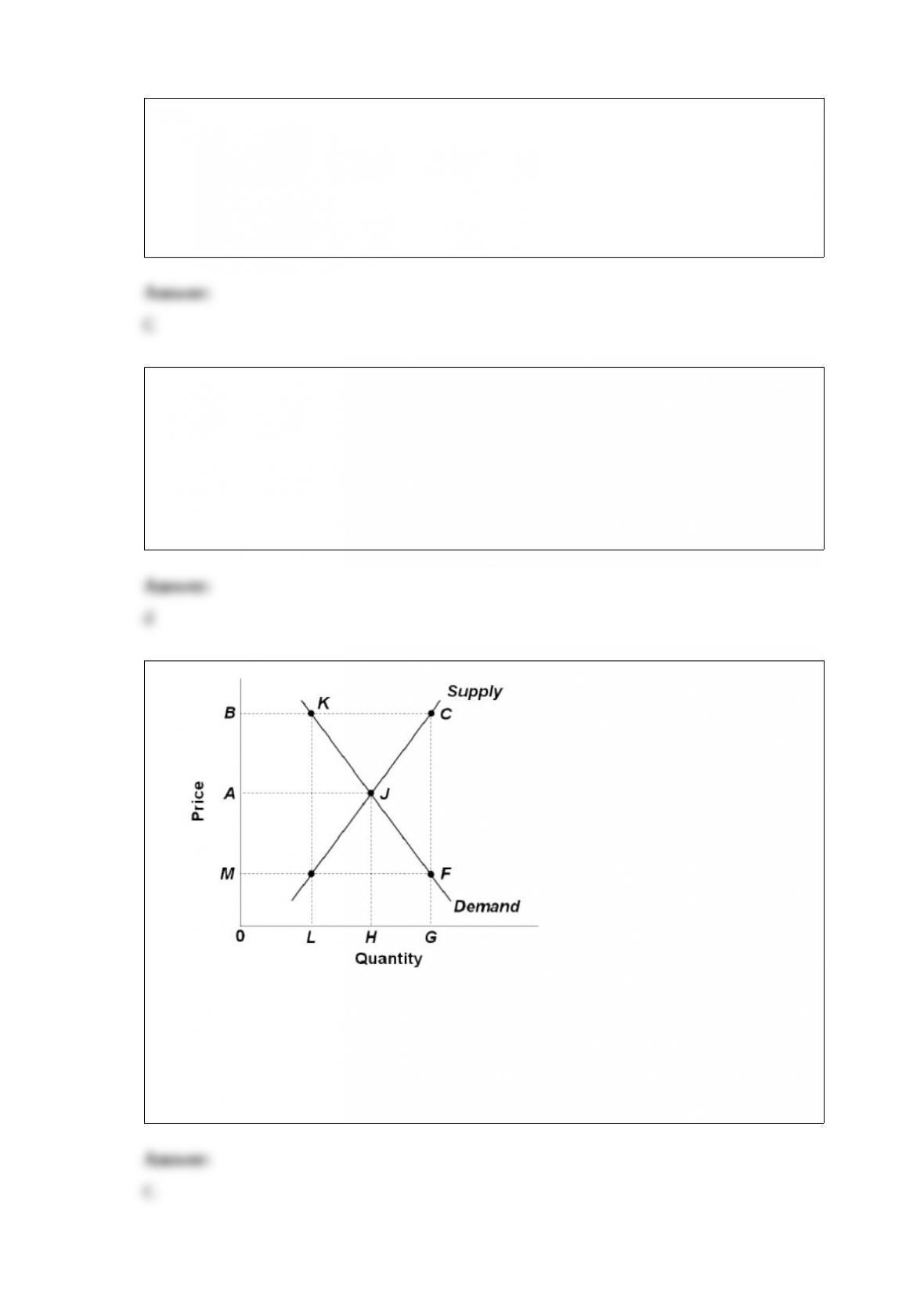
9)
Refer to the above diagram and assume that prices and wages are flexible both upward
and downward in the economy. In the extended AD-AS model:
A.demand-pull inflation would involve a rightward shift of curve A, followed by a
rightward shift of curve C.

B.cost-push inflation would involve a rightward shift of curve A, followed by a leftward
shift of curve C.
C.recession would involve a leftward shift of curve A, followed by a leftward shift of
curves C and D.
D.recession could be caused by either a leftward shift of curve A or a leftward shift of
curve C
10) in the short run the sure-screen t-shirt company is producing 500 units of output. its
average variable costs are $2.00 and its average fixed costs are $.50. the firm’s total
costs:
a.are $2.50.
b.are $1,250.
c.are $750.
d.are $1,100.
11) Consider the following situations. Explain how each will affect the earning ability
of those discussed.
(a)Lucy has always been more goal-oriented than her brother Frank. For example,
during high school Lucy wouldnt hesitate to pull an all-nighter to make sure she was
prepared for a test, while Frank would only study until he got bored and decided to go
out with his friends.
(b)Roger works as a dentist, while his friend Hugh is a policeman.
(c)Sarah and Jackie are roommates together in college and both are hoping to get into
law school after graduation. Sarahs dad is a businessman and Jackies dad is a prominent
lawyer.
12) Suppose the productivity of labor increases and at the same time the price of
capital, which is complementary to labor, increases. As a result, the demand for labor:
A.will increase.
B.will decrease.
C.may either increase or decrease.
D.will not change.
13) suppose the nominal annual interest rate on a two year loan is 8 percent and lenders
expect inflation to be 5 percent in each of the two years. the annual real rate of interest
is:
a.6 percent.
b.8 percent.
c.2 percent.
d.3 percent.
14)
Refer to the above diagram for the corn market. As a consequence of a price support of
B, consumers will:
A.increase their purchases of the product.
B.pay a lower price, M rather than A, for the product.
C.pay a higher price, B rather than A, for the product.
D.pay a higher price, A rather than M, for the product.
15) real per capita gdp:
a.grows at approximately the same rate for all countries.
b.was much more equal across nations in 1820 than it is today.
c.has been about 20 times higher in the richer nations than the poorer nations for about
2000 years.
d.grows much faster in “leader countries” than in “follower countries.”
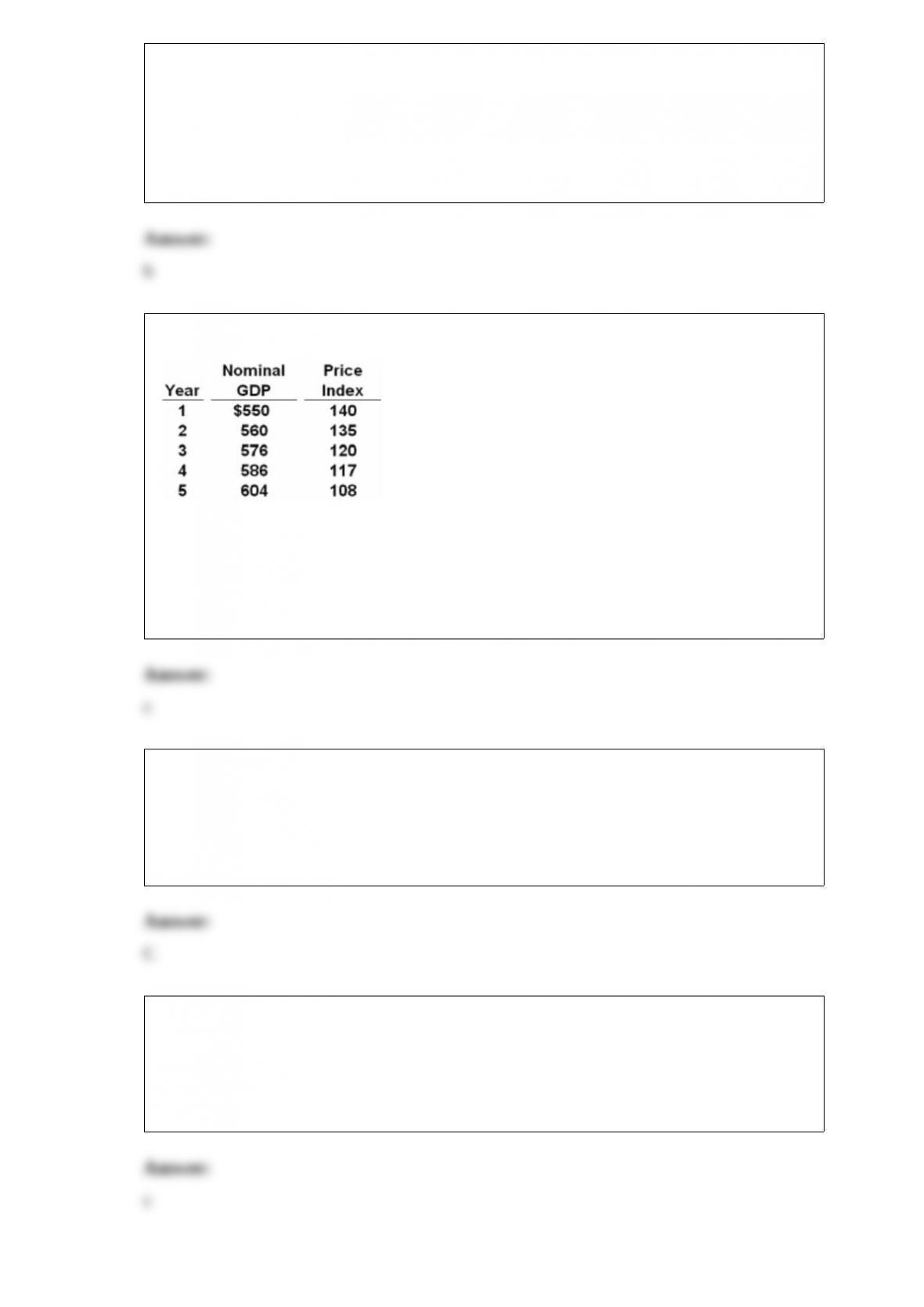
16) answer the next question(s) on the basis of the following information:
in the economy above, real gdp for year 3 is:
a.$512.
b.$428.
c.$480.
d.$691.
17) Which of the following tools of monetary policy is considered the most important?
A.the discount rate
B.the reserve ratio
C.open market operations
D.the term auction facility
18) real per capita gdp in the united states in 2007 was approximately:
a.$28,500
b.$36,800
c.$38,200
d.$11.6 trillion
19) Minimum-wage legislation is less likely to have adverse effects on employment
when the:
A.affected labor market is monopsonistic.
B.economy has high unemployment.
C.derived demand for labor is shifting to the left.
D.affected labor market is perfectly competitive.
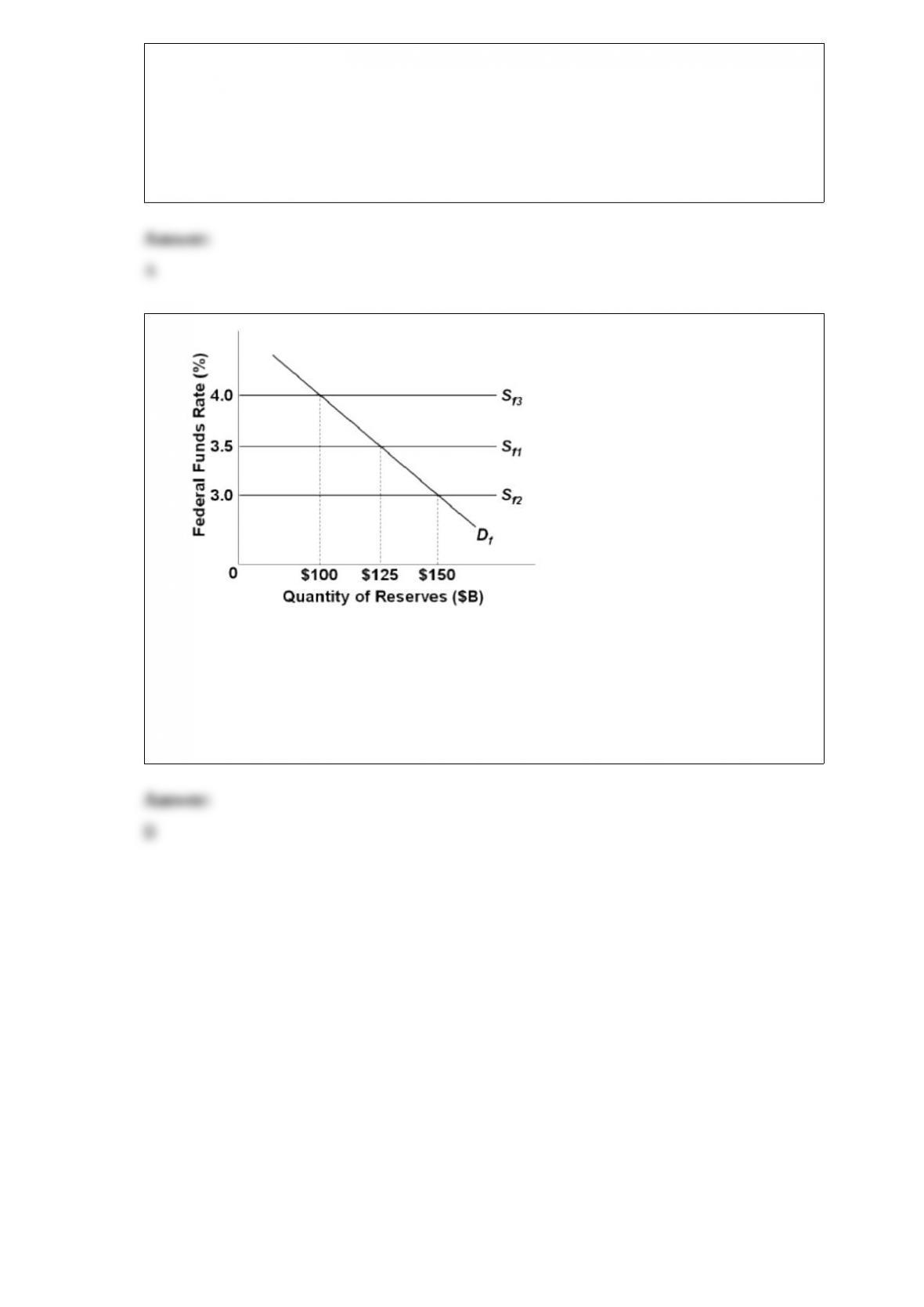
20)
Refer to the above diagram for the Federal funds market. If the quantity of reserves
rises from $100 billion to $150 billion, we can expect:
A.the Federal funds rate to fall to 3.5 percent.
B.the discount rate to fall.
C.the prime interest rate to fall below 4.0 percent.
D.banks to become more cautious in lending.