
An inferior good is defined as a good for which demand decreases when:
A) the price increases.
B) income increases.
C) the price decreases.
D) income decreases.
Recall the Application. The federal government marketing order that helped reduce
asymmetric information about kiwifruit led to:
A) a decrease in the spread between the price of New Zealand and U.S. kiwifruit.
B) lower quality kiwifruit sales.
C) more kiwifruit imports.
D) lower kiwifruit sales.
The supply curve for a perfectly competitive market:
A) is the summation of all the average cost curves of each firm in a market.
B) is the summation of all the marginal cost curves, above the minimum of the average
variable cost curve, from all the individual firms in the market.

C) is not related to the supply curves of individual firms.
D) is independent of price.
Prior to the financial crisis and recession which began in 2007, credit for mortgages was
________, creating a ________.
A) virtually unavailable; housing bubble
B) only available to borrowers with high credit scores; shortage of affordable housing
C) easily obtained; housing boom
D) unavailable to low-income borrowers; large demand for rental properties
According to this Application, the policies used by the European Union to support the
agricultural sectors of its member countries created excess supply. Excess supply can be
generated if a government establishes a:
A) price ceiling below the market equilibrium price.
B) price ceiling above the market equilibrium price.
C) price floor below the market equilibrium price.
D) price floor above the market equilibrium price.

Suppose that if poor households have a price elasticity of demand for medical care of
0.70 and wealthy households have a price elasticity of demand for medical care of 0.10,
then a 10% increase in the price of medical care would lead to poor households
reducing their quantity demanded for medical care by:
A) seven times the amount that wealthy household reduce their quantity demanded for
medical care.
B) one-seventh the amount that wealthy households reduce their quantity demanded for
medical care.
C) one-tenth the amount that wealthy households reduce their quantity demanded for
medical care.
D) ten times the amount that wealthy household reduce their quantity demanded for
medical care.
Under a system of marketable pollution permits:
A) pollution will increase.
B) firms may trade the right to pollute a certain amount.
C) firms can only buy the right to pollute from the government.
D) the government is not involved.

If the prices of inputs do not increase as an industry grows, the industry is a(n):
A) decreasing cost industry.
B) constant cost industry.
C) increasing cost industry.
D) nonexistent industry.
Producer surplus is:
A) the difference between the highest market price consumers are willing to pay for a
product and the minimum amount producers are willing to accept for that product.
B) the difference between the market price consumers are willing to pay for a product
and the actual price they pay.
C) the price a producer receives for a product minus the marginal cost of production.
D) the economic profit earned from the sale of a good, minus its marginal cost of
production.

The value of money or income in terms of the quantity of goods the money can buy is
called its:
A) real value.
B) marginal value.
C) nominal value.
D) implicit value.
The increase in the U.S trade deficit with Mexico after NAFTA went into effect was
most likely the result of:
A) predatory dumping by U.S. companies.
B) the devaluation of the peso.
C) the appreciation of the peso.
D) predatory dumping by Mexican companies.
The price of pineapples has risen dramatically. Which of the following is likely to
happen?

A) The quantity of pineapples supplied will increase.
B) The quantity of pineapples supplied will decrease.
C) The supply of pineapples will decrease.
D) The supply of pineapples will increase.
Recall the Application about the break-even price for growing switchgrass, a
perennial grass that is native to the U.S. plains states and is used to create biofuel,
to answer the following question(s).
Recall the Application. If the minimum of average total cost for switchgrass farmers is
$55 per ton and the minimum of average variable costs is $40 per ton, then at a price of
$35 per ton in the short run the switchgrass farmer will:
A) shut down, that is bring no switchgrass to market.
B) operate losing money.
C) make a zero economic profit.
D) make a positive economic profit.
Given their skills and knowledge, mine workers earn higher incomes than they would in
another occupation. This is partly because:

A) mine workers take the higher risk of injury or death.
B) few people have skills and knowledge required for mining works.
C) the skills required of mine workers can be acquired through costly training.
D) all of the above
If the population increases, the market demand for most products will:
A) not change.
B) decrease.
C) increase.
D) depend on supply.
The opportunity cost of going to college:
A) is zero if your parents pay your tuition.
B) is equal to the cost of tuition, room and board, and other expenses.
C) includes wages you lose by going to school instead of working.

D) is the same for all students at a particular school who pay full tuition.
Given the slope of a supply curve, if a demand curve becomes more price elastic:
A) the share of a tax consumers take becomes smaller.
B) the share of a tax consumers take becomes greater.
C) consumers pay the entire amount of a tax.
D) There is not sufficient information.
Which of the following is NOT an example of price discrimination?
A) A restaurant offers senior citizens a discount.
B) A supermarket offers coupons to its customers.
C) An electric company charges different rates to its business and residential customers.
D) An electronics superstore charges a lower price than a small retailer for the same
television set.

An oligopoly could occur for the following reasons:
A) advertising campaigns.
B) economics of scale in production.
C) government barriers to entry.
D) all of the above
Steven lives in a big city where there is a shortage of parking. He has a parking spot in
his driveway where he parks his car. Which of the following statement is most correct?
A) Steven has a lower opportunity cost of owning a car than his neighbor, who must
rent a parking spot.
B) The opportunity cost of using the parking spot is zero, because Steven owns the
house.
C) The opportunity cost of using the parking spot is the price he could charge someone
else for using the spot.
D) The opportunity cost depends on how much Steven’s mortgage payment is.

Sirens located around a town to warn citizens of the approach of a tornado are an
example of:
A) an external cost.
B) a private good.
C) a common resource.
D) a public good.
For a nation to have ________ in producing a good it must have a lower opportunity
cost of producing that good than the other country.
A) a comparative advantage
B) an absolute advantage
C) an autarky advantage
D) both a comparative advantage and an absolute advantage
All else equal, if demand is relatively elastic and supply is relatively inelastic, a tax on a
product will cause:

A) buyers to bear a larger portion of the tax burden.
B) sellers to bear a larger portion of the tax burden.
C) buyers and sellers to share the tax burden equally.
D) It is impossible to tell from this information who will bear the greater tax burden.
If the demand curve facing a firm had a price elasticity of demand equal to zero and the
firm raised its price, its total revenue would:
A) decrease slightly.
B) fall to zero.
C) not change.
D) increase.
The best way to make healthy food choices is to shop:
A) when you are hungry.
B) using gut feelings.
C) when your glucose levels are low.

D) when your brain is fully fueled.
Which of the following is the regulation that the U.S. currently use to regulate
automobile pollution?
A) uniform abatement
B) diagnosis and treatment
C) command and control
D) marketable pollution permits
The Act which outlawed price discrimination for the purpose of reducing competition
was the:
A) Sherman Act.
B) Clayton Act.
C) Robinson-Patman Act.
D) Celler-Kefauver Act.

If the findings in the application are true, then if the World Bank wants to improve the
return of its infrastructure projects in countries with inefficient governments like
Zimbabwe, then it must first:
A) improve the people’s right to own property.
B) discourage freedom of expression.
C) encourage the government to nationalize all industries.
D) bribe the country’s politicians.
Which of the following is a microeconomic question?
A) Is it sensible for the government to subsidize college education?
B) Why do some countries grow faster than others?
C) Should Congress and the president take action to reduce the unemployment rate?
D) All of the above are microeconomic questions.
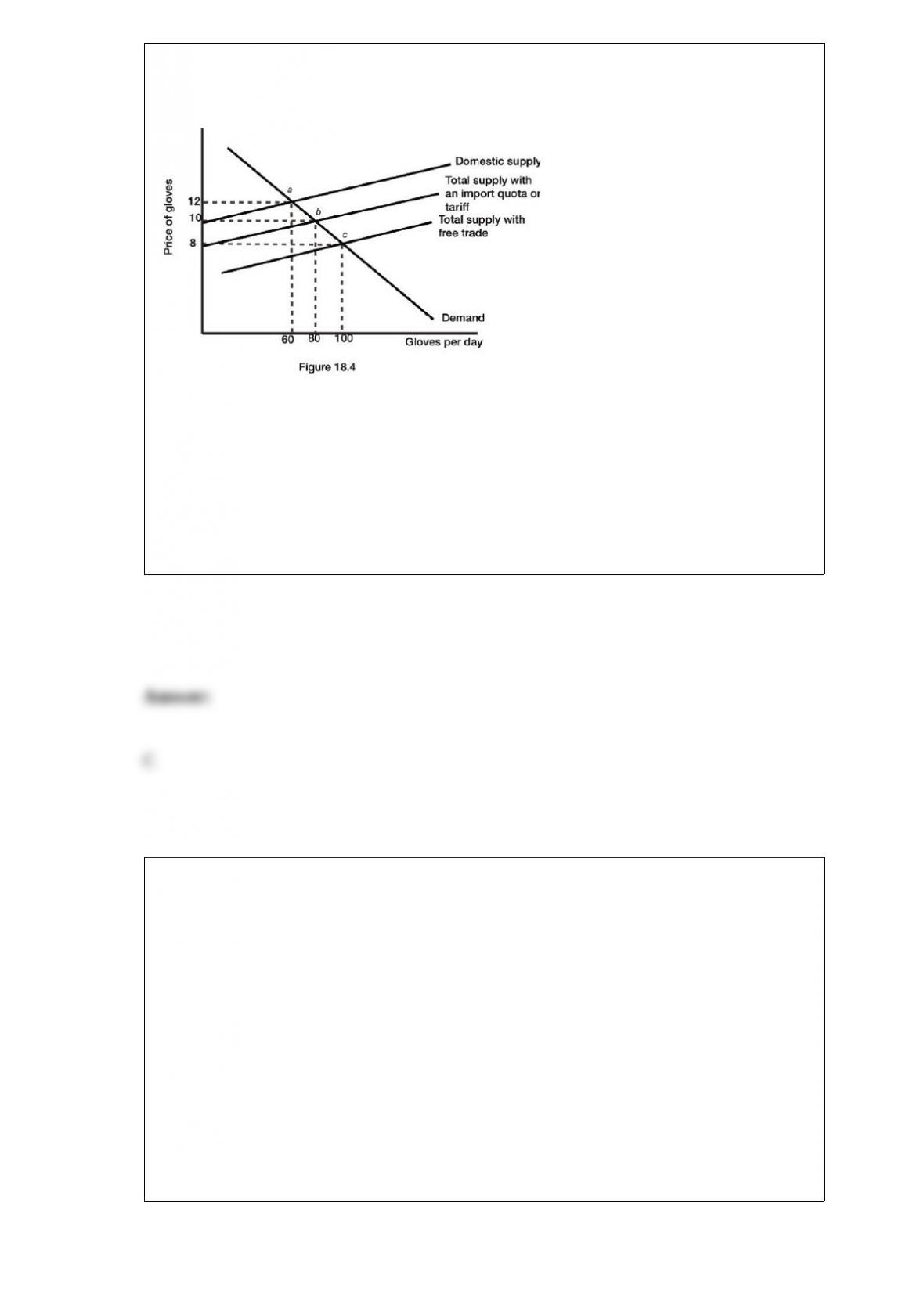
Refer to Figure 18.4. With an import ban, what is the equilibrium quantity of gloves in
Duckland?
A) 100
B) 80
C) 60
D) 40
Recall the Application about South African consumer lender that offered different
interest rates in loan offers via mass mailings answer the following question(s).
According to the Application, the number of consumers who accepted a particular loan
offer from the mass mailings:
A) was lower for offer letters with low interest rates.
B) was higher for offer letters with high interest rates.
C) was lower for offer letters with high interest rates.
D) did not vary with the different interest rates.

The principle of opportunity cost is:
A) the opportunity cost of something is what someone sacrifices to get it.
B) is the satisfaction of obtaining the best next alternative
C) is the choice someone has to make between two different goods.
D) the cost of paying for something someone needs.
A possible reason a nation might impose a protectionist policy such as a tariff is to:
A) help firms establish a world monopoly in a particular market.
B) increase the level of imports.
C) encourage specialization in the good in which the nation has a comparative
advantage.
D) increase the welfare of domestic consumers.
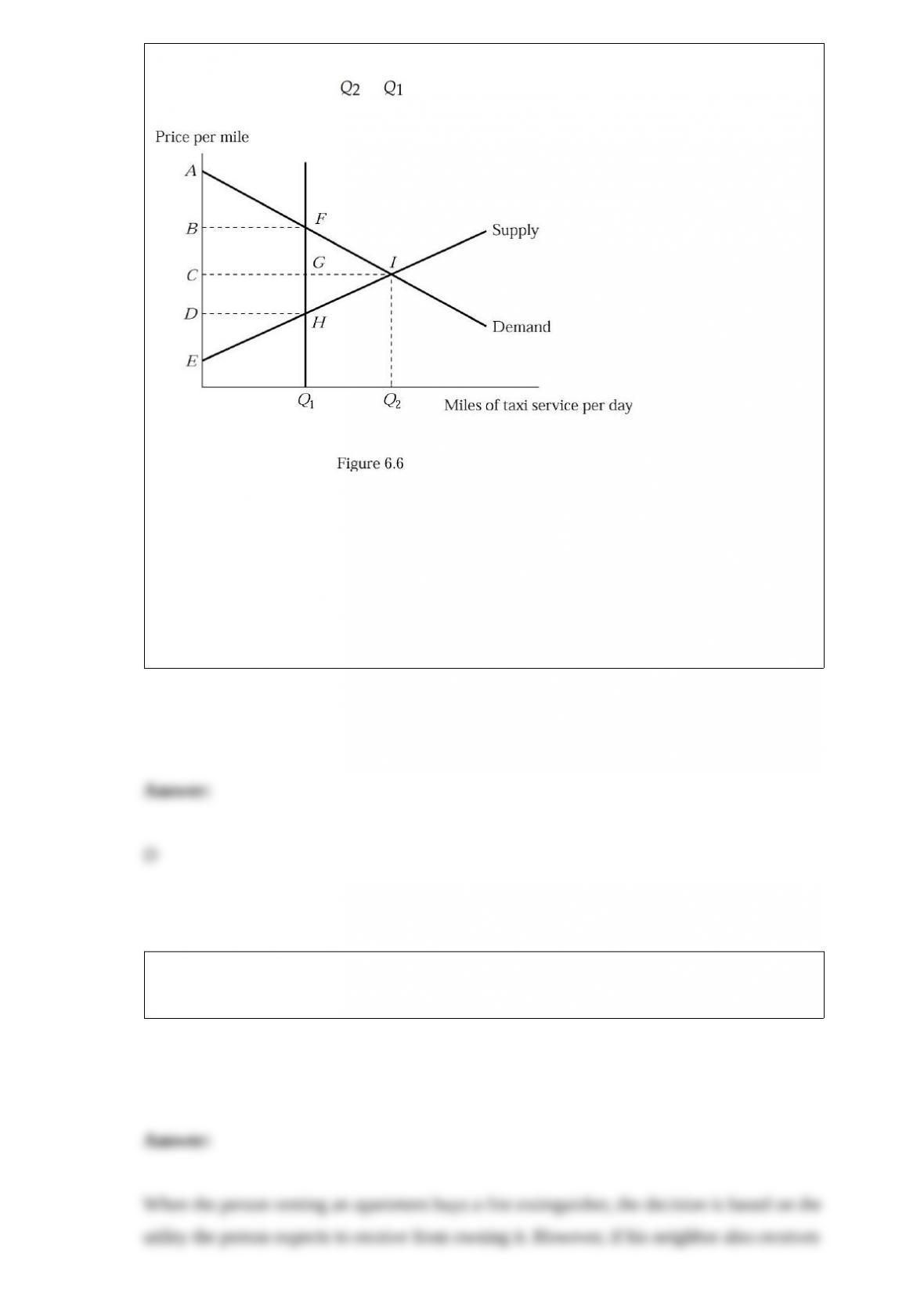
Refer to Figure 6.6, which shows a market for taxi medallions. If the number of taxi
licenses is reduced from to :
A) the gain in consumer surplus equals the loss in producer surplus.
B) the gain in producer surplus equals the loss in consumer surplus.
C) the gain in consumer surplus is greater than the loss in producer surplus.
D) the gain in producer surplus is smaller than the loss in consumer surplus.
The purchase of fire extinguishers by apartment dwellers provides benefits to their
neighbors. Explain why this situation leads to an inefficient outcome.

Explain why the demand for labor is a derived demand.
Define a natural monopoly.
Health insurance leads to what types of moral hazards?
Why might a firm pay a celebrity to endorse its product?
Explain the concept of diminishing returns.
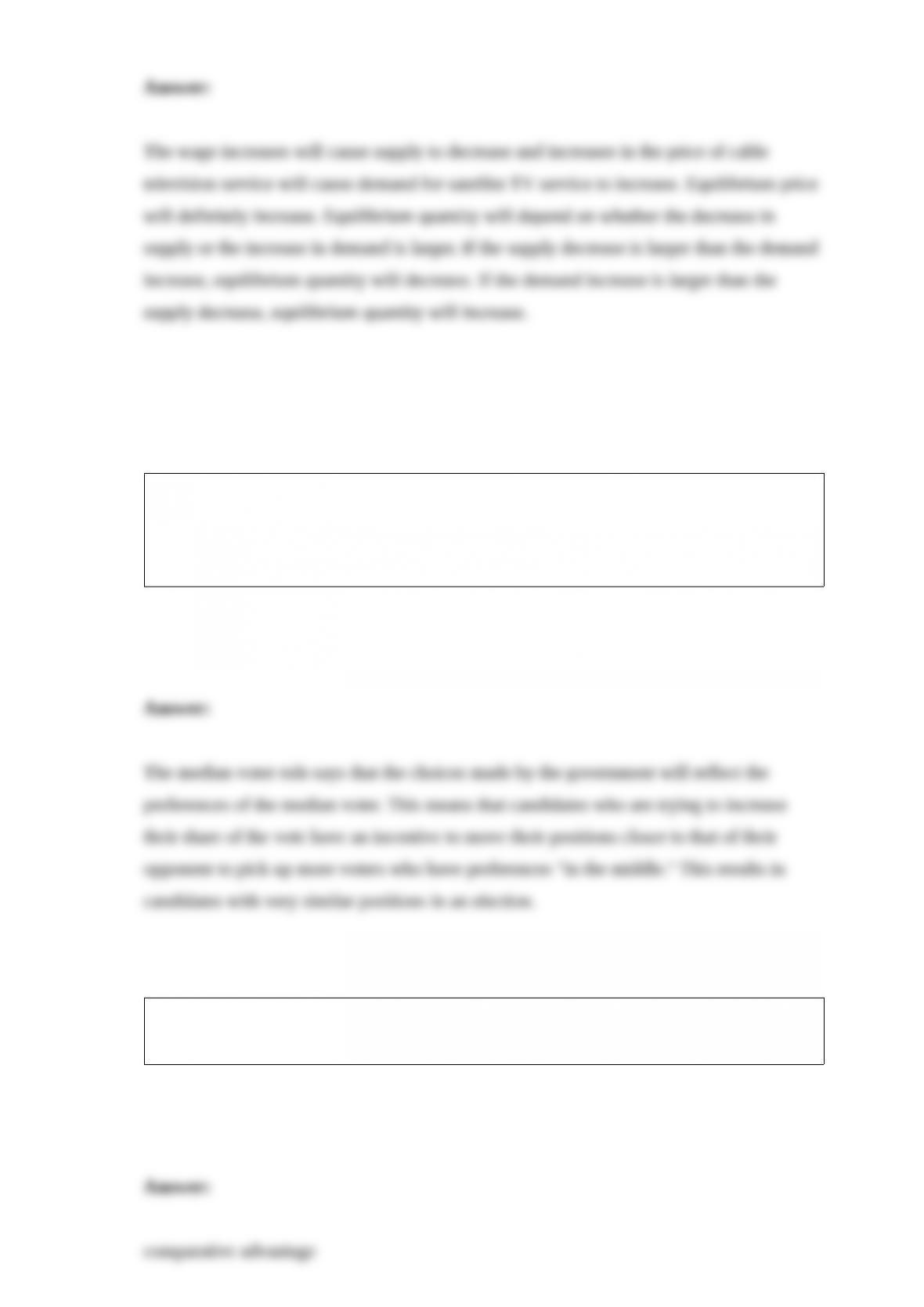
Consider two individuals, Celia and Sondra, who produce bracelets and pendants.
Celia’s and Sondra’s hourly productivity are as follows:
Who has the absolute advantage or comparative advantage in the production of
bracelets or pendants?

What is the relationship between marginal cost and fixed cost?
Explain the difference between fixed costs in the short run and in the long run.
Explain what will happen to the equilibrium price and quantity of satellite TV service if
the wages of the workers who provide the satellite TV service increase while at the
same time the price of cable television service (a substitute for satellite TV service) also
increases.
In many elections the Republican and Democratic candidates share remarkably similar
viewsso similar that independent candidates (who rarely win the elections) often enter
elections to represent opposing views. How can the similarity between the Republicans
and Democrats be explained?
When a person producing a particular product has a lower opportunity cost than another
person, that person is considered to have a ________ over the other.
When the price of bread rises from $1.25 to $1.50 per loaf, quantity demanded falls
from 5,800 per week to 5,500. Calculate total revenue both before and after the price
change. What can we tell about the price elasticity of demand for bread?
For most goods and services, income elasticity of demand tends to be smaller in the
short run than in the long run. However, a recent study shows that the demand for a
durable good such as automobiles tends to be more income-elastic in the short run than
in the long run. Explain why.
Comment on the following statement: “When an external cost is present, and a firm
does not factor this cost into its decisions, the firm is likely to produce a level of output
that is lower than the efficient level.”
Suppose that a firm maximizes its profits by producing a quantity of 20 units. The
market price is $5. The firm’s variable costs are $70 and its fixed costs are $40. What
should the firm do in the short run? In the long run?
Table 7.4 shows how the total utility that Zach derives from eating candy bars changes
as he consumes more and more candy bars each day. Fill in the table. Do the numbers in
the table support the law of diminishing marginal utility? Explain.
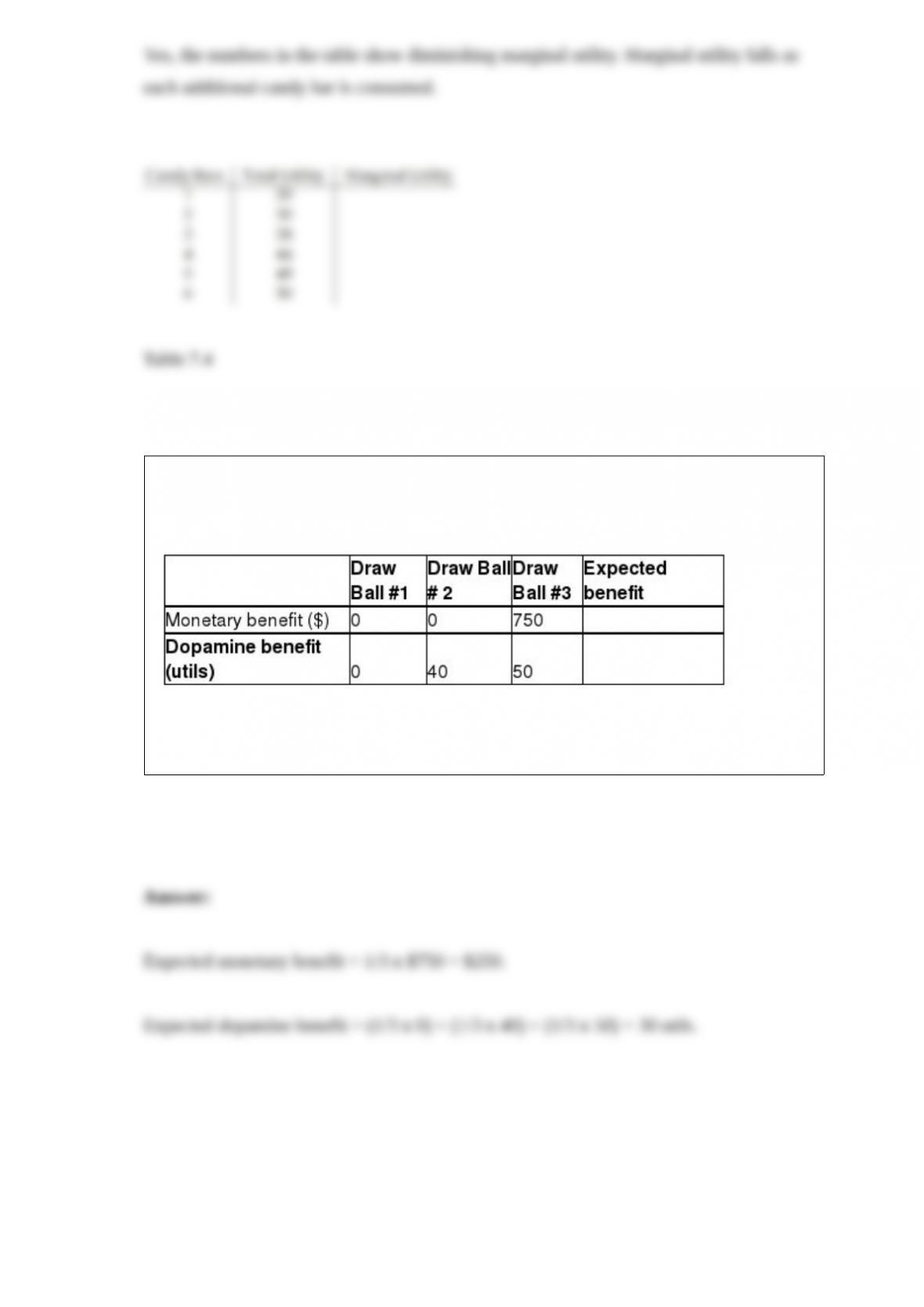
Refer to the Table. Calculate the expected monetary benefit and the expected dopamine
benefit from the game represented in the table.
Table 7.1
The Table represents the payoffs for a gambling game. The player blindly draws
one of three balls, marked 1, 2, and 3, from an urn. The cost to play the game is
$375 per draw.