1) Many charities like the Sierra Club are established to deal with externalities.
a.True
b.False
2) The circular-flow diagram
a.is an economic model.
b.incorporates two types of decision makers: households and firms.
c.represents the flows of inputs, outputs, and dollars.
d.All of the above are correct.
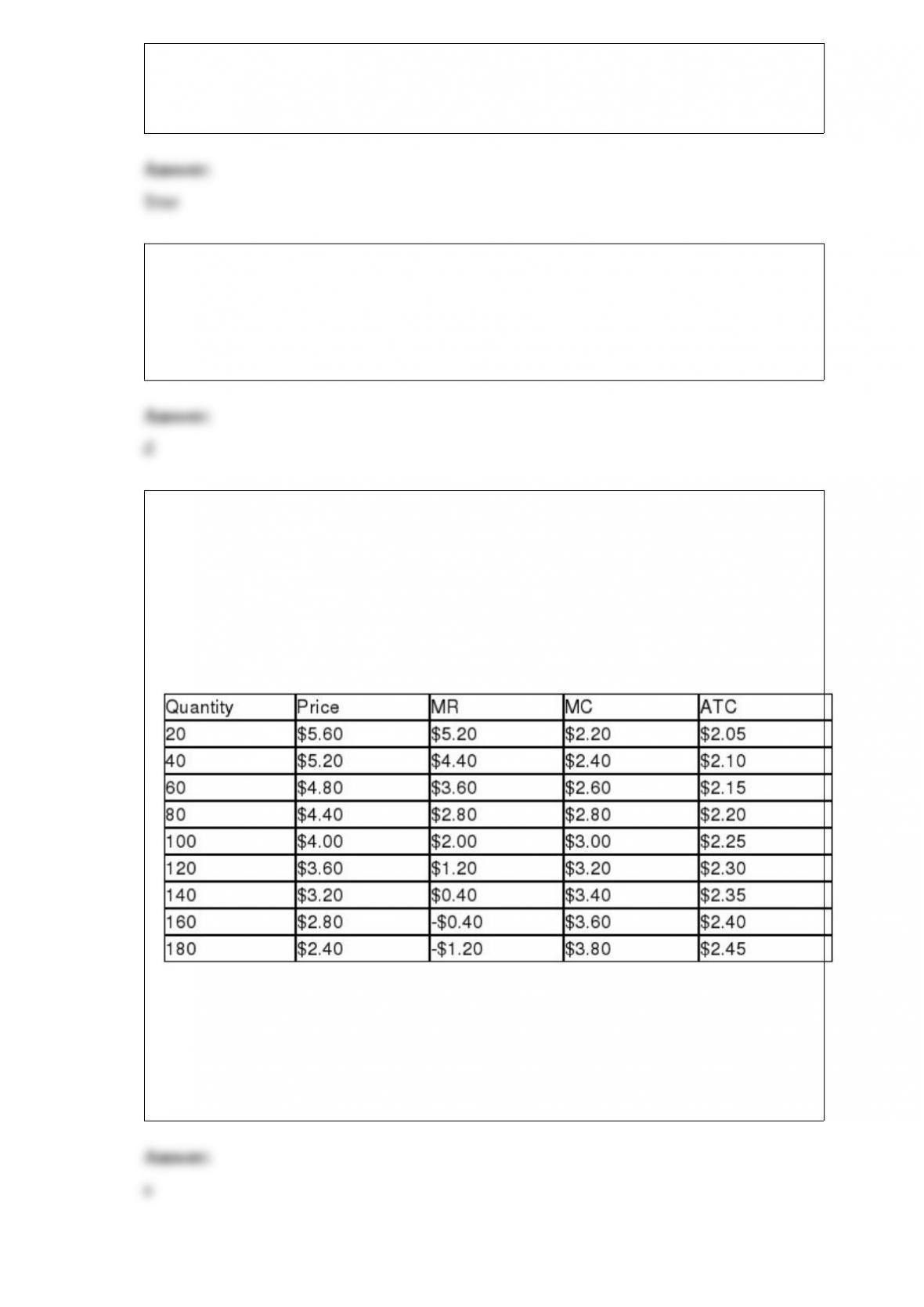
3) Scenario 16-3
Peter operates an ice cream shop in the center of Fairfield. He sells several unusual
flavors of organic, homemade ice cream so he has a monopoly over his own ice cream,
though he competes with many other firms selling ice cream in Fairfield for the same
customers. Peter’s demand and cost values for sales per day are given in the table below.
(Everyone who purchases Peter’s ice cream buys a double scoop cone because it’s so
delicious.)
How many double scoop ice cream cones should Peter sell per day to maximize his
profit?
a.80
b.100
c.120
d.140

4) The following table contains a demand schedule for a good.
If the law of demand applies to this good, then A could be
a.0
b.100
c.200
d.400
5) In-kind transfers are transfers to the poor
a.in the form of goods and services rather than cash.
b.in the form of goods, services, and cash.
c.from private charitable organizations only.
d.from the federal government only.
6) To promote good economic outcomes, policymakers should strive to enact policies
that
a.enhance productivity.
b.enhance individuals’ market power.
c.result in a rapidly-growing quantity of money.
d.All of the above are correct.
7) Figure 17-3. Hector and Bart are roommates. On a particular day, their apartment
needs to be cleaned. Each person has to decide whether to take part in cleaning. At the
end of the day, either the apartment will be completely clean (if one or both roommates
take part in cleaning), or it will remain dirty (if neither roommate cleans). With
happiness measured on a scale of 1 (very unhappy) to 10 (very happy), the possible
outcomes are as follows:
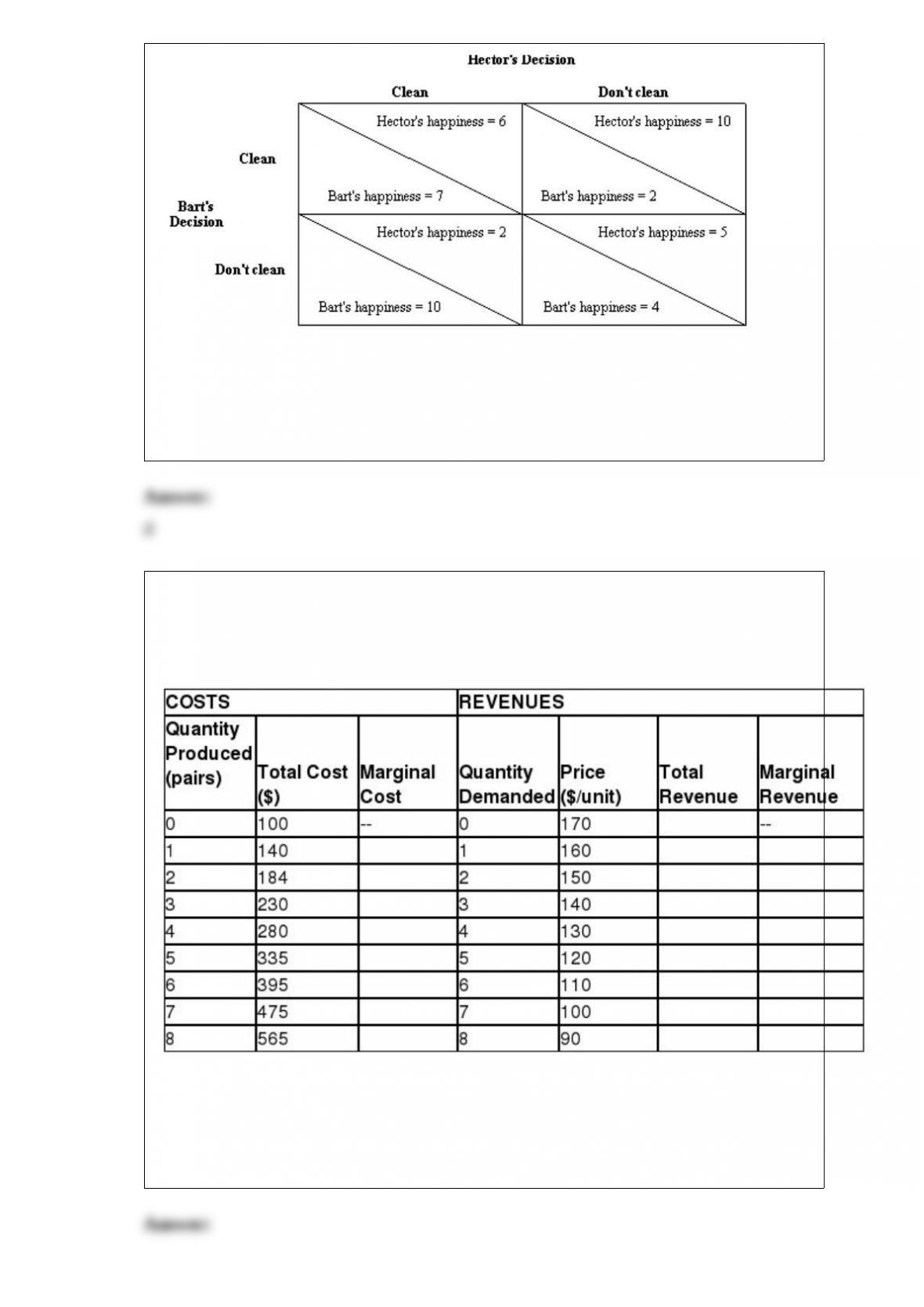
Refer to Figure 17-3. The dominant strategy for Hector is to
a.clean, and the dominant strategy for Bart is to clean.
b.clean, and the dominant strategy for Bart is to refrain from cleaning.
c.refrain from cleaning, and the dominant strategy for Bart is to clean.
d.refrain from cleaning, and the dominant strategy for Bart is to refrain from cleaning.
8) Table 15-7
Sally owns the only shoe store in town. She has the following cost and revenue
information.
What is the total revenue from selling 8 pairs of shoes?
a. $90
b. $695
c. $720
d. $800
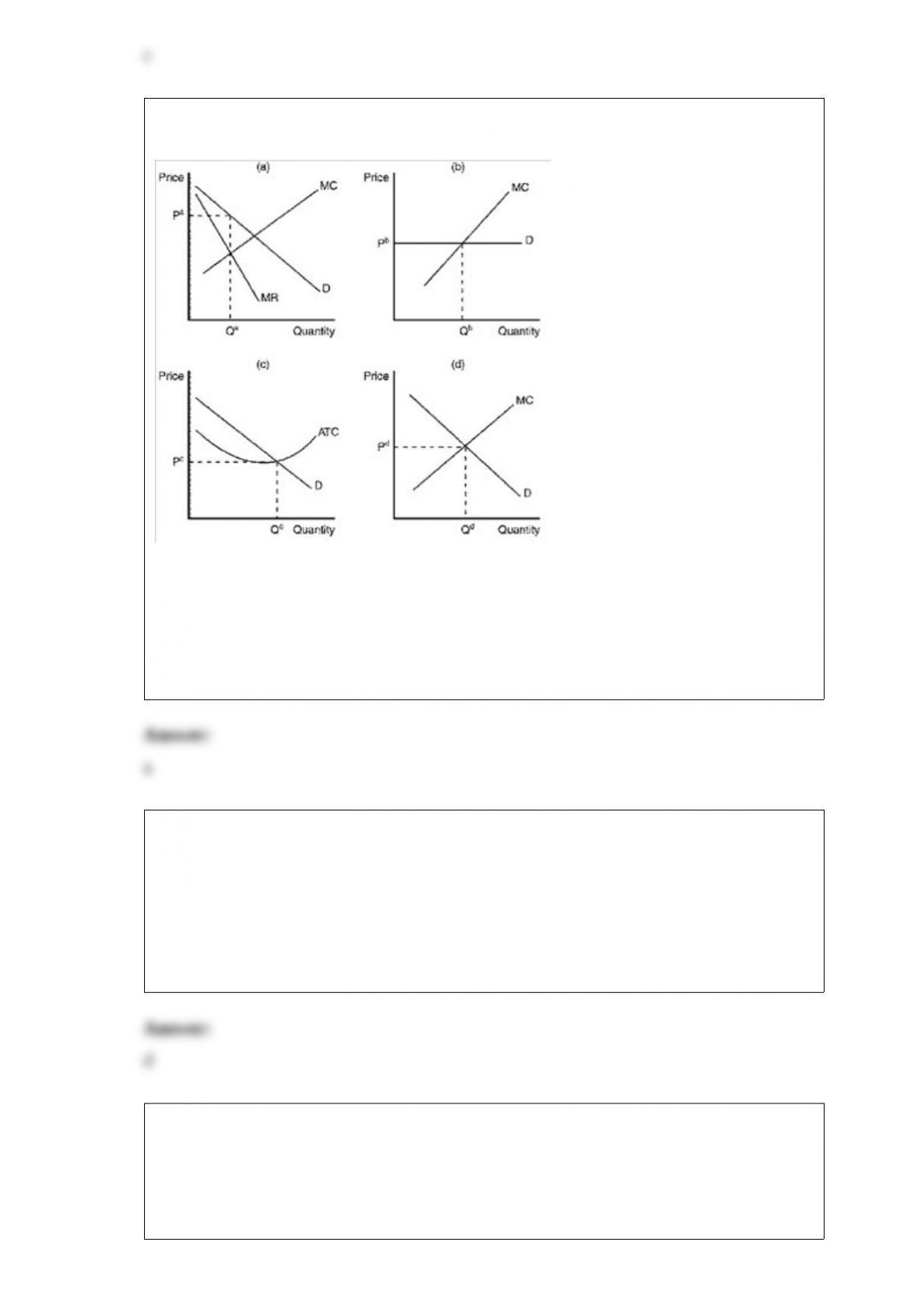
9) Figure 16-7
If a firm in a monopolistically competitive market was producing the level of output
depicted as Qdin panel (d), it would
a.not be maximizing its profit.
b.be minimizing its losses.
c.be losing market share to other firms in the market.
d.be operating at excess capacity.
10) Suppose chocolate-dipped strawberries are currently selling for $30 per dozen, but
the equilibrium price of chocolate-dipped strawberries is $20 per dozen. We would
expect a
a.shortage to exist and the market price of chocolate-dipped strawberries to increase.
b.shortage to exist and the market price of chocolate-dipped strawberries to decrease.
c.surplus to exist and the market price of chocolate-dipped strawberries to increase.
d.surplus to exist and the market price of chocolate-dipped strawberries to decrease.
11) The price elasticities of supply and demand affect
a.both the size of the deadweight loss from a tax and the tax incidence.
b.the size of the deadweight loss from a tax but not the tax incidence.
c.the tax incidence but not the size of the deadweight loss from a tax.
d.neither the size of the deadweight loss from a tax nor the tax incidence.

12) An effective minimum wage law will increase the quantity of labor demanded.
a.True
b.False
13) Most Americans agree that our tax system should
(i)be fair.
(ii)be efficient.
(iii)impose as small a cost on society as possible.
(iv)use a value-added tax (VAT) instead of an income tax.
a.(ii) only
b.(ii) and (iii) only
c.(i), (ii), and (iii) only
d.(i), (ii), (iii), and (iv)
14) Differences in human capital among workers can often be attributed to social or
political processes rather than economic processes.
a.True
b.False
15) Arturo’s Production Possibilities FrontierDina’s Production Possibilities
Frontier
a.M.
b.L+M+N+Y+B.
c.L+M+Y.
d.J.

18) Economists speaking like scientists make
a.normative statements.
b.prescriptive statements.
c.claims about how the world is.
d.claims about how the world should be.
19) If firms in a particular market sell similar or identical products, then the market is
(i)perfectly competitive.
(ii)monopolistically competitive.
(iii)an oligopoly.
a.(i) or (ii) only
b.(ii) or (iii) only
c.(i) or (iii) only
d.(i) only