The level of real GDP in the long run is
A) potential GDP.
B) affected by changes in the price level.
C) determined solely by aggregate demand.
D) the same as the level of nominal GDP in the long run.
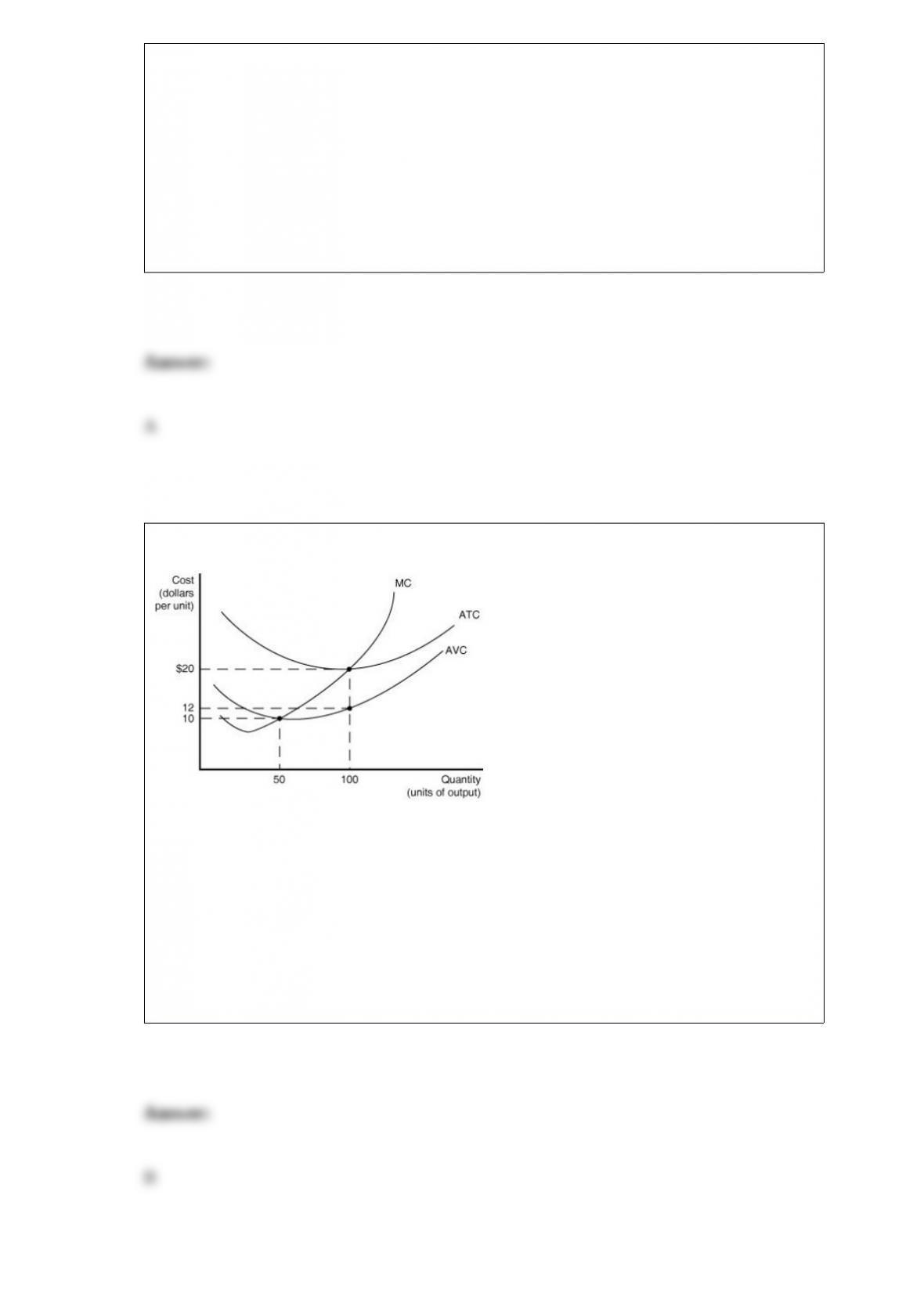
Figure 11-7
Figure 11-7 shows the cost structure for a
firm. If output is 100 units what is the fixed cost of production?
A) $8
B) $800
C) $1,000
D) This cannot be determined from the diagram.

The branch of economics which studies the behavior of entire economies is called
A) public economics.
B) microeconomics.
C) macroeconomics.
D) normative economics.
Farmers can raise either goats or ostriches on their land. Which of the following would
cause the supply of goats to decrease?
A) an increase in the price of ostriches
B) a decrease in the price of goats
C) an increase in the demand for goats
D) an increase in the price of ostrich feed
Which of the following statements about perfect price discrimination is false?
A) There is no consumer surplus if a firm engages in perfect price discrimination.
B) Perfect price discrimination occurs when the seller charges the highest price each
consumer would be willing to pay for the product.
C) A condition for perfect price discrimination is that it must be costlier to service some
customers than others.

D) For the price-discriminating firm, its marginal revenue curve coincides with its
demand curve.
Which of the following will increase the real interest rate?
A) an increase in the supply of loanable funds
B) an increase in household saving
C) an increase in the demand for loanable funds
D) an increase in the budget surplus
An increase in the wage rate causes
A) a rightward shift of the firm’s labor demand curve.
B) a leftward shift of the firm’s labor demand curve.
C) a decrease in the quantity of labor demanded.
D) an increase in labor’s marginal productivity.

If the marginal benefit of reducing emissions of some air pollutant is greater than the
marginal cost,
A) further reductions will make society better off.
B) the marginal benefit will rise and the marginal cost will fall as further reductions are
made.
C) economic efficiency will be achieved when emissions are reduced to zero.
D) private businesses, rather the consumers, should be made to pay for the cost of
further reductions.
A dominant strategy is
A) an equilibrium where each firm chooses the best strategy, given the strategies of
other firms.
B) a strategy chosen by two firms that decide to charge the same price or otherwise not
to compete.
C) a strategy that is obviously the best for each firm that is a party to a business
decision.
D) a strategy that is the best for a firm no matter what strategies other firms use.
The monetary growth rule is a plan for increasing the quantity of money

A) at a fixed rate that does not respond to changes in the economic condition.
B) at a rate which increases as the economy grows.
C) at a rate which decreases as the economy declines.
D) at a rate which increases during recessions and decreases during expansions.
A study by the Congressional Budget Office (CBO) regarding the corporate income tax
included the following statement: “A corporation may write its check to the Internal
Revenue Service for payment of the corporate income tax, but the money must come
from somewhere…” The comments that followed this statement argued that
A) corporations pass on some of the burden of the tax to investors in the company, to
workers, and to consumers.
B) the corporate income tax is a reliable source of revenue because corporations cannot
avoid paying the tax.
C) it is necessary to retain the tax because it is based on the ability-to-pay principle.
D) the tax is more progressive than the individual income tax.
If the long-run aggregate supply curve is vertical,
A) the economy stays at the natural rate of inflation in the long run.
B) the short-run Phillips curve must be vertical.

C) unemployment and inflation are positively related in the long run.
D) the trade-off between unemployment and inflation cannot be permanent.
Adverse selection will occur in a market as a result of
A) asymmetric information.
B) moral hazard.
C) the sale of “lemons.”
D) rational ignorance.
Actual real GDP will be above potential GDP if
A) firms are producing below capacity.
B) firms are producing at capacity.
C) firms are producing above capacity.
D) inflation is rising.